Talk Back Wednesday

rojcover10

You’ve read the book, now share your reflections or questions.

Finish this sentence, ‘Chum’s greatest personal asset had to be . . . ‘

or

‘Helen traveled across the US and around the Atlantic world because?’

Post your responses and we’ll talk.

I would love to hear from you,

Gail

“River of January,” Oregon City Edition

Women600whelenhayes600w

             Hellooo Portanders!

Gail Chumbley presents her new work, “River of January,” Thursday, August 20th, 7:00 PM at the Oregon City Library.

Description OREGON CITY OREGON CARNEGIE LIBRARY copy.jpg

606 John Adams Street

Be grand to see you there!

This Week, 1935

IMG_0191

The old pilot’s time with us grew to mean a great deal to me, personally, but made it that much harder to let him go at the end.

Chum’s last years brought him out west to Boise. It was much easier for my husband to care for him than the semi-regular flights to Miami, sorting out some kind of preventable crisis. Once his father settled in here, they were together every day at the assisted living facility. I believe their time together gave both of them a lot of comfort.

As for Me? I just loved to sit and talk to my father-in-law. If he had felt more spry I would have dragged him into my history class for my own version of “Show & Tell.” I mean, really! William Howard Taft was in the White House the year Chum was born! His life was a damn book. (see River of January)

On one particular Sunday we drove over for a visit, and brought him Mexican food . . . Chum’s favorite. I was anxious to talk to him because we had rented “The Aviator” the night before, the film about Howard Hughes, and Chum had worked for the millionaire at one time.

Me: So we watched a movie about your old buddy, last night–Howard Hughes.

Chum: Ha. He kept the Kleenex business in the black.

Me: (Oh, geez! How could he know that?) And your old girl friend, Kathryn Hepburn.

Chum: Yeah. Katy. She was a nice girl.

Me:(Katy? A nice girl?)

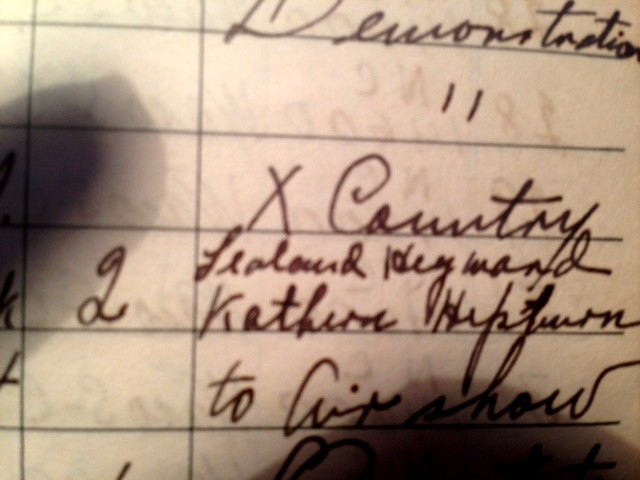
Chum: Her boyfriend, that theater producer, Leland Hayward–I taught him flying lessons, and she came along.

Me: Yeah. (Yeah)

And here it is folks, if you didn’t see at the top. The old history student has to whip out the proof. Have a nice weekend.

  IMG_0192

Gail Chumbley is the author of River of January. Available on Amazon.

The Meat Grinder

7804d740-1a8d-3515-a0cb-5ba757515e12

101 years ago today, Serb teenager, Gavrilo Princip shot and killed the heir to the Austro-Hungarian throne, on the heir’s fateful visit to Sarajevo. That one deadly act, carried out over a century ago, set into motion a series of events which ultimately resulted in the unimaginable bloodbath of World War One.

Last Wednesday while presenting my memoir, “River of January,” to a library group, an unexpected gasp came from a listener in the seats. My brain flew into immediate damage control “What I had said, (did I cuss?) Was the projector working behind me? Were my pants zipped? After only a heartbeat the cause dawned on me.

It was a 1928 snapshot of Mont Chumbley, the story’s central figure, beaming across the screen. He was uniformed in the garb of a Navy Seaman Recruit, proudly shouldering his rifle. He looks dignified in his pose, pleased at successfully becoming a part of the United States Navy—but his achievement had also left his family back on the Virginia farm in deep crisis.

Young Mont, “Chum” had required his father’s permission to join up, and the father had adamantly refused to go along with the idea. To modern ears, such as the listener Wednesday night, this obstruction seemed unpatriotic, a father ought to be proud; a military career today is considered noble and honorable. But not back in 1928.

The line that earned that unexpected gasp came after a direct quote from Chum. “Back then, in Norfolk there were signs in the parks saying, ‘Dogs And Sailors Keep Off The Grass’.”

We forget, but after the 1918 Armistice, America was truly sorry it had committed to war against Germany. The universal feeling was fighting in Europe had been a monumental mistake, and one that would never, ever be repeated. The country doggedly pursued isolation for twenty years until Japanese Zeros hit the Pacific fleet at Pearl Harbor in 1941. Between 1919 and 1941 military budgets were annually slashed, recruitment limited, and the military faced near elimination by a nation and Congress bent on going it alone.

The Treaty of Versailles that officially ended the war, along with its League of Nations was soundly defeated by a non cooperative US Senate. The Washington Naval Treaty of 1921 strictly limited the number of ships each maritime nation could possess, and the Kellogg-Briand Pact, an agreement between the US and France literally outlawed war. The public also grew convinced that American bankers and arms producers had only pushed for war to increase their profits. Companies like Dupont Chemical, and the banking House of Morgan were dubbed “Merchants of Death.”

Internationalism was dead, Fortress America was born.

That was the political climate surrounding Mont Chumbley’s ambition to join the Navy and learn to fly airplanes. Understandably his family fervently opposed this decision, and his father did all he could to block his son’s hopes for a military career. Mont’s aunt said it best, “The military is a refuge for scoundrels.”

And even after enlisting, young Mont learned his chances of getting into a cockpit were slim to none in light of draconian budget cuts inflicted on the Navy.

America’s enthusiasm for foreign involvement, the military, and war had fallen into fanatical disfavor. The meat grinder that had been World War One left our nation outraged and remorseful . . . America would never make that same mistake again.

New York, 1933

HOWARD-AILOR HOWARD-AILOR-SALES-CORP

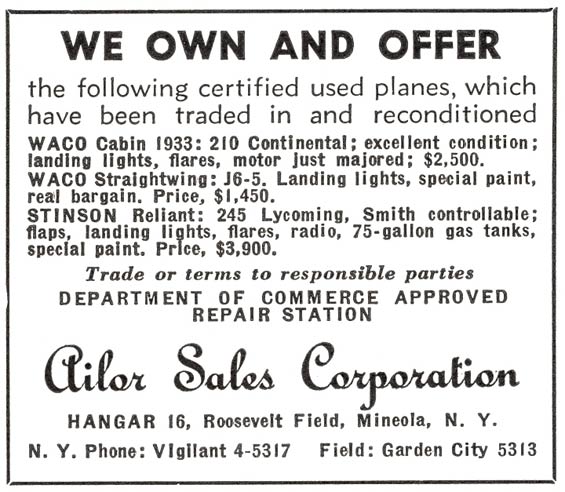
“So you’ve been to see all the big boys, eh?” commented a sales representative from Long Island who was seated behind a battered old desk. Airplane distributor Howard Ailor of Waco Aircraft studied the young man’s face. “And by the looks of you they all turned you down.”
“That is about right, Mr. Ailor.” Chum responded, trying to look confident. “I was hoping you might know of something out here, maybe something at Roosevelt Field.”
“I don’t know you, son, but let me give you some advice. Don’t dawdle around hoping for that phone call. This is no economy to sit by and wait for miracles. You’ll starve first. Push your way into the air business with your own equipment, that‘s what I say, and I can help you with that. We have some beauties right here on site.”
Chum listened to the silver-tongued salesman, surprised that he agreed with all Ailor had to say.
Chum also realized that he had returned to an America deep in the throes of financial depression.
Economic life in the 1920s had played out as a frenzied, unregulated party. By all appearances the country had embraced infinite prosperity. Insider trading and other shady practices reigned on Wall Street, where market manipulators pooled cash and bought up stock, artificially driving up values. Regular folk, believing they were on to something big, bought these tainted stocks as crooked investors dumped them, reaping fabulous profits.
Indiscriminate buying, using easy credit, pumped the overblown Dow Jones to ballooning artificial heights. Even private banks joined the frenzy, wagering the savings of their account holders to increase their own bottom line.
This facade of spreading affluence ensured the “hands off” economic policies accepted in Washington. Then the market imploded. On October 29, 1929, “Black Tuesday,” the savings of a nation disappeared with the steepest financial crash in American history. Thousands upon thousands of people were ruined and the enterprise of a nation dried up.
Young Mont Chumbley had resigned from the Navy without another job, and now found there were none. The pilot’s only and best assets were his optimism, his pluck, and an old Chevy.
“Over here,” Ailor directed Chum, as they walked toward a hangar housing a red-with-black-trim Waco cabin biplane. “This baby’s a real beauty, right? We can take it up for a spin, if you like, but you can’t have this one—it’s spoken for. Still cough up a down payment and we’ll order you a new one. It’d be here in only six weeks.
“I came here looking for a job—and you want to sell me an airplane?” Chum blurted in disbelief.
Ailor continued to rattle on as though the pilot had not spoken. “Hell! I’m feeling generous. I’ll even let you rent office space right here on Roosevelt Field for a percentage of whatever you earn as you get your footing.”
Chum realized he had never encountered such a smooth operator. Ailor finally faced the boy. “Look, you can’t negotiate with reality, son. And the reality is that there are no jobs. The country’s flat busted.”
Chum knew his mouth hung open in reaction to the salesman’s bald audacity. But he also knew he agreed. Ailor was absolutely right.
Chum needed to find a way to buy that airplane. It appeared to be the only real option open to him. With little money left from his dwindling resources, he found a Western Union office and cabled his mother in Pulaski for help. He hadn’t written or visited much since joining the service and felt badly his note only asked her for money. However, Martha didn’t complain or hesitate.
“I’ll run down to our bank in town—still solvent, doors open,” she wired him right away. “A thousand, Mont? Is that enough? Where should I wire it?” Martha would still do anything to help her boy.

River of January by Gail Chumbley available at www.river-of-january.com and Amazon.com

Partly The Mob

sept291931

The room was hot, and humid, but the old man would not turn on the air. He said that it cost too much money.  The fact that this was Miami and July made no difference,that ancient swamp cooler remained silent in the living room window. To emphasize his granite determination to deny Florida Power and Light an extra penny, Chum dressed each morning in long pants, a belt, and a long sleeve shirt, cuffs buttoned. Mont Chumbley did not project the South Beach image favored by the city’s Chamber of Commerce.

However his strict rules of economy were cast aside the summer I flew down to record his story. And I do mean record, as in tape recorded interviews which lasted, in all, five days. And when I needed quiet the most (for quality purposes,) he decided to switch on that neglected, thundering swamp cooler, providing a Phil Specter-esque ‘wall of sound’ which muffled his fascinating story.

We were both nervous. I hadn’t been married to his son long, and my husband hadn’t come along on this trip. It was just the two of us: new father-in-law talking with new daughter-in-law. But I couldn’t let the awkwardness get in the way, I had traveled three time zones to get the story, and we had to soldier on despite our mutual jitters.

I hit record on the tape player, and immediately he began anxiously whacking a nearby phone book with a pencil. We now had a beat to the swamp cooler’s roar. And he did that for my comfort. How courteous.

I tried to play back the sessions right away to transcribe the contents. It’s safe to say that deciphering his voice from the background clatter grew to be a problem. Imagine the musical “Stomp,” with people trying to converse over crashing trashcan lids.

After a couple of days of this fidgeting he settled down, and to be completely honest, I did too. Chum even forgot to turn on the air once or twice. And his story in aviation began to unfold, carrying us away from noisy appliances; to days before there were such things as air conditioners–to the skies of another era.

Wow.

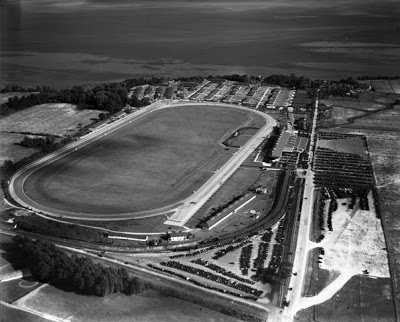
One story that made it into the book tells of his hair raising landing on the infield of a Maryland horse track. Later I had to hit the replay button a half dozen times to get the name right, listening hard to his phonetic pronunciation, buried beneath screeching layers of white noise. Shaped by his Virginia drawl, I deciphered, Har-Day-Graw.

I typed HardayGraw into a search engine. “Do you mean Havre de Grace?” quickly popped up . Hmm. Well, I guess I do. Maybe.

Lo and behold, Havre de Grace was a horse racing track between Washington DC and Philadelphia, tucked into the Maryland countryside. The web site indicated that this track evolved as a joint venture, owned partly by the town of the same name, and partly by the mob.

Partly by the Mob? Are you serious? And everybody knew? I had to look a little deeper.

Apparently in an agreement with the Governor of Maryland, and a former congressman, in a partnership with mobster, Arnold Rothstein, Havre de Grace came to life. And this was no small time nag fest, either. Among the thoroughbreds who graced, Havre de Grace were legends, Man ‘o War, his son, War Admiral, and the indomitable, Seabiscuit, You can’t make this stuff up.

That week in hot, sticky Miami has grown into one of the most pivotal of my life. I felt like Wendy clasping Peter’s hand for her flight to Neverland. But in my case Chum piloted the yoke to “Yesteryearland.”

This Havre de Grace anecdote, with Arnold Rothstein, and a hair raising unauthorized landing from the sky, merged with many, many other episodic rivulets that flowed into this fascinating river of narrative. This “River of January.”

Gail Chumbley is the author of the memoir, River of January

#riverofjanuary

West Palm Beach

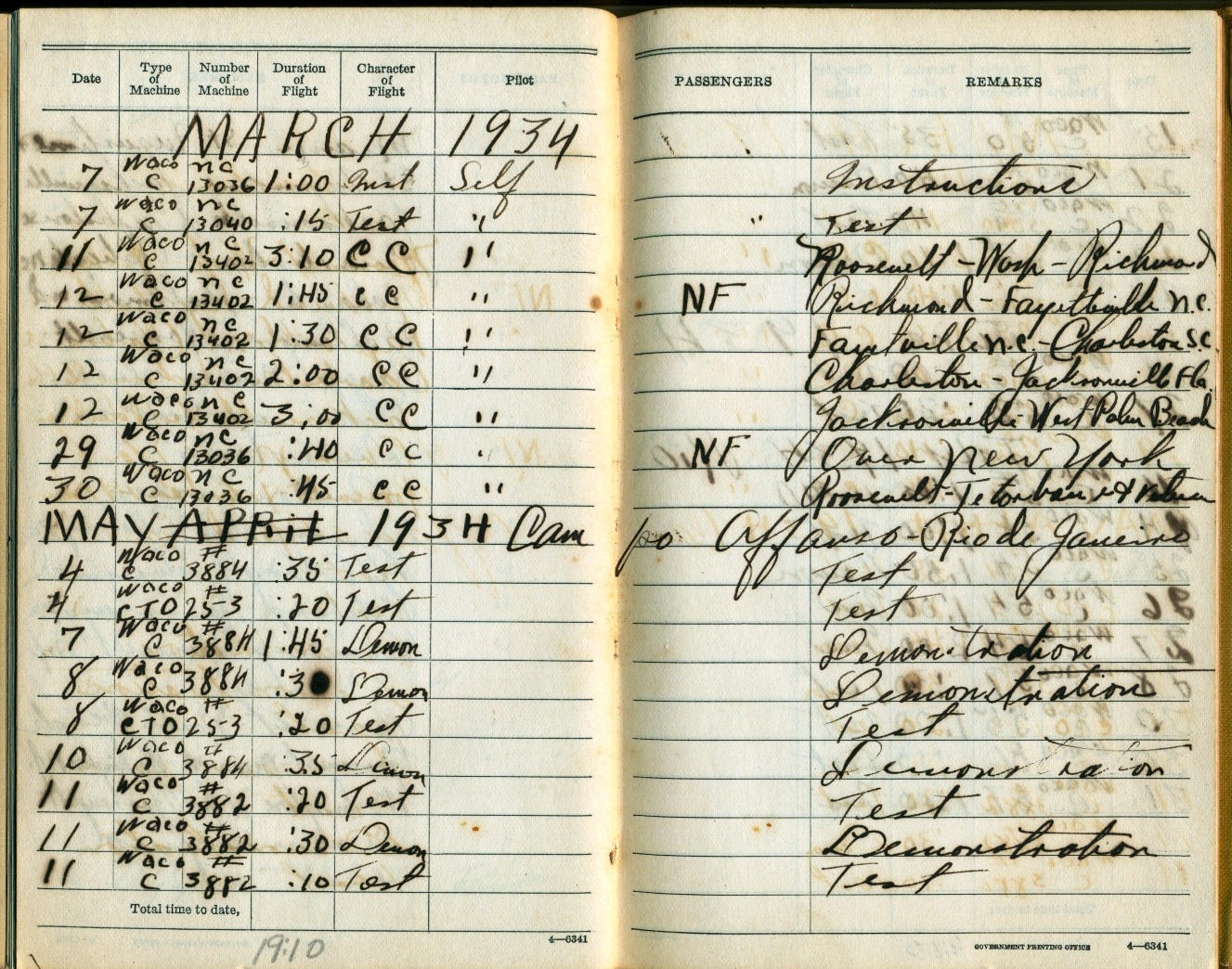
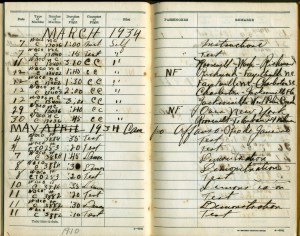
logbook2An excerpt from River of January for your Sunday evening.
At first he told himself that Howard Hughes’ good wages kept him in West Palm Beach. But Chum also knew his curiosity played a big part in remaining at the field. The famous tycoon was already a legend in aviation, as well as in motion pictures, and the young pilot had long admired self-made men. And though he looked forward to his new job, he was just as eager to watch the millionaire up close.
Over the next few weeks, Chum noticed that Hughes followed the same pattern each day. His driver motored up to the hangar in a Cadillac LaSalle, closely shadowed by another large Oldsmobile. The famed pilot stepped from the backseat, unfolding all six foot four inches of him. At same time, an entourage of followers poured out of the second car, casually circling the celebrity.
Chum also noticed that the aviator only spoke to his head mechanic, nodding frequently while he smoked a cigarette. Then Hughes and company inspected the rest of the facility—the tall tycoon facing the ground, continuing to acknowledge his lead man’s comments.
If he looked up, Hughes sometimes nodded to Chum or to the other men in the hangar. Then with this morning ritual finished, Mr. Hughes and his retinue returned to their waiting cars and drove off to other unknown destinations.
On one especially stifling afternoon, Hughes unexpectedly turned up at the steamy buggy hangar, departing from his usual routine. Caught off guard, the crew quickly picked up their tools and bustled around, appearing busy. Hughes seemed not to notice.
Instead the famed pilot looked at his head mechanic and loudly announced, “These gentlemen and I,” pointing to his cohorts, “are leaving for Los Angeles. Since that plane,” Hughes stuck his thumb toward the Waco still on the tarmac, “was used, we will travel by rail.” A few of the boys glanced Chum’s way.
“Yes, sir, don’t worry about a thing here, sir,” the foreman answered. Hughes nodded again, and he and his associates left the field in a caravan of black autos.
“Wonder which beautiful actress Hughes is meeting.” A young grease monkey sighed as he twirled a ratchet around his finger.
“Jean Harlow, you think?” said a kid still staring out the hangar doors.
“My money is on Paulette Goddard,” added another, plunking coins into a soda machine.
“Back to work, boys.” The head mechanic laughed. “We’re not going anywhere.”
Chum smiled. Just the phrase, “back to work,” began to amuse him. As far as he could see the commotion was all “make work” instead of real industry. He was becoming restless from boredom.
After Hughes’ dramatic exit, the crew mostly loitered around the hangar, sweating in the muggy heat—listening to the radio, smoking, sipping cokes, and playing cribbage. After a week of this meaningless inactivity, the young pilot, staring blankly into an immaculate engine, abruptly resolved, “As soon as I’m paid, I’m gone.”
Three monotonous days later, Hughes and his party surprisingly reappeared at the field. The aviator had apparently changed his plans at the rail switching station in Jacksonville and never turned west. Still, Hughes’ return made no noticeable impact, and the days continued to drag on: Cokes, cigarettes, cribbage, and heat.
While he was perched on a ladder examining another pristine Lycoming engine, Chum heard his name from across the facility.
“Over here,” Chum called back, “Up on the ladder.”
“Telephone call, buddy,” a mechanic hollered. “In the hangar office.”
“Thanks, JJ,” he yelled, climbing down.
The voice on the line hollered, “Chum? That you, sport?”
Chum paused, trying to place the echoing but familiar voice. “It’s me, boy, Hugh Perry.”
Recognition lit Chum’s eyes,
“Hey Mr. Perry, good to hear your voice. How are things up north?” Perry worked as the executive of sales for Waco Aircraft in Troy, Ohio, the company that manufactured his airplane.
“Well, now, I’m real good Chum, and business is pretty good. In fact, that’s what I’m calling about.”
Chum felt his pulse quicken. “What can I do for you sir?”
“You know, you did so damn good in that race and, well, would you be interested in working for us, Chum?”
Feeling his spirits begin to soar, Chum had to ask, “What would the job entail, Mr. Perry? Would you want me in Troy?”
“No, no, wouldn’t do that to you, Chum, Troy is no place for a dapper gent like you,” Perry chuckled. “We have this new model and there is some interest for it in South America. Smiling, Chum sensed the skies were opening and the archangels were tuning up a hallelujah chorus.
“That sounds real attractive, Mr. Perry. I think I would be interested in a job like that,” even his voice smiled.
“And here I thought you would be all star-struck, slumming it with Howard Hughes,” Perry laughed. “But when this position came up, your name was the first to come to mind. I thought I would give you first refusal.”
“I’m glad you did Mr. Perry, and your timing is pretty good, I was thinking about a change anyway. Guess I miss my Waco,” Chum laughed. But before hanging up, the young pilot suddenly wondered, “Mr. Perry, what equipment are the South Americans interested in?”
“Keeping up with our new aircraft are you, kid?” Perry sounded pleased.
“I guess I have, sir.”
“Well, the Brazilians are very eager about a new fighter plane we’ve developed.”
“A fighter?” Chum repeated, baffled.
“I know, I know—don’t understand what they would need it for either.”
Chum quieted in thought, wondering who could possibly threaten Brazil. “You still there, kid?”
“Yeah, Mr. Perry, I’m here. Just strange to imagine any South American trouble that would require machine gun strafing.”
Shaking off that concern, Chum again became enthused. “You shipping the demo model to Roosevelt Field?”
“At the moment the plane’s with the Navy. They want to test it, too,” Perry explained. “Our agreement was three months for those flyboys to check it out. We’ll ship it down to Rio de Janeiro after the military is done with it.”
Chum hung up the office telephone, and stood motionless, absorbing this implausible change of fortune. Chum slowly walked out of the office, stopping to appraise the entire, immense working space.
Mechanics continued to poke around the equipment, the lead man in the far corner looked over a clipboard, a cigarette, ash dangerously angled, wedged between his right hand fingers. Silently, the young pilot made his decision and headed out the open hangar door, leaving behind Ailor’s Waco Cabin, still parked to the side of the facility, and away from Howard Hughes and his West Palm interests. With a sense of elation, he cheerfully hiked the three miles to his hotel, collected his belongings, and caught a taxi to the train depot.
Restored, and back in control for the first time since the air race, Chum looked forward to returning to New York.

Gail Chumbley is the author of River of January. The book is available at www.river-of-january and on Amazon.com