A Brussels Thanksgiving

FullSizeRender(2)

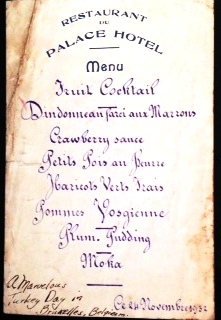
Hand lettered menu from The Palace Hotel in Brussels, Belgium, celebrating an American Thanksgiving,  1932

Brussels#1

The dance company all autographed the occasion on the back side.

Note Mistinguett’s signature in the lower left quadrant. Many of these figures appear in River of January

Gail Chumbley is the author of the memoir, River of January, also available on Kindle

Sale on Kindle for 99 cents!

th

River of January Cyber Sale

Monday 8:00 AM to Tuesday 10:00 PM

Only .99 cents on Kindle!

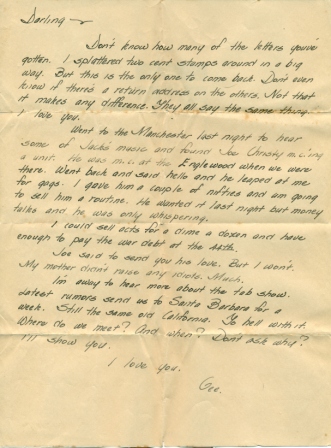
Darling, I love you, Gee

GrantLetter0001

Peppered through the vast family archive used in the writing of River of January, exist three special sets of letters. Though largely filled with conventional chatter and sentimental superlatives, these documents also provide a fascinating peek into another time and place–of a nation suffering through economic free fall, and perched on the threshold of war.

The letters frequently mention the turbulent state of international affairs, from fascist Italy, to the Spanish Civil War; episodes that eventually and inevitably led to the Second World War. Even more ink is expended discussing the difficult economic situation stemming from the fallout of the Stock Market Crash–securing theater bookings, closing business contracts, and aviation training in a downsized Navy. Still, aside from the monumental, most of the content reported simple day to day life, shared with humor and concise observations. From their correspondence these men clearly promoted themselves, vibrantly rising from the faded and yellowing paper.

The first are a series of letters mailed from a Hollywood address, composed by comedy writer, Grant Garrett. (See above). The second collection, posted almost exclusively from Europe, came from the hand of a 28-year-old Belgian entrepreneur, Elie Gelaki. Serious and painfully formal, Elie’s letter reveal a methodical mind, clearly continental in manner with a determined nature. Finally, the last, and largest collection came from Mont Chumbley, Virginia farm boy turned aviator, who looms largest in the memoir. His writing reveals a practical, warm, and straightforward young man who expressed himself in plain language.

Despite definite differences in style, these three writers did share many qualities. All were deeply ambitious, establishing successful careers in the particularly difficult years of the Great Depression. They were clearly literate and educated, in a time when many (at least in America) did not regularly attend nor graduate from secondary school. These letters rise from the ordinary, written with distinctive originality, candor, and technical accuracy.

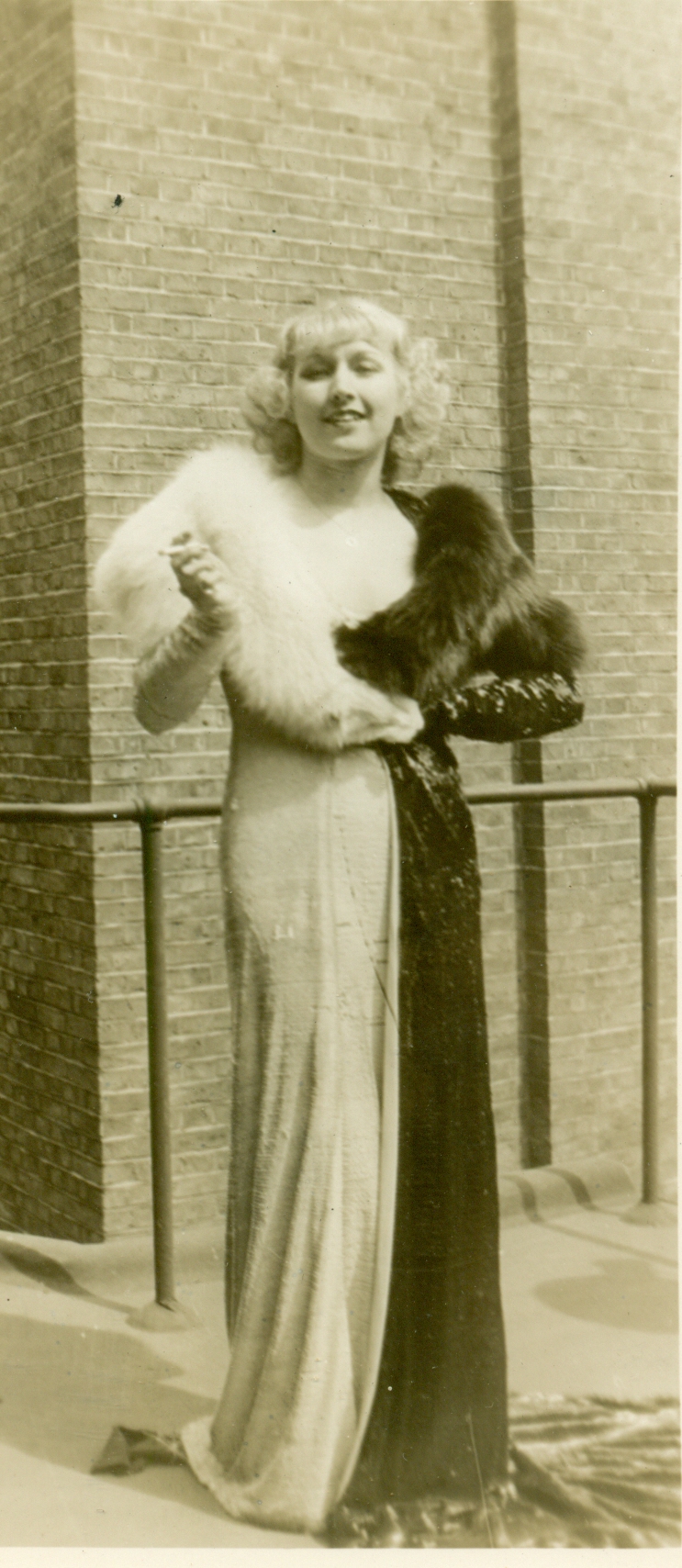
The link that tied this portion of the archive together was the beautiful New York dancer who received each letter, and preserved them all, Helen Thompson.

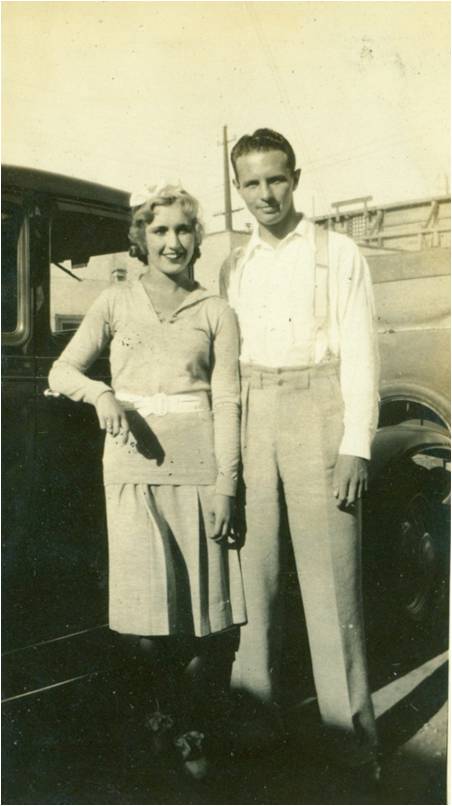
Garrett&Thompson

Grant Garrett became Helen’s first heartthrob. A native of Los Angeles, Garrett was a regular script contributor to radio shows and vaudeville acts. A talented singer and dancer in his own right, he interviewed Helen to partner with him for an upcoming tour across the country in 1931. After their junket ended, she returned to New York, and he returned to Hollywood. Now in love, the couple exchanged a series of clandestine letters, (her mother forbade Helen to see him again) with only Grant’s compositions still surviving today.

For a nineteen-year-old girl, Grant was hard to resist. Moody, smart, and funny . . . he was the essence of the tortured poet, a perfect combination of beauty, pain and passion. Of her suitors, Grant was the only one who shared her profession, and their time together forged a strong, and influential bond. Helen’s association with Grant provided something of a professional finishing school for her. From Grant she learned to laugh through tough times, and push through adversity because “the show must go on.”

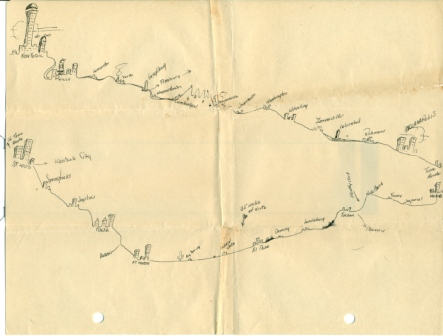
GrantMap0001

Grant’s whimsical map of a planned Garrett & Thompson reunion tour.

Next time, Belgian, Elie Gelaki.

Read more about Grant Garrett, Elie, and Mont Chumbley in River of January, available in hard copy and on Kindle.

Excerpt Saturday: A Cultured Gentleman

Image

Europe
1932

After Brussels, Elie visited nearly every town Helen played, frequently heralding his arrival with a spray of flowers waiting for her at each hotel.
“Please, please invite your friends to join us on our outing,” Elie cheerfully encouraged Helen.
In Paris, where Voila was performing, Elie motored a carload of Beauties to the countryside, stopping at the Bourbon Palace of Versailles. The American girls strolled amid the recovering gardens, the graceful flowing fountains, and grand buildings that had been severely neglected during the Great War, not so long before.
“Elie, this place is magical!” Helen exclaimed. “Have you been here before?”
“Only once,” the young man replied. “We—my mother, two sisters and I, traveled to Paris after the funeral of my father in northwest France. Perhaps I will take you up there another time.”
They toured the ornate grand salons including Marie Antoinette’s Petit Trianon, the queen’s palace. Helen lost herself, dazzled with the elaborate ivory and gold friezes along the walls and ceilings, and the gold-framed paintings hung in arched cornices.
Later, standing before a vast mirror in the Hall of Mirrors, the couple caught their reflection together—Elie smiling tenderly while Helen felt an inexplicable pang of regret.
In Strasbourg, on another day trip, the pair enjoyed a 12:00 tour of the town’s beautiful Gothic cathedral.
“Oh!” Helen exclaimed, captivated by the cathedral’s ornate astronomical clock inside the transept.
Elie whispered, “Wait my dear, it gets better.”
After only a few moments, small figurines emerged from above the blue and gold clock, within a square opening of the sandstone wall. The carvings represented the phases of life, holy saints, and culminated with statuettes of Jesus and his twelve apostles. While absorbed in the intricacy of the synchronized whirring, Helen felt a touch on her hand, as Elie took her arm. Together, the two silently contemplated this majestic tribute to the Almighty’s dominion over time.
On another stop Elie caught up with Helen by driving to Geneva. In the morning, before rehearsals, the Belgian escorted the dancer on a visit to the League of Nations.
“How did you manage passes, Elie? Charlotte and Grace were told they needed a sponsor to attend,” Helen whispered in the vast paneled halls, watching Elie retrieve the official cards from his pocket.
“I have a business contact here in the city who agreed to endorse us,” Elie quietly responded.
Finding their seats in the public gallery, Helen listened as one prominent gentleman after another eloquently spoke of a peaceful world. Moved by the solemn atmosphere in the chamber, the dignified proceedings, and the sincerity of all the delegates’ remarks, she whispered to her new friend, “These men sound determined to spare the world from another war.”
“My dearest girl, I truly hope they are successful,” Elie answered emotionally, gazing at the proceedings with brimming eyes.

*

Elie was in London on business, unable to attend Helen’s ballet performance in Erba, a town in northern Italy which was a holdover obligation from the Gambarelli contract. Mistinguett permitted the rest of the cast time off while the girls rehearsed for the somber ballet—Goethe’s Faust. This dark saga, a morality tale of the man who sold his soul to the devil for worldly power, puzzled the ballerinas.
“Ballet is a serious dance form, it’s true,” complained Una, “but this performance is so grim, I’ll bet there’s no belly laughs, or knee slappers in the aisles tonight.”
A murmur of assent echoed in the dressing room.

*

The cast party after the program proved to be anything but grim or serious. Accompanied by two Italian boys, Eddie and Nikko—young men the dancers had met earlier—the crowd left the theater in a cacophony of chatter and laughter.
Parading to a nearby café, the American girls swarmed around small tables on the stone terrace. Under a garland of dim light bulbs strung around the courtyard, clouds of rising blue cigarette smoke, laughter, and chinking glasses animated the softly lit oasis, the celebration flowing easily against the night.
“Have you tasted cognac, Miss Helene?” Nikko asked, in an innocent tone.
“No, Nikko. It’s bourbon for this girl.”
“My dear, cognac is the nectar of the heavens. You must try a sip.”
Helen reluctantly stared at the cognac the Italian pushed in front of her. She cautiously raised the snifter, appraised the aroma warily, and sipped. Choking a bit, she concluded, “This isn’t bad.”
Nikko, grinning, ordered another. The more cognac she consumed, the more earnestly the dancer explained how she was properly instructed to perform Ballet spotters back in New York.
Eddie sat, enchanted, listening to the pretty American girl. He suddenly asked, “Lovely Helene, would you permit me the privilege of observing your spotters?”
Nikko winked at his friend, and then added, “I have never seen a New York spotter.”
“Go on, Helen, show us how your Mr. Evans says it should be done,” egged on Grace, weaving unsteadily around the table to watch.
“New York spotters!” demanded several voices. Looking blearily around at her audience, Helen wobbled to her feet. The little crowd applauded.
“Hop up on the table, Helen. We can’t see your footwork from here,” shouted Carmen. Helen warily looked at the tabletop. She carefully placed her knee onto the edge, testing its strength, and satisfied it wouldn’t tip or collapse, awkwardly clambered up.
She clumsily rose to her toes. Lightheaded from the alcohol, the dancer tried to focus on a fixed spot, but just couldn’t pinpoint one. One rotation she turned, then another, and Helen began to gather speed. Inevitably, and all too soon, the girl tottered, losing her footing and equilibrium. Luckily for her, spectators surrounded the table and as she listed at a dangerous angle, the boys caught her before she hit the unforgiving flagstones.
Sick and sore the next morning, the no-longer-graceful ballerina retching in the bathroom, gasped, “Nectar for the gods? Tasted more like lighter fluid. I—hate—everyone.”

*

Elie caught up with the Mistinguett Company when Helen and her friends returned to Paris. Pleased to be reunited with the lovely American girl, he offered the group another afternoon tour in his Packard.
“I have my automobile, and you can decide our destination,” he invited.
“We’ve been to The Louvre.” Carmen mentioned.
“I loved the Mona Lisa, remember, Helen?” added Charlotte.
“The Winged Victory was wonderful, too. Plus we have visited the Arch de Triomphe and the Eiffel Tower,” Helen finished. “I think that today it’s your choice, Elie.”
The Belgian looked the girls over, gazing mostly at Helen. “I believe I have an idea. Climb in. We will motor north.”
The party journeyed under a cloudless blue sky to the northeast. Eventually, after passing through some small villages, Elie veered onto a narrow road, parking his Packard in a field.
“This is the battle area known as the Marne,” he announced soberly.
The girls quietly climbed out of his vehicle almost reverently at the familiar name of the legendary site. The young man guided the group over the ribbons of scarred landscape left by the many futile attacks that made up the Marne Campaign in the Great War.
“Was your father killed here, Elie?” Helen whispered.
“No, Helen, he died later, further northwest near the Somme River. That is where he is buried.”
It wasn’t a topic she gushed over in her letters to New York. That afternoon excursion made the wreckage of war too real for a dancer from faraway America.

*

Back in Paris Helen was astonished to find a letter postmarked from Los Angeles, California. Grant’s letter seemed from another world, another lifetime. Helen slowly opened the envelope and read,

My Dearest Little Nell
As you can see I am still residing in the City of Angels. Your silence took the starch out of a booking to South America and I took a pass. I am waiting patiently for my partner to return from her world travels. Shall play nary a date till you arrive… will continue to play my hunches instead… and never doubt me even when I am not with you.

Below his note, Grant had sketched a whimsical map of the routes he planned to book for her return.
He cleverly illustrated the stops with leaning snowy mountains in Denver, oversized, smiling cactus in Phoenix, and swaying skyscrapers back in New York.
“Oh Grant Garrett, you are a charmer, and I do miss you,” she murmured, feeling a little sentimental.
“Helen, did you say something?” Grace asked, glancing up from her bed.
“Oh—no. Sorry, Grace. I didn’t mean to wake you,” the girl murmered.
Lying back on her pillow she mused, I can hardly believe it, but Grant hasn’t crossed my mind since I sailed in April. The tour has been so fast and so thrilling. For now, she yawned, I’m just glad to be here. I’m far enough away from those who spend all of their time planning my life.

Gail Chumbley is the author of River of January
Talk Back Wednesday

rojcover10

You’ve read the book, now share your reflections or questions.

Finish this sentence, ‘Chum’s greatest personal asset had to be . . . ‘

or

‘Helen traveled across the US and around the Atlantic world because?’

Post your responses and we’ll talk.

I would love to hear from you,

Gail

Polyphoto International

Polyphoto2

While composing “River of January,” I spent much of my time searching and analyzing family papers. These letters, pictures, and news clippings, along with other souvenirs, make up an enormous archive which spans over seventy years of the twentieth century. Along with Chum and Helen, many secondary individuals are mentioned in the papers, and when I stumbled upon those names, curiosity sent me on the hunt for more information. One of the characters who rose from the stacks was a proper young Belgian named Elie Gelaki.

Elie made quite an entrance into Helen’s life, and subsequently into the pages of “River of January.” His romantic introduction into the story is reminiscent of a 1930’s Hollywood musical. While taking in the premier of “Voila Paris,” at the Palace Theater in Brussels, Elie spotted the girl of his dreams gracing the stage in a solo act. Apparently the smitten young gent quickly scanned the playbill and decided that the girl must be the dancer named Lillian. In an impulse of ardent infatuation Elie sends a note back stage to Lillian inviting her to meet him after the show. Alas, Lillian doesn’t respond and fails to appear at Elie’s appointed location.

The following night the resilient young man again attends the production. Again he watches, thoroughly enchanted, by the vision that is, he thinks, Lillian, Insistent in his attentions, Elie, this night sends flowers and a typed letter composed earlier that day. Again he implores the dancer to rendezvous at a preselected spot. And happily for Elie, this time she materializes out of the dark snowy night.

The girl seems, Elie notices, amused somehow by his attentions. Then he finds out why. The dancer he believed was Lillian in fact was Helen, and that Lillian had a boyfriend back home, in New York. He is embarrassed by the mix up, but more than that, Elie is charmed by the American girl. After drinks at a late night cafe, he asks to see Helen the following day. And so began the courtship of Elie Gelaki with the breathtaking blonde from New York.

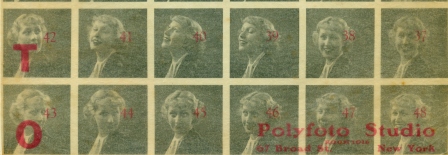
Bringing light to this man, lost to anonymity was an true pleasure. Searching through the volumes of primary sources and the internet, I discovered Elie was born in 1906 in Palestine. Further research, this time reading his avalanche of correspondence (to Helen) revealed that he supported two sisters and a mother in Brussels. Elie proudly shared with Helen his deepest ambition as a businessman, founding a company he intended to expand around the world. He had named the firm, “Polyphoto International,” and confidently assured her that the unique processes he developed would change professional photography forever.

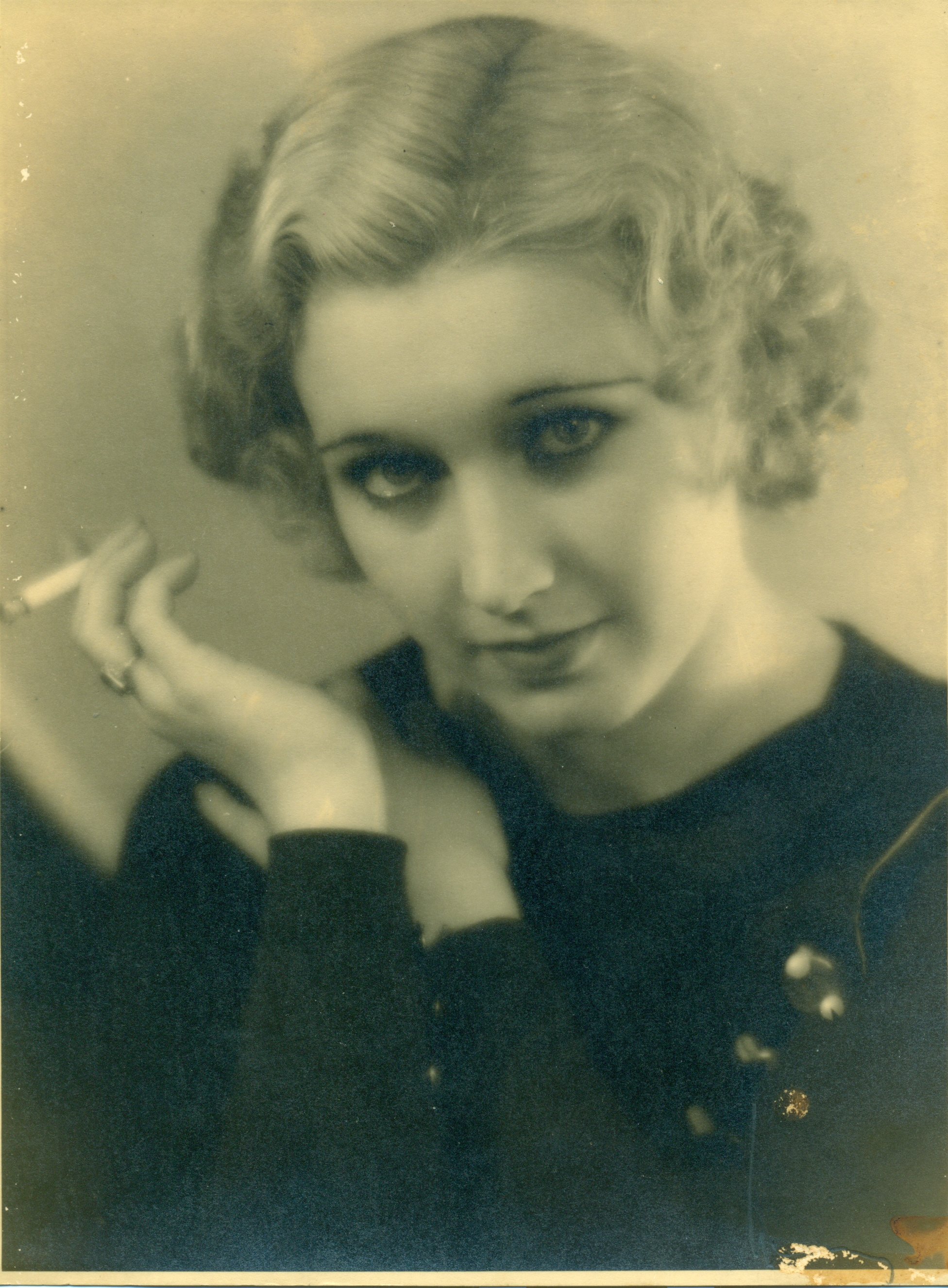
I have thought a lot about this enamored young man, (he was only 28 when they met) and I have ransacked the archive many, many times looking for any picture that might be this steadfast suitor. I’ve never found one. His letters were so loving, so personal, that I had to ask myself why Helen, who kept every other slip of paper had no picture of Elie.

He actually complained about this scarcity as well.

In 1936, four years after they met in Europe, Elie writes Helen in New York begging her for an updated photo. He laments, “If it weren’t for the one (picture) you gave me Brussels, I would have forgotten what you looked like.” Apparently the shortage went both ways.

I had to ask myself why? Why would Helen go out of her way to omit “Elie pictures” from her vast collection of mementos? Then I chanced upon a letter Helen sent to her mother in the middle of her 1932-33, European tour. She goes out of her way to assure her mother that she would never marry a Jew. Now this might sound harsh to modern ears, but I think that Helen felt torn by her denial and his Jewish heritage. From current family members who knew Helen, she once admitted she had a “thing” for Elie, using the word “heartthrob.”

At the time she met the young man, antisemitism was on the up tick, and not only in Europe–but in America as well. What I believe pressured Helen to write such things, was placating her mother. Any single girl worth her salt knows what to say to mother when it comes to “boys.” For Helen, at that time and that place, a rejection was much easier than the truth. And her words belie her actions. She must have given the young man reason enough to continue his amorous pursuit for four long years. He pursued Helen across the world . . .  and by the end of the book, across two oceans.

This continental gentleman, this Elie Gelaki, carefully, and thoughtfully laid out his future. He aimed to achieve financial success in the business world, and he aimed to make the American girl his wife. He wrote her constantly and sailed over the Atlantic to see her when he could. In “River of January” the last readers hear from Elie is in a letter from Kobe, Japan, dated 1936. He explains to Helen that “I hope to conduct Polyphoto business in this city, (Kobe).” And that is it, he is gone. Elie just vanishes.

I know, and readers understand, that all of his plans and dreams and hopes and ambitions mattered not a bit. A war is coming. A war of explosive magnitude, fueled by hate and violence and war crimes. A war against the Jews. Elie’s individualism, his personal ambitions, his entire world was devastated in the massive cataclysm of World War Two.

Uncovering this young man left me troubled. I felt as if Helen had been compromised, as were so many others, to sacrifice her natural regard for the young man in order to conform to conventional thought. Though only an episode in the bigger picture of “River,” this ardent suitor, this diligent businessman, deserves the dignity of recognition and remembrance.

Brussels, November, 1932

HVienna0001

From the new memoir, River of January . . .

Booked at the Palace Hotel in Brussels, the show’s new variety lineup fused seamlessly. First the star, Mistinguett, with the ballet troupe opened the evening program. Helen, unable to dance both with her friends and in her solo, chose the latter. Happily, it became a crowd favorite. Though she would have liked to dance with the company, Helen knew the ovations she garnered were well worth watching the opening from the wings. Next on the bill was synchronized dancing from American Earl Leslie and his line of hoofers, followed by the other company entertainers and their specialties.
The program closed with the full cast in a colorful, peacock-inspired, extravaganza. It featured Mistinguett center-stage, supporting a headdress of colossal feathered plumes of blue, turquoise, and purple, shimmering above her blonde hair. Her “Beauties” were costumed in silvery tutus, sequined halters, and tight, sparkling caps, each sprouting over sized silver feathers, flanking their star from both sides.
The male dancers, in black tuxedos, peeked out between each feathered girl. Under the dazzling lights, the symmetrical tableau moved patrons to their feet, applauding and shouting for more.
For a second night more flowers appeared, and this time a note accompanied the gift on Lillian’s dressing room table. As she again picked up the vase and turned toward the trash bin, Carmen stopped her, “At least read the note first, Lillian.”
“Yeah Lil, c’mon!” the other dancers chanted.
“Who wrote it?” asked Grace.
“Is it signed?” wondered Carmen.
Rolling her eyes, the dancer huffed dramatically, then slit open the note with a nail file and read in a flat, monotone:

You were really wonderful in your solo specialty and all through the review and I do want once again to ask you if you will let me pilot you through town in my car when and for as long as you may care. Should you not care to see or know me, please allow these flowers to tell you of my admiration, and remember that you have a person who cares for you in the little city of Brussels.

“But I didn’t have a solo,” Lillian exclaimed. “The only one who had a solo was…”
The girls stood silently, and then all eyes shifted to Helen. Lillian laughed once—a bit annoyed, and handed the vase to her friend, saying, “I believe these belong to you.”
Banter erupted again, now aimed at Helen.
“Jeepers girl, he admires you!” and “Wonder who it is that cares for you in this little city, kid?”
Helen took their teasing in stride, curtsying and blowing kisses. But when the dancers began chatting about the imminent cast party, Helen lowered herself onto a rickety stool and read on. “I feel I must say that I am not an ‘old butter and egg man’ … I am just twenty-eight and not too ugly … My only fault is that I think you are my ideal.”
Her eyes lingered on the words “my ideal.” Unexpectedly charmed, Helen appraised this communiqué with new eyes, and decided to follow the mysterious sender’s written instructions on how and where to meet him.
She dressed quickly and quietly to avoid any friendly needling. Helen hurried out the dressing room, heaving open the steel stage door into the quiet alley behind the theater.
Stepping to the corner of the building, she peeked around to the snow-lined, busy street. Helen carefully studied the faces of the bundled up after-theatre crowd crunching by, and scrutinized moving and parked automobiles. From her vantage point, She soon spied a grey Packard, emitting white-blue exhaust from a quietly idling engine. Scanning the note again, Helen felt certain that the young man would be waiting in that car. Her stomach faintly roiling, she stepped forward, trying to distinguish the driver through his frosty door window.
Helen realized, “Oh, he looks nice,” and shyly continued to approach his vehicle. The driver stepped out of his door, all smiles.
“You must be Lillian,” he beamed, “I am Elie. Elie Gelaki,” he added, bowing to kiss Helen’s gloved hand. She noticed that the young man’s voice formally articulated his clear English.
She bashfully smiled and felt her face grow warm. “Actually, I’m Helen,” she clarified. “I do hope that I am the one the message was meant for…”
Elie Gelaki unexpectedly gazed at her forcefully. “I meant you.”
The two stood self-consciously beside the running automobile.
“Why don’t I take you inside this café? It is quite cold tonight.”
“That would be lovely, Mr. Gelaki,” Helen smiled, more relaxed.
The young man gently took hold of her arm, explaining, “I’m Elie, and this street is quite icy.” He courteously escorted the dancer into a nearby coffee house.
“So you are the Helen Thompson on the bill, not Lillian Ward,” he said after they were seated. “I am sorry about the confusion. I hope it was of no embarrassment to you.”
“No more than usual,” the dancer laughed. “My friends spend more time teasing each other than dancing.” She paused, changing the subject. “Tell me about yourself, Elie.”
“I am a native of Palestine. But now I live here, in Brussels, with my mother and two sisters. My dear father has been for dead for some time.” He noticed Helen suddenly frown. “Did I say something offensive?”
“No. I’m sorry. My father died some years ago, too.” Helen’s own grief abruptly gripped her heart. After Floyd Thompson died, after his funeral, she knew something truly good had vanished forever from her world.
Her frown turned into a sympathetic smile. His face glowed in reply
Elie changed the subject. “I have recently founded a new photo company. I call it Polyfoto International,” he stated proudly. “At this time I am expanding my interests in Europe, across North America, and on into Asia.
“What type of photography do you specialize in?” Helen politely asked.
“ I will accompany you into my studio and photograph your lovely face. Then you will know,” Elie responded.
While he chatted about his life and work, Helen studied the Belgian. He wasn’t terribly tall, and had a clear complexion, subtly suggesting a childhood of freckles. His thick hair ranged from light brown to dark blonde and he combed it back off of his forehead. Elie gazed at her from olive green eyes speckled with glints of brown and gold. Though he seemed a serious man, he smiled broadly as he spoke in his appealing English, and his laughter was deep and friendly.
“Would you consider joining me for lunch tomorrow?” he asked. “I would be happy to guide you on a personal sightseeing tour of the city afterward.”
“Love to,” she answered promptly, drawn toward this young man. Elie thanked her with a happy grin.
The troublesome doubt dawned on her later, as she tiptoed into her dark hotel room.
“He’s Jewish,” she whispered to herself. “My mother would just die if she knew I was seeing a Jew.”
Yet, despite all the prejudice against Jewish people, she liked Elie and decided to give the young man a chance. He seemed nice, and she wanted to see the sights around Brussels.

River of January is available on Amazon and at www.river-of-january.com