The Ice Vanities


Hruba0001

1939

Arms twined around skaters on each side, Helen balanced nervously in the shadows. In V-shape formation, costumed in tall Hussar caps, and military jackets resplendent with gold brocade, the line stood expectantly in the dark. She shivered from a combination of excitement and the frigid draft wafting from the ice. Her ears thudded, inundated by the echoing din from the impatient audience. Much louder than a theater, she absently noted.

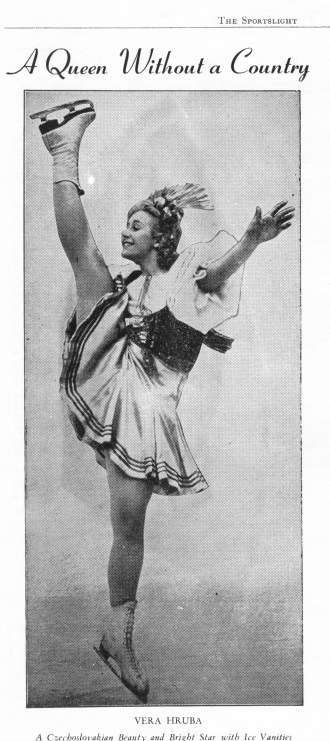
Positioned at the apex of the two wings stood Czech Olympian, Vera Hruba—one of three women headliners in the new production. When the last measures of an orchestral stringed overture faded to a close, the house lights darkened, and the arena fell silent for an expectant moment. With a commanding flourish, the opening bars of a military march surged to all corners of the house. Spotlights swept over the glittering skate-line, as Helen pushed off her left foot, in sync with the tempo. Following two more beats, Hruba burst from the crux of the V, and raced the circumference of the rink, spotlights holding tight to her revolutions. The audience roared in appreciation with waves of echoing applause. Helen’s first ice show had begun.

If rehearsals were any gauge, she already felt great confidence in the show’s success. The dance line often lingered along the rail, chatting, stretching—waiting for the director to call them onto the ice. “That’s ViVi-Anne Hulton, she’s Swedish,” Clara Wilkins leaned in whispering, both studying the soloist on the ice. “She’s been skating since she was ten,” Clara nodded, as Hulton executed a perfectly timed waltz jump. “Boy, that little Swedish meatball knows her footwork.” The girls standing nearby murmured in awed agreement.

Chestnut-haired Lois Dworshak sprinted past the attentive chorus line. Helen automatically glanced again at her well-informed friend and Clara didn’t disappoint. “She, Lois there, is a bit of a prodigy. She skated a little as a kid in Minnesota but, actually hasn’t skated professionally all that long. She’s good too, huh?”

“Jeepers, you can say that again,” Helen muttered.

“But, the real story in this cast is Vera Hruba.” This time, May Judels, head line-skater, spoke up from the other side of Eileen. Listening eyes shifted toward May. “Vera met Hitler, just like Sonja Henie did, at the Olympics in Berlin. She finished her freestyle routine, and came in pretty high, I think. Vera didn’t medal or anything, but still skated a pretty good program.

“So what happened?” asked another girl, Margo.

“Hitler says to her, ‘How would you like to skate for the swastika?’ And Vera, (she doesn’t much like Germans), told him she’d rather skate on a swastika!” Heads turned in unison, watching as Hruba completed a flying camel. “So,” May sighed, “to make a long story longer, Vera and her mother left Prague in ’37 as refugees, the Hun’s marched in, and Hitler made a public statement that Vera shouldn’t wear Czech costumes or skate to Czech folk songs. He said Czechoslovakia was gone, never rise again. Vera then responded, publicly rejecting the Fuehrer’s comments, saying she’d always be a Czech, and that Hitler could, in so many words, go fly a kite.”

“Their own little war . . . now that’s guts,” Helen’s eyes returned to center ice. “Makes Henie even more of an apple polisher.”

“A swastika polisher,” Margo corrected, as the director motioned the giggling chorus to center ice.

Gail Chumbley is the author of River of January, also available on Kindle. The second volume, The Figure Eight is due out in September 2016


Relive Rio

ROJAd

SELF-e_AmbassadorBadge_Web-Red

I Said YES!

SELF-e_AmbassadorBadge_Web-Red

Hi Gail,

To start, I want to congratulate you on having your book River of January chosen by Library Journal for inclusion in SELF-e Select.


Since your book has been chosen to be a part of SELF-e Select, Meridian Library would like to invite you to be a featured author at an event they are hosting as a part of Indie Author Day on October 8th. During this event, the local writing community will be coming together in the library to celebrate local authorship and will then join the larger indie community through a digital presentation of industry leaders that will take place at 2 pm EST.


The event will be taking place in Meridian, ID. If you are interested in attending and speaking on a panel about indie publishing, please let me know and I will get you in touch with the librarian who is coordinating the event.

Best,

Allie
Allie McKinney
Content Project Operations Manager
BiblioLabs
100 Calhoun Street, Suite 200
Charleston, SC 29401

Image

Gail Chumbley is the author of River of January. Also available on Kindle

Lucky Thirteen

discharge330001

In River of January and the sequel, The Figure Eight, (in progress) Mont Chumbley repeatedly insists the number 13 is lucky for him. In that spirit “Chum” left the US Navy on June 13, 1933, his 24th birthday, to pursue a career in civilian aviation. Today would be the pilot’s 107th birthday. For more of his fascinating story read River of January, available in hard copy and on Kindle.

Strike Up the Band-a few more hours!

th

River of January‘s Free Kindle Weekend!

Enjoy a read on the house compliments of Kindle. Available from Saturday morning through Monday night.

When you’re done tell a friend, and say something nice on Amazon Reviews!

Gail Chumbley is the author of the memoir, River of January. Also available on Kindle.

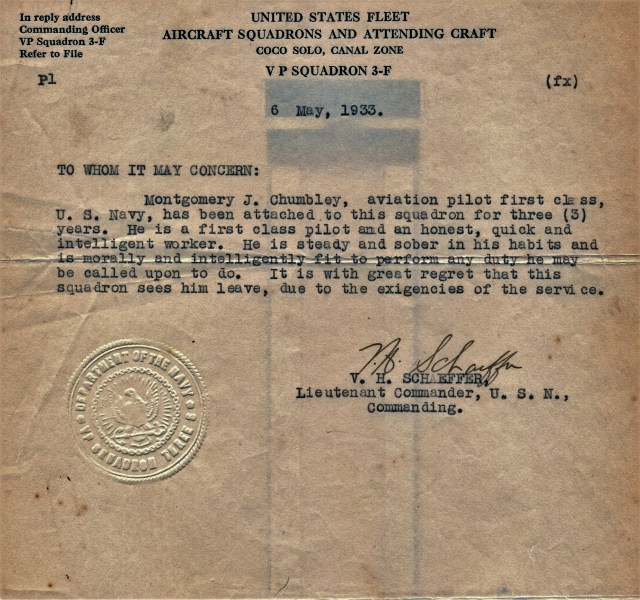
A First Class Pilot

Navydetatchment19330001

This letter, one of hundreds of documents used in River of January, marks Chum’s first discharge from the Navy in 1933. This letter speaks highly of the young man who five months later would prevail in the “Darkness Derby,” continental air race.

Gail Chumbley is the author of the memoir, River of January. Available on Amazon and Kindle.

River of January, Boise Library Edition

e0f80dea5a55ee5b

Thursday, May 12th River of January meets the Boise Public Library.

Join Gail for a lively, multimedia look at the archive that became the memoir,

River of January

The program begins at 7pm in the third floor’s Marion Bingham Room.

“This history could be lost” had she not known the story. Janet Juroch~The Idaho World

A Wedding Is Announced

WeddingAnnouncement

Eighty two years ago today Helen and Chum married in Manhattan. Vows were exchanged at the “Little Church Around the Corner,” on East 29th and 5th Avenue. Formally known as The Church of the Transfiguration, this congregation opened its doors to show people, a group commonly shunned by other, more proper, churches in the city.

New York, 1933

HOWARD-AILOR HOWARD-AILOR-SALES-CORP

“So you’ve been to see all the big boys, eh?” commented a sales representative from Long Island who was seated behind a battered old desk. Airplane distributor Howard Ailor of Waco Aircraft studied the young man’s face. “And by the looks of you they all turned you down.”
“That is about right, Mr. Ailor.” Chum responded, trying to look confident. “I was hoping you might know of something out here, maybe something at Roosevelt Field.”
“I don’t know you, son, but let me give you some advice. Don’t dawdle around hoping for that phone call. This is no economy to sit by and wait for miracles. You’ll starve first. Push your way into the air business with your own equipment, that‘s what I say, and I can help you with that. We have some beauties right here on site.”
Chum listened to the silver-tongued salesman, surprised that he agreed with all Ailor had to say.
Chum also realized that he had returned to an America deep in the throes of financial depression.
Economic life in the 1920s had played out as a frenzied, unregulated party. By all appearances the country had embraced infinite prosperity. Insider trading and other shady practices reigned on Wall Street, where market manipulators pooled cash and bought up stock, artificially driving up values. Regular folk, believing they were on to something big, bought these tainted stocks as crooked investors dumped them, reaping fabulous profits.
Indiscriminate buying, using easy credit, pumped the overblown Dow Jones to ballooning artificial heights. Even private banks joined the frenzy, wagering the savings of their account holders to increase their own bottom line.
This facade of spreading affluence ensured the “hands off” economic policies accepted in Washington. Then the market imploded. On October 29, 1929, “Black Tuesday,” the savings of a nation disappeared with the steepest financial crash in American history. Thousands upon thousands of people were ruined and the enterprise of a nation dried up.
Young Mont Chumbley had resigned from the Navy without another job, and now found there were none. The pilot’s only and best assets were his optimism, his pluck, and an old Chevy.
“Over here,” Ailor directed Chum, as they walked toward a hangar housing a red-with-black-trim Waco cabin biplane. “This baby’s a real beauty, right? We can take it up for a spin, if you like, but you can’t have this one—it’s spoken for. Still cough up a down payment and we’ll order you a new one. It’d be here in only six weeks.
“I came here looking for a job—and you want to sell me an airplane?” Chum blurted in disbelief.
Ailor continued to rattle on as though the pilot had not spoken. “Hell! I’m feeling generous. I’ll even let you rent office space right here on Roosevelt Field for a percentage of whatever you earn as you get your footing.”
Chum realized he had never encountered such a smooth operator. Ailor finally faced the boy. “Look, you can’t negotiate with reality, son. And the reality is that there are no jobs. The country’s flat busted.”
Chum knew his mouth hung open in reaction to the salesman’s bald audacity. But he also knew he agreed. Ailor was absolutely right.
Chum needed to find a way to buy that airplane. It appeared to be the only real option open to him. With little money left from his dwindling resources, he found a Western Union office and cabled his mother in Pulaski for help. He hadn’t written or visited much since joining the service and felt badly his note only asked her for money. However, Martha didn’t complain or hesitate.
“I’ll run down to our bank in town—still solvent, doors open,” she wired him right away. “A thousand, Mont? Is that enough? Where should I wire it?” Martha would still do anything to help her boy.

River of January by Gail Chumbley available at www.river-of-january.com and Amazon.com

Partly The Mob

sept291931

The room was hot, and humid, but the old man would not turn on the air. He said that it cost too much money.  The fact that this was Miami and July made no difference,that ancient swamp cooler remained silent in the living room window. To emphasize his granite determination to deny Florida Power and Light an extra penny, Chum dressed each morning in long pants, a belt, and a long sleeve shirt, cuffs buttoned. Mont Chumbley did not project the South Beach image favored by the city’s Chamber of Commerce.

However his strict rules of economy were cast aside the summer I flew down to record his story. And I do mean record, as in tape recorded interviews which lasted, in all, five days. And when I needed quiet the most (for quality purposes,) he decided to switch on that neglected, thundering swamp cooler, providing a Phil Specter-esque ‘wall of sound’ which muffled his fascinating story.

We were both nervous. I hadn’t been married to his son long, and my husband hadn’t come along on this trip. It was just the two of us: new father-in-law talking with new daughter-in-law. But I couldn’t let the awkwardness get in the way, I had traveled three time zones to get the story, and we had to soldier on despite our mutual jitters.

I hit record on the tape player, and immediately he began anxiously whacking a nearby phone book with a pencil. We now had a beat to the swamp cooler’s roar. And he did that for my comfort. How courteous.

I tried to play back the sessions right away to transcribe the contents. It’s safe to say that deciphering his voice from the background clatter grew to be a problem. Imagine the musical “Stomp,” with people trying to converse over crashing trashcan lids.

After a couple of days of this fidgeting he settled down, and to be completely honest, I did too. Chum even forgot to turn on the air once or twice. And his story in aviation began to unfold, carrying us away from noisy appliances; to days before there were such things as air conditioners–to the skies of another era.

Wow.

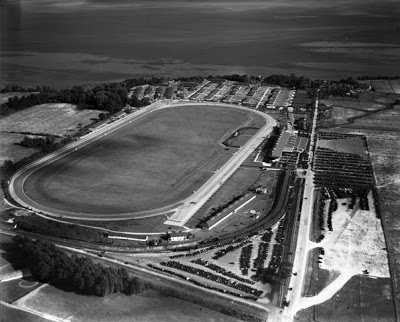
One story that made it into the book tells of his hair raising landing on the infield of a Maryland horse track. Later I had to hit the replay button a half dozen times to get the name right, listening hard to his phonetic pronunciation, buried beneath screeching layers of white noise. Shaped by his Virginia drawl, I deciphered, Har-Day-Graw.

I typed HardayGraw into a search engine. “Do you mean Havre de Grace?” quickly popped up . Hmm. Well, I guess I do. Maybe.

Lo and behold, Havre de Grace was a horse racing track between Washington DC and Philadelphia, tucked into the Maryland countryside. The web site indicated that this track evolved as a joint venture, owned partly by the town of the same name, and partly by the mob.

Partly by the Mob? Are you serious? And everybody knew? I had to look a little deeper.

Apparently in an agreement with the Governor of Maryland, and a former congressman, in a partnership with mobster, Arnold Rothstein, Havre de Grace came to life. And this was no small time nag fest, either. Among the thoroughbreds who graced, Havre de Grace were legends, Man ‘o War, his son, War Admiral, and the indomitable, Seabiscuit, You can’t make this stuff up.

That week in hot, sticky Miami has grown into one of the most pivotal of my life. I felt like Wendy clasping Peter’s hand for her flight to Neverland. But in my case Chum piloted the yoke to “Yesteryearland.”

This Havre de Grace anecdote, with Arnold Rothstein, and a hair raising unauthorized landing from the sky, merged with many, many other episodic rivulets that flowed into this fascinating river of narrative. This “River of January.”

Gail Chumbley is the author of the memoir, River of January

#riverofjanuary