In the late 19th Century the fix was in for the wealthy. This era, remembered as the Industrial or Gilded Age, witnessed overawed politicians who regularly legislated for and bowed to those known as America’s robber barons.
Ferocious drama played out between classes in the decades following the Civil War. In an oppressive atmosphere only the courageous and determined risked all to seek economic justice. Unionizers, in particular risked their lives in the cause of organizing labor. Individuals like Eugene Debs of the American Railway Union and Terrance Powderly of the Knights of Labor faced physical and economic harm through government sanctioned violence. The historic record is teeming with instances of brutality, hazardous working conditions, and bloodshed meted out by powerful business owners.
Particularly dangerous was organizing in American mines, mills, and factories. It didn’t help that the general public was unsympathetic to workers plight, universally convinced that the rich were chosen by God, therefore entitled to lord over the working class. In general laborers, especially the foreign-born were viewed as a cheap commodity, a disposable cog in the wheel of production and profits.
The most significant use concerned the Pullman Strike of 1894. Workers at the Pullman Palace Car Company (think Wild Wild West railcars) sold their freedom as a condition of employment to the company’s powerful owner, George Pullman. Workers lived in his town, (Pullman, Illinois) where their wages were debited for utilities, rent, and other monthly fees. During the economic downturn in 1893, hourly wages were drastically reduced, but Mr. Pullman still deducted his usual payments.
Denied temporary leniency Pullman workers voted to strike.
Mr. Pullman was not amused.
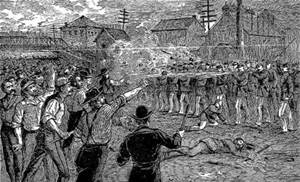
Of course the U.S. Attorney General at the time issued an injunction, and deployed federal troops into the fray. Soldiers soon poured into Pullman’s town, and opened fire. Some thirty strikers fell, while many more lay wounded.
The Pullman Strike fell apart in bloody violence, however, the heavy-handed tactics used by Pullman left people across the country uneasy.
How could a land that aspired to liberty, not check the tyranny of powerful industrialists?
Other disputes followed the same pattern; The Railway Strike of 1873, The Haymarket Riot of 1886, the Ludlow Massacre in 1914 Colorado, and New York City’s tragic Triangle Shirtwaist Fire in 1911 which killed nearly 150 immigrant girls.
The aim of this essay was meant to discuss the advances made by labor from the New Deal through the 1960’s. I hoped to share my childhood as a daughter who benefited from my father’s membership in the Steel Workers Union. And how my blue collar family sent me to college allowing me to passed on my good fortune as a public school teacher.
That story isn’t going to happen. Not today.
Once again the fix is in with overawed Republicans bowing to the moneyed class. Lawlessness defines a new oppressive atmosphere through the administration of a blowhard who scorns us all. Government sanctioned violence is an everyday occurrence, meted out by poorly trained thugs who track down immigrants and bystanders considered deserving of violence..
A new breed of robber barons has emerged with names like Gates, Bezos, Musk, and Thiel. These men demand Congress kiss their rings of power, along with a pedophile, opportunist president always on the take.
Again those who stand up against injustice are cut down by violence like Renee Goode, and Alex Pretti and many others denied due process and locked up in ICE detention centers.
Everyday Americans are once again uneasy, viewed as we are as merely cheap commodities to a GOP that wishes to strip us of our inheritance of liberty, including the right to the secret ballot.
“The man who has his millions will want everything he can lay his hands on and then raise his voice against the poor devil who wants ten cents more a day.” ~ Samuel Gompers, founder of the AFL
Have a thoughtful Labor Day
Gail Chumbley is the author of the two-part memoir “River of January,” and “River of January: Figure Eight,” co-writer of the screenplay, “Dancing On Air” based on those books. She has penned three stage plays on history topics, “Clay” on the life of Senator Henry Clay, “Wolf By The Ears” examining the beginnings of American slavery, and “Peer Review” where 47 is confronted by specters of four past presidents.