Then There was This One

Standing outside, rain or shine, hot or cold, fire drills were a pain. They interrupted the flow of the lesson, the morning, the afternoon, the day. I especially hated that obnoxious buzz alerting all to evacuate when testing was underway.

But, there was this game we played while getting soaked, or freezing, or scrumming together to shoot the breeze. I called it the ABC Game, and here is how it played out. Someone would pick a category, say World War Two, or Harry Potter and we would take turns filling in the next word.  A is for Azkaban, for example. And it was not only fun, but kept the kids together and occupied till the all-clear bell back to class.

So for your reading enjoyment, and to hopefully sell some books, I shall play the ABC’s of River of January.  Ahem, here goes.

A-Aviation

B-Buenos Aires

C-Chum

D-Don Dean Club

E-Mr. Evans

F-France

G-Grant Garrett

H-Helen or Hollywood

I-Ile de France

J-Jans & Whalen

K-Mr. Koserin

L-Lartique Agency

M-Mistinguett

N-“Night Flight”

O-Ovation

P-Pan American or Palladium

Q-Queen Mary

R-Rio de Janeiro

S-Surratt

T-Thompson

U-ungent pots

V-“Voila Paris”

W-Harold Whalen

X-who knows, xylophone

Y-yawl?

Z-zeitgeist?

Order River of January today.


Good Times Bad Times


Image


This is not a blog about Led Zeppelin. I have shamelessly used this title and image to get your attention. I am sort of sorry, but not really.

This blog however does concern the song title, “Good Times, Bad Times.”

At a book publishing seminar I attended a while back the speaker warned that marketing books was much more difficult than writing books. I didn’t believe her, or more accurately I couldn’t allow myself to believe her. At the time I was slinging rubbish into my manuscript and worse, knew my style was bad.

A couple of years later here we are–River of January is complete and I am finding that wise facilitator’s words haunting me. I think we are doing everything right, talking about the work whenever and wherever I can find a platform. Book stores, libraries, service clubs, book clubs, pushing the story on friends–you get the picture, Those who have read River, for the most part, ooze with enthusiasm and push me to complete part 2, The Figure Eight. And I am trying to get back into that writing zone, communing with Helen and Chum, by studying their mementos, listening to Chum’s taped interviews, and brushing up on the historic background of their lives. But there is this big problem in my attitude toward the second manuscript . . . plunging into the marketing angle again, when I have only sold around two hundred books with the first one.

My husband is a good cheerleader, claiming that everything with the book is good, and that we will meet our goals. We will sell books, and the public will respond in a positive manner. I think he might be right, the whole package is gorgeous: cover, interior design, pictures, font, paper color and yes, even the style and especially the story.

So Good Times must certainly follow this funk in the process of publication, and leave behind the episodes of Bad Times.

So once again consider River of January. It’s a pretty good read, even if I say so myself.

Eyes of the Beholder

Image

Is he trying to hold her hand? I have stared, examined, and analyzed this snapshot a zillion times and wonder what Grant is thinking about Helen.

Pictured above was the Vaudeville team of Garrett & Thompson–a team of hoofers out of Los Angeles touring Depresson-era America. Cracking jokes, singing, and of course blending in Helen’s ballet talent, the two traveled from here to there earning scarce cash to get by.

River of January  is not a romance novel (not that there is anything wrong with those). However the story does include the twenty-something search for love, finding flirtations along the path to adulthood. Grant Garrett became Helen’s first passion–the team leader, writer, and choreographer. She was very young, just eighteen, when she fell under the spell of her partner.

Since the publication of the book, I’ve asked readers their views on this chapter, on Grant Garrett. One young lady admitted she had a “crush” on Grant. A man-friend dismissed the dancer as a “cad.” Many others simply want to know what became of this debonaire song and dance man. (I smile and reply “Book Two).

His letters reveal much on his growing ardor concerning Helen. He fell hard for her and desperately wanted to make her his wife. But that never happened. What does that say about Helen? What does that reveal about the smitten suitor? Was it love? Was it for the moment? Was he actually a cad?

That is the beauty of releasing a book. It immediately becomes the property of the reader, and in more ways than a purchase. All whose eyes rake the pages decide for themselves the quality and nature of the characters, and their intentions.

As for me, I too have a crush on Grant. His letters entertained me all through the research for this creative nonfiction work. A handsome face, and razor sharp sense of humor, and an eagerness for success are hard for this writer to resist.

Now for my pitch: If you have read River, please comment on the smooth operator pictured above. I’d love, LOVE, to hear your opinions on his character.


A New April

Image

Right now, in classrooms across America, and overseas, thousands 17-year-olds are preparing for the AP US History exam. They, and their instructors are obsessed with cause and effect, analyzing, and determining the impact of events on the course of America’s story.  Moreover, they are crazed beyond their usual teen-angst, buried deep in prep books, on-line quizzes, and flashcards. As a recovering AP teacher, myself, I can admit that I was as nuts as my students, my thin lank hair shot upward from constant fussing.

My hair fell out too, embedding in combs and brushes, as I speculated on essay prompts, that one ringer multiple choice question, and wracking my brains for review strategies. The only significance the month of April held was driving intensity, drilling kids on historic dates; Lexington and Concord, the firing on Fort Sumter, the surrender at Appomattox Courthouse, President Wilson’s Declaration of War in 1917, the battle of Okinawa, MLK’s murder, and the Oklahoma City bombing, That was what April meant in April.

To quote John Lennon, “and now my life has changed, in oh so many ways.”  Today April holds a whole new definition. My husband rises first in the morning, putters in the kitchen, fetches coffee, tends to the dog, and is back in bed, back to sleep. Big plans for my morning include writing this blog, making some calls related to book talks, a three mile walk through the Idaho mountains, then working on Figure Eight, the second installment of River of January. What a difference!  Nowadays, getting manic and crazy is optional. My hair has grown back in, standing up only in the morning, and the only brush with AP US History occurs in my dreams; the responsibility passed on into other capable hands.

This month, at least here in the high country, has been especially beautiful. We have already enjoyed a few 70 plus degree days, and the green is returning to the flora. Our sweet deer neighbors are no longer a mangy grey, emerging from the trees wearing a warm honey coat. With a little snow still on the peaks, the sky an ultra blue, and the pines deep green and rugged, I think sometimes this must be Eden.

My years as a possessed, percolating history instructor provided a gift of passionate purpose that enriched me more than depleted.  But, now . . . I wouldn’t trade this new phase of my life for all the historic dates in April.

Gail Chumbley is the author of River of January also available on Kindle.

Identity

ImagePBS ran a series called “Finding Your Roots.”  It was hosted by historian Dr. Robert Louis Gates and focused on celebrities and their genealogy.  Yo Yo Ma, Meryl Streep, Eva Longoria, etc . . . were featured on the program. The show quickly transitioned beyond the begats of family trees when Dr. Gates added revealing blood tests concerning ethnic group composition.  One guest, an African American professor, found that she was actually Caucasian, with little African makeup.  The woman looked visibly shaken as she absorbed the news, clearly at a loss to define herself in this new light.  It felt almost cruel to watch her grapple with the science.

Identity can be a slippery concept.  For thirty three years I was known as teacher.  Along with wife and mother, teacher constituted the third leg of my reality.  Family concerns and lesson plans ran equally through my thoughts.  I listened to my husband’s work problems, worried about  classwork my own two had to complete, and prepared for my own lectures.  That was my life and my identity.

Any travel, reading, or discussion usually had a connection to history.  I attended seminars at Gettysburg, along the Oregon Trail, and touring the grounds at Mt. Vernon, Virginia.  After years of historic pursuits, I retired and turned to writing.

The people I am meeting now, while promoting “River of January,” think that I am a writer.  A WRITER!  I am not settled yet with that new moniker, it feels pretentious to presume the role of author.  Does taking a story that fell into my lap, experimenting with sentences to tell the story, adding pictures and a cover make me a writer?  This new definition of Gail is going to take a while to break in, like new shoes, or a pair of jeans fresh out of the dryer.

Identity is a funny concept.  When exactly does it happen?  When does an occupation become an identity?  The professor featured on PBS taught African-American studies, considered herself black and then bloodwork betrayed her foundations of reality.  What has she done with that new information?  Who is she now?

And that reminds me–I hated Metaphysical Philosophy in college.  I wasn’t too thrilled with Voltaire, Montesquieu, or the rest of those dudes, either

 At our most essential level who are we as people?  If another looks to me as a writer, am I indeed what they see?  I can counter that notion with thousands of kids who passed through my classroom and see only teacher.

Western Union

Western Union

My computer crashed, but I have wonderful neighbors who are IT wonders. The little gadget is now up and working. Progress on all fronts with the book. Speaking engagements are lining up and books should be done by the end of the month.
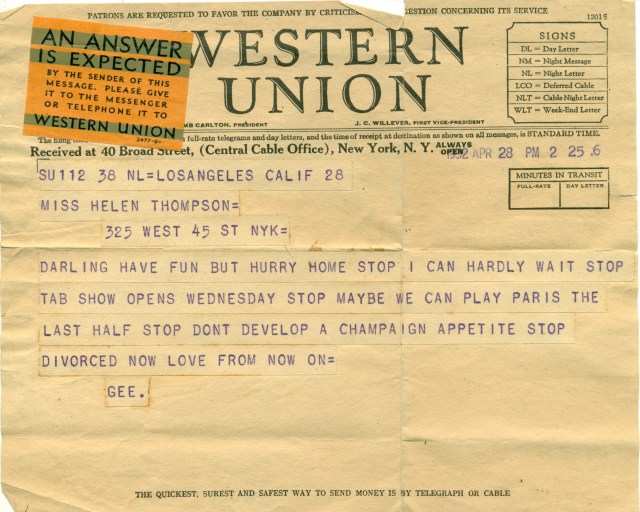
Pictured is a telegram for Helen from an admirer, before she shipped off to Europe in 1932. The story appears in the book.

Do You Understand Now?


Image


My book, River of January is not, I repeat, not a romance novel. Does it contain a love story? Yes indeed, and a good one too.  However, the two destined to find each other, Chum and Helen, meet later in the book.

The manuscript has made a small circle of rounds, either for review or because someone felt they could help promote the work. And of all the folks who have read it, only two readers complained that the romantic part didn’t come soon enough in the story.  I have to admit that was frustrating to hear, because so much cool stuff transpires before they meet in the book.  Paris, London, Rome, Vienna, dancing, singing, and ocean liners for Helen. Tragedy, endurance, ambition, aviation, air racing, and adventure for Chum.  And all of the action is true and verifiable. What do these readers think?  Is real life no more than a love story?  Is their life no more than a love story?

I understand enough to say that these folks are looking for a marketable formula. They look for the effort to possess the elements that sell in fiction. However my work is creative nonfiction and follows no predictable pattern, just like any persons life. These two people pursued avenues that opened to them, as we all do.  It’s just that their paths included vaudeville stages, the silver screen and the golden age of aviation. Isn’t that enough?  I wrote the book to chronicle two actual lives. If the work sells on that merit, that will be wonderful. My limit is changing the story up to fit a commercial template. To even think of shuffling the events around feels sleazy and unethical.

It was my son, my sage, who reduced the conundrum down to a simple truth. He explained that once I commit the words to paper I lose control of how readers perceive them. And he is right. After the telling, the tale belongs to each individual and their unique interpretations.  And that means letting go of the outcome.

English 101


Apostrophes

I worked with quite a number of English teachers during my long thirty-three year teaching career.  They, as a group of educators, contribute a great deal to the heart of a school.  Over the years it has become my opinion that the purpose of language arts is to cultivate the dreams of dreamers, the hearts of romantics, and inspire the hero in all of us.

Back during my days in high school I recall reading Romeo and Juliet as a freshman.  It surprised me that teen angst played a central role in a Shakespearean play.  I suffered deeply from those same dramatics and felt validated that I didn’t suffer alone, Shakespeare understood.  By my junior year I developed a serious crush on transcendentalist, Henry David Thoreau–that dude sought the identical truths troubling my path at the same time.  In college, Flannery O’Conner’s A Good Man is Hard to Find haunted my thoughts for many months after reading.

In light of the power of the written word, I’ve never understood an English teacher’s penchant for dissecting the writing of their students.  Correct their grammar, okay, but the voice on the paper is so personal that trimming and cobbling feels more like slashing and burning creativity.  (Math teachers really hate it when English teachers correct their grammar.  In one inservice an offending math presenter snapped back, “now for your algebra equation).  I get the part about smoothing out sentences, polishing images and descriptions, but how much is too much intimidation and infringement on the writers soul.

This blog sounds somewhat defensive, and I am aware of my sensitivity.  My book is in it’s final edits and reviewers are hopefully at work as I write, plowing their way through my manuscript.  I have refrained from asking anyone from a Language Arts background to review my work, out of fear of a big red bad grade.  Writing River of January has been such a journey, such a sacrifice of my time and heart, I don’t think I could bear to have banal technicalities flaying the story.  I’ll let my publisher/editor suffer through those arcane changes.

The truth of the matter is that I did not set out in life to be a writer.  I was a history teacher.  In my area of expertise my students excelled in expository writing . . . you remember, the old blue book essays.  The mechanics weren’t as important as voice, evidence, and argumentation.  Where my writing lacks is in the finesse of perfect structure–and that is, I am painfully aware, my weakness.

So English teachers of America–give us heart, inspire us, and let us find our voices in our writing. Besides, since the start of this project I’ve written and rewritten so much that I can see sentence structure much more clearly.  It takes hours and hours of writing to become a better writer. Put away your red pen and let the kids write amok.  As they improve, then go back and point out the rules of sentence structure.  For young learners the corrections will make so much more sense.

Gail Chumbley is author of River of January