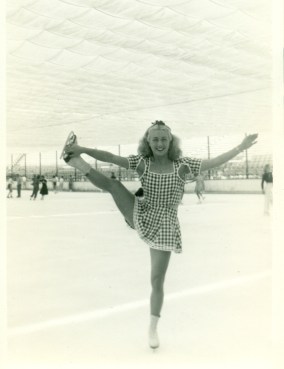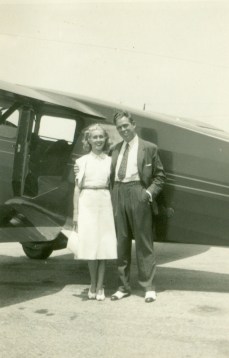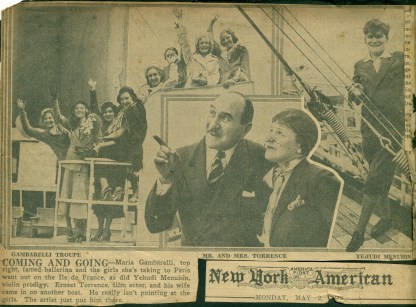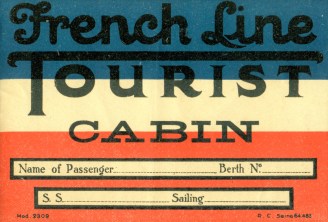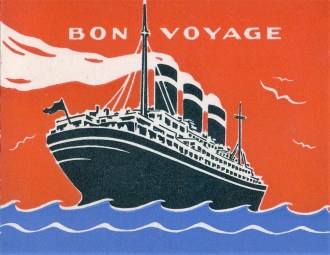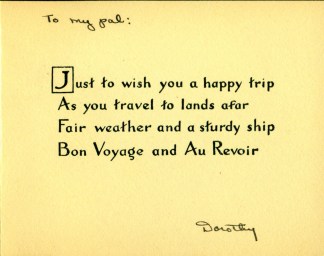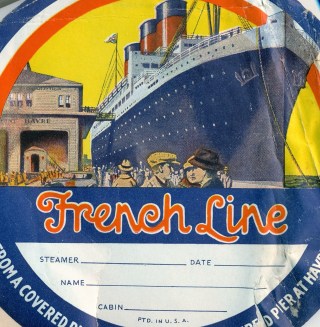
Eighty-three years ago.
Glendale, California
Wichita
New York
Gail Chumbley is the author of River of January, a memoir. Also available on Kindle.
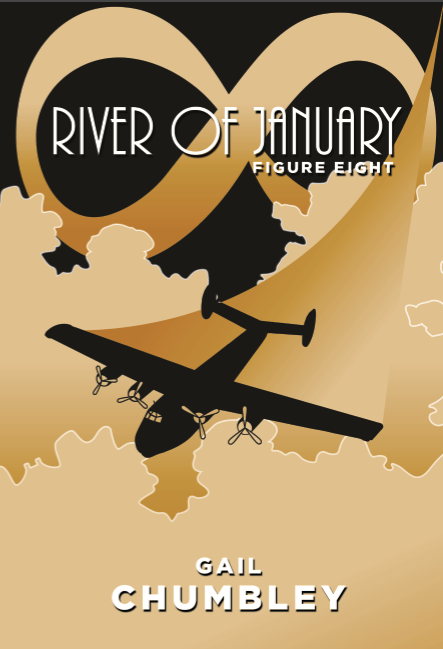
Watch for River of January: Figure Eight in November.
Eighty-three years ago.
Glendale, California
Wichita
New York
Gail Chumbley is the author of River of January, a memoir. Also available on Kindle.
Watch for River of January: Figure Eight in November.

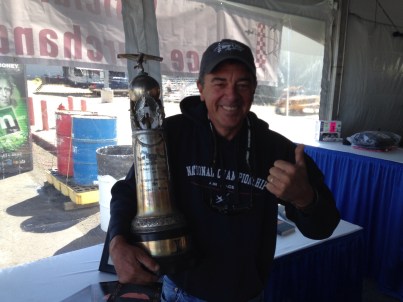
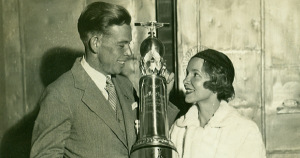
A visitor with the “Darkness Derby” trophy
Reno is situated in a golden bowl below mountains that separate Nevada from California. This enormous basin pulsates with life; upscale strip malls, flashy casinos, and relentless traffic following endless suburban growth.
To the north, off the beltway circling the “Biggest Little City,” sits Stead, Nevada, a locale clearly not touched by the same affluence as the rest of the region. A boarded up Catholic church, a Title-I elementary school and a Job Corps Center secured behind a grim, chain link fence, indicate that the very poor live world’s away from the prosperous south.
But at the end of this impoverished section of road, the world changes. Parachutists drift overhead in swatches of white, zigzagging through a deep blue autumn sky. Aircraft of every model and engine size wait, tied down on the asphalt, wing to wing. Vintage bi-planes, silvery jets, oddly shaped experimental aircraft, and muscly aerobatic planes flash in the brilliant sunlight. Thrilled attendees weave through the rows, admiring and discussing these miracles of flight. The owners relax inside the shade of hangars–a protective eye on their aircraft, monitoring visitors with a mixture of casual diligence and satisfied pride.
We, my husband and I, watch the action from inside a tented gift shop in the pits. How the gods of fortune placed us among the elite of the Reno Air Races, in the pits, is a miracle of another kind. In waves, the chosen, carrying pit passes, ebb and flow from our tent. When the Blue Angels blast down the runway, rising in a series deafening concussions, the tent empties. As the spectacle comes to a roaring close, and these seraphs return to earth, the shop once again fills with customers.
These pilots can’t seem to keep themselves from staring at our table. The oversized trophy Chum won in 1933, placed at the center of our book display, captivates these Twenty-first Century flyers. “Can I get a picture of this?” one man asks. “How much would you take for the trophy?” asks another. “They don’t make them like this anymore,” says another. “You need to take care of this one.”
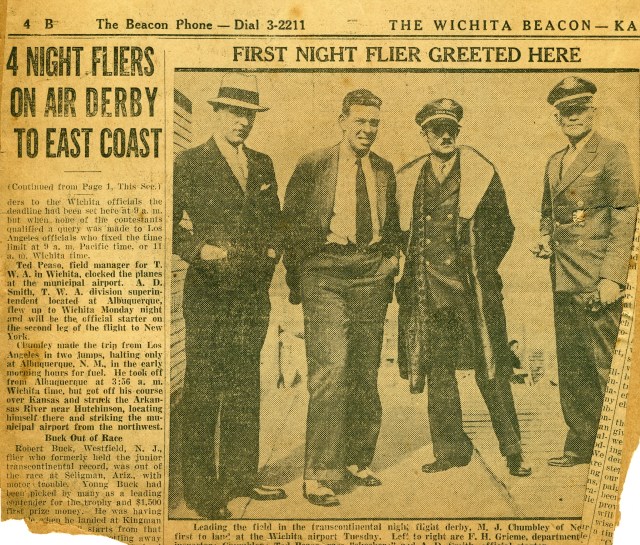
Conversations soon turn to the race itself, 1933’s “Darkness Derby.” For this Depression-era contest pilots flew, one by one, into the eastern twilight. Beginning in Glendale California, nearly twenty intrepid aviators ascended, stopping first in Albuquerque, then north to Wichita, then sprinting to the finish at Roosevelt Field, Long Island. This event celebrated both “Roosevelt Field Days,” and a new Helen Hayes, Clark Gable film titled, “Night Flight.”
Beside the tarnished trophy, we display a framed glossy of Miss Hayes presenting Derby winner, Mont Chumbley, with the very same trophy, at her movie’s premier.

Reactions varied. One pilot gushed that my father-in-law was a bonafide aviation pioneer. Enthused the admirer added, that your father-in-law managed to find his way through the blackness and win the race was incredible–he had no flight instruments. I smile because I already know, and this visitor’s wonder matches my own. I also smile because for the first time, since publishing “River of January,” I’m with people who understand the profound significance of his victory.
Another visitor tells us he edits an aviation magazine out of Ohio, and would like me to submit a piece regarding the “Darkness Derby.” This editor promises us that he will see to it that the race is officially recorded for posterity. My husband and I are very pleased with this assurance, as well. We’d always hoped to get Chum’s accomplishment recognized by fellow aviators and officially recorded.
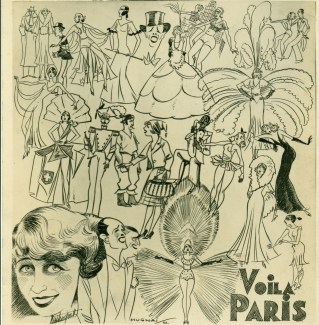
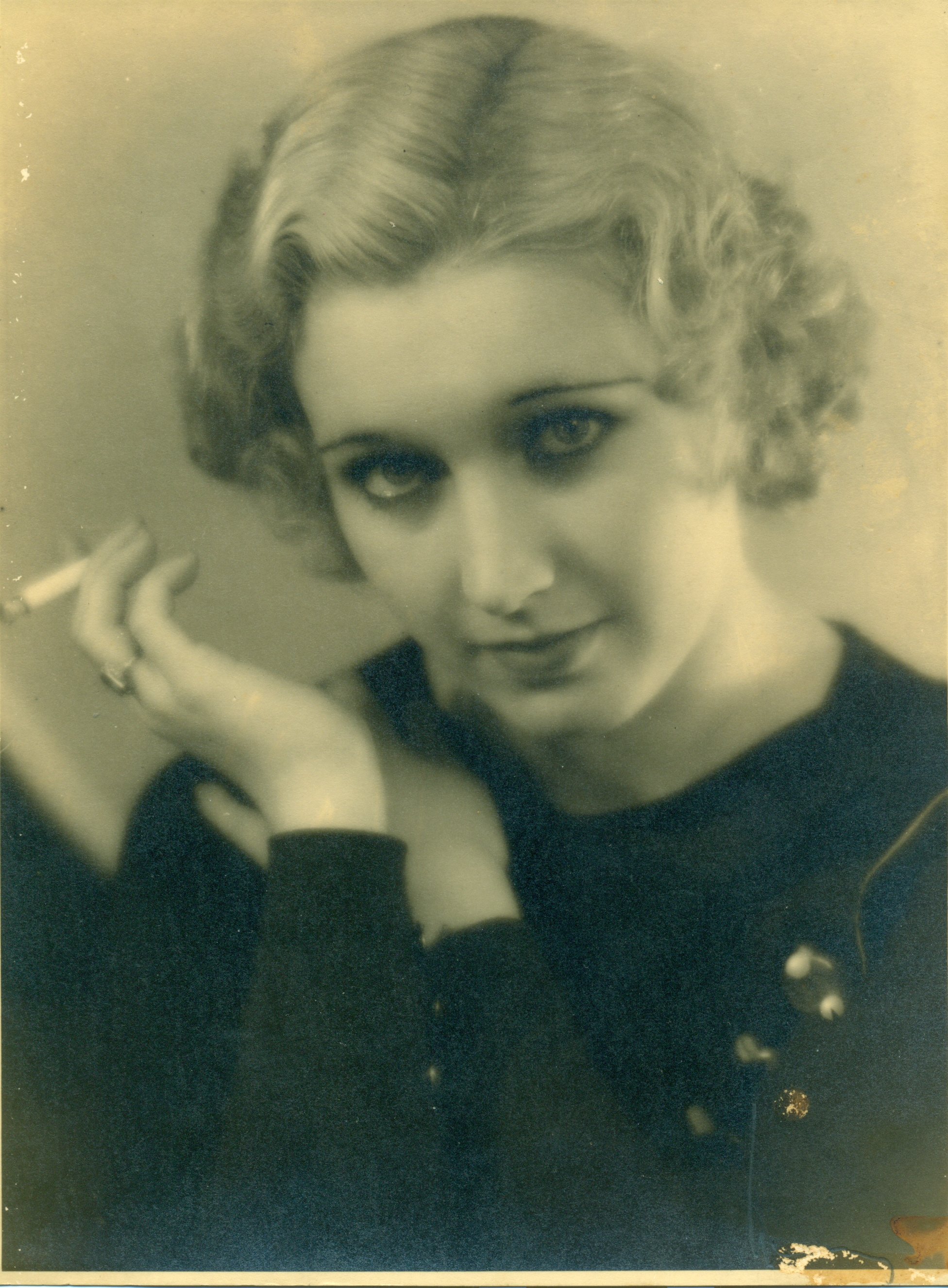
Happily, Chum isn’t the only recipient of accolades. Equal attention and interest are directed to Chum’s future wife, a lovely girl also named Helen, Helen Thompson. Her photograph lights up our table with timeless beauty and glamor. She smiles from a vintage, Hollywood glossy emitting a radiance that seems to add to Chum’s luster. I quickly add that this girl’s glamor masked her own courage and ambition in the world of entertainment. Helen Thompson too, took enormous professional risks, performing across three continents during the tumult of the early 1930’s. It was in Rio de Janeiro, in 1936, while dancing at the Copacabana Casino, she met her dashing aviator.
In Reno my husband and I stepped into the world of avid flyers, and they understood our purpose in sharing “River of January.” With all the adulation paid to our exhibit, all the books we sold and signed, Chum and Helen’s story is carried on to inspire future generations of adventurers.

Gail Chumbley is the author of the memoir, River of January and River of January: Figure Eight. Book one is available on Kindle.

I cannot recall the words I used to soothe my juniors on that horrible day. However, the soul-deep pain remains remarkably sharp in my emotional memory.
Vaguely I can see my son, a senior at the same high school, enter my classroom to check on his mom, the American History teacher. Seeing his face, I wanted to go to pieces.
It was later, in the local newspaper, that I discovered not only the words I shared with my students but the transforming pain they endured watching their country attacked.
(For the writer’s privacy I’ve deleted their identity)

Gail Chumbley is the author of the two-part memoir, “River of January,” and “River of January: Figure Eight,” both available on Kindle. Chumbley has also composed two history plays: Clay on the life of Henry Clay and Wolf By The Ears a study in racism.
gailchumbley@gmail.com
The fix was in during America’s late 19th Century. This era, remembered as the Industrial/Gilded Age, witnessed awed politicians who regularly legislated and protected those known as robber barons.
Ferocious drama played out for decades following the Civil War. In this fraught atmosphere courageous and determined union organizers risked all to seek economic justice in the face of dangerous obstacles. Unionizers faced their names appearing on a black list, (meaning no one would hire them), bodily harm, and government sanctioned violence. The historic record is littered with instances of brutality, hazardous working conditions, and bloodshed meted out by powerful business owners.
Particularly lethal for workers was attempting to organize workers in American mines, mills, and factories. It didn’t help that the general public was unsympathetic to workers plight, universally convinced by “The Gospel of Wealth,” a secular-sacred creed that maintained the rich were chosen by God, therefore entitled to lord over the working class. In general laborers, especially the foreign-born were viewed as a cheap commodity, a disposable cog in the wheel of production and profits.
Andrew Carnegie, in particular detested the working class, and even more the activists who threatened his control over Carnegie Steel. For example, as a remedy to thwart unionizers, managers deliberately placed workers of different nationalities next to one another on the production line. Language barriers effectively frustrated organizers trying to increase membership. Then there were corporate spies, and hired guns such as the Pinkerton Detectives out of Chicago, or Federal troops sent by Washington to quell strikes. If those measures failed to break the union, Carnegie opted to lock out strikers, filling jobs with scab labor.
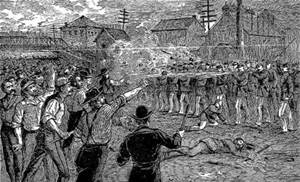
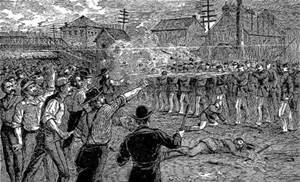
The use of an injunction proved a particularly nasty device owners used. A state governor would claim interference of interstate commerce; meaning troops could move in to ensure the free transfer of mail and freight. Once the injunction was issued soldiers were deployed, guns blazing into crowds of strikers, not unlike battles from the recent Civil War.
The most significant use of the injunction concerned the Pullman Strike of 1894. Workers at the Pullman Palace Car Company (think Wild Wild West railcar) sold their freedom to the company’s powerful owner, George Pullman. Laborers lived in his company town, (Pullman, Illinois) where their wages were docked for utilities, rent, and other fees each month. During the economic downturn of the Panic of 1893, hourly wages were drastically cut, but Mr. Pullman still deducted his same monthly payments.
Demanding leniency the Pullman workers voted to strike.
Union leaders knew they had to avoid a federal injunction for armed troopers would intervene leading to violence. Seeking to avoid a military showdown strikers took extra care that the trains continued to roll through Illinois. In solidarity, rail workers helped by unhooking Pullman Cars, parking them on side tracks, then reconnecting the rest of the train cars. Off they chugged to adjacent states.
Mr. Pullman was not amused.
Of course the U.S. Attorney General at the time issued an injunction, ordering federal troops into the fray. Soldiers poured out of rail cars in Pullman, opened fire, killing some thirty strikers, and wounding many more. The strike was broken, but the heavy-handed tactics used by Pullman left some uneasy.
Not that he cared.
Could a land that aspired to liberty, also check the tyranny of powerful industrialists?
Other disputes followed the same pattern; The Haymarket Riot, the Homestead Strike, the Ludlow Massacre in Colorado, and New York City’s tragic Triangle Shirtwaist Fire in 1911 which killed nearly 150 immigrant girls.
Still, despite many violent setbacks, changes began to come about for the working class. When Theodore Roosevelt became president in 1901, he championed some real reforms. In 1902 when a coal strike threatened the coming winter supplies, TR stepped in.
Initially the mine owners refused to recognize the authority of the United Mine Workers and refused to budge.
With winter coming the President took drastic action. Roosevelt essentially sided with the strikers. He threatened the owners, warning he was willing to send in the army, but this time to work coal fields. In short the owners were obliged to sit down with union leaders and negotiate.
This President was not blind to the threat of social and economic injustice.
Fast forward to 1950’s where I grew up in a blue collar, union household. My dad, an active member of the United Steel Workers, tended white-hot pots of molten metal for Kaiser Aluminum. Because of his job, benefits, and union activities, his only daughter (me) earned a university degree, and pursued a fulfilling, professional calling in public education.
Because of the time and the place, my dad’s employment offered benefits neither my mother nor grandmother enjoyed. College, a degree in American History, and a professional career as a teacher. His union job made my professional path possible.
Of course at the time, I didn’t fully appreciate the price paid for my good life, but that four-year degree opened my eyes. The benefits that shaped my path did not come easily.
Today unions are still vilified by many. Nonetheless those who suffered and sacrificed built an American economy that still provides a good living for many . Those valiant few must be remembered.
BTW, industrial workers demanded and won the right to honor the Sabbath as a day of worship, not labor. Those of the Jewish faith and Christian established the tradition of weekends, setting aside Saturday and Sunday.
Have a thoughtful Labor Day
I grew up in a union household. And truth be told, the benefits of the Steel Workers Union saw me through college, making my career in education possible. Through a combination of post-war prosperity, cheap hydro power from the Columbia River, and full industrial production at Kaiser Aluminum, my life took an affirming and enriching path. Of course at the time, I didn’t understand the real cost paid for my good life, until I taught Labor History to high school juniors. What I found in my research was a story of real people enduring violence and intimidation that, in the end, made possible the emergence of America as the world’s greatest economic power.
Labor strikes in the 19th Century were especially bitter, bathed in violence and bloodshed. Operating under the creed of “The Gospel of Wealth,” entitled industrialists viewed workers as a cheap and plentiful commodity, no more than a…
View original post 659 more words

Forty years ago, and I was dressed for the Eagle Farmers Market. The overalls wore out, but “River of January,” and I will still be there!
See you Saturday by the gazebo–9:30am to 2:00pm.

“River of January” is flying into the Eagle Saturday Market. Come by and say hello. Join the many who have read and loved this exciting, true adventure. Gail Chumbley, the author will be on hand to sign books from 9:30 to 2:00pm.
River of January is available online at www.river-of-january.com, at Amazon.com, and on Kindle. Look for the sequel, “River of January: The Figure Eight,” this Fall.

South Atlantic
1936
Aside from the never-ending Elie issue, the voyage itself passed pleasantly. Helen and Lila scrambled out of their beds each morning ready for fun. They hurried to breakfast in the dining room, joining the other young people on the ship. And depending on their moods, Helen and her cohorts played shuffleboard, ping-pong, or other games on deck. After meals she strolled with Lila around the upper level, and the girls always found time to take in the afternoon sun.
Helen enjoyed the scenic two-week voyage, which included additional ports of call along the way, for passengers and mail. Helen noticed that each time they docked, The Southern Cross steered into harbors increasingly clogged with more ocean-going traffic. Recife, in particular was congested enough the ship had to sit off shore until its scheduled arrival time. Anxious for Rio, Helen asked a crew member why the ship had to sit and wait.
“Must keep to the timetable, Miss. The cost of coming into port early can be as high as $500 a day.”
After another stop in Vitorio, the ship downshifted to a veritable crawl. She could feel the air thicken, heavy and muggy, in the motionless heat. Sweltering, the two American girls grew impatient with the slower pace and filled their time packing then repacking their trunks.
The last night on board, Helen took her time washing and setting her hair. She had painted her nails and toes a bright red, and had gone to bed early; 8:00 PM. Lila did the same. The day before, during lunch, an elderly lady from Connecticut had described the beauty of approaching Rio by sea.
“There is no panorama more exquisite than entering Guanabara Bay at sunrise,” the matron declared, her eyes bright with enthusiasm.
Their curiosity piqued, the girls thanked their luncheon partner, and agreed to greet the dawn as it lighted their nearly mythical destination.
The deck appeared empty, dark, and still just before 4:30 AM. The girls had stumbled out of their beds, pulled on their robes, and stepped out into the cool air. As Helen’s eyes adjusted, she could identify other early risers, also clad in their robes. Clustering at the railing, the onlookers were absolutely overwhelmed with the panorama that gradually unveiled before them.
Helen gazed as the sun, rising from behind her, shadowed an elongated silhouette of the ship on the quiet water. Sugar Loaf Mountain presented slowly, from the summit down, exposed by the rising light, cobalt and gold reflecting on the calm, glassy bay. The relatively dry morning air and growing excitement over their imminent departure from the ship left both girls exhilarated.
“Lila, this was a keen idea!”
“Sure was. Glad I thought of it,” Lila replied, laughing.
*
Helen’s intuition alerted her that something wasn’t quite right. Standing behind Lila, in the customs queue, she watched as a short, balding official approached them from the head of the line. He tapped both girls on the shoulder, gesturing for them to step off to the side.
Innocently, she and her friend complied, dragging their trunks and pulling smaller bags with them. The official then returned to the front of the passageway without a word. The two girls looked at each other, puzzled at the strange request. There seemed to be no special reason they were targeted, and no one who bothered to provide them with an explanation.
The Club Copacabana manager, Mr. Max Koserin arrived to the docks to personally pick up his American dancers around 10:00 AM. He smiled at his new employees, whom he noticed at once. His expression shifted dramatically, however, when he realized they were standing alone, outside of the customs queue, with their baggage at their feet.
“Good Morning, ladies. I presume that you are Miss Thompson and Miss Hart?” Koserin asked.
Helen spoke first. “Yes. I’m Helen, and this is Lila. Thank goodness you’re here, Mr. Koserin. That man at the front pulled us out of line without telling us why. We don’t understand what’s going on.”
“Please try not to worry,” their new boss assured, looking them both in the eye. “I will get to the bottom of this unfortunate misunderstanding.”
Koserin walked to the customs officer and began what quickly escalated into a heated exchange. Helen felt her hope for a quick resolution fade.
“This gentleman has informed me that the city of Rio has recently passed an ordinance requiring all foreign acts coming into the city to deposit a bond with the police,” the club manager explained when he returned.
“We have to…?” Lila began to cry out.
“No, no, my dear, that is my job,” Koserin soothed the frightened dancer.
Mr. Koserin explained that the sum required for their bond totaled the entire eight-week salary for both girls, paid in advance. Strangely, Helen again became calm when the manager didn’t blink at the so-called “news.” In fact he showed no surprise at all. She guessed he expected the snag.
Still, he turned to the girls and cautioned, “Please do not worry, I will be back.”
Lila opened her mouth to speak, but Koserin raised his hand, continuing, “It will take most of the day to generate that sum of money. Stay together and please don’t be alarmed.”
Koserin smiled serenely and then departed.
Again watching the little bald bureaucrat, she noticed that he barely glanced at the passports of travelers he was processing. She quickly understood that the two of them were victims of petty corruption. No actual protocols existed for performers or any other workers to enter the country. She recalled her trips to the police station and consulate in New York, now wondering why she had bothered.
As the day dragged on, Helen grew more certain that their new boss’ presence wasn’t just limited to a warm welcome and a lift to their hotel. She believed that Koserin had rescued other new acts delayed the same way. And though she trusted that he would return with their affidavits, it didn’t help that both girls were stranded in the heat and humidity. No one offered them a chair, a drink of water, shade, or any help. The two Americans just stood miserably under the Rio sun.
When Lila meekly asked, the chief steward refused to permit them to go to their compartment to wait out of the heat.
Wiping her forehead with a handkerchief from her purse, Helen sighed. It had been hours, and there was no sign of Mr. Koserin with their ransom. Her eyes, automatically raked the docks searching for their boss, then toward the departing passengers. It was at that moment Helen locked eyes with the bullish little customs agent.
“That official over there, do you see him? Helen whispered to Lila.
“The man who pulled us out of line?” Lila asked.
“Yes, him.” He keeps leering at me. It’s been getting worse the last hour or so.”
“Disgusting!” Lila scoffed.
“I wonder how often that little twit gets away with his scheme,” Helen quipped. Both girls shuddered, glancing again toward the toad-like bureaucrat.
Time ground on and they watched as a queue of new passengers began boarding from the dock below.
Observing the foot traffic Helen realized, “Lila, I think we have another problem. This ship is scheduled to leave for Buenos Aires at five o’clock.” Swallowing her panic she added, “And we’re going too, if this problem isn’t resolved.”
Out of the corner of her eye she caught the official again, grinning suggestively. Tears traced down Lila’s pink, burning cheeks.
Turning away, glancing automatically toward the dock, Helen gasped as a throng of newspapermen and photographers swarmed up the passageway. “Someone’s tipped a Rio newspaper. We’re news, now.”
Reporters crowded around their trunks, shouting in Portuguese, vying for a story or photo of the two trapped American starlets.
Lila, wet-eyed, stared ahead, not acknowledging the cameras or chaos. Helen, feeling protective of her new friend, held up one hand, blocking the mob, while placing her other arm around her distressed friend. Beginning to lose her own composure, she glanced again from her wristwatch to the dock, as Mr. Koserin suddenly appeared. He had finally returned. Striding with authority up the passageway, carrying papers above his head, Koserin presented two affidavits of money placed with the local magistrates.
“I have never been so happy to see someone in my life!” Helen laughed, now equally as teary eyed. Truly, for both girls, Koserin was a sight for sore eyes. The manager glared coldly as the disappointed official shrugged, accepting the documents—releasing the Americans to enter the city.
After the all-day ordeal the two demoralized girls descended the passageway with their benefactor. Helen asked Koserin for only one kindness, “Could we please have a drink of water?”
Gail Chumbley is the author of “River of January,” and “River of January: Figure Eight,” a memoir. Hard copies are available at http://www.river-of-january.com, and also on Kindle
Questions or comments? Contact Gail at gailchumbley@gmail.com
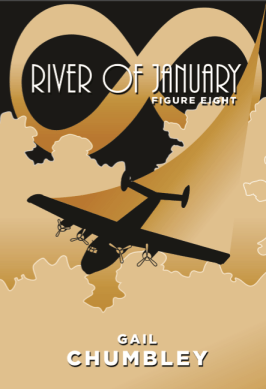
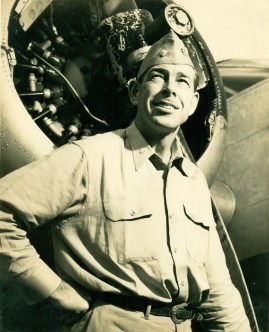
Chum returned to uniform by August 1941. Luckily he had worked for Eastern Air Lines exactly one year, vesting his employment, ensuring a job when he returned from the war. But that raises an interesting question, what war? There was no American war. Six more months transpired until the Japanese attack on Pearl Harbor. The answer to this intriguing question reads something like this; President Roosevelt instituted the preparations he could–Cash and Carry,The Destroyer Deal, quickly followed by the Lend Lease Act in 1941. America’s first peacetime draft had already been activated the year before, in 1940. Everybody knew what was coming, except for the bulk of the American population. They found out the hard way, later, across the Pacific, on a mild Hawaiian Sabbath.
Gail Chumbley is the author of the memoir, River of January, and the forthcoming sequel, River of January: The Figure Eight.
River of January is also available on Kindle.

Found this gem on the back cover of a 1948 playbill. The program was “Hats Off to Ice,” a Sonja Henie icetravaganza at Rockefeller Center’s Center Theatre. Time to consider new Christmas tree decorations.
Gail Chumbley is the author of River of January, a memoir. Also available on Kindle.
Look for the sequel, “River of January: The Figure Eight,” coming soon.
My husband got a tattoo. I don’t like tattoos. He’s too old for a tattoo. And I didn’t approve until he showed me the result.

This sweetheart chose the Sopwith Camel from my book cover, River of January.

I can’t be too annoyed, dammit.
Gail Chumbley is the author of River of January, a memoir. Also available on Kindle.