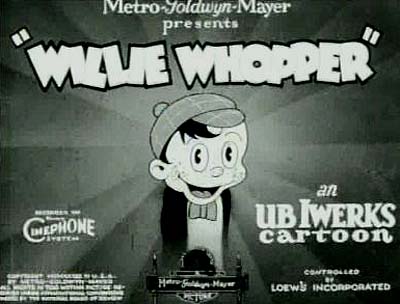
Willie wins the race and pays the mortgage!
https://www.youtube.com/watch?v=ns9hDz5hIh8
This little gem was made the same year Chum won the Darkness Derby.
Read River of January today!
Willie wins the race and pays the mortgage!
https://www.youtube.com/watch?v=ns9hDz5hIh8
This little gem was made the same year Chum won the Darkness Derby.
Read River of January today!


Please permit me to reintroduce these four figures from America’s antebellum period.
Thomas Jefferson, best recognized as the author of the Declaration of Independence, the third president of the U.S., and the man behind the purchase of the Louisiana Territory in 1803.
Andrew Jackson, the celebrated hero of the Battle of New Orleans, noted Indian fighter, and seventh president of the U.S.
John C. Calhoun; Congressman, turned Senator, from South Carolina, who served two separate administrations as Vice President.
Jefferson Davis, a former soldier in the Mexican War, one-time Secretary of War, and later President of the Confederate States of America.
All four of these men avidly pursued political careers, embraced the social norms of their era, and all hailed from the Old South.
Ironically if one found the courage to ask their occupation, none would have mentioned politics. Instead, to a man, all would have replied, “I am a farmer.”
To modern ears that curt answer feels a bit disingenuous and profoundly understated. However, in the early nineteenth century, exercising dominion over large tracts of land, and cultivating crops as far as the eye could see, was considered the most noble and honorable of pursuits. In keeping with carefully practiced manners, one politely, and tactfully left unmentioned, the reality that hidden among the hogsheads of tobacco, the bales of cotton, and bags of rice, there germinated a mightier harvest of exaggerated superiority, violent racism, and self deception.
The truth was these politicians were all slave masters; lords of the lash, who derived a living “wringing their bread from the sweat of other men’s faces,” (as Lincoln so eloquently described). These four also minimized the financial underpinnings which afforded each man’s elevated social standing; for any talk of the dark brutality behind their “greatness,” was simply not discussed in genteel society. Each cavalier capably hijacked, and effectively distorted American virtues, such as the ideals of freedom and the social contract to suit their own ends.
No central power held any authority over their personal affairs and conduct.
The maestro of this sophistry was Thomas Jefferson. Proffered as the “Sage of Monticello,” Jefferson brilliantly articulated a vision of America where all lived freely, untouched by the outside world, upon private acres of liberty, immune from any overreaching government. Occasionally those noble scions of property did assemble together to establish necessary laws on general issues; infrastructure, property disputes . . . common needs beyond plantation boundaries. For Jefferson, his fellow planters were “natural aristocrats,” the only power qualified to decide what mattered most. Only this paternal elite knew best what constituted the common good for lesser members of the community.
After the regrettable passage of a clearly unconstitutional law, the Sedition Act in 1798, Jefferson jumped into action against the Adams administration, authoring a tract titled the “Kentucky Resolution.” This position statement, submitted to the Kentucky Legislature, introduced the concept of ‘nullifying’ Federal law. The idea was simple. If a majority of delegates, assembled in special convention, renounced this Federal statute, the law was rendered null and void within the state.
For the first time, in one pivotal moment, Jefferson’s insidious principle found its way into the fabric of American politics, but found no traction in surrounding states . . . at least not yet.
Away from public scrutiny, Master Tom held sway over some 600 slaves, and fathered six children by his deceased wife’s half-sister—a slave—Sally Hemings. According to plantation records meticulously scribed by “the Sage,” himself, regular whippings, especially of young male slaves were scheduled, performed, and unquestioned. Jefferson understood slave labor required obedience, and obedience was assured only through violence. Apologists have argued that Jefferson felt troubled by such practices and attempted to lay blame in the nation’s colonial past. Yet he did nothing meaningful to end this tortuous practice, even when he could. Emancipation would have simply been his ruin.
And it is that legacy of deception–Jefferson’s cries for personal liberty versus the cries of the enslaved–that shaped his politics. The human nightmare Master Tom inflicted on his people laboring upon his lands was nobody’s business but his—and Jefferson’s aristocratic peers shared that same view.
Andrew Jackson interestingly enough didn’t care for Thomas Jefferson. As a young Congressman, then Senator from Tennessee, Jackson realized he couldn’t remain seated through all that talking and rules of procedure required in law making. Jefferson, in return, thought the brash young man a tad impetuous and well, nuts. But both planters did share in the same world view, “What happens on my plantation stays on my plantation.” Jackson too, was a ferocious master who answered to no law, but his own. A merchant in both horse and slave trading, Jackson dueled any who questioned his honor, supervised cotton production on his fiefdom (The Hermitage) and eradicated indigenous peoples on lands Jackson saw as better suited for more cotton production.
To Jackson’s credit he did not attempt any pretense of civic virtue, or learned philosophy.
When elected in 1828, President Jackson exercised a different style. “Old Hickory” governed very efficiently without any of the political nonsense of protocol or formality.
Even Supreme Court reverses proved no obstacle. Chief Justice John Marshall ruled that the Cherokee Nation, et al, could remain on their ancestral lands in Georgia. Unimpressed by the judicial decision, Jackson cynically carried on ordering the military to remove the tribes from the state. The President knew the land in question was broad, and fertile; perfect for plantation crops. Plus gold discoveries in the same region put paid to the inevitable, accelerating a massive forced death march known as the Trail of Tears.
In another episode, Jackson, finding himself formally censured by the Senate (for vetoing the re-authorization of the Second Bank of the United States) used his considerable influence to have that rebuke expunged from the Congressional Record. His overly exaggerated sense of honor demanded that Jackson demand that this official insult be eradicated.
In a candid moment Jackson later confessed his only regrets as president was not hanging the Senator behind the censure.
Jackson injected a petty impetuosity to national politics unrivaled until today’s shenanigans. And though Jackson’s enemies christened him “King Andrew I,” his unilateral style did not derive from any monarchical notions. Rather, the President’s conduct came from his background. Jackson was accustomed to being obeyed—he was Master Andrew, a member of the planter class.
Before Senator John C. Calhoun of South Carolina soured into a states’ right’s militant, his political outlook had been national in scope. With unusual clarity, young Representative Calhoun once confessed that slavery was a “necessary evil,” vital to South Carolina’s prosperity. Over time he married a wealthy Charleston cousin, elevating his standing and political authority in Southern society. Calhoun began renovations on Fort Hill, a plantation in the uplands of South Carolina, which, with his new wife, cemented his bona fides as a member the ruling class. This ambitious politician had truly arrived, assuming the role of gentleman, influential political figure, and a prominent slave master. Much like Monticello, Fort Hill was an ever-expanding operation, endlessly improved using the same teams of slaves that tended his fields.
However, in a series of unforeseen reverses beginning in 1828, Calhoun’s political prospects declined.
This self-made politician-planter coveted the highest office in the land. Calhoun had served as Vice President under both John Quincy Adams and Andrew Jackson, and viewed his ascendency to the White House a natural next step. Yet circumstances played out beyond his control. These events aren’t exactly pertinent to this essay, but look them up. Interesting stuff.
Bitter, Calhoun resigned the vice presidency and returned to Fort Hill an angry man. His stance on slavery changed as well, leaving him vitriolic and defensive. Under increasing pressure from growing abolitionist criticism, Calhoun, speaking now for the entire South, adamantly insisted the institution was not evil, after all, but instead a ‘positive good.’
When a high import tariff was passed by Congress, Calhoun defiantly announced South Carolina would not collect this “Tariff of Abominations.” Moreover, the angry former Vice President organized a state convention to nullify (remember Jefferson’s Kentucky Resolution?) the Federal law. With Calhoun’s newly minted militancy, the former Vice President defiantly stood his ground.
President Jackson did not suffer Calhoun’s impertinent challenge lightly. As another slave master, he bluntly threatened Calhoun in terms both “gentlemen” understood—the president personally guaranteed Calhoun’s thrashing. Fortunately this particular crisis was averted by cooler heads in Washington, postponing the curse of fraternal bloodshed for a later generation.
But the question of states’ rights, local control, and the sovereignty of the master class merely continued to boil. Nullification bloomed into full secession by 1861 after decades of discord. No longer did the planter class tolerate insults or challenges to their natural preeminence and power. South Carolina, (Calhoun’s home state) became the first of the eleven to secede from the Union on December 20, 1860. Delegates attending the state convention did not wait for the final electoral college results, to reject the victory of nationalist Abraham Lincoln as president. So enraged were these aristocratic lords, that Lincoln’s name did not appear on the ballot in most southern precincts.
I’ve added Confederate President Jefferson Davis to this piece because of his later role in perpetuating the genteel myth of the Southern aristocracy. After battles and bullets finally settled the supremacy of the Federal government, Davis, released from jail began a writing career. He penned first, The Rise and Fall of the Confederate Government, followed later by A Short History of the Confederate States of America. In both of these works, Davis revisited the events leading to secession, briefly described in this essay.
Rehashing Constitutional debates from the Philadelphia convention, Davis insisted that the States existed before the Union, thus could leave whenever the Feds no longer acted on their behalf. Reiterating this view in both volumes, the defeated Secessionist defended the South’s righteous justification in standing up to tyranny. Davis repeatedly echoed the virtues of States’ Rights, nullification, and local political control. Sadly for our nation’s history, Jefferson Davis had not only the last word, but also the lasting spin on the noble myth of “The Lost Cause.” Oh, and this is significant—Jefferson Davis was a planter as well, the master of “Brierfield,” a plantation near Vicksburg, Mississippi before the onset of the war.
For this student of history, the bandying about of terms like “States Rights,” “nullification,” and “secession,” coupled with an unending vilification of the Federal Government brings me pause. This fanciful yarn was only concocted as an appealing cover for a legacy of hubris, power, greed, hate, racial exploitation, and violence.
This essay closes with no examination of the State’s Rights’ issue in the Twenty-first Century. Modern history most certainly has much to lend, especially regarding the Civil Rights. The point of this effort, rather, is to shed light on a dominant enduring political influence. This venerable lot is not only vibrantly alive, but has left a tradition of chaos, intransigence, and gridlock. And this crowd has no intention to cooperate or compromise.
And I must confess when Representative Joe Wilson, a defoliant-resistant sprout from South Carolina shouted, “You Lie,” to President Obama, on the occasion of his first State of the Union address, my Nationalist-leaning blood froze. Though no longer permitted to inflict public whippings, or issue challenges to duels; the outraged indignation of America’s antebellum period roared across the House Chamber. On that cold, historic, January night in 2009, the master’s voice thundered once again.
Gail Chumbey is the author of River of January.
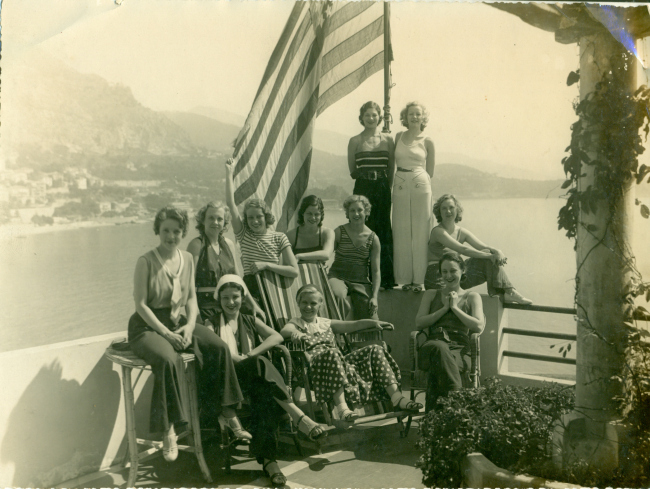
Helen seated below flag in stripped tank and blond hair-Monte Carlo 1932
Chum once told me that he never suffered from jet lag. And he later flew jets. The early flights didn’t reach ten thousand feet in altitude and the duration was relatively short. Time zone hopping took a lot longer from the east to the west, and back again. Flights landed before the body or even the mind was too zapped. I asked him how he sustained himself waking up in a different place nearly every day. He looked at me with a perplexed expression, as though he couldn’t fathom the question. “I never had any problems,” he’d repeat. “I never struggled to sleep, and my appetite was always good.”
Those few, still living when I began River of January told me, amused, that Chum made a habit of standing on his hands, heels against the hotel wall every…
View original post 285 more words

From New York
 To Rio de Janeiro

Journey by air, rail, and sea!

In Barry Levinson’s nostalgic film, Avalon, the central character, Sam, an old, old man shares a personal existential crisis. He tells his grandson of a walk he took around his old Baltimore neighborhood, and how he sadly found nothing he remembered, nothing familiar, no landmarks from the past. He explained that his distress was finally lessened when he found his now-deceased wife’s childhood home, and the old place was still standing. Sam admitted that until finding that old house, he worried for a moment that he never existed.
On Tuesday I led a book talk on River of January. The setting for this presentation was an assisted living facility, with an older group of listeners. At first my audience stiffly withheld their reaction to the story, clearly reserving their judgement. This audience quietly measured my credibility, waiting politely before offering any encouragement. Lucky for me, as the story progressed, the weather in the room shifted dramatically. Tossing out an Ethel Merman reference here, and a Bela Lugosi picture there, knowing smiles and nods rippled across the room. Adding a Howard Hughes anecdote for good measure, the listeners and I became one–kindred spirits–celebrating the names and cultural references of another era’s childhood. Their earlier caution was cast aside as memories surfaced, validated in story and song.
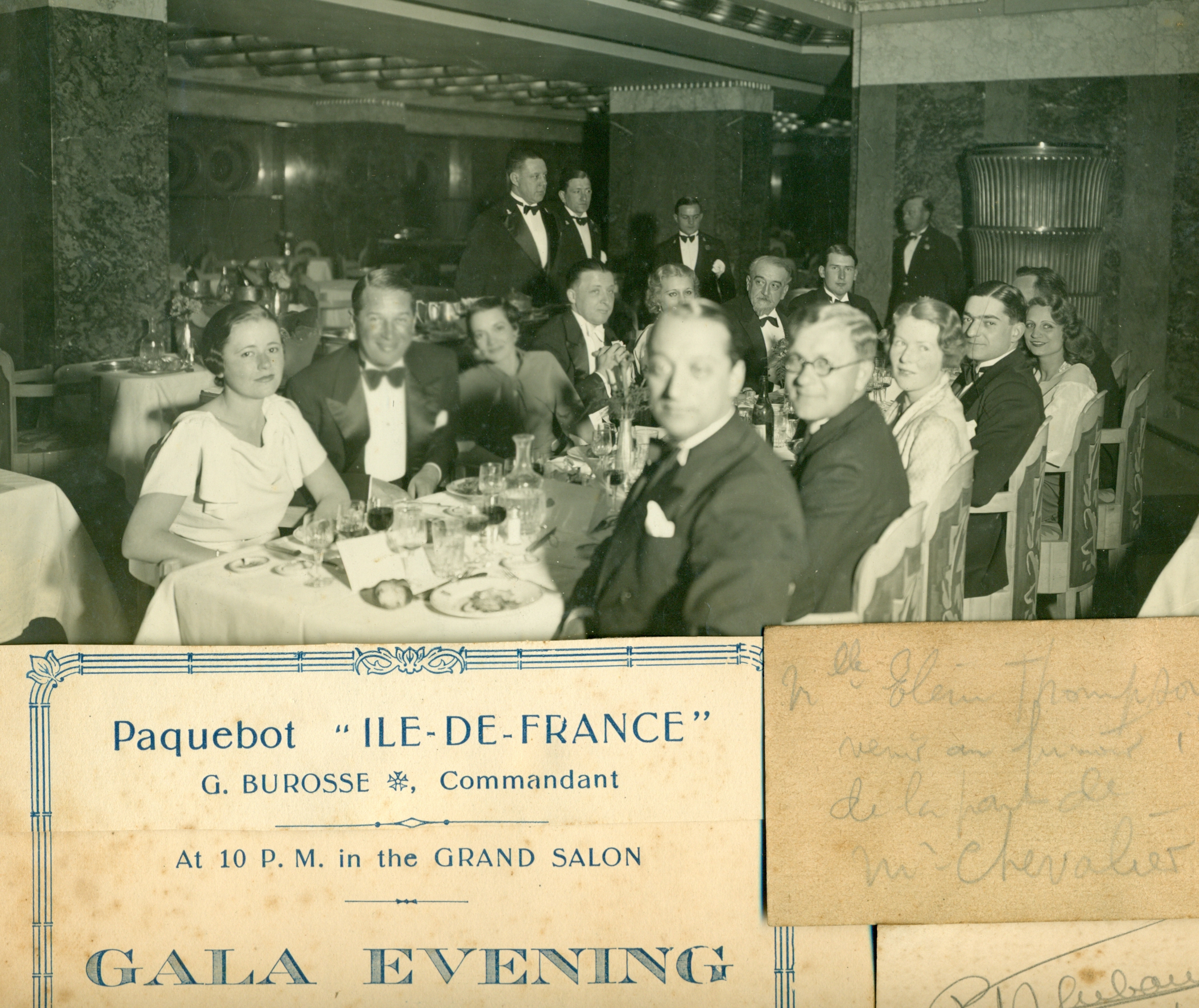
I’ve delivered the River of January talk to many groups in the last year; service clubs, libraries, and book stores. But senior facilities are fast becoming a favorite venue. The slide show and period music especially draws the older crowd enthusiastically into the story. On one particular slide, for example, a handsome man sits in the foreground, smiling directly into the camera. I like to point out this individual, identifying him as the young French actor, Maurice Chevalier. The ohs and ah’s are audible from the seats. It funny, but in other settings, projecting this same slide, the reactions are markedly different. Blank expressions seem to say “Should I know this guy?” So it is with great pleasure that I can validate this historic story with people culturally moored to the time period.
Drawing references to the past, both visually and with music means something tangible to elders. Satisfied faces momentarily lose age, wrinkles and graying hair. A child’s wonder shines from bright, animated eyes, as we share together the journey back in time to the world of Helen and Chum.
By the end of the presentation my friends at the assisted living facility treated me as an insider. These folks were in no hurry to leave and lingered long afterward to share their own reflections of years gone by. They talked of their experience using terms they believed I would understand. “Goody Goody” wafted from my cd player, serenading and livening the closing clean up. My husband tended to the packing, because I had people to visit, and stories to hear. In the glow of the presentation, accompanied by the melodies of another era, joy colored our personal exchanges, as these seniors beamed in the knowledge that indeed they, and their times are remembered.
Gail Chumbley is the author of River of January, available at www.river-of-january.com and on Amazon.

One of my earliest recollections is kneeling on the cold basement floor in our Spokane house, lining up plastic Yankee infantry against an equal number of plastic Confederates. My brother would narrate the battle that was about to break loose, building up the suspense and drama that was destined to follow. But the art and beauty of the exercise was in the meticulous preparations, lines crafted and lovingly placed by my brother, an expression of his deep reverence for the past. And our fascination wasn’t limited to the basement, but rose upstairs to the rest of the house.
Our childhood dinners consisted of meals cooked for quantity, not quality, my mother bending over backward to please her crew of picky eaters. One brother only liked tomatoes, no lettuce. Another wouldn’t eat onions, and I wouldn’t eat potatoes, (I’ll get fat!). My mother should have tossed a loaf of white bread and peanut butter on the table and said to hell with us. But in truth, our dinners weren’t ever about the cuisine. That table was a place of interaction, debate and information. And we, my parents and three brothers talked about all sorts of topics; politics, swing music, classical music, FDR, and JFK. My mother knew every actor and singer ever filmed or recorded, so popular culture also had a rich review over those dry, bland hamburgers. My younger brothers typically listened and chewed, passively soaking up the banter as a normal dinner conversation.
My childhood memories are mainly a potpourri of All-American road trips. Slides of Montana’s Lewis and Clark Caverns, the Little Bighorn Battlefield, Yellowstone Park, and Wall Drug, flash on the screen of my memory. These destinations were of such value to my folks; that they packed up a station wagon, replaced later by a truck and camper, crammed in their four noisy kids, and made many magical history tours. I especially remember standing on Calhoun Hill near Hardin, Montana, wondering how Custer missed the massive Sioux and Cheyenne encampments. Constructed in 1805 on the Pacific coast, Fort Clatsop, Oregon sheltered the Lewis and Clark Expedition. Visiting the site permitted me to physically touch this stockaded sanctuary of another time.
Wonder became permanently hotwired into my temperament.
A degree in American History came as no surprise to anyone. As in medical families, military families, or law enforcement families I followed my childhood path, nurtured in a family that treasured our nation’s history. As though I had been handed Diogenes lamp, illuminating past events became my present-day pursuit. I had to share this passion with others. This journey of discovery was not a solitary enterprise. So earning a secondary teaching certificate set my future into motion, allowing a way to disseminate the fire I felt for the past.
What a ride! I am now at the other end of my teaching career, and can honestly say that I even loved the tough days. I made a living out of being myself, constantly reinforced with a sense of liberation, and vindication. Magic happened after that tardy bell rang. And I knew then as I know now, that there was no cooler place to work than in my classroom. Who needed Hogwarts, I had Lincoln! Service projects came to life behind that door, efforts such as the Veterans Oral History Project in conjunction with the Library of Congress—fund raising for the World War Two Memorial—donations to support local history museums, and the yearly spray of flowers for the Vietnam Memorial each Memorial weekend.
And most gratifying of all was the connection students made to an earlier America. They grew beyond what they could see, feel and touch. They became more than just themselves. I can recall an essay on Richard Nixon where a girl ruled his desire to win at all costs, cost Nixon his place in history. Another student who pointed out that after Washington’s humiliation at the 1754 Battle of Fort Necessity near present-day Pittsburgh, later foreshadowed the President’s crack down on the 1794 Whiskey Rebels in the same location. The student pointed out that Washington would not be made a fool twice in the same place forty years later. Brilliant, brilliant, brilliant.
Those voila moments transcend the past to a present relevance. How Washington used his few military strengths to undermine the military strengths of the British in the Revolution. How Ho Chi Minh used those same strengths to undermine the same American efforts in Vietnam. Likewise how British violation of American trade lead the US into the War of 1812. And later how German violation of American trade lead the US into World War One. The examples are vast and instructive, processed with the same reverence and regard as my brother and his toy soldiers.
Now, in retirement, an entire archive of historic primary sources have fallen into my lap. An original story has come my way detailing a young ambitious couple who challenged the Twentieth Century and left a notable trail. I have been handed a micro-history narrative, to add to the larger picture of America. What an unexpected gift for this history addict!
Writing River of January has fed my soul. It turns out that Chum, my main character, rubbed shoulders with aviators Howard Hughes, and Amelia Earhart, and even actress Kathryn Hepburn. And from his words and records, he barely took notice of their celebrity. Helen, the other main character, knew “Red Hot Mama,” Sophie Tucker, the dashing Frenchman Maurice Chevalier, and a very young Humphrey Bogart in his first film. Those people were her peers and she rolled with that crowd on an equal footing.
This story grips my heart. I’ve was groomed from my parents dinner table to craft such a book. This Saturday missive is perhaps my long overdue expression of gratitude. I am thankful for my hardwired passion for earlier times, and how vital a role the past eternally plays. I am grateful that I value ideals, ideas and vibrant lives over material possessions . . . I will never be poor. I thank the Lord my heart is enriched by remembering what came before.
Gail Chumbley is the author of the creative non-fiction work, River of January
My computer was on the blink, and a friend came over to fix it. Sitting around the table, waiting for some curative program to download, we got to talking about all the world’s problems. Soon enough the discussion moved to kids and education. Frustrated, he had just left a math position at an alternative high school, while I had just retired after a long career in public schools. We found we agreed on many, many points. In particular he still felt exasperated by the constant refrain of, “I’ll never use this (Algebra) again. Why should I have to learn it?
Now believe me, there was a time that I would have joined the ranks of complainers, because math was not, and has never been my strong suit. Today however, I’ve changed my mind about this age old gripe, realizing it wasn’t about math at all. With new eyes I looked at my math-computer friend and answered, “You were simply trying to teach him how to think–how to use steps to problem solve.”
And that, in my humble opinion, is the essential purpose of educating young people in all disciplines.
I spent over half of my career, before retirement, teaching AP US History, and Sophomore Honors History. This accelerated teaching assignment changed my approach and my philosophy of education almost at once. Rather than listing a fountain of facts to little test takers, I instead became a trainer of thinkers.
Embracing a new sense of purpose, classroom instruction no longer meant listing chronologies of events and dates, (though these have a place in coursework) but on how to synthesis those facts into a broader, deeper, meaning. Students were required to sort through diverse pieces of information, measuring facts into a larger coherent idea, a political viewpoint, an economic trend, or an emerging social movement. Let me illustrate.
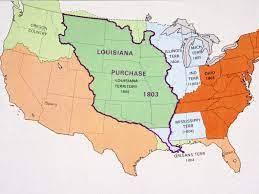
In a simple compare/contrast question the kids had to examine the expansionist policies of Presidents Thomas Jefferson, and James K. Polk. Jefferson doubled the size of America in 1803, while Polk stretched the nation to the Pacific coast by 1848.
With a line down the middle of a piece of paper, students listed every fact concerning both presidential policies. Next they examined those facts: Louisiana Purchase through a treaty with France . . . Lewis and Clark Expedition . . . War with Mexico . . . land acquisitions of the Mexican Cession . . . opening of California, the Oregon Territory, etc . . . With all that listing and sorting of facts, the students drew conclusions from the historic record.
If done properly learners were able to make some solid observations regarding Jefferson’s diplomacy in his negotiated French real estate deal, versus Polk’s use of military force with Mexico. In this exercise students also developed a competent writing style, finding a distinctive voice while crafting conclusions; a literary flair.
Eventually, kids would find both presidents wanted the same thing—western land. But they realized Jefferson’s approach was more peaceful, or more principled, and France was too powerful to provoke, while later President Polk cast aside negotiations, opting for war against a weaker foe, (or something like that).
The art of teaching critical thinking, and expository writing takes lots of discipline, dedication and tons of practice. And to be honest, some kids simply weren’t willing to take that risk, resistant to that advanced coursework. Some parents balked, believing that teachers shouldn’t ask so much of their young ones, and GPA’s were too valuable to imperil with such a tough class. I understood the hesitation; critical thinking takes a bit acquire.
And I, too, often worried and stewed over my students’ progress, often perceiving poor performance as a personal failure. I sometimes considered lowering my standards so everyone would get an “A,” and I would be their favorite teacher.
There were many tears throughout the school year, a fair share of grumbling, and resentment to the rigor. Still, by June the majority of my students had persevered, becoming accomplished independent thinkers. They had bravely risked a relentless “boot camp” curriculum, and prevailed.
To drive home their achievements, I’d ask the kids to read some of their first essays from fall quarter, and compare the writing to more recent pieces. They were pretty proud of themselves, satisfied they could take on the world. From the beginning of the year to the end, these students never realized how accomplished they could, and eventually did become.
The point is that, we, as teachers, and also as parents, must expect more from our kids beyond showing up to class, and staying awake. Young people must stretch themselves to reach those aspirations. Frankly, if we expect nothing from our students, that is what we’ll get, nothing.
As one student later confessed, “I learned my education is my responsibility.”
Gail Chumbley is the author of River of January and River of January: Figure Eight. Both books available on Kindle. Chumbley has also authored the stage play, “Clay,” and “Wolf By The Ears.”
gailchumbley@gmail.com
Doesn’t a cruise sound wonderful?!
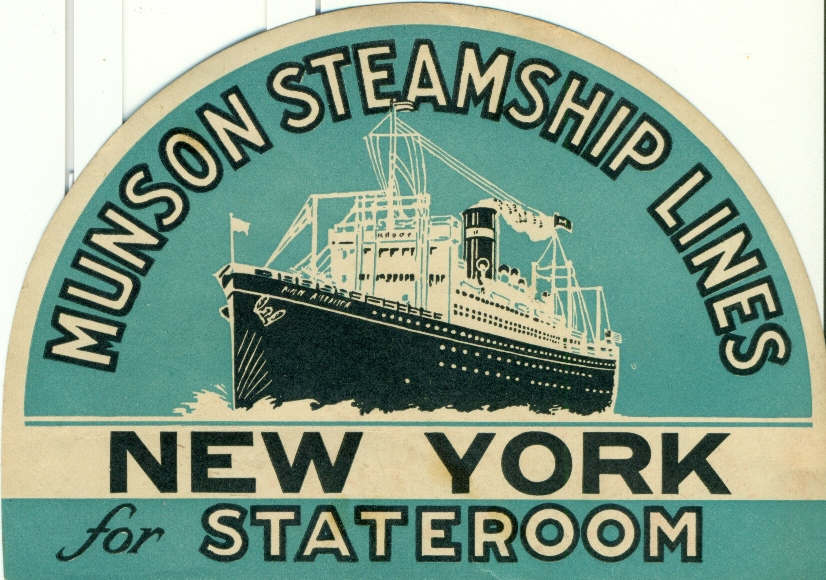
First Chum, then Helen traveled to South America via the Munson Line. A couple of names come to mind, “The Western World,” and the “American Legion.” “River of January” carries the reader back to an earlier glamorous, and wondrous world.
http://www.river-of-january.com/Need some good cold weather reading? Follow the link and relive the adventure of River of January

“Believing with you that religion is a matter which lies solely between man & his god, that he owes account to none other for his faith or his worship, that the legitimate powers of government reach actions only, and not opinions, I contemplate with sovereign reverence that act of the whole American people which declared that their legislature should make no law respecting an establishment of religion, or prohibiting the free exercise thereof, thus building a wall of separation between church and state.” Thomas Jefferson, January 1, 1802
President Jefferson did not mince his words. He drew a clear distinction between what is personal and sacred, and what remained secular and public. History had taught Jefferson that invoking the Almighty usually ended in bloody holy wars, rendering effective civil government unworkable. Of all the founders, President Jefferson grasped the importance of detaching faith from law.
If you follow my blog you already know I’m not a big fan of Jefferson. His actions, as well as his writings on race alone, provide a legacy of duplicitous thinking. For example the practice of beating young slaves daily was of no matter to the master of Monticello. But on the issue of natural rights, his Lockean take on the social contract– Jefferson’s views ring with authority.
This morning the Idaho Legislature killed a bill in committee that would “Add the Words,” (protecting the LGBT community) to the Human Rights Act in Idaho. Following three days of impassioned testimony from supporters and detractors, HB2 fell in a 13-4 vote. A significant amount of testimony came from various churches on both sides of the issue. The fearful tended toward the shrill, impassioned by their emotions. One fellow, in particular, ranted that his wife shouldn’t have to share a public bathroom with a transgender individual. He was so riled up the committee chair admonished him to control himself. His answer, “Well Praise the Lord.”
Now the Gay community in Idaho didn’t seek this fight. These folks have done their best get along in society. The term ‘closeted’ comes to mind here. The threat of eviction, job termination, and outright violence has demanded a covenant of silence. However, over time, the preponderance of social, economic, and political mistreatment has galvanized this movement for simple justice. These citizens have had enough. They ask for equal protection under the law in explicit, measurable language to deter the countless harms endured, that were so eloquently enumerated in this week’s testimony.
As a student of American History I understand this disconnect between contending factions. We are a nation founded under the tenants of the Enlightenment. Jefferson actually lifted John Locke’s language when he described ‘natural rights’ which he articulated as ‘certain unalienable rights.’ And at the same time America is one of the most religious nations in the world. Always has been. The trick is remembering to separate these two competing voices of law and of faith. Even my debate students were taught to keep God out of the tournaments. Once invoked, the open exchange of ideas is over. God has spoken.
For the longevity of the American Creed, our law makers must use their heads when shaping legislation. When kneeling to pray, worship with all of your heart. I do.
But please leave those competing, conflicting, diverse, religious convictions at the door of the halls of law. Contending voices achieve nothing but a counter productive cacophony of discord.
And next time . . . Add the Words.
Gail Chumbley is a retired history teacher and the author of the nonfiction work, River of January

 Gail Chumbley