Talk Back Wednesday

rojcover10

You’ve read the book, now share your reflections or questions.

Finish this sentence, ‘Chum’s greatest personal asset had to be . . . ‘

or

‘Helen traveled across the US and around the Atlantic world because?’

Post your responses and we’ll talk.

I would love to hear from you,

Gail

“River of January,” Oregon City Edition

Women600whelenhayes600w

             Hellooo Portanders!

Gail Chumbley presents her new work, “River of January,” Thursday, August 20th, 7:00 PM at the Oregon City Library.

Description OREGON CITY OREGON CARNEGIE LIBRARY copy.jpg

606 John Adams Street

Be grand to see you there!

This Week, 1935

IMG_0191

The old pilot’s time with us grew to mean a great deal to me, personally, but made it that much harder to let him go at the end.

Chum’s last years brought him out west to Boise. It was much easier for my husband to care for him than the semi-regular flights to Miami, sorting out some kind of preventable crisis. Once his father settled in here, they were together every day at the assisted living facility. I believe their time together gave both of them a lot of comfort.

As for Me? I just loved to sit and talk to my father-in-law. If he had felt more spry I would have dragged him into my history class for my own version of “Show & Tell.” I mean, really! William Howard Taft was in the White House the year Chum was born! His life was a damn book. (see River of January)

On one particular Sunday we drove over for a visit, and brought him Mexican food . . . Chum’s favorite. I was anxious to talk to him because we had rented “The Aviator” the night before, the film about Howard Hughes, and Chum had worked for the millionaire at one time.

Me: So we watched a movie about your old buddy, last night–Howard Hughes.

Chum: Ha. He kept the Kleenex business in the black.

Me: (Oh, geez! How could he know that?) And your old girl friend, Kathryn Hepburn.

Chum: Yeah. Katy. She was a nice girl.

Me:(Katy? A nice girl?)

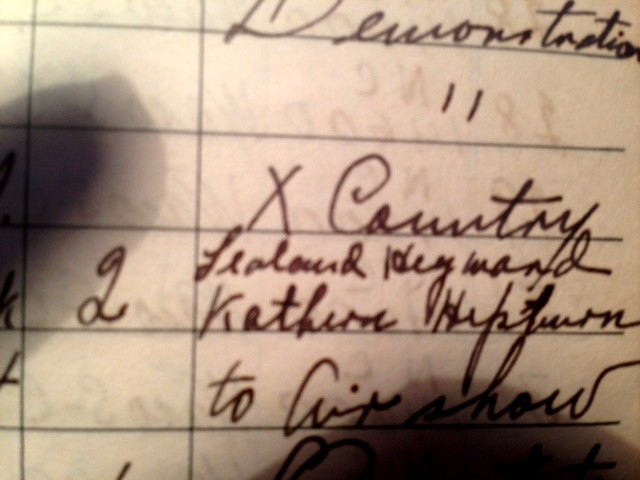
Chum: Her boyfriend, that theater producer, Leland Hayward–I taught him flying lessons, and she came along.

Me: Yeah. (Yeah)

And here it is folks, if you didn’t see at the top. The old history student has to whip out the proof. Have a nice weekend.

  IMG_0192

Gail Chumbley is the author of River of January. Available on Amazon.
That’s All

th

Colonel Clark used to bring his young son down to the dojo where my brothers took judo lessons. My grandfather had enrolled my older brother first, and then my two younger brothers when they were old enough. I sometimes came along to watch these lessons because, first of all, it was something to do on a boring school night, and I liked to look at the cute boys dressed in their gi (white gear).

My Grandpa Ray always sat with Colonel Clark, if the old gent happened to be present. That meant I sat with Colonel Clark, too, not fun for a twelve-year-old, boy-crazy girl. The two old men would talk and talk, seated next to one another, though their eyes remained on their boys training on the mats. They never seemed to look each other, but still seemed absorbed in their conversation.

My own attention span, something close to that of a hummingbird, only caught snippets of the quiet discussion. “MacArthur, Wainwright, and Bataan,” were among the many utterances exchanged by my Grandpa and the Colonel. And despite my commitment to shallow-minded teen angst, I sensed something grave, something momentous had happened in the back and forth of these two old men.

My brother later translated the mysterious conversation I unwillingly witnessed. Colonel Clark had been left on the Bataan Peninsula when General Douglas MacArthur was evacuated from the Philippines in 1942. Under the new command of General Jonathan Wainwright some 22,000 Americans surrendered to Japanese occupiers, among them young Clark. The Japanese forced this defeated army on a death march (along with their Filipino comrades) some sixty miles in the jungle. The men suffered from heat exhaustion, and dehydration, staggering on, hat-less and barefoot. When a captive stumbled, or fainted, the penalty meant an immediate beheading.

Colonel Clark had witnessed this nightmarish brutality, forced to suffer in ways words fail to recreate.

In defiance of considerable odds, Colonel Clark survived his ordeal. And that was the ordinary older man who spoke quietly with my Grandfather, watching a young son he should never, in reality, have sired.

I am a much better listener today, and recognize that valiant warriors everywhere are frequently disguised as harmless old men. Listening to these elderly gents has enriched my understanding of the past far more than I thought possible.

For example there was George, the high school janitor. For many years he pushed a mop down the halls where I taught American history. Sporting two hearing aids, this diminutive man wielded a mop that was wider that he was tall. All told, George looked like a gentle and harmless grandfather.

I’d often find George standing outside my classroom door listening to me blather on about the Second World War, as if I understood. Later I discovered that that mild mannered 80-year-old had once packed a M-1 Garand, shivering aboard one of those Higgins boats motoring toward Omaha Beach in 1944.

“So George, what do you remember most about D-Day?”

“It was awful early, and the water was awful cold.”

Then there was Roy. Smiling, white-haired Roy.

As a teenager he had gone straight from the Civilian Conservation Corps right into the US Army.

“What do you remember most about D-Day, Roy?”

“I lost everyone in my outfit. I was real scared. Later I was regrouped with survivors from other platoons. You see that was bad because I’m Mexican, and my first platoon got used to me, and stopped calling me Juan or Jose. I had to start all over with the new bunch. For days, as we moved inland, these new boys were giving me the business. One guy said, ‘Mexicans can’t shoot.’ I said that I could. So he said, ‘Ok Manuel. Show me you can shoot. See those birds on that tree branch up ahead? Shoot one of those birds.’ I lifted up my rifle and aimed at the branch and pulled the trigger.” Roy begins laughing.

“I missed the branch, the birds flew away, and twelve Germans came out of the grove with their hands up.”

Astounded, I couldn’t speak. Roy simply chuckled.

Colonel Clark, George, and Roy. They were just boys who found their lives defined in ways we civilians can never comprehend. They were scared, and hot, and cold, and hungry, and suffering, and ultimately lucky. They returned home.

That’s All.

Gail Chumbley is the author of River of January, and River of January: Figure Eight, a two-part memoir. Also available on Kindle.

New York, 1933

HOWARD-AILOR HOWARD-AILOR-SALES-CORP

“So you’ve been to see all the big boys, eh?” commented a sales representative from Long Island who was seated behind a battered old desk. Airplane distributor Howard Ailor of Waco Aircraft studied the young man’s face. “And by the looks of you they all turned you down.”
“That is about right, Mr. Ailor.” Chum responded, trying to look confident. “I was hoping you might know of something out here, maybe something at Roosevelt Field.”
“I don’t know you, son, but let me give you some advice. Don’t dawdle around hoping for that phone call. This is no economy to sit by and wait for miracles. You’ll starve first. Push your way into the air business with your own equipment, that‘s what I say, and I can help you with that. We have some beauties right here on site.”
Chum listened to the silver-tongued salesman, surprised that he agreed with all Ailor had to say.
Chum also realized that he had returned to an America deep in the throes of financial depression.
Economic life in the 1920s had played out as a frenzied, unregulated party. By all appearances the country had embraced infinite prosperity. Insider trading and other shady practices reigned on Wall Street, where market manipulators pooled cash and bought up stock, artificially driving up values. Regular folk, believing they were on to something big, bought these tainted stocks as crooked investors dumped them, reaping fabulous profits.
Indiscriminate buying, using easy credit, pumped the overblown Dow Jones to ballooning artificial heights. Even private banks joined the frenzy, wagering the savings of their account holders to increase their own bottom line.
This facade of spreading affluence ensured the “hands off” economic policies accepted in Washington. Then the market imploded. On October 29, 1929, “Black Tuesday,” the savings of a nation disappeared with the steepest financial crash in American history. Thousands upon thousands of people were ruined and the enterprise of a nation dried up.
Young Mont Chumbley had resigned from the Navy without another job, and now found there were none. The pilot’s only and best assets were his optimism, his pluck, and an old Chevy.
“Over here,” Ailor directed Chum, as they walked toward a hangar housing a red-with-black-trim Waco cabin biplane. “This baby’s a real beauty, right? We can take it up for a spin, if you like, but you can’t have this one—it’s spoken for. Still cough up a down payment and we’ll order you a new one. It’d be here in only six weeks.
“I came here looking for a job—and you want to sell me an airplane?” Chum blurted in disbelief.
Ailor continued to rattle on as though the pilot had not spoken. “Hell! I’m feeling generous. I’ll even let you rent office space right here on Roosevelt Field for a percentage of whatever you earn as you get your footing.”
Chum realized he had never encountered such a smooth operator. Ailor finally faced the boy. “Look, you can’t negotiate with reality, son. And the reality is that there are no jobs. The country’s flat busted.”
Chum knew his mouth hung open in reaction to the salesman’s bald audacity. But he also knew he agreed. Ailor was absolutely right.
Chum needed to find a way to buy that airplane. It appeared to be the only real option open to him. With little money left from his dwindling resources, he found a Western Union office and cabled his mother in Pulaski for help. He hadn’t written or visited much since joining the service and felt badly his note only asked her for money. However, Martha didn’t complain or hesitate.
“I’ll run down to our bank in town—still solvent, doors open,” she wired him right away. “A thousand, Mont? Is that enough? Where should I wire it?” Martha would still do anything to help her boy.

River of January by Gail Chumbley available at www.river-of-january.com and Amazon.com

Spud Manning

th

Only six years had passed from Lindbergh’s Atlantic flight, when Chum won the cross-country Darkness Derby in October of 1933. Public wonder and oodles of press coverage followed aviators across the country, and around the world. Pilots were viewed as rustic pioneers risking the unforgiving rules of gravity. Hustling for every penny, Mont Chumbley used his rare talent for more than business, offering lessons during the week, and moonlighting weekends entertaining an aviation-crazy public.

County fairs proved a reliable source of pocket money, and he beat the bushes to find well attended events. In good weather he could charge $5 dollars for three passes over local fairgrounds; enough for gas, dinner and a little left over for his time.

It was on today, May 16, back in 1933 that Chum flew his Waco biplane to a fair in Binghamton, New York. He traveled north from New York looking for a little fun, and maybe a few extra bucks. He hit gold that day when he met up with famed parachute jumper, Spud Manning. Now Spud was a young guy, too, and much like Chum, had to make his luck to survive in Depression-era America. So what this enterprising gent challenged, was jumping from airplanes.

With Chum soaring at 15,000 feet, Manning, harnessed in his chute, clutched a bag of flour to his chest. In his fall Manning released the contents to trace his descent. The 25 year old’s shtick was to risk death by falling until the last possible moment, somewhere around 1000 feet, to pull his ripcord. He succeeded to scare the hell out of patrons and they paid him to do it again.

Presumably Spud carried out his jump the same way on that May 16th in Binghamton New York. Leaping for profits, Spuds and Chum performed the stunt as long as it paid. Spuds leaped into the sky, likely accumulating a dusty, white face as the flour plumed up from his arms. Rolling on the ground, grappling with his chute, he jumped to his feet delighting the dazzled crowds.

That May 16th must have left hundreds of Binghamton fair goers in awe. Clear blue weather, excited customers, viewing their landscape from the Waco in three memorable passes; all capped off by the heart stopping jumps of Spud Manning.

Sadly, Chum’s afternoon associate had less than four months to live. Spud was killed that September when, as a passenger on experimental aircraft, he crashed into Lake Michigan. His body and two others washed up on shore ending a massive search over the water.

Chum clearly understood death accompanied each flight, but he loved flying more than dwelling on his fears. Presumably Spud Manning too, resigned himself to the possible price of repeated defiance to the forces of gravity.

Somehow the miracle of the sky rendered the hazards irrelevant.

Gail Chumbley is author of memoir River of January

The Outside World

My mom took a job in the early sixties with the US Postal Service. At first it was part-time, mostly needed at Christmas, but by 1966 she hired on full time. 

There were four kids, a house, and a yard, and Mom probably was pretty overwhelmed—something today I fully understand. For help my parents decided to host a student each term who attended a secretarial school in Spokane, called Kinman Business University. Lord knows what kind of credential awaited these young ladies after completion, but students did acquire skills such as shorthand, typing, filing, and other tasks.

The first girl who who came to stay with us was named Corrine. I can’t remember exactly the year, most likely around 1965 or 1966. I was in fourth grade. 

Corrine came to us from Alaska, and I remember she told me she was part Filipino or Native American, or both. I thought that pretty cool, Corrine to me symbolized the wonder of the outside world. 

Our house was constantly in a state of chaos, with quarrels, messes, a blaring TV, with people coming and going—chaos. But to walk into Corrine’s small quarters felt like a completely different world. All of her things were neatly stowed away, her bed carefully made, and the space even smelled differently than the rest of the house. I loved visiting her room, as it felt like an oasis of tranquility in a sea of crazy disarray. And it was in her little sanctuary that serene Corrine shared her life with me just a little.

A picture sat on her dresser of a boy. When I asked who he was, she told me his name was Ty, and that they planned on getting married in a few years. Married! I never knew a girl who had plans to get married! The only people I knew who were married were parents, and they were boring. 

He was called Ty, short for Tyrone, and he was visiting Spokane soon. Ty had received his draft notice and following basic training in the Army, he would ship out to a country called Vietnam. Corrine clearly missed him very much, and was anxious to see Ty before he flew to Southeast Asia.

My memories of his first visit are a little vague. I do recall that they sat on the couch in our living room and held hands in front of my parents. That moment struck me as fascinatingly real. 

Looking back I am sure that there were much deeper emotions at play, but whatever vibes filled the room zoomed over my 10-year-old radar.

And then Ty was gone.

The school term ended, and Corrine packed up most of her things and returned to Cordova for the summer. I’m not sure of the details or decisions, but she did return to us the next fall. Once again her room became that wonderful respite from the anarchy of the rest of the house. Ty’s picture again graced her dresser. 

Letters began to arrive to our house written on onion-skin parchment, marked AIR MAIL, bearing Corrine’s name. I’d never seen stationary like that, and she explained that was the cheapest way she and Ty could exchange letters. The paper was light blue, and felt like stiff tissue, but held its shape without creasing. Corrine had stacks of it, both fresh and received—the only sign of clutter in her neat little world.

Finally Ty came back to our house, and this visit was very different from the first meeting. The couple did not sit on the couch and hold hands. Not this time. My pre-teen sensibilities were shocked to see a grown man lying across her lap on the couch sobbing like his heart had broken. 

Poor Corrine! She, too, was dissolved in tears; red, puffy eyes behind her glasses. Ty couldn’t seem to help himself,  or compose himself, and he wouldn’t let go of her. The whole situation felt very surreal. I didn’t understand. How could this orderly girl, and her once orderly fiancé come apart like this, and in front of all of us?

That chapter occurred a very long time ago. My mother still worked, and there were other girls we housed. Still sweet Corrine and Ty live on in my memory as if only yesterday.

I grew up, went away to college, earned a degree in American History, becoming a teacher. 

For years and years I taught a unit on the Vietnam War to high school juniors. I recited the facts surrounding America’s entrance into that long, long, conflict. But in all my experience with those lesson plans, the veterans who visited my class describing their personal war, the analysis by historians we studied, nothing affected me more than the tragic transformation of that broken young man from Alaska.

Gail Chumbley is the author of the two-part memoir “River of January,” and “River of January: Figure Eight.”

Chumbley has also authored two stage plays, “Clay” on the life of Statesman Henry Clay, and “Wolf By The Ears” an exploration of American racism and slavery.

gailchumbley@gmail.com

Polyphoto International

Polyphoto2

While composing “River of January,” I spent much of my time searching and analyzing family papers. These letters, pictures, and news clippings, along with other souvenirs, make up an enormous archive which spans over seventy years of the twentieth century. Along with Chum and Helen, many secondary individuals are mentioned in the papers, and when I stumbled upon those names, curiosity sent me on the hunt for more information. One of the characters who rose from the stacks was a proper young Belgian named Elie Gelaki.

Elie made quite an entrance into Helen’s life, and subsequently into the pages of “River of January.” His romantic introduction into the story is reminiscent of a 1930’s Hollywood musical. While taking in the premier of “Voila Paris,” at the Palace Theater in Brussels, Elie spotted the girl of his dreams gracing the stage in a solo act. Apparently the smitten young gent quickly scanned the playbill and decided that the girl must be the dancer named Lillian. In an impulse of ardent infatuation Elie sends a note back stage to Lillian inviting her to meet him after the show. Alas, Lillian doesn’t respond and fails to appear at Elie’s appointed location.

The following night the resilient young man again attends the production. Again he watches, thoroughly enchanted, by the vision that is, he thinks, Lillian, Insistent in his attentions, Elie, this night sends flowers and a typed letter composed earlier that day. Again he implores the dancer to rendezvous at a preselected spot. And happily for Elie, this time she materializes out of the dark snowy night.

The girl seems, Elie notices, amused somehow by his attentions. Then he finds out why. The dancer he believed was Lillian in fact was Helen, and that Lillian had a boyfriend back home, in New York. He is embarrassed by the mix up, but more than that, Elie is charmed by the American girl. After drinks at a late night cafe, he asks to see Helen the following day. And so began the courtship of Elie Gelaki with the breathtaking blonde from New York.

Bringing light to this man, lost to anonymity was an true pleasure. Searching through the volumes of primary sources and the internet, I discovered Elie was born in 1906 in Palestine. Further research, this time reading his avalanche of correspondence (to Helen) revealed that he supported two sisters and a mother in Brussels. Elie proudly shared with Helen his deepest ambition as a businessman, founding a company he intended to expand around the world. He had named the firm, “Polyphoto International,” and confidently assured her that the unique processes he developed would change professional photography forever.

I have thought a lot about this enamored young man, (he was only 28 when they met) and I have ransacked the archive many, many times looking for any picture that might be this steadfast suitor. I’ve never found one. His letters were so loving, so personal, that I had to ask myself why Helen, who kept every other slip of paper had no picture of Elie.

He actually complained about this scarcity as well.

In 1936, four years after they met in Europe, Elie writes Helen in New York begging her for an updated photo. He laments, “If it weren’t for the one (picture) you gave me Brussels, I would have forgotten what you looked like.” Apparently the shortage went both ways.

I had to ask myself why? Why would Helen go out of her way to omit “Elie pictures” from her vast collection of mementos? Then I chanced upon a letter Helen sent to her mother in the middle of her 1932-33, European tour. She goes out of her way to assure her mother that she would never marry a Jew. Now this might sound harsh to modern ears, but I think that Helen felt torn by her denial and his Jewish heritage. From current family members who knew Helen, she once admitted she had a “thing” for Elie, using the word “heartthrob.”

At the time she met the young man, antisemitism was on the up tick, and not only in Europe–but in America as well. What I believe pressured Helen to write such things, was placating her mother. Any single girl worth her salt knows what to say to mother when it comes to “boys.” For Helen, at that time and that place, a rejection was much easier than the truth. And her words belie her actions. She must have given the young man reason enough to continue his amorous pursuit for four long years. He pursued Helen across the world . . .  and by the end of the book, across two oceans.

This continental gentleman, this Elie Gelaki, carefully, and thoughtfully laid out his future. He aimed to achieve financial success in the business world, and he aimed to make the American girl his wife. He wrote her constantly and sailed over the Atlantic to see her when he could. In “River of January” the last readers hear from Elie is in a letter from Kobe, Japan, dated 1936. He explains to Helen that “I hope to conduct Polyphoto business in this city, (Kobe).” And that is it, he is gone. Elie just vanishes.

I know, and readers understand, that all of his plans and dreams and hopes and ambitions mattered not a bit. A war is coming. A war of explosive magnitude, fueled by hate and violence and war crimes. A war against the Jews. Elie’s individualism, his personal ambitions, his entire world was devastated in the massive cataclysm of World War Two.

Uncovering this young man left me troubled. I felt as if Helen had been compromised, as were so many others, to sacrifice her natural regard for the young man in order to conform to conventional thought. Though only an episode in the bigger picture of “River,” this ardent suitor, this diligent businessman, deserves the dignity of recognition and remembrance.

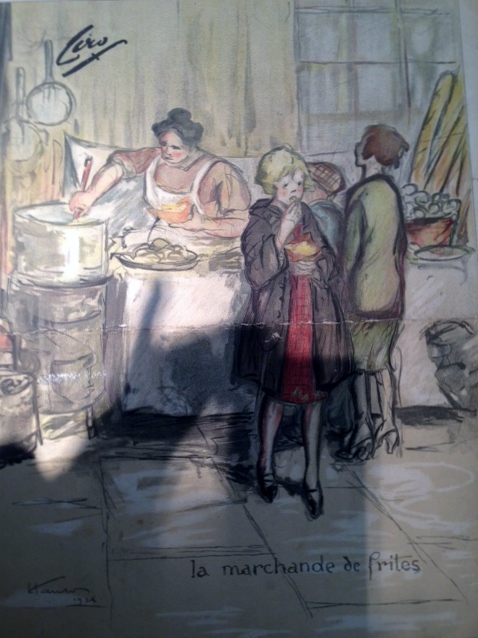
La marchande de frites

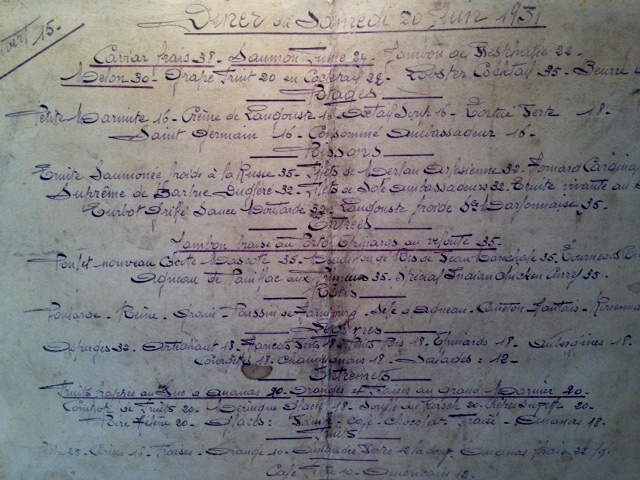
la marchande de fritesThe time was August, 1932. The place was Monte Carlo. This little gem is a menu from an eatery patronized by Helen and her fellow ballerinas, the “American Beauties.” Though the cover is a print, the interior meal selections were meticulously   penned in an ultraviolet flourish.

Helen collected a dozen or so such menus on her year-long excursion; pocketed from bistro’s, pubs, and cafe’s across Europe.  It is hard to say if management frowned upon this custom, or offered menus willingly for advertising purposes. Regardless, the simple beauty of the artwork and flowing cursive recalls a commitment to elegance and style long since abandoned.


la marchand menu

Gail Chumbley is the author of River of January, a non-fiction memoir.


The American Gentry

Please permit me to reintroduce these four figures from America’s antebellum period.

Thomas Jefferson, best recognized as the author of the Declaration of Independence, the third president of the U.S., and the man behind the purchase of the Louisiana Territory in 1803.

Andrew Jackson, the celebrated hero of the Battle of New Orleans, noted Indian fighter, and seventh president of the U.S.

John C. Calhoun; Congressman, turned Senator, from South Carolina, who served two separate administrations as Vice President.

Jefferson Davis, a former soldier in the Mexican War, one-time Secretary of War, and later President of the Confederate States of America.

All four of these men avidly pursued political careers, embraced the social norms of their era, and all hailed from the Old South.

Ironically if one found the courage to ask their occupation, none would have mentioned politics. Instead, to a man, all would have replied, “I am a farmer.”

To modern ears that curt answer feels a bit disingenuous and profoundly understated. However, in the early nineteenth century, exercising dominion over large tracts of land, and cultivating crops as far as the eye could see, was considered the most noble and honorable of pursuits. In keeping with carefully practiced manners, one politely, and tactfully left unmentioned, the reality that hidden among the hogsheads of tobacco, the bales of cotton, and bags of rice, there germinated a mightier harvest of exaggerated superiority, violent racism, and self deception.

The truth was these politicians were all slave masters; lords of the lash, who derived a living “wringing their bread from the sweat of other men’s faces,” (as Lincoln so eloquently described). These four also minimized the financial underpinnings which afforded each man’s elevated social standing; for any talk of the dark brutality behind their “greatness,” was simply not discussed in genteel society. Each cavalier capably hijacked, and effectively distorted  American virtues, such as the ideals of freedom and the social contract to suit their own ends.

No central power held any authority over their personal affairs and conduct.

The maestro of this sophistry was Thomas Jefferson. Proffered as the “Sage of Monticello,” Jefferson brilliantly articulated a vision of America where all lived freely, untouched by the outside world, upon private acres of liberty, immune from any overreaching government. Occasionally those noble scions of property did assemble together to establish necessary laws on general issues; infrastructure, property disputes . . . common needs beyond plantation boundaries. For Jefferson, his fellow planters were “natural aristocrats,” the only power qualified to decide what mattered most. Only this paternal elite knew best what constituted the common good for lesser members of the community.

After the regrettable passage of a clearly unconstitutional law, the Sedition Act in 1798, Jefferson jumped into action against the Adams administration, authoring a tract titled the “Kentucky Resolution.” This position statement, submitted to the Kentucky Legislature, introduced the concept of ‘nullifying’ Federal law. The idea was simple. If a majority of delegates, assembled in special convention, renounced this Federal statute, the law was rendered null and void within the state.

For the first time, in one pivotal moment, Jefferson’s insidious principle found its way into the fabric of American politics, but found no traction in surrounding states . . . at least not yet.

Away from public scrutiny, Master Tom held sway over some 600 slaves, and fathered six children by his deceased wife’s half-sister—a slave—Sally Hemings. According to plantation records meticulously scribed by “the Sage,” himself, regular whippings, especially of young male slaves were scheduled, performed, and unquestioned. Jefferson understood slave labor required obedience, and obedience was assured only through violence. Apologists have argued that Jefferson felt troubled by such practices and attempted to lay blame in the nation’s colonial past. Yet he did nothing meaningful to end this tortuous practice, even when he could. Emancipation would have simply been his ruin.

And it is that legacy of deception–Jefferson’s cries for personal liberty versus the cries of the enslaved–that shaped his politics. The human nightmare Master Tom inflicted on his people laboring upon his lands was nobody’s business but his—and Jefferson’s aristocratic peers shared that same view.

Andrew Jackson interestingly enough didn’t care for Thomas Jefferson. As a young Congressman, then Senator from Tennessee, Jackson realized he couldn’t remain seated through all that talking and rules of procedure required in law making. Jefferson, in return, thought the brash young man a tad impetuous and well, nuts. But both planters did share in the same world view, “What happens on my plantation stays on my plantation.” Jackson too, was a ferocious master who answered to no law, but his own. A merchant in both horse and slave trading, Jackson dueled any who questioned his honor, supervised cotton production on his fiefdom (The Hermitage) and eradicated indigenous peoples on lands Jackson saw as better suited for more cotton production.

To Jackson’s credit he did not attempt any pretense of civic virtue, or learned philosophy.

When elected in 1828, President Jackson exercised a different style. “Old Hickory” governed very efficiently without any of the political nonsense of protocol or formality.

Even Supreme Court reverses proved no obstacle. Chief Justice John Marshall ruled that the Cherokee Nation, et al, could remain on their ancestral lands in Georgia. Unimpressed by the judicial decision, Jackson cynically carried on ordering the military to remove the tribes from the state. The President knew the land in question was broad, and fertile; perfect for plantation crops. Plus gold discoveries in the same region put paid to the inevitable, accelerating a massive forced death march known as the Trail of Tears.

In another episode, Jackson, finding himself formally censured by the Senate (for vetoing the re-authorization of the Second Bank of the United States) used his considerable influence to have that rebuke expunged from the Congressional Record. His overly exaggerated sense of honor demanded that Jackson demand that this official insult be eradicated.

In a candid moment Jackson later confessed his only regrets as president was not hanging the Senator behind the censure.

Jackson injected a petty impetuosity to national politics unrivaled until today’s shenanigans. And though Jackson’s enemies christened him “King Andrew I,” his unilateral style did not derive from any monarchical notions. Rather, the President’s conduct came from his background. Jackson was accustomed to being obeyed—he was Master Andrew, a member of the planter class.

Before Senator John C. Calhoun of South Carolina soured into a states’ right’s militant, his political outlook had been national in scope. With unusual clarity, young Representative Calhoun once confessed that slavery was a “necessary evil,” vital to South Carolina’s prosperity. Over time he married a wealthy Charleston cousin, elevating his standing and political authority in Southern society. Calhoun began renovations on Fort Hill, a plantation in the uplands of South Carolina, which, with his new wife, cemented his bona fides as a member the ruling class. This ambitious politician had truly arrived, assuming the role of gentleman, influential political figure, and a prominent slave master. Much like Monticello, Fort Hill was an ever-expanding operation, endlessly improved using the same teams of slaves that tended his fields.

However, in a series of unforeseen reverses beginning in 1828, Calhoun’s political prospects declined.

This self-made politician-planter coveted the highest office in the land. Calhoun had served as Vice President under both John Quincy Adams and Andrew Jackson, and viewed his ascendency to the White House a natural next step. Yet circumstances played out beyond his control. These events aren’t exactly pertinent to this essay, but look them up. Interesting stuff.

Bitter, Calhoun resigned the vice presidency and returned to Fort Hill an angry man. His stance on slavery changed as well, leaving him vitriolic and defensive. Under increasing pressure from growing abolitionist criticism, Calhoun, speaking now for the entire South, adamantly insisted the institution was not evil, after all, but instead a ‘positive good.’

When a high import tariff was passed by Congress, Calhoun defiantly announced South Carolina would not collect this “Tariff of Abominations.” Moreover, the angry former Vice President organized a state convention to nullify (remember Jefferson’s Kentucky Resolution?) the Federal law. With Calhoun’s newly minted militancy, the former Vice President defiantly stood his ground.

President Jackson did not suffer Calhoun’s impertinent challenge lightly. As another slave master, he bluntly threatened Calhoun in terms both “gentlemen” understood—the president personally guaranteed Calhoun’s thrashing. Fortunately this particular crisis was averted by cooler heads in Washington, postponing the curse of fraternal bloodshed for a later generation.

But the question of states’ rights, local control, and the sovereignty of the master class merely continued to boil. Nullification bloomed into full secession by 1861 after decades of discord. No longer did the planter class tolerate insults or challenges to their natural preeminence and power. South Carolina, (Calhoun’s home state) became the first of the eleven to secede from the Union on December 20, 1860. Delegates attending the state convention did not wait for the final electoral college results, to reject the victory of nationalist Abraham Lincoln as president. So enraged were these aristocratic lords, that Lincoln’s name did not appear on the ballot in most southern precincts.

I’ve added Confederate President Jefferson Davis to this piece because of his later role in perpetuating the genteel myth of the Southern aristocracy. After battles and bullets finally settled the supremacy of the Federal government, Davis, released from jail began a writing career. He penned first, The Rise and Fall of the Confederate Government, followed later by A Short History of the Confederate States of America. In both of these works, Davis revisited the events leading to secession, briefly described in this essay.

Rehashing Constitutional debates from the Philadelphia convention, Davis insisted that the States existed before the Union, thus could leave whenever the Feds no longer acted on their behalf. Reiterating this view in both volumes, the defeated Secessionist defended the South’s righteous justification in standing up to tyranny. Davis repeatedly echoed the virtues of States’ Rights, nullification, and local political control. Sadly for our nation’s history, Jefferson Davis had not only the last word, but also the lasting spin on the noble myth of “The Lost Cause.” Oh, and this is significant—Jefferson Davis was a planter as well, the master of “Brierfield,” a plantation near Vicksburg, Mississippi before the onset of the war.

For this student of history, the bandying about of terms like “States Rights,” “nullification,” and “secession,” coupled with an unending vilification of the Federal Government brings me pause. This fanciful yarn was only concocted as an appealing cover for a legacy of hubris, power, greed, hate, racial exploitation, and violence.

This essay closes with no examination of the State’s Rights’ issue in the Twenty-first Century. Modern history most certainly has much to lend, especially regarding the Civil Rights. The point of this effort, rather, is to shed light on a dominant enduring political influence. This venerable lot is not only vibrantly alive, but has left a tradition of chaos, intransigence, and gridlock. And this crowd has no intention to cooperate or compromise.

And I must confess when Representative Joe Wilson, a defoliant-resistant sprout from South Carolina shouted, “You Lie,” to President Obama, on the occasion of his first State of the Union address, my Nationalist-leaning blood froze. Though no longer permitted to inflict public whippings, or issue challenges to duels; the outraged indignation of America’s antebellum period roared across the House Chamber. On that cold, historic, January night in 2009, the master’s voice thundered once again.

Gail Chumbey is the author of River of January.