The Final Straw

The September 11th attacks in 2001 got our school year off to a strange start. There was, of course, the horror, and a lot of unplanned discussion about the Middle East. The course I taught covered Early American History through Reconstruction, and I couldn’t afford to take a lot of time to debrief. Nonetheless, the events of that day provided useful lessons that surfaced later in the year. 

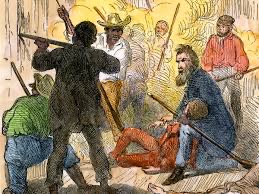
By the following Spring the curriculum arrived to the series of calamities that led to the Civil War. The last compromises crumbled, and blood had spilled at Harpers Ferry. The story then turned to John Brown, God’s Avenging Angel, determined to slay slavery. 

Brown is a complicated figure, believing he had been chosen by the Great Jehovah, to draw the sword of mighty justice.

And a debatable issue offered itself.

The link to Brown and 911 suspect, a French-Moroccan terrorist, Zacarias Moussaoui, centered on jail time. Moussaoui’s trial was underway and came up in class discussion.

John Brown had been captured in Harpers Ferry, after a standoff with Marines under the command of Colonel Robert E Lee. Intending to spark a slave insurrection, Brown and his raiders, including his sons had occupied the Federal arsenal in that river town. But once the military arrived the old man subsequently surrendered. 

As Brown awaited trial in Charles Town Virginia, the Governor, Henry Wise permitted reporters from Northern papers to interview Old Brown. To the press, Brown passionately defended his cause, insisting it was the work of righteousness. Newspaper readers throughout the North responded with support and compassion, gathering disciples for the cause of freedom.

However, in the South, the old man’s name was reviled. Viewed as a criminal below the Mason-Dixon, Brown was vilified as evil incarnate, hell bent on inciting slaves to murder their masters. Military training increased across the South, in preparation to defend their “peculiar institution.”

John Brown’s raid is often seen as one of the final straws, aside from Lincoln’s election the next year, leading to secession and a force of arms.

Prior to of horror of 911, Zacarias Moussaoui was detained in Minnesota. His immigration status apparently had irregularities, and his flight school enrollment tripped some security wires. At his trial, Moussaoui put on a noisy show, acting as his own attorney, and pitching frequent temper tantrums in the courtroom for all to see, including journalists. Initially the accused insisted he was innocent, then later confessed. Quite the circus.

During and following the conviction of the terrorist, Moussaoui demanded the judge permit him access to the press. The French terrorist had his side of the story, and he wanted to air his grievances on a national and international platform.

The judge said no. And Moussaoui today is a lifer, quietly incarcerated at Super Max in Florence, Colorado, and barely a footnote in history.

The significance of this complicated, and controversial comparison? Surely the Civil War would have transpired regardless of Brown; slavery was inconsistent in a nation that professed liberty.

But that fifteen minutes of notoriety can produce real dangerous blowback.  

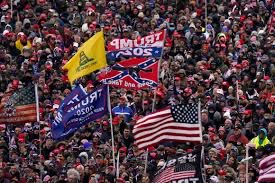
In light of the events on January 6th, thank the Lord DJT is grounded from social media.

Gail Chumbley is a history educator and author of the two-part memoir, “River of January,” and “River of January: Figure Eight. Both titles on Kindle.
A Rare Topic

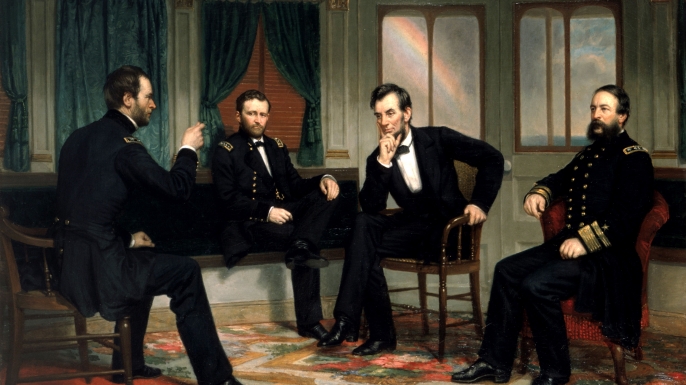
Lincoln, Grant, Sherman, and Gideon Wells aboard the River Queen, 1865

Watching a news host and guest discuss the topic of America’s Reconstruction era, my ears perked up, so rare is this matter presented. 

First of all, Reconstruction was the difficult period following the Civil War. The battles had ended, and the victorious president dead at the hands of an assassin. A new Battle Royale between Congress and the new President, Andrew Johnson, erupted over who would direct the aftermath. 

The thrust of the cable conversation centered on how important this time period remains, and that schools need to teach it. Much like Flo in the insurance ads, I started yelling at the television that I did cover that period, dammit. We all did in my department.

President Lincoln, before his death, had considered the role of newly freed persons as a moral imperative. Subsequent to the Emancipation, he had pushed for passage of the 13th Amendment, as dramatized in the film, “Lincoln.” Throughout the last months of the war Lincoln had revealed his vision of restoring Southern States. Based on the 1860 election records, when 10 percent in the rebellious states swore a loyalty oath, each state could reform their constitutions recognizing the abolition of slavery. President Lincoln believed he possessed the power to pardon, and he would make full use of that Constitutional power. 

Legally speaking, President Lincoln viewed secession as an attempt to leave the Union, and that attempt had failed. The Chief Executive would pardon the ring leaders, and move on to rebuild the nation. But his political opponents, the Radical Republicans, under the leadership of Congressman Thaddeus Stevens, and Senator Charles Sumner, saw the situation differently. 

For these abolitionists punishment was the order of the day. The 1864 Wade-Davis Bill mandated 50% plus of 1860 election rosters took that loyalty oath. To Stevens, Sumner and the like, these Rebel states had committed political suicide. Only after that majority swore the oath, including recognition of the 13th Amendment, would Congress consider readmitting each, as if new states. 

A political fight was brewing as to which branch held the reins to mend the nation, and deal with the lot of Freedmen.

The short answer is Lincoln’s death derailed any compromise. The Radicals held the day, and Southern whites would suffer. And Andrew Johnson was no match for an angry, determined Congress. In 1867 Federal forces occupied the South in political districts. Soon after, the Legislative Branch attempted to impeach the hapless new president. 

Though the 14th Amendment guaranteed citizenship to the newly freed, and the 15th guaranteed the vote, northern opinion drifted into apathy. Enforcing the rights of Freedmen lost popularity, and dropped from the headlines.

The Old South reasserted traditional apartheid rules.

The cost for the newly freed? Desperate people wandered back to the old master. With no protection, lynching became common as domestic terrorists spread fear. Rights of citizenship went unenforced, with sharecropping and the crop lien system replacing legal bondage. 

Perpetual debt chained workers to the land as effectively as if slavery remained legal. 

Poll taxes, vagrancy laws, and literacy tests tyrannized the newly freed, as did threats of violence from the Klan, and the Knights of the White Camelia.

In 1876, Republican Rutherford B Hayes barely won the presidency in a tight election. His campaign officials cut a deal with three Southern electoral delegations. Florida, (of course) South Carolina, and Louisiana. These states agreed to direct their electors to vote Republican, and in return the Hayes people promised to withdraw the bluecoats. Free Blacks were abandoned.

All in all, the promise of liberty lay in ashes.

When the moment arrived for equal justice, the cause died due to a lack of interest.

The cable host and his guest were right.

Gail Chumbley is a history educator and author of the two-part memoir, “River of January” and “River of January: Figure Eight.”

gailchumbley@gmail.com

The Bloody Shirt

Principled soldiers of conscience, the victorious army knew they had served well, defending the Constitution to the last full measure.

May of 1865 witnessed Washington’s Grand Review of the Union Army. Smartly uniformed soldiers filed past crowds, in a river of Union blue. The guns had silenced a mere month earlier at Appomattox, Virginia; the Republic preserved.

A brilliant sun glinted off polished bayonets, and the parade route decorated with miles of silk banners, tattered company colors and patriotic bunting. Rejoicing greeted the passing soldiers in shouts and fluttering handkerchiefs. Flower petals rained down in a fragrant carpet of gratitude. 

The bloody war finally, truly, had ended. 

One year later, near Springfield, Illinois, a group of veterans established a fraternal association, the Grand Army of the Republic. The idea caught fire nationally as other veterans founded their own local chapters; a place men could remember, share, and grieve for lost friends. Soon these war horses got busy extending their service to those they had defended.

First, survivors lent aid to disabled fellow veterans, assistance to widows and their dependents, and orphan homes. Soon preserving battle sites added to the group’s outreach. Before long members began seeking electoral office to further serve the nation.

A story has it General Benjamin Butler, now a Congressman, grew extremely agitated while speechifying, and produced a torn, and bloody shirt he claimed came from the battlefield. Soon the practice of “waving the bloody shirt,” invoking war credentials, became customary for candidates. The saying “vote the way you shot,” launched the careers of numerous politicians. 

Presidents from Ulysses Grant, (1868-1876) through William McKinley (1896-1901) had faced the rebels on the battlefield.*

War memorials and monuments mushroomed, funded with GAR donations. Reunions, benevolent societies, veterans homes, and hospitals kept local chapters busy. In fact, much of GAR efforts were eventually assumed by the Federal Government, particularly pensions for those who had served.

Over time survivors of the Civil War dwindled in number. However, the organization soldiered on until 1956 when it finally faded. Loosely related, though more a coincidence, our last five star general was serving as president when the GAR closed its doors. President Dwight David Eisenhower, who kept a farm in Gettysburg, happened to occupy the White House.

This brotherhood, this Grand Army of the Republic, rose to defend our democracy in the mid-19th Century. This model of valor, and sacrifice shaped the character of the military for years to come. 

But one truth is quite clear, no officer ever advocated for a coup, and there was not one sucker or loser in their ranks.

In 2021 we can do no less.

*Chester Arthur served in the New York Militia, Grover Cleveland did not serve.

Gail Chumbley is a history educator, author and playwright. Her two-part memoir, “River of January,” and “River of January: Figure Eight,” are both available on Kindle.

gailchumbley@gmail.com

The Arrogance of Now

Each year I prepared for two major wars, the finale if you will, of second semester US History. With a combined sense of dread and anticipation, I led the kids through the causes, and progression of the Civil War (with 10th graders), and WWII (with my Juniors). 

A lifetime of study in these eras, especially Antebellum America, tells an anxious story, as two passionate belief systems came to blows. Sophomores learned that our nation, a democracy born in such promise, plunged into the abyss over America’s original sin, slavery.

Meanwhile, for Juniors, the failures of the uneasy peace that followed WWI shaped a broader corrosion. The world after 1919 disintegrated into deadly factions, underscored by exaggerated entitlement, racial hate, and lust for revenge.

Much like America’s 19th Century plunge into the breach, the 20th Century also debased human life, sliding into scapegoating, unthinkable cruelty, and massacre. This record is hard to face, let alone study. 

Real monsters masqueraded as heads of state; Stalin, Hitler, Mussolini, and the War Lords of Japan. All, to varying degrees, convinced regular people that the “worth” of others was suspect, and targeting civilians an acceptable strategy. Yet, as awful as both conflicts were, it’s hard not to stare, and to hopefully recognize the signs when hate again emerges as a justification for horror.

The heresy of exceptionalism, normalizing violence on the vulnerable, and extremism, unleashed evil on the world. Andersonville Prison, Fort Pillow Massacre, the Rape of Nanking, Bataan, the Warsaw Ghetto, and death camps. More than one a student wondered aloud, how could that happen?

In increments.

These signs are clear again. Those same pre-conditions have resurfaced, right now, here in our communities, states, and nation. 

A white nationalist parade in Charlotte that kills one, where there were “good people on both sides.” Normalized daily murders of people of color, and incendiary rhetoric that ends with an attack on the US Capitol, killing five. All offenses excused and minimized by a once great political party, that has forsaken its moral underpinnings. 

The only difference between the Proud Boys and the Brown Shirts is the Brown Shirts didn’t wear Carhartt and flannel.

This endless playlist has looped over repeatedly, cursed by the “blind arrogance of now.” But dear reader, now is then, and deluded people do not change with time. The descent into barbarity is more predictable than exceptional. 

When reasonable folks are manipulated by the chorus of the Big Lie, the era doesn’t matter. Society inevitably falls into depravity.   

Gail Chumbley is a career history educator, and author of the two-part memoir “River of January,” and “River of January: Figure Eight.” Both titles on Kindle.

gailchumbley@gmail.com

Vision

Along Highway 55, northwest of McCall, Idaho, lies a stretch of highway winding through breathtaking mountains. The terrain tinges a powdery blue, set against traces of white from the previous winter, while the Payette River churns beside the roadway. This route isn’t fast, but the scenery more than compensates for the slow pace. 

After a steep descent from the mountain town, the highway straightens and a number of cabins and trailers are visible. Trump signs abound, (not unusual) along with flags emblazoned with Don’t Tread On Me or, the black, blue, and white version of the Stars and Stripes.

One particular double-wide sits near the highway’s edge, where bikes and snowmobiles sit forgotten in the tall grass. Passing that property always catches my eye. Cemented between the gravel shoulder and the dirt driveway stands a mailbox bearing the Confederate flag.

The irony of that dated symbol on a rural mailbox, is that the Confederate mail system had actually broken down by the end of the Civil War. Any Rebel correspondence between battle front and home became haphazard at best. Often soldiers, who were able, walked letters home for their comrades still fighting in the field.

At the same time, the Northern mail system witnessed an important innovation. The grim number of Union dead, posted publicly in northern town squares, grew too long for privacy and decency. Families had been forced by circumstance to endure their devastating losses in the company of an entire community, an unseemly breach of 19th Century etiquette. Congress responded to this situation by requiring mail delivery to be private, sent to each home.

Needless to say, that stenciled mailbox, standing along the highway struck me as absurdly ironic. Those in our state, who peddle in conspiracy and fan contempt for the Federal Government, would collect no mail, nor enjoy any other public-funded service.

An expansion bridge those residents must cross to reach Boise, was constructed by agencies of FDR’s New Deal back in the 1930’s. The forest fires that increasingly threaten that little enclave of homes, are fought through funds from the Department of the Interior. 

More national programs underscore the paradox of that small protest of painted aluminum. Flood control, WIC nutrition, Title 1 Education funds, Medicare and Medicaid, all making life better for those residing in that remote, road-side residence. 

The South lost the Civil War because intractable people and their leaders lacked both organization, unity, and vision. These “dissatisfied fellow countrymen” to use Lincoln’s phrase, understood only grievance and fury. For example, hard-pressed Jefferson Davis in Virginia could not persuade the Governor of Georgia to dispatch fresh reinforcements to stave off Robert E. Lee’s ultimate defeat. 

In the end, the politics of simmering outrage and division is unfocused and unproductive. State leaders who promote incendiary hogwash for short-term gain, leave followers pointlessly aggrieved, and easily manipulated, exactly where agenda-driven politicians want them. And this pressure-cooker style of propaganda and defiance quickly deteriorates into blind violence, destroying much of what Americans wish to preserve. (January 6, 2021 comes to mind.)

So express yourselves, my fellow Idahoans, let your freak flags fly. Though emotions and symbols do not violate federal law. However, if political leaders agitate an overthrow of the system, that is treason. And we all would all lose more amenities than you realize.

Including an empty mailbox.

Gail Chumbley is a history educator and author. Her works include “River of January” and “River of January: Figure Eight,” both available on Kindle. Chumbley has also written three historical plays, “Clay,” “Wolf By The Ears,” and “Peer Review.”

gailchumbley@ymail.com

No Fooling

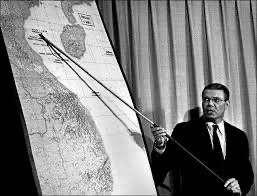
Secretary of Defense Robert McNamara, 1964

“. . .the best test of truth is the power of the thought to get itself accepted in the competition of the market, and that truth is the only ground upon which their wishes safely can be carried out.”

Oliver Wendell Holmes.

Short run or long run, popular beliefs seem to ebb and flow, ever changing. One idea gains traction in one generation then is cast off with time and deeper understanding. The quality that sustains any belief must rest upon a moral high ground; an affirming principle.

Hear me out.

On April 12, 1861, the opening shots of Civil War thundered over Charleston Harbor. The South Carolina legislature had already voted to secede from the Union, and President Lincoln issued a clear statement in his first inaugural address. Assuring Southerners he had no intention of interfering in state matters, meaning slavery, but warned that any state uprising was his business, and that fateful step rested solely in Southern hands.

The President kept his word. 

Once shots were fired on Fort Sumter, the Union rapidly mobilized to put down the rebellion. 

Lincoln’s policy rang firm and clear. The Union would defend the Constitution against illegal aggression.

A century later President Lyndon Johnson attempted to orchestrate a similar scenario in Southeast Asia. In August of 1964, the American people were told North Vietnamese torpedo boats had fired upon two American destroyers in the Gulf of Tonkin. There was no real evidence of the incident, apart from heavy weather and the distracting fog of war. From that event the United States began feeding ground troops to hold the line against Communism. Officially dated from 1959 until 1975, the Vietnam War expended 58,000 young men, and countless Vietnamese nationals.

Today Vietnam is a Communist country. Johnson’s gung-ho attempt backfired because his policy had been built on a lie. 

Likewise, George W Bush squandered world-wide goodwill after the attack on 911. With America in mourning from the terrorist assault on our soil, this president redirected righteous ire to the nation of Iraq. Afghanistan, where the actual culprits were hiding out, came later. 

In the end, nothing of value came from that lie, except uncorking anarchy in Iraq.

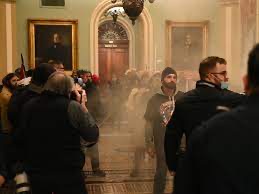
This last January another massive presidential lie duped hundreds into thinking an election had been stolen. No proof of the deception existed, because nothing sneaky happened. To the contrary, abundant truth refuted the the claim. 

A self-absorbed swindler convinced hundreds of followers to act upon his interests. Citizens mobilized themselves and attacked our nation’s Capitol. No proof, no moral high ground, no affirmation of our democratic system, just puppets exploited by a very sick man.

Mr Lincoln understood the power of truth.

Kindred Spirit?

Sen Henry Clay portrait (left of door.)

The word from a Kentucky acquaintance is that Mitch McConnell fancies himself a Henry Clay scholar. That probably means little to most, but Senator Clay (1777-1852) nearly single-handedly held the US together, postponing Civil War for over 40 years.

With a name that epitomizes progress and compromise, it feels odd Mitch McConnell proclaims a kindred spirit in Senator Clay. This earlier Kentucky Senator bent over backwards to protect and promote the vitality of our young republic.

Clay rolled up his sleeves and cultivated coalitions among his fellow law makers to keep the nation from fracturing. He orchestrated the passage of the Missouri Compromise in 1820, the Compromise Tariff of 1833, and the Compromise of 1850; all crafted to maintain the Union. In fact, the Civil War erupted AFTER Clay’s death, as no other Senator possessed the talent and determination to keep Congress talking.

In the interest of full disclosure, yes, Henry Clay owned slaves. And yes, he believed in gradual emancipation, as slavery proved antithetical to economic progress. The Senator’s commitment to America drove his efforts, and Clay worked with all political factions, even those he opposed.

McConnell does nothing, and takes pride in doing nothing. Invoking Senator Clay, who did a lot, is poor cover for an old obstructing politician to presume. Clay did not dig in his heels to impede the opposition party’s efforts to govern.

Henry Clay served his country, McConnell serves himself.

Gail Chumbley is the author of the two-part memoir, “River of January,” and “River of January: Figure Eight,” and the stage play, “Clay.”

gailchumbley@gmail.com

Hysteria and Martyrs

I didn’t care what my students thought. Their opinions were no business of mine. That they knew how to express those ideas, using factual information, was my business.

To introduce point of view, and critical thinking a quick textbook analysis did the trick. In groups (I assigned) students researched various history texts to spot biases in the presentation of historic facts. 

Over the years, a collection of comped survey books had accumulated on my classroom shelf. I used them for my own preparation, but decided to teach the same techniques to the kids. The task was pretty simple. All groups were asked to look up the two same topics: The Salem Witch Trials of 1692, and John Brown’s Raid at Harpers Ferry in 1859. They noted the title of the text, the authors, the publication date, and any particular word choices used to explain or describe each episode.

This was the first day of school, mind you, and holy cow the results rocked these 15-year-olds orderly world.

When each group reported their conclusions, skewed viewpoints abounded. In other words the same facts drew decidedly different conclusions.

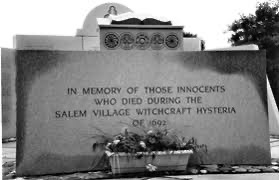
One book blamed the Witch Trials on tensions stemming from continuous Native attacks. Another blamed simmering resentment over social class, inheritance disputes, and property ownership. Moldy grain was to blame according to the Prentice Hall book. The good people living north of Boston were tripping on ergot fungus, a hallucinogen spreading on damp wheat baked into bread.

Nearly all texts made use of the terms “fear,” and “hysteria.”

The John Brown case provided even more interesting results. If the book had been published before 2001, Brown generally came off a saint. If after, the language use grew more sinister. In pre-911 America, fighting slavery had a righteous, noble language, that justified the violence. Something to the effect that, in the name of the mighty Jehovah, Brown martyred himself to strike a blow against evil. By contrast, books published after the collapse of the Twin Towers dismiss Brown’s means as unfortunate, though slavery was still bad.

By the end of this exercise students often seemed flummoxed asking “who can we believe?” 

“Yourself, of course, and your analysis skills,” I always replied.

Gail Chumbley is the author of the two-part memoir “River of January,” and “River of January: Figure Eight.” Both titles available on Kindle.

For more explanation on this lesson email at gailchumbley@gmail.com

An America To Believe In

Religion in politics presumes all citizens essentially hold to the same beliefs. This premise also insists that religious conformity assures civic virtue and good order. However, in practice theocracies actually run counter to effective government, because invoking God in public debate stymies any exchange of thoughts. Without a “free market of ideas,” our society cannot advance, condemning the nation to decline, (See Middle Ages).   

The Constitution’s framers did not lightly pen any Article, Section, or Clause without study or debate, and that especially includes the later admission of the Bill of Rights. James Madison, in particular, examined other government systems, from the Greek City States through the Age of Reason. What Madison discovered was politics combined with religion inevitably sows public conflict; damaging both political and religious institutions. Madison’s purposeful language in drafting the First Amendment, (free exercise and establishment clauses) signaled that the United States would not repeat those fruitless mistakes. 

Lessons existed in America’s past, as well. In Colonial New England Puritan dissenters, such as Roger Williams, and Anne Hutchinson publicly rejected mandatory church compliance. Williams, later exiled to Rhode Island, defended his religious principles writing,

Enforced uniformity confounds civil and religious liberty and denies the principles of Christianity and civility. No man shall be required to worship or maintain a worship against his will.

As the first Catholic-Presidential candidate, John F Kennedy later echoed the same idea stating,

. . .it is apparently necessary for me to state once again not what kind of church I believe in — for that should be important only to me — but what kind of America I believe in.

And that was the point. American citizens must choose to worship freely, or not. That is the essence of American liberty. Law cannot dictate conscience, as our individual thoughts are as unique as our finger prints.

Despite the secular legacy of American law, religious prerequisites still surface from one era to another. In the earliest years of the Republic a fervor of evangelism blazed hot, recognized today as the Second Great Awakening. Beginning around 1800, and lasting until the Civil War, endless, exhausting revivals criss-crossed the country.

Choosing a faith among many began early and today is an American tradition.

Loosely paralleling “The Age of (Andrew) Jackson,” politics followed a similar evangelicalism, giving every person a choice in both their faith and their vote. As Americans migrated west voting rights followed, extending to the lower classes. Increasing numbers of farmers and tradesmen could cast their ballots and follow their understanding of Jesus with the same passion. 

Another unexpected outcome of the Second Great Awakening came in the form of countless spinoffs. Rural isolation cultivated a veritable Garden of Eden in new Protestant sects. For example William Miller of upstate New York forecasted the return of Christ as urgently imminent. He, and his followers believed Jesus would reappear sometime between 1843-1844. After the dates passed with no rapture, the church regrouped becoming today’s Seventh Day Adventists.

Methodists dispatched “circuit riders” into America’s interior. Men like Peter Cartwright, the epitome of a frontier “stump speaker,” could preach the Word of God, while beating the hell out of any heckler. 

Presbyterians split a couple of times before the Civil War. First, regarding whether or not untrained missionaries could lead revivals, or only seminary trained ministers. This controversy tore believers apart.

The schism for Presbyterians and other denominations sprouted from the controversy over slavery. North of the Mason-Dixon Line believers felt their duty was to take action and cleanse America of this national sin. Southerners, however countered that God made no mistakes, and it was God who appointed masters, and placed the slaves beneath them. Rather a handy absolution, that. It took a war to change the politics of slavery, but churches first led the way.

Perhaps the best advice on separation of church and state came from Justice William O Douglas in the court’s ruling, Engel V Vitale, 1962.

“once government finances a religious exercise it inserts a divisive influence into our communities.”

Dictating conscience is a fools errand, and a liberated conscience is the essential foundation of America.

Oh, and Christian Nationalism is neither Christian nor national. Quite to the contrary, that brand of absolutism does not promote public virtue, nor good order, but does lead to national decline, (see Holy Roman Empire)

Gail Chumbley is a history educator, blogger, and author of the two-part memoir, “River of January,” and “River of January: Figure Eight. Both titles are available on Kindle. Chumbley has authored three stage plays, “Clay,” “Peer Review”, and Wolf ByTheEars.” examining America’s past and present.

You’ve Been Played

Strains between North and South had reached critical mass by November, 1860. Escalating tensions burst with the election of America’s first Republican President, Abraham Lincoln of Illinois. The South Carolina legislature reacted by voting their state out of the Union on December 20th, a mere month later. By Spring 1861, the Confederate States of America consolidated, and on April 9th cannons fired upon a Union fort in Charleston Harbor. So began a bloody fraternal war. 

A longstanding question is how in the world did Planters, a small slice of the southern population, convince a mass of their social inferiors to risk life and limb, defending their aristocracy? The answer is rather simple, and lamentable. Folks from the lower rungs lived by the social rules fixed by the wealthy elite. The Planter Class established the rituals of polite society, and every white man below the Mason-Dixon hoped to someday to join their ranks (acquiring land and slaves).

The lower classes defended a minority they ached to join.

A small middle class of land holding farmers, and city professionals, also labored to reach the same social summit. In other words, acquiring the trappings of wealth, punched one’s ticket to ride.

Beneath this merchant-landholding tier massed poor whites. These desperate souls were left to precariously scratch out some kind existence as itinerant tenants. Contempt for this hardscrabble class is still evident through pejoratives that are still in use. Belittling terms like crackers, trash, hillbillies, and rednecks linger on in our lexicon.    

The Old South, in general, also distrusted the outside world. Foreigners, Yankees, Catholics, Jews, and immigrants, meaning anyone who might challenge rigorous, aristocratic formalities. The consequences for this delicate arrangement were profound. As the North industrialized, innovated, and modernized, Southern society languished, governed by reactionaries, more interested in public manners and bloodlines.

Outraged and insulted by Yankee ways, the wealthy roused the lower classes to defend Southern traditions, while in reality, barring any real opportunity of upward mobility.

This dynamic remains modern American politics. The GOP, in our time, is requiring the same fidelity. Party leadership honestly does not wish to serve you. All candidates want is your money and your vote to protect their interests, (especially the guy at the top). These characters are happy to rile voters through exhibitionism, and scapegoating whatever grievance you wish, especially piling it on minorities, the poor and the dispossessed.

But remember this, the traffic is one way only, and you are serve them, not the other way around. Keep delivering cash and power to the top, and nothing changes.

In short, you’ve been played by your chosen betters.

Gail Chumbley is the author of the two-part memoir, “River of January,” and “River of January: Figure Eight.” Both are available on Kindle.

gailchumbley@gmail.com