Waves


Preaching in 1630, Massachusetts Bay Governor John Winthrop, declared the new Puritan settlement a godly utopia, “A City on a Hill.” Since that time Winthrop’s assurance of purpose and perfection has shaped the narrative that is American history. For over two centuries the United States pushed forward striving to make real those founding aspirations. Many Americans, either in groups or as individuals have fought the good fight to extend liberty for all: the most notable example being the abolition of slavery. Yet the path toward realizing the dream of heaven on earth has been many times interrupted with progress’s nemesis—armed warfare.

As Revolutionary War zeal subsided in the late 1700’s, a series of remote camp meetings sparked a movement called the Second Great Awakening. (Yes there was a First) The popularity of these rousing evangelical revivals lit an impassioned fire that called Americans, mostly Northerners to eradicate sin in the shiny new republic. Determined reformers such as Charles Grandison Finney, Frederick Douglass, and Elizabeth Cady Stanton labored tirelessly to rid America of her shortcomings; drunkenness, degrading of women, punitive treatment of the mentally ill, racial inequality . . . in order for the country live up to its charge as a “called nation.”

Despite the diversity of causes and legions of faithful supporters, slavery alone came to dwarf all other movements and to ultimately divide the country. Early instances of violence in the effort to end slavery offered a taste of the violence to come in the Civil War; Abolitionist-editor, Elijah Lovejoy was shot dead in the doorway of his newspaper office, while another anti-slavery editor, William Lloyd Garrison found himself tarred and feathered repeatedly by those who hated his militancy. Zealot John Brown hacked to death five pro-slavers in an episode known as “Bleeding Kansas.” In these instances, “the writing on the wall” had truly been composed in blood.

When hostilities began in April, 1861 the energy of a nation fixated on the course of each battle, fear and resolve ebbing and flowing with each outcome. The shape of America’s future waited in the balance. Finally, after four ghastly years of bloody fighting, Southern hopes of an agrarian, slave-ocracy died, and as President Lincoln so eloquently phrased it, America found “a new birth of freedom.”

Left unaddressed were those other reforms, forgotten in the war. The mentally ill remained behind bars, incarcerated alongside dangerous criminals. Women were legally considered wards of their husbands, with no more standing than dependent children. Countless young children toiled endlessly in textile mills and coal mines, exploited by owners, deprived of any chance for an education. And the legions of former slaves faced a new form of slavery, Jim Crow and sharecropping.

Reform again gathered momentum in the late 19th Century. Aiming once more for that ‘city’ aspiration, the Progressive movement took shape, carried on by a new generation of the faithful, imbued with a sense of social justice to confront the many wrongs left unaddressed from an earlier time, and new issues related to urban growth. Notables from this post bellum movement include; Jane Addams, one of the founders of American Social Work, writer Upton Sinclair and his shocking expose’ The Jungle a condemnation of the meat industry, and John Dewey who normalized public education with coherent curriculum’s and compulsory school attendance. Dewey believed, as had the founders of America, that the nation relied upon and deserved an educated electorate to safeguard the promise of America into the future.

This movement found a great deal of success in improving the country and the lives of its citizens. Building safety reform came on the heels of the Triangle Shirtwaist Fire in 1911. The Jungle brought about the establishment of the Food and Drug Administration, while political reforms included the secret ballot, limiting “Bossism,” and other forms of political corruption.

Then, in 1914 Europe went to war. By 1916 Progressive President, Woodrow Wilson committed America to join in, asking for a declaration against Germany, sending American soldiers into the trenches. And once again, when the guns silenced progressive reforms disappeared as if they had not existed. On the imaginary road to “Normalcy,” the wealthy and powerful misused the country as a personal piggy bank, plundering and cheating with no legal check.

After a decade long litany of economic abuses tanked the Stock Market in 1929, the nation once again turned toward progress, this time on an unparalleled scale. The advent of Franklin Roosevelt and his wife, Eleanor, to the White House marked a revitalization of reshaping America to benefit all Americans. The New Deal remembered for its alphabet agencies, aimed to recover the devastated economy and ward off future abuses that had nearly destroyed the well being of the Republic.

America’s entrance into World War Two bucked the pattern of a reactionary pushback. FDR remained at the helm, until Harry Truman took the reins of government, continuing the tradition of affirming change. GOP President Dwight David Eisenhower kept a moderate hand on the tiller, particularly in the realm of Civil Rights, enforcing the Brown V. Board of Education decision to desegregate public schools.

But with JFK’s murder, the wheels once again came off social progress. As much as LBJ tried to give America all he could; The Civil Rights Act of 1964, The Voting Rights Act of 1965, the Highways Beautification Act, Head Start, Medicaid, and many more pieces of his Great Society legislation, Vietnam eroded all the good.

That endless nightmare of a stalemate in Southeast Asia worked at cross purposes for bettering society. The daily body count, student protests, war atrocities, such as the My Lai massacre, or the shock of the TET Offensive in 1968 sapped America’s desire to do anything but find a way out of the jungle.

Promoting the general welfare came nearly to a complete halt by 1980. The advent of the Reagan Revolution, and subsequent downsizing of the federal government left the vulnerable largely on their own. School lunch programs were cut, the mentally ill let out on the streets of America, while the armament industry threw the nation into deep deficits.

On this Memorial weekend it might be good to consider the potential of America when at peace. Trapped today in an endless cycle of war, this nation struggles to find her soul, to embrace together the light of our national promise. Two military presidents, our first, General George Washington and our thirty fourth, General Dwight D. Eisenhower pleaded with America in their farewell remarks to avoid war as the worst use of our best abilities. Both men, forged in the adversity of difficult wars, recognized the wasteful distraction and deadly allure of war. Washington cautioned against “entangling alliances, and Eisenhower “the military-industrial complex.”

Ultimately, those who know war grasps what is truly lost. Every weapon produced in a munitions factory most certainly casts a wrench into the wheels of human progress. Winthrop meant his reference from the book of Matthew to inspire an example to the world. Forcing Americanism by the barrel of a gun is born to failure, achieving nothing lasting but resentment abroad, and stagnating injustice at home.

Gail Chumbley is the author of the memoir, River of January, also available on Kindle.
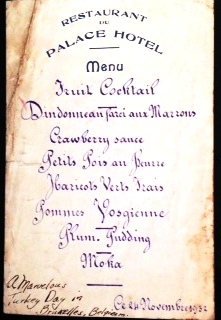
A Brussels Thanksgiving

FullSizeRender(2)

Hand lettered menu from The Palace Hotel in Brussels, Belgium, celebrating an American Thanksgiving,  1932

Brussels#1

The dance company all autographed the occasion on the back side.

Note Mistinguett’s signature in the lower left quadrant. Many of these figures appear in River of January

Gail Chumbley is the author of the memoir, River of January, also available on Kindle

River of January: Friday Excerpt

balletshoes

New York, 1931

Early for Helen’s Gambarelli audition at the Roxy, the girl and her mother crowded among throngs of other hopefuls. Mothers pulled distracted daughters through the bedlam, while their girls tried to catch words with each other. All the dancers were dressed in rehearsal skirts, tights, and leotards—toe shoes slung over shoulders, or around necks. A pianist, oblivious to the chaos, loudly played echoing chords from the stage. Reaching for her mother’s hand, Helen, shouldered her way to a pair of empty seats to the right of the center aisle.
For the next three hours the two women witnessed extraordinary dancing. Yet while watching her competition perform their hearts out, Helen remained tranquil. She knew her craft—she knew she could compete. She had continued to train with her dance instructor, Mr. Evans regardless of her other obligations.
“Helen Thompson,” a small male assistant, with a receding hairline, read from a clipboard.
Helen rose, glancing at Bertha with a small smile. A little jittery when she stepped onto the stage, the girl’s dedication and discipline overrode her nerves. She posed, arms up, gracefully curved, head back, chin raised to the right, and she struck her regal beginning position. The pianist struck the opening bars, and her talent, training, and passion combined into graceful execution. Helen presented Stravinsky’s Firebird—the tableau in which the Firebird rejoices over the destruction of the evil Kashchei. Her mastery of fluid motion and grace assured Helen’s selection for a spot as a Gambarelli “Beauty,” and she began rehearsals with a new troupe of ballerinas almost immediately after auditions.

Gail Chumbley is the author of the memoir, River of January, also available on Kindle

Excerpt Saturday: A Cultured Gentleman

Image

Europe
1932

After Brussels, Elie visited nearly every town Helen played, frequently heralding his arrival with a spray of flowers waiting for her at each hotel.
“Please, please invite your friends to join us on our outing,” Elie cheerfully encouraged Helen.
In Paris, where Voila was performing, Elie motored a carload of Beauties to the countryside, stopping at the Bourbon Palace of Versailles. The American girls strolled amid the recovering gardens, the graceful flowing fountains, and grand buildings that had been severely neglected during the Great War, not so long before.
“Elie, this place is magical!” Helen exclaimed. “Have you been here before?”
“Only once,” the young man replied. “We—my mother, two sisters and I, traveled to Paris after the funeral of my father in northwest France. Perhaps I will take you up there another time.”
They toured the ornate grand salons including Marie Antoinette’s Petit Trianon, the queen’s palace. Helen lost herself, dazzled with the elaborate ivory and gold friezes along the walls and ceilings, and the gold-framed paintings hung in arched cornices.
Later, standing before a vast mirror in the Hall of Mirrors, the couple caught their reflection together—Elie smiling tenderly while Helen felt an inexplicable pang of regret.
In Strasbourg, on another day trip, the pair enjoyed a 12:00 tour of the town’s beautiful Gothic cathedral.
“Oh!” Helen exclaimed, captivated by the cathedral’s ornate astronomical clock inside the transept.
Elie whispered, “Wait my dear, it gets better.”
After only a few moments, small figurines emerged from above the blue and gold clock, within a square opening of the sandstone wall. The carvings represented the phases of life, holy saints, and culminated with statuettes of Jesus and his twelve apostles. While absorbed in the intricacy of the synchronized whirring, Helen felt a touch on her hand, as Elie took her arm. Together, the two silently contemplated this majestic tribute to the Almighty’s dominion over time.
On another stop Elie caught up with Helen by driving to Geneva. In the morning, before rehearsals, the Belgian escorted the dancer on a visit to the League of Nations.
“How did you manage passes, Elie? Charlotte and Grace were told they needed a sponsor to attend,” Helen whispered in the vast paneled halls, watching Elie retrieve the official cards from his pocket.
“I have a business contact here in the city who agreed to endorse us,” Elie quietly responded.
Finding their seats in the public gallery, Helen listened as one prominent gentleman after another eloquently spoke of a peaceful world. Moved by the solemn atmosphere in the chamber, the dignified proceedings, and the sincerity of all the delegates’ remarks, she whispered to her new friend, “These men sound determined to spare the world from another war.”
“My dearest girl, I truly hope they are successful,” Elie answered emotionally, gazing at the proceedings with brimming eyes.

*

Elie was in London on business, unable to attend Helen’s ballet performance in Erba, a town in northern Italy which was a holdover obligation from the Gambarelli contract. Mistinguett permitted the rest of the cast time off while the girls rehearsed for the somber ballet—Goethe’s Faust. This dark saga, a morality tale of the man who sold his soul to the devil for worldly power, puzzled the ballerinas.
“Ballet is a serious dance form, it’s true,” complained Una, “but this performance is so grim, I’ll bet there’s no belly laughs, or knee slappers in the aisles tonight.”
A murmur of assent echoed in the dressing room.

*

The cast party after the program proved to be anything but grim or serious. Accompanied by two Italian boys, Eddie and Nikko—young men the dancers had met earlier—the crowd left the theater in a cacophony of chatter and laughter.
Parading to a nearby café, the American girls swarmed around small tables on the stone terrace. Under a garland of dim light bulbs strung around the courtyard, clouds of rising blue cigarette smoke, laughter, and chinking glasses animated the softly lit oasis, the celebration flowing easily against the night.
“Have you tasted cognac, Miss Helene?” Nikko asked, in an innocent tone.
“No, Nikko. It’s bourbon for this girl.”
“My dear, cognac is the nectar of the heavens. You must try a sip.”
Helen reluctantly stared at the cognac the Italian pushed in front of her. She cautiously raised the snifter, appraised the aroma warily, and sipped. Choking a bit, she concluded, “This isn’t bad.”
Nikko, grinning, ordered another. The more cognac she consumed, the more earnestly the dancer explained how she was properly instructed to perform Ballet spotters back in New York.
Eddie sat, enchanted, listening to the pretty American girl. He suddenly asked, “Lovely Helene, would you permit me the privilege of observing your spotters?”
Nikko winked at his friend, and then added, “I have never seen a New York spotter.”
“Go on, Helen, show us how your Mr. Evans says it should be done,” egged on Grace, weaving unsteadily around the table to watch.
“New York spotters!” demanded several voices. Looking blearily around at her audience, Helen wobbled to her feet. The little crowd applauded.
“Hop up on the table, Helen. We can’t see your footwork from here,” shouted Carmen. Helen warily looked at the tabletop. She carefully placed her knee onto the edge, testing its strength, and satisfied it wouldn’t tip or collapse, awkwardly clambered up.
She clumsily rose to her toes. Lightheaded from the alcohol, the dancer tried to focus on a fixed spot, but just couldn’t pinpoint one. One rotation she turned, then another, and Helen began to gather speed. Inevitably, and all too soon, the girl tottered, losing her footing and equilibrium. Luckily for her, spectators surrounded the table and as she listed at a dangerous angle, the boys caught her before she hit the unforgiving flagstones.
Sick and sore the next morning, the no-longer-graceful ballerina retching in the bathroom, gasped, “Nectar for the gods? Tasted more like lighter fluid. I—hate—everyone.”

*

Elie caught up with the Mistinguett Company when Helen and her friends returned to Paris. Pleased to be reunited with the lovely American girl, he offered the group another afternoon tour in his Packard.
“I have my automobile, and you can decide our destination,” he invited.
“We’ve been to The Louvre.” Carmen mentioned.
“I loved the Mona Lisa, remember, Helen?” added Charlotte.
“The Winged Victory was wonderful, too. Plus we have visited the Arch de Triomphe and the Eiffel Tower,” Helen finished. “I think that today it’s your choice, Elie.”
The Belgian looked the girls over, gazing mostly at Helen. “I believe I have an idea. Climb in. We will motor north.”
The party journeyed under a cloudless blue sky to the northeast. Eventually, after passing through some small villages, Elie veered onto a narrow road, parking his Packard in a field.
“This is the battle area known as the Marne,” he announced soberly.
The girls quietly climbed out of his vehicle almost reverently at the familiar name of the legendary site. The young man guided the group over the ribbons of scarred landscape left by the many futile attacks that made up the Marne Campaign in the Great War.
“Was your father killed here, Elie?” Helen whispered.
“No, Helen, he died later, further northwest near the Somme River. That is where he is buried.”
It wasn’t a topic she gushed over in her letters to New York. That afternoon excursion made the wreckage of war too real for a dancer from faraway America.

*

Back in Paris Helen was astonished to find a letter postmarked from Los Angeles, California. Grant’s letter seemed from another world, another lifetime. Helen slowly opened the envelope and read,

My Dearest Little Nell
As you can see I am still residing in the City of Angels. Your silence took the starch out of a booking to South America and I took a pass. I am waiting patiently for my partner to return from her world travels. Shall play nary a date till you arrive… will continue to play my hunches instead… and never doubt me even when I am not with you.

Below his note, Grant had sketched a whimsical map of the routes he planned to book for her return.
He cleverly illustrated the stops with leaning snowy mountains in Denver, oversized, smiling cactus in Phoenix, and swaying skyscrapers back in New York.
“Oh Grant Garrett, you are a charmer, and I do miss you,” she murmured, feeling a little sentimental.
“Helen, did you say something?” Grace asked, glancing up from her bed.
“Oh—no. Sorry, Grace. I didn’t mean to wake you,” the girl murmered.
Lying back on her pillow she mused, I can hardly believe it, but Grant hasn’t crossed my mind since I sailed in April. The tour has been so fast and so thrilling. For now, she yawned, I’m just glad to be here. I’m far enough away from those who spend all of their time planning my life.

Gail Chumbley is the author of River of January

A French Legend

Miss2

“Rumor has it that Mistinguett served as a spy for the French government during the Great War while she was dancing across the continent. They may be watching her again because of that new leader in Germany,” Lillian remarked as the company sunned themselves on exclusive Larvotto Beach.
“Who told you such a thing, Lillian?” Una, another dancer, asked skeptically.
“Didier, the older stage manager at the Terminus—he seems to know all about Miss.”
Charlotte’s eyes grew large. “How thrilling!”
“And she’s had many affairs with younger men,” Lillian continued, enjoying the attention. “You’re familiar with Maurice Chevalier?”
“Of course.”
“Supposedly they shared a passionate, very public romance. Miss launched his career when she plucked him from a music hall chorus line and cast him into his first film, La Valse Renversante.”
“No!” Charlotte blurted.
“Oh, yes!”
“Isn’t he a lot younger?”
“Thirteen years, according to Didier.”
“Lucky woman!” Charlotte said. The rest of the girl’s laughed at her response.

Page 75, River of January