A Useful Myth

Arguing for the goodness of his vast wealth, Andrew Carnegie, in 1889 proffered society is all the better for the existence of the rich. He stated that God had given him the talent to make money, and he would use his God-given talent to it’s full extent. This steel baron continued that the prosperity of the few, like himself, lifts the standard of living for all citizens. Shorthand for his philosophy, let the rich get richer because it’s good for everybody.

Economist and social critic Henry George took issue with Carnegie’s premise. In rebuttal George insisted that in no way did concentrated wealth help anyone except the rich. Carnegie’s Gospel of Wealth was in fact a myth, and useful one for oppressing the lower classes. Where Carnegie argued the betterment of people, George countered a wedge had been forced through society, crushing the poor into oblivion. 

In our time Carnegie’s argument has permeated American culture, and has matastasized so deeply in our belief system, that the super rich are nearly worshipped. Today’s robber barons, Bezsos, Zuckerberg, Musk, Gates, and others are perceived as superior, breathing the rare air of the most blessed. These characters are untouchable.

In the tradition of Henry George the reality is something quite different. According to psychologists the super wealthy share strikingly similar characteristics. Obsession with money drives these individuals. Making money, keeping money, and making more money is an obsession. Appearances are everything and must be maintained at all times. The exhaustive race for money and rank distorts moral judgement, compassion, and empathy. Screwing others over is part of the game.

Another characteristic shared by the ultra rich is confidence and a capacity for risk, however I would argue that also describes gang leaders and con men. Most compelling is that these individuals are no happier for their efforts.

Like Henry George our culture needs to dispense with the idea of moral superiority among the wealthiest. God did not make these men rich no more than God make drunks drunks, and druggies, druggies. This is obsessive-compulsive behavior and should be seen as such.

As to charitable work among this crowd, remember the Sacklers made OxyContin, a ton of money, leading to thousands of American deaths, while donating millions to museums and universities. Clearly vast wealth does not require a moral compass, nor help the most vulnerable among us.

The Presbyterian in Scotland-born Carnegie knew his justification ran counter to his childhood faith. From the First Commandment’s “Thou shall have no other gods before me,” to Jesus’ “Verily I say unto you it is hard for a rich man to enter the kingdom of heaven. This steel man betrayed and countered the tenets of his youth, creating the false god of money.

And Americans have been devout followers ever since.

Gail Chumbley is the author of the two part memoir River of January, and River of January: Figure Eight. She has also authored three stage plays, Clay, Wolf By The Ears, and Peer Review. Chumbley is the co-writer of Dancing On Air a screenplay based on her River books.

The Patriotic Long Game

When reflecting on my career as a public classroom teacher I hold on to many fond memories. The subject, American History, provided a lot of fascinating stories to share with teenagers coming of age in America. The kids came from varying backgrounds and abilities but once the door closed we focused on a subject that linked us together as one people.

One memorable lesson concerned the Second Continental Congress and adoption of the Declaration of Independence. Together we unpacked the document, followed by guided questioning to clarify the contents. Thomas Jefferson lists the extraordinary circumstances that brought about the decision to split with Britain. Part of the substance listed the abuses of the King and measures colonials had to take to be heard. Toward the end of the lesson I asked the class who they thought Jefferson might be addressing with his lengthy explanation. One boy cautiously raised his hand, an astonished expression on his face, and in a surprised voice he answered  “me.”

Indeed.

Toward the end of the academic year the kids were assigned to sit down with an elder and interview the person about their recollections of life in an earlier time. Students had studied a lot of decades which prepared them for those recordings. In a particularly powerful interview a boy contacted his uncle, a Vietnam veteran, and asked him to tell about his tour of duty in that bygone war. This veteran had not spoken of his service to anyone since returning in the late 1960’s. And although this poor man wept through the recording he apparently cleansed his soul for after decades of self-imposed isolation the uncle began to join family get-togethers.

My student said it was a miracle.

Lessons from the past such as these are vital to understanding America’s present. Though the course required a great deal of writing and analysis, a sense of accomplishment filled the room with an aura of confidence, and national belonging.

Today, over a decade has passed since my retirement, and much has changed in American classrooms. Rather than sanctuaries of learning classrooms have become battle fronts in the culture wars. A small, but loud minority has succeeded in chipping away at the foundation of public education, ironically something Mr. Jefferson promoted as vital to freedom. Sadly those misguided assaults imperil our nation’s ability to survive intact. 

The underlying cause appears to concern social class, power, and money. To educate all requires tax dollars, dollars fewer want to pay. Further, education implies looking toward the future, providing hope that the promise of America will pass on to new generations. Making money now and keeping it is more important than any investment in other people’s kids. Besides the upper classes can afford to educate their children, and believing they must shelter them from the lower classes. That attitude runs counter to America’s motto: E Pluribus Unum, Out of Many, One. Education is a promise that opens up a world of possibilities. That power and possibilities the well-heeled wish to hoard.

Take, for example, Betsy DuVos appointed by Trump 1.0. She took the job as Secretary of Education for the sole purpose of defunding and dismantling public schools. This is not hyperbole. As Secretary of Education, she made no secret of her contempt for public education. In her official role she pushed for school vouchers, charter schools, private institutions, all designed to ensure gated-community education. Stripping down federal education statutes and funding marked her time in Washington.

With Trump 2.0 even the Department of Education is gone. Critics attacking public education lack serious understanding of our public system, and that threatens our national viability.

History could not be more clear regarding the obligation to America’s youth. After the Revolutionary War as land opened up in the Great Lakes area, Congress passed the Northwest Ordinance (1787). This law organized a numbered survey grid mandating revenue from section 16 of the survey be earmarked for public education.

In the years after the Civil War waves of immigrants from Eastern and Southern Europe flooded upon America’s shores. To aid the newcomers settlement houses, such as the Neighborhood Guild in New York City, and Chicago’s Hull House, children attended classes to learn to be American. Too bad we can’t rally the same enthusiasm for all our kids today.

Now self-appointed curriculum experts pack local school board meetings, demanding removal of books, blaming and bullying over-worked teachers which isn’t helpful. Understandably many educators leave after only a few years, while the rest bravely persevere. What our teachers need is meaningful support as they shoulder the duty of classroom instruction plus all the distractions of behavior problems, lockdown drills, bomb threats, and active shooter protocols.

This is an issue of national self interest. There is nothing sentimental or saccharine about how it takes a village. It does take all of us. We all bear responsibility to all of our kids, for they cannot do this for themselves.

Leave teachers alone and let them continue to weave that same magic I experienced for all of our students. We have and will continue to turn potential into reality.

Whether a parent or an educator, or a retired senior, we are depending on you all to protect the patriotic long game.

Gail Chumbley is the author of the two-part memoir “River of January,” and “River of January: Figure Eight,” co-writer of the screenplay, and “Dancing On Air” based on those books. She has penned three stage plays on history topics, “Clay” on the life of Senator Henry Clay, “Wolf By The Ears” examining the beginnings of American slavery, and “Peer Review” where 47 is confronted by specters of four past presidents.

Bull Moose

The only thing new in the world is the history you don't know.  Harry Truman

The story began with a promise. Following his electoral victory in 1904, Theodore Roosevelt vowed to the public he would not run again in 1908. Assuming office in 1901, following the death of William McKinley, then Vice-President Theodore Roosevelt could have run in ‘08. But he had made that promise. 

Selecting an heir, TR tapped the occupation governor of the Philippines, William Howard Taft. TR believed he could happily step aside and pursue private interests with Mr. Taft in the White House. Taft did not want to be president, but his wife did. Though preferring a seat on the Supreme Court, Taft soon caved to his wife and accepted TR’s offer. 

Reform and good government played a large part in Roosevelt’s administration. He challenged unfettered capitalism, pushing for regulations of railroads, and breaking John D. Rockefeller’s stranglehold on the oil industry. One of Theodore’s paramount issues was preserving America’s treasure trove of national parks, and wilderness areas. 

TR loved the West and wished to regulate development where it wasn’t needed. After completing his term, and Taft safely elected, TR went on safari in Africa with one of his sons. By the time Roosevelt returned he learned things were not to his liking in Washington. Taft had made decisions, and endorsed policies Roosevelt had opposed during his administration. 

In short, Taft had the audacity to run his own administration. 

A big issue of contention was conservation of lands and natural resources. Unlike TR, Taft opened up Alaska’s Chugach National Forest to coal mining. Worse, Taft fired TR’s man in the Forest Service, Gifford Pinchot, a spokesman for public land as recreational for the people. Suffice it to say this, and other disputes turned ugly.

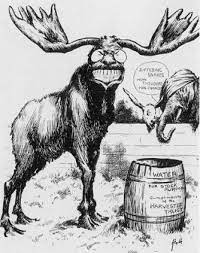
The 1912 campaign season began with TR’s new third party, the Progressive or Bull Moose Party. William Howard Taft also announced his run for a second term for the GOP. New Jersey Governor, Woodrow Wilson, received the Democratic nomination in Baltimore. 

Of course the Republican Party split between Republican conservatives, and the Progressives backing Roosevelt. And Wilson became the 28th President of the United States.

What does that moment of time portend for today? Certainly a major Republican split between traditional and reactionary members is in the offing. Much like TR’s progressive agenda, and Taft’s middle-of-the road-conservatism, GOP voters are going to have to decide. 

Clearly this same party is sliding into another major split in 2024. Is neofascism the preference of today’s organization? That one announced candidate has another term coming, and has made plenty of promises too. Will middle of the road conservatives tone him down and redeem the party in their own image? Maybe. But for today the smart money is on that 80-year-old moderate incumbent.

Gail Chumbley is the author of the two-part memoir, “River of January,” and “River of January: Figure Eight.” Chumbley has penned two historic plays, “Clay” about the life of statesman Henry Clay, and “Wolf By The Ears,” exploring the the beginnings of slavery and racism.

gailchumbley@gmail.com

A Different Code

“He has created a false public sentiment, by giving to the world a different code of morals for men and women, by which moral delinquencies which exclude women from society, are not only tolerated but deemed of little account in man.”Elizabeth Cady Stanton, Declaration of Sentiments 1848.

Nurse Margaret Sanger related an experience that inspired her career in family planning. Called to a dilapidated tenement building, Sanger found a pre-teen immigrant girl writhing in the throes of childbirth.

Attempting to assist the child, Sanger soon recognized the girl was slipping away, bleeding out on a filthy mattress. Indifferent, the girl’s family crowded nearby in a small parlor seemingly resigned to the life and death drama in the next room. 

Soon the bloody battle ceased, as both girl and infant were no more.

A mother herself, Sanger built her life’s work in promoting a woman’s right to choose if, or when to bear a child. 

As for Sanger, she found herself under arrest in 1916 for advocating sex education and birth control through the mail. The charge sheet read that her actions were indecent. Despite that legal setback, a determined Sanger founded Planned Parenthood later that same year.

June 24th, 2022 the Supreme Court ruled women no longer have physical autonomy. The government claims an overriding interest in American women’s reproduction. Plainly females are once again set aside as second-class citizens, leaving men free of any culpability for their actions. For one moment think if men were required a reversible vasectomy at age 16. No male would tolerate such a law, and this is the same invasion of privacy women are forced to obey.

Justice Alito, in his majority opinion, stressed moral judgement over legal arguments when the issue is reproduction. 

In fact, in overturning Roe, women are stripped of the most consequential of life decisions, reinforcing Mrs Stanton’s phrase in 1848, that “a different code” is still alive and well. Women cannot be trusted with their own bodies.

That Planned Parenthood offers so many other services is not the point. That neonatal disorders portend a fatal, and agonizing death for newborns isn’t the point, either.

One of the most precious American underpinnings is the right to privacy. And remember that Prohibition, too, attempted to police private practices. That fiasco resulted in an uptick of violent crime, and corruption because like it or not, people drink. The same is true of abortion. The procedure has not been halted in the country, but made more risky.

The Supreme Court has not ended abortion in America. 

This isn’t over.

*Justice Thomas indicates he would go after birth control next. Does he realize he opens a pandora’s box that could threaten overturning Loving V. Virginia

The Unforgivable Curse

Many of us have read JK Rowling’s Harry Potter books and/or watched the films. The author created a wondrous world of spells, incantations, and even included law and order via three unforgivable curses. 

There are guardrails in this tale, and a bit of a messiah storyline. Harry willingly sacrifices himself, as had his parents and many others before. However, the “Boy Who Lived,” does, and returns to fight and vanquish wickedness. 

Love, too, permeates the storyline, and the righteous power of good over evil. 

But that’s not my take.

As a career History educator I came to a different conclusion; Harry Potter told me that failing to understand our shared past can be lethal. And that was the metaphor I preached to my History students.

Harry rises to the threat and defends all that is good and valuable in his world. If he didn’t, Harry could have been killed and his world destroyed.

It’s so apropos at this moment in our history to grasp our collective story as Americans.

Honest differences within the confines of our beliefs is one thing. Obliterating the tenants of democracy is quite another. 

Americans cannot surrender our country to this would-be dictator, the things that have cost our people so dearly. Freezing soldiers at Valley Forge did not languish to enable DJT to trademark his brand to hotels, steaks or a failed university. The fallen at Gettysburg, and the suffering in Battle of the Bulge was not to pave the way for DJT to get us all killed from a ravaging plague. The girls who perished in the Triangle Shirtwaist Fire, the miners murdered in the Ludlow Massacre, or humiliated Civil Rights workers beaten at the Woolworth’s lunch counter was not for Donald Trump to validate racism and sexism and undo labor laws. 

He doesn’t know our nation’s history, and as George Santayana warned us, we are condemned to sacrifice all over again. 

Vote. 

Gail Chumbley is the author of the two-part memoir, “River of January,” and “River of January: Figure Eight.

gailchumbley@gmail.com

Half-breeds, Stalwarts, and Mugwumps

His political career was none too stellar, except for that one moment he seized history.

This dapper-looking fellow is President Chester Alan Arthur, (1881-1885). Arthur was considered a dandy, pursuing an opulent lifestyle filled with fine food, drink, and expensive suits; largely paid for from the public trough.

Arthur came of political age in the post-Civil War Gilded Age, a world of political machines, graft and corruption. When a supporter helped their man get elected, position and profit rained down in return.

This dubious system functioned rather well for victorious elective candidates through countless election cycles. The political universe of Chet Arthur and his band of Republican cronies became expert skimmers from the public trough and the public trust. In the Republican Party this faction was christened Stalwarts, and Stalwarts liked their well-oiled approach to public service very much, indeed.

Arthur, himself, had been named Collector for the New York Customs House during the Grant Administration, and money from this lucrative Customs House flowed to Arthur’s friends and political operatives. His particular patron was the powerful New York Senator, Roscoe Conkling, a master in Senate handiwork.

Opposing this Old Guard of money changers were the crudely titled, Half-breeds. This oddly pejorative moniker (too common in that era) represented a growing group of reformers in the GOP who aimed to clean up the corrupt practice of patronage. Senator James G. Blaine of Maine believed government jobs should be based on merit, not connections, and Blaine promoted the use of Civil Service Exams. In other words, Half-breeds endorsed qualified government workers over payola for their friends. The Stalwarts were horrified.

In the 1880 Presidential Election the Republicans, in a heated convention, split the ticket with candidates of both wings. For President, James Garfield, a Half-breed, and for Vice President, Stalwart, Chester Arthur, crony of Sen. Conkling. The Party felt it had fused the differences between the two factions, and the fat cats believed they could continue to prey. Then came the Garfield assassination.

In July, 1881, President Garfield, a distinguished Union general, and a former member of the House of Representatives, appeared at the Baltimore and Potomac Rail Station in Washington DC. In the crowd waited Charles Guiteau, an unhinged, office-seeking Stalwart. Guiteau approached the President in the crowd, shooting him at close range. Garfield died two months later from his infected wounds.

Guiteau had shouted, after opening fire, that he was a Stalwart, and would now get a government job. He didn’t. In fact, all Guiteau received was a date with the hangman, carried out in June, 1882.

And what of Chester A. Arthur? He assumed the presidency in a charged atmosphere of national grief. So changed was Arthur, that he promoted passage of the Pendleton Act of 1883. This act created the Civil Service Commission, and mandated written exams for classes of government jobs. The Stalwarts were horrified, but politically could do nothing. Garfield had been made a martyr for reform, and Arthur took the high road, making that reform real.

Oh, and by the way, the Mugwumps were another reforming splinter of the GOP. So appalled by the legacy of bribery and corruption, they bolted the party in 1884 for Democrat, Grover Cleveland.

Wonder how the 2020 Election will reshape the current GOP?

Gail Chumbley is the author of the two-part memoir, “River of January,” and “River of January: Figure Eight.” Both books are available on Kindle.

gailchumbley@gmail.com