Tagwords

World War One, The Great Depression, Vaudeville, Golden Age of Aviation, Amelia Earhart, Golden Age of Hollywood, Rise of Fascism, Waco Aircraft, Professional Ice Skating, Sonja Henie, World War Two, Battle of the Atlantic, Pearl Harbor, War in the Pacific, Cold War, Sun Belt, America as a World Power.

Get the two-part Memoir, River of January and River of January: Figure Eight and connect these fascinating dots. Also available on Amazon.com

If you’ve enjoyed this adventure, leave a review on Amazon.com. Thanks, Gail.


Fighting Joe

IMG_0791

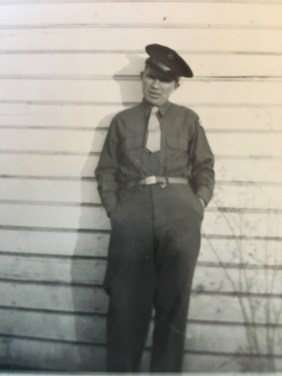
His name was Joseph Andrew Tucker, and he was my grandpa–my mom’s biological father. We didn’t see him very often growing up, as he had remarried and devoted himself to his new wife’s family. I can’t say that I ever felt particularly close to this grandparent, though he was always kind to me.

Looking back, I came to realize that I did respect him. There seemed to be an aura of purpose and certainty around Grandpa Joe, along with a perpetual cloud of cherry tobacco, curling from his pipe. Yet, other than that youthful impression, I honestly knew very little about Joe.

The following is what I’ve pieced together since his death.

Joe Tucker arrived in Spokane, Washington in 1937. He came west from Arkansas following his five-year-old daughter, (as his ex-wife had settled in the Pacific Northwest). Joe found work with the Great Northern Railroad, because Spokane was, and still is, bisected with busy, screeching rail lines. At about the same time he found work, Joe met and married a local widow, a woman named Velma, who brought three children of her own into the marriage.

In and out of the US Army since initially enlisting in 1929; he was discharged after a second hitch in 1938. However, following the Pearl Harbor attack, and America’s entry into World War Two, Joe realized he’d surely be called back for active duty. Not anxious to leave his young daughter, or his new family, he requested a deferment of some kind, due to his previous service, and current domestic responsibilities. He was promptly denied. And, once again, Joe found himself in uniform.

Part of the XIX Corps, Joe Tucker and his new outfit underwent infantry training in support of an armored division. (When he departed Spokane, his new wife, Velma, switched on a kitchen radio, and didn’t turn it off for the next four years).

After six months at Camp Polk, Louisiana, the entire Corps shipped out for England as part of the buildup for the D-Day invasion. Joe and his company was stationed in the south of England, in Wiltshire, adjacent to Southampton, the primary staging area for Operation Overlord. In a letter to Velma on eve of the June invasion he cautioned her that Your’e going to see a lot of frightening news, but really, it’s not as bad as they say.

On June 6th, the first Allied wave crossed the English Channel, securing a beachhead in Normandy in exchange for thousands of American soldiers. Days later, Joe’s infantry unit, and accompanying tanks, rolled onto those same blood-soaked beaches; members of the XIX Corps bracing for their own European crusade.

For the next five months the XIX slugged their way from Castilly, to St. Lo, battling their way through the storied Siegfried Line, crossing the Meuse River in Holland. However, by mid-December, the slog to Germany came to a violent halt with an unexpected push-back in the Ardennes Forest, later called “The Battle of the Bulge.” During the darkest days of this German counter offensive, Joe and his buddies switched to defensive warfare, retreating back into Belgium.

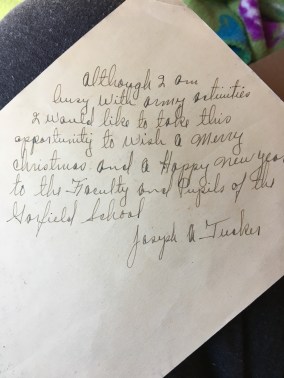
My grandfather’s utter surprise at this sudden German attack is evidenced by an optimistic Christmas card he mailed to my mother’s elementary school in early December, 1944.

IMG_0793

IMG_0794

Late one night, Joe found himself on guard duty in the worst of the stalemate. His Sergeant voiced concern that my grandfather might have fallen asleep at his post. “Go check on Tucker, make sure he’s awake,” the Sarge ordered one of Joe’s buddies. But the fellow soldier came to his friend’s defense. “Sir, you can bet Tucker’s eyes are open.” And they were, Joe heard the whole exchange from his post.

fullsizeoutput_524

Joe Tucker, second from left.

When Hitler’s last gamble failed in early 1945, the XIX Corps turned toward the east, battling their way into the Rhineland. Near Katzenfurt, Germany, an exhausted Joe Tucker, stumbled across an abandoned American tank left by a roadside. Weary, he crawled inside the hatch, falling asleep almost at once. Waking hours later, uncertain of where he was, or the time, Joe bolted awake to the sound of men shouting. He realized at once that the language was German, and that some kind of patrol was approaching his armored sanctuary. Alert, Joe sat up and seized the 50 calibre machine gun mounted on the tank. He opened up on the German patrol, saving his, and probably other GI lives. For this action, Tucker was awarded the Bronze Star.

German resistance began to noticeably give way the deeper into Germany the XIX Corps marched. Reaching the Elbe River, in Southern Germany, the Army encountered the Red Army for the first time. When the German surrender came, and the war officially ended,  Joe Tucker received his orders to head home.

Finally back in Spokane by September, 1945, Sergeant Joseph Tucker was formally discharged. His wife, Velma switched off that kitchen radio. Her Joe had come home.

Once again, my grandfather resumed his job as a switchman at the Great Northern Railroad. And despite his earlier reluctance to activate in 1942, Joe Tucker volunteered for duty with the Washington National Guard.

In the years following the war, Grandpa became an active member of the Spokane Democratic Party. Influenced by his deep Arkansas roots, Joe carried New Deal sensibilities to Eastern Washington politics. His tireless work canvassing neighborhoods for local, state, and national candidates, eventually earned notice across the Cascades, in Olympia, and from gubernatorial candidate Albert Rosellini in Seattle.

By the late 1950’s, Joe Tucker’s modest home on Boone Avenue became the center of vital party planning. Velma later remarked on one occasion when Governor Rosellini, Senators Henry Jackson, and Warren Magnusson all conferred among her couch pillows and crocheted afghans consulting with my grandfather on major strategy. Joe was an esteemed asset, working city precincts with the same determination that carried him from Normandy to Germany. And the party counted him a senior operative.

All Joe wanted was a level playing field–that those with power and money would have to follow the rules everyone else did. The powerful could not exploit those who lacked position and privilege. He saw firsthand the power that every day American’s brought to enormous obstacles–he fought along side them in Europe. Joe believed that the rest of us were as worthy as the richest people in the country. His wartime experiences reinforced the curse of tyranny, and the absence of democracy.

You see, Joe Tucker was a foot soldier, nothing more, nothing less. In war, he committed himself to serve his country–an enlisted guy who lugged a rifle for the rest of us. In peace he poured that same devotion to his family, his job, and his wider community. There was work to do for America in all three spheres, and my grandfather never shirked away from doing his bit.

Have a safe and thoughtful Veterans Day.

Gail Chumbley is the author of the two-part memoir, River of January and River of January: Figure Eight. http://www.river-of-january.com. Also available on Kindle.

gailchumbley@gmail.com

Indie Everyday

A4904C51-3483-49D0-8D64-E022F045510C

With apologies to Nathanial Hawthorne, this shirt is my version of the Scarlett Letter.  “Hello, my name is Gail, and I’m an Indie author . . . the process is hard, but very gratifying (even while pulling weeds in the garden).

This weekend I invite you to pick up River of January, and the sequel, River of January: Figure Eight.  If in Boise, check out Rediscovered Books, in Salt Lake, Sam Weller’s in Trolley Square, and Spokane’s Aunties Books. Also available on Amazon.com.

Gail Chumbley is the author of the two-part memoir, River of January.

Ouch?

bonvoyagecard10001So I just read a scathing review of my first book, “River of January.” This reader really hated it, and made a real effort to express her distaste. To say she went out of her way to revile the story doesn’t do justice to the term ‘condemnation,’ and continued to blast me as the author.

So how exactly does a writer react to such a scorcher of a reprimand?

I’d like to get upset and obsess over the two measly stars and every berating word in the post. But I can’t seem to throw myself on that grenade. And much as I’d like to feel mortified and humiliated, I don’t. All that reacting is just too much work–takes too much energy. Besides, if the aim of a book is to elicit an emotional response, then, I suppose, my book has found a kind of success.

Three years ago this review would have destroyed me, almost as if someone had pointed out that my beautiful new baby is actually ugly, and that I’m a blind fool. But as a writer I’ve let go of that kind of perfectionism, and any illusion that I fart roses.

This true story is what it is, and I happen to think it’s damn good, and count myself lucky that it came into my life.

So what now?

I turn on my laptop and compose this blog. Writing is what I do. And some will connect to my  voice and identify with this quandary. Others have already clicked cancel.

I suppose that’s why cars come in different colors.

Gail Chumbley is the author of the two-part memoir River of January and River of January: Figure Eight.


Goody Goody


In the memoir, “River of January,” Helen, a beautiful and talented dancer, set sail in 1936 to Rio de Janeiro, Brazil. She eagerly  looked forward to a two week performance at the famed Copacabana Hotel, with an additional two week option to play in Buenos Aires.

On her sheet music for the number, Goody Goody–one of the many songs prepared for this engagement–Helen penciled in her dance steps among the musical notes and rests.

No film survives of Helen Thompson’s April, 1936 performances in South America, but I found this little gem from the same year. (Personal point . . . I think Helen was a better dancer than the girl in this clip).

Happy Friday.


Gail Chumbley is the author of River of January and River of January: Figure Eight and on Amazon.com.

The Pitch

Long rows of rectangular tables, draped and decorated, filled the hall. Cellophane covered baskets, revealing festive gifts sat inches apart, attracting hopeful bids from the browsers wandering about the silent auction. Attendees seemed to understand the drill, strolling from basket to basket, pen in hand, increasing the previous bid. And the purpose behind this auction? The IEA Children’s Fund; a statewide account to help Idaho kids with food, clothing, supplies, shoes, and any other need disadvantaged students face.

I squeezed in between colorful, refugee-sewn bags and wallets, and a boxed WiFi yoga program, complete with a mat and ready-to-use internet software. My books sat displayed below eye level, requiring some adjustments to attract possible buyers.

Both “River of January,” and “River of January: Figure Eight” are rich with archival images. However, space limitations left the usual eye catchers tucked in a satchel, under my chair. Though dismayed at first, I remembered that the books have photo galleries inside, and my tactic instantly shifted. “Are you a reader?” I begin. And what’s cool about teachers is that 99.9% told me ‘yes.’ (Of course they are, we teachers are the champions of literacy.) Then I whipped out the photos in book one.

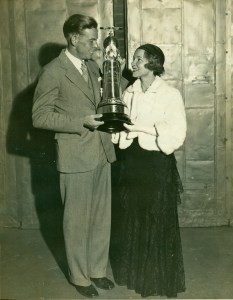
I begin . . . “River of January is a true story, a memoir, that I have written in a novelized style. Here is my main charter, a pilot, who won an air race in 1933. Here he is receiving the winning trophy from actress Helen Hayes at the premier of her newest movie, Night Flight co-starring Clark Gable.” (The listener looks mildly interested. I go on.)

helenhayes0001


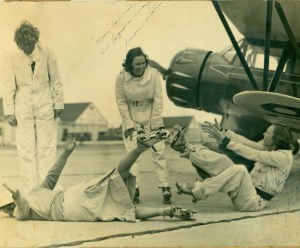
The girl in the middle, laughing, was his girlfriend, she was a pilot too. On the left is Amelia Earhart, the president of the female flying group called The 99’s.”  (I hear an audible WOW. We’re getting somewhere.)

Image

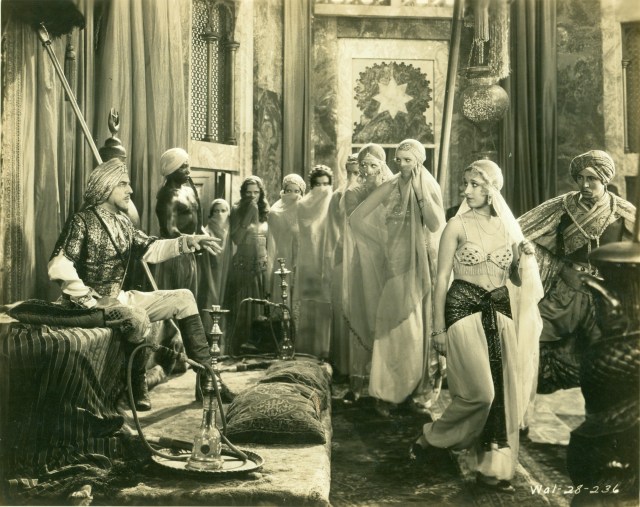
“And this girl is the other main character, and she was a show girl, dancer, and actress. The picture is a clip from a 1931 movie she appeared in called Women of All Nations. Not much of a film, but she had a closeup. Oh, that’s Bela Lugosi in the turban.” (Now I hear a ‘that’s amazing.’)

Women0001

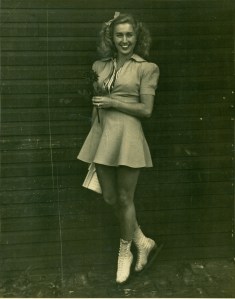
“Yeah,” I agree. “And it’s only the first book. In book two, he ships out to the Pacific, and she becomes a professional ice skater in a Sonja Henie Ice Show.”

helenskates0001

(I reach for the second book, “Figure Eight.”). Here he is with the head of Eastern Airlines, Captain Eddie Rickenbacker. You know, the WWI flying ace?” Now they want to know the price, and would I take a debit card?

Rickenbaker0001

“Would you like me to sign the books?” They would. And I thank the purchaser, and ask for feedback on Amazon.

What is nice is that all teachers share an innate sense of wonder. My natural fascination with the story easily connected to like-minded listeners among the professional educators circling that hall.

And that’s my pitch. I let the two main characters sell the memoir because they were nothing short of amazing.

Plus I , too, happily made a donation for each book sold to the IEA Children’s Fund.


Gail Chumbley is the author of the two-part memoir, “River of January” and “River of January: Figure Eight.” Both books are available at www.river-of-january.com, or on Amazon.


Tell Me a Story


Drawing inferences; the ability to examine evidence and attach meaning, was the bedrock of my history classes. Believe it or not, forming conclusions from documents isn’t intuitive for everyone, and more often than not, an acquired assessment skill.

Context is huge . . . the medium, (photo, painting, film clip, political poster, diary entry, news story) allows a document to fit into a broader story. And that same critical thinking skill is what I had to use in my books, “River of January,” and “River of January: Figure Eight.”

Please examine the following images from the archive and make them fit into a narrative.

Happy Friday


Gail Chumbley is the author of the two-part memoir, River of January, and River of January: Figure Eight. Visit her website at www.river-of-january.com or order on Amazon.com

Christmas in Algeria, 1932

Dearest Mother,
I have read your letter and I want you to know that Miss has given us that warning already. We never go out alone. Earl Leslie and the other boys keep a close eye on us. There, that should relieve your concern.
North Africa is very strange, but I like it here. Una bought a guidebook and we have, as a group, toured Tunis and Algiers on foot. The buildings are a mix of the past here. The book calls the style “Ottoman-French. I guess that means both Middle Eastern and European.
Every morning we wake up to a public call to prayer. The people are mostly Muslim and the calls are part of their customs. I think it sounds soothing—usually the sound of the caller lulls me back to sleep. Curious, isn’t it?
The heat here is dry, and the sun blinding white. We stroll through the narrow streets (in groups) where the sun can’t reach us, making for darker, cooler shade. Nameless women veiled from head to toe pull their children along dressed all in white. It’s such an exotic world.
Silly as this sounds, I tried to buy you Christmas gifts in the market, but found nothing. You’ll have to settle for a telegram, because this is a Muslim country and they don’t celebrate Christmas. And, Mother, please have a happy Christmas.
We girls have all decided to do our own gift exchange and sing Christmas carols. We’ve hung paper chains on a palm tree in the lobby of the Algiers Hotel! The hotel managers gave us permission.
Merry Christmas Mother. I love you and Eileen very much. The young man I mentioned is not serious. His name is Elie, (Jewish, I know) and he has kindly showed us all around tourist sites.
Helen

River of January, page 165-166.

Indie writer, Gail Chumbley is the author of the memoir, River of January and River of January: Figure Eight. Available at www.river-of-january.com and on Amazon.com.

We All Do

IndiePics

Sitting in on a writing seminar a while back, the keynote speaker, finishing his remarks on the business of publishing, opened the floor for questions. A young lady, seated at the end of my row grew visibly nervous and asked, “But, I don’t want to have to market my books, I just want to write them.”

In a gentle voice, the guest speaker replied, “We all do, but that’s no longer how the book business works.”

And, readers, that no longer is how the book business works.

Agents and publishers today are far more concerned with a writers social media platform, then any content wedged between a book’s jacket. Even traditionally published authors must carry the heaviest burden of getting their works into the public arena. For example, I’ve been watching a news commentator on one of the cable networks handling the publication of his new book. He still does his broadcast every night, but goes on air from the various venues where he is presenting–like the parking lot of Barnes & Noble the other night. At the end of each program, this correspondent plugs his title and where his next appearance is scheduled. He has quite the platform, and his publisher loves it.

Now some everyday folks are pretty savvy at this platform game, too. Utilizing electronic media, many writers successfully finesse Facebook analytics, embed advertisements on search engines, as well as on Nook Press, Kobo, Amazon, and a multitude of other outlets.  And I must add that I am in awe of this style of enterprise and business outreach. Many of these electronic resources are way out of my skill set–cultivating an online following one of my most daunting challenges.

Plainly history education and story telling is my forte; Selling–shilling my name and image about, leaves me a bit overwhelmed and self conscious. Like the young lady at the seminar, I just want to write my books, too.

Sometimes I wonder if I would have written anything, knowing what I know now about the media game. But then I remember some particular episode, his heart-pounding night flight in 1933, or her dance tour of Europe during the rise of Hitler, and I realize writing River of January, and Figure Eight was never a choice: life handed the task to me, and I am responsible.

So I switched on my laptop and wrote this blog.

Gail Chumbley is the author of River of January and River of January: Figure Eight

Also available on Amazon. River of January is on sale this weekend on Kindle.


Oh, To Be Young

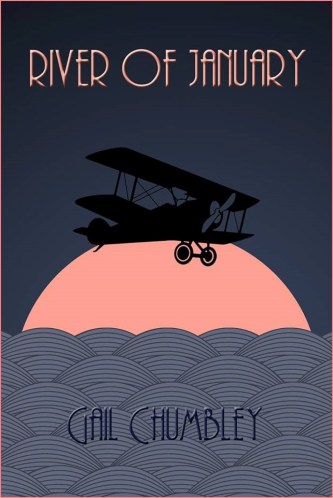
Kindle patrons! River of January is on sale this weekend! From Friday through Sunday night, the adventure is yours for 99 cents. What a barg! Download the book, give it a read, and leave a short review.

Enjoy this sneak peek.
rojcover

“Hello, Chumbley here—hello?”

“Morning Chum,” flashed an urgent voice. “This is Richard Ross, and I am awfully glad I caught you at the office! We have a horse posted in the third race and need to get to Baltimore, fast.”

“Havre de Grace Race Track?”

“A horse in the third.”

“Wait, where are you calling from?” the young man asked.

“Newark. We’ll be waiting at the airfield for you to arrive.”

“Horse track, huh?  Roger that. I’ll gas up the Waco and be over soon.”  Jogging to the hangar

“Hello, Chumbley here—hello?”

“Morning Chum,” flashed an urgent voice. “This is Richard Ross, and I am awfully glad I caught you at the office! We have a horse posted in the third race and need to get to Baltimore, fast.”

“Havre de Grace Race Track?”

“A horse in the third.”

“Wait, where are you calling from?” the young man asked.

“Newark. We’ll be waiting at the airfield for you to arrive.”

“Horse track, huh?  Roger that. I’ll gas up the Waco and be over soon.”  Jogging to the hangar Chum reflected, “This trip sounds like fun, especially if I make a couple of bucks.”

Taxiing down the runway, the flyer lifted off—his trip was just a short hop west—and Chum presently approached the New Jersey landing strip. From his windshield he could see three figures moving outside an office building near the tarmac.

“Must be Ross,” Chum mumbled. Touching down, the pilot slowed and turned the plane toward his passengers. But he noticed they were running toward the Waco. Ross was shouting something and waving his arms.

“We need to go, now, Chum!” the pilot finally heard above his roaring engine. Chuckling, as they clambered aboard, the flyer again turned and taxied down the same airstrip, quickly lifting off toward the southeast. His three passengers breathlessly discussed the upcoming race card. Thoroughly entertained by their excitement, Chum listened.

“That number six will be tough to beat,” and “I paid a call to those stables and I wasn’t that impressed.”

This flight wasn’t long either, but apparently too lengthy for the impatient stockbrokers. As Chum circled the county airfield, Ross reached up and patted his shoulder. “Not here, Chum. It’s too far from Havre de Grace. Land the plane at the track, put it down on the infield!”

Stunned, the pilot clarified, “At the horse track?”

“Yes sir! There’s no one better than you to pull off a landing like this one!”

As he doubtfully turned his plane around, dangerous images passed through Chum’s mind—in particular, the incident in Elmira. He understood, as every pilot understood, that potential disaster rode along with him on every flight.

Chum worried:  What are the chances of cart-wheeling the plane? Can I regain lift if I come too close to the viewer stands? Will I be arrested?

Ross read Chum’s alarm and assured the pilot, “I trust you. The field is long enough for a good flyboy like you to manage. And we’ll pay for any mishap or damage.”

“How ’bout my broken neck?” the pilot half-joked.

The broker snickered.

Chum shrugged, lowered the nose of his Waco, and touched down firmly, bouncing on the grass, and smoothing out as the plane slowed. By the end of the infield, the Waco stopped, facing the viewing stands. Safe. No snags. Leaning over the yoke, he inhaled deeply realizing he’d held his breath through the approach, the landing, and the braking.

Movement in his peripheral vision caught his notice. Four race officials were rushing from under the track’s white railing. The men waved their clipboards and arms over their heads, rushing toward his Waco.

Chum caught the crowd’s mixed responses to his sudden appearance. Some in the crowd stood stunned, mouths hanging open, while others cheered, jumping and clapping as though his arrival was scheduled entertainment.

The pilot burst into laughter. “Now, there’s the sensible crowd!” he chortled, watching as the panicked stampeded out the exits. Chum turned to tell his passengers to look at the stands, but saw that Ross had popped open the cabin door, and was dropping down from the plane.

“Take it easy, fellas. Take it easy,” Ross shouted to the officials. “This pilot is the best. He does this kind of landing all the time!”

The police quickly arrived and Ross, now joined by his two associates, stood outside, as if guarding the plane. The broker talked fast, and to Chum it appeared as if the authorities were calming down, physically stepping back from the wealthy New Yorker.

Maybe they realize he’s a big shot, the pilot concluded. After some tense moments the police, track managers, and officials unexpectedly shook hands with the New York businessmen, and strolled off the grass.

Hoisting himself back up into the cabin, Ross smiled. “No jail for us today, Chumbley. The track manager—the palooka in the blue blazer—only asked that you move your plane to the center of the infield, and that we stay until today’s race card is finished.”

Finally unhooking his safety harness, Chum stretched, climbed out of the Waco and shook his head in disbelief. He mumbled, “Tough treatment for men who live for horses.”

Chum reflected, “This trip sounds like fun, especially if I make a couple of bucks.”

Taxiing down the runway, the flyer lifted off—his trip was just a short hop west—and Chum presently approached the New Jersey landing strip. From his windshield he could see three figures moving outside an office building near the tarmac.

“Must be Ross,” Chum mumbled. Touching down, the pilot slowed and turned the plane toward his passengers. But he noticed they were running toward the Waco. Ross was shouting something and waving his arms.

“We need to go, now, Chum!” the pilot finally heard above his roaring engine. Chuckling, as they clambered aboard, the flyer again turned and taxied down the same airstrip, quickly lifting off toward the southeast. His three passengers breathlessly discussed the upcoming race card. Thoroughly entertained by their excitement, Chum listened.

“That number six will be tough to beat,” and “I paid a call to those stables and I wasn’t that impressed.”

This flight wasn’t long either, but apparently too lengthy for the impatient stockbrokers. As Chum circled the county airfield, Ross reached up and patted his shoulder. “Not here, Chum. It’s too far from Havre de Grace. Land the plane at the track, put it down on the infield!”

Stunned, the pilot clarified, “At the horse track?”

“Yes sir! There’s no one better than you to pull off a landing like this one!”

As he doubtfully turned his plane around, dangerous images passed through Chum’s mind—in particular, the incident in Elmira. He understood, as every pilot understood, that potential disaster rode along with him on every flight.

Chum worried:  What are the chances of cart-wheeling the plane? Can I regain lift if I come too close to the viewer stands? Will I be arrested?

Ross read Chum’s alarm and assured the pilot, “I trust you. The field is long enough for a good flyboy like you to manage. And we’ll pay for any mishap or damage.”

“How ’bout my broken neck?” the pilot half-joked.

The broker snickered.

Chum shrugged, lowered the nose of his Waco, and touched down firmly, bouncing on the grass, and smoothing out as the plane slowed. By the end of the infield, the Waco stopped, facing the viewing stands. Safe. No snags. Leaning over the yoke, he inhaled deeply realizing he’d held his breath through the approach, the landing, and the braking.

Movement in his peripheral vision caught his notice. Four race officials were rushing from under the track’s white railing. The men waved their clipboards and arms over their heads, rushing toward his Waco.

Chum caught the crowd’s mixed responses to his sudden appearance. Some in the crowd stood stunned, mouths hanging open, while others cheered, jumping and clapping as though his arrival was scheduled entertainment.

The pilot burst into laughter. “Now, there’s the sensible crowd!” he chortled, watching as the panicked stampeded out the exits. Chum turned to tell his passengers to look at the stands, but saw that Ross had popped open the cabin door, and was dropping down from the plane.

“Take it easy, fellas. Take it easy,” Ross shouted to the officials. “This pilot is the best. He does this kind of landing all the time!”

The police quickly arrived and Ross, now joined by his two associates, stood outside, as if guarding the plane. The broker talked fast, and to Chum it appeared as if the authorities were calming down, physically stepping back from the wealthy New Yorker.

Maybe they realize he’s a big shot, the pilot concluded. After some tense moments the police, track managers, and officials unexpectedly shook hands with the New York businessmen, and strolled off the grass.

Hoisting himself back up into the cabin, Ross smiled. “No jail for us today, Chumbley. The track manager—the palooka in the blue blazer—only asked that you move your plane to the center of the infield, and that we stay until today’s race card is finished.”

Finally unhooking his safety harness, Chum stretched, climbed out of the Waco and shook his head in disbelief. He mumbled, “Tough treatment for men who live for horses.”


Book Two, River of January: Figure Eight is available at http://www.river-of-january.com or at Amazon.com