
His name was Joseph Andrew Tucker, and he was my grandpa–my mom’s biological father. We didn’t see him very often growing up, as he had remarried and devoted himself to his new wife’s family. I can’t say that I ever felt particularly close to this grandparent, though he was always kind to me.
Looking back, I came to realize that I did respect him. There seemed to be an aura of purpose and certainty around Grandpa Joe, along with a perpetual cloud of cherry tobacco, curling from his pipe. Yet, other than that youthful impression, I honestly knew very little about Joe.
The following is what I’ve pieced together since his death.
Joe Tucker arrived in Spokane, Washington in 1937. He came west from Arkansas following his five-year-old daughter, (as his ex-wife had settled in the Pacific Northwest). Joe found work with the Great Northern Railroad, because Spokane was, and still is, bisected with busy, screeching rail lines. At about the same time he found work, Joe met, courted, and married a local widow, a woman named Velma, who brought three children of her own into the marriage.
In and out of the US Army since initially enlisting in 1929 he was eventually discharged after a second hitch in 1938. However, following the Pearl Harbor attack, and America’s entry into World War Two, Joe realized he’d surely be called back to active duty. Not anxious to leave his young daughter, or his new family, he requested a deferment of some kind, due to his previous service and current domestic responsibilities. He was promptly denied. And, once again Joe donned a uniform.
His new wife, Velma switched on a kitchen radio when he left, and she didn’t turn it off for the next four years.
Part of the XIX Corps, Joe Tucker and his fellow recruits began infantry training as support of an armored division.
After six months of training at Camp Polk, Louisiana, the entire Corps shipped over to England as part of the buildup for the D-Day invasion. His company was billeted near Southampton the primary staging area for the secret invasion of France, code named Operation Overlord. In a reassuring letter to Velma on eve of the June invasion he wrote “Your’e going to see a lot of frightening news, but really, it’s not as bad as they say.”
On June 6th, the first Allied troops traversed the roiling English Channel, and at great loss of life secured a beachhead on Normandy. A day later, on the 7th, Joe Tucker’s infantry unit and accompanying tanks, rolled onto those same blood-soaked beaches; members of the XIX Corps bracing for their own European crusade.
For the next five months the XIX slugged their way from Castilly, to St. Lo, battling their way through the storied Siegfried Line, then crossing the Meuse River in Holland. However, by mid-December, the slog to Germany came to a violent halt with an unexpected push-back in the Ardennes Forest, later called “The Battle of the Bulge.” During the darkest days of this German counter offensive, Joe and his buddies switched to defensive warfare, retreating back into Belgium.
My grandfather’s utter surprise at this sudden German resistance is evidenced by an optimistic Christmas card he mailed to my mother’s elementary school in early December, 1944.


Late one night, Joe found himself on guard duty during the worst of the stalemate. The family story goes that a Sergeant voiced concern that my grandfather might have fallen asleep at his post. “Go check on Tucker, make sure he’s awake,” the Sarge ordered. But a fellow soldier came to Joe’s defense. “Sir, you can bet Tucker’s eyes are open.” And they were, my grandfather heard the whole exchange from his post.
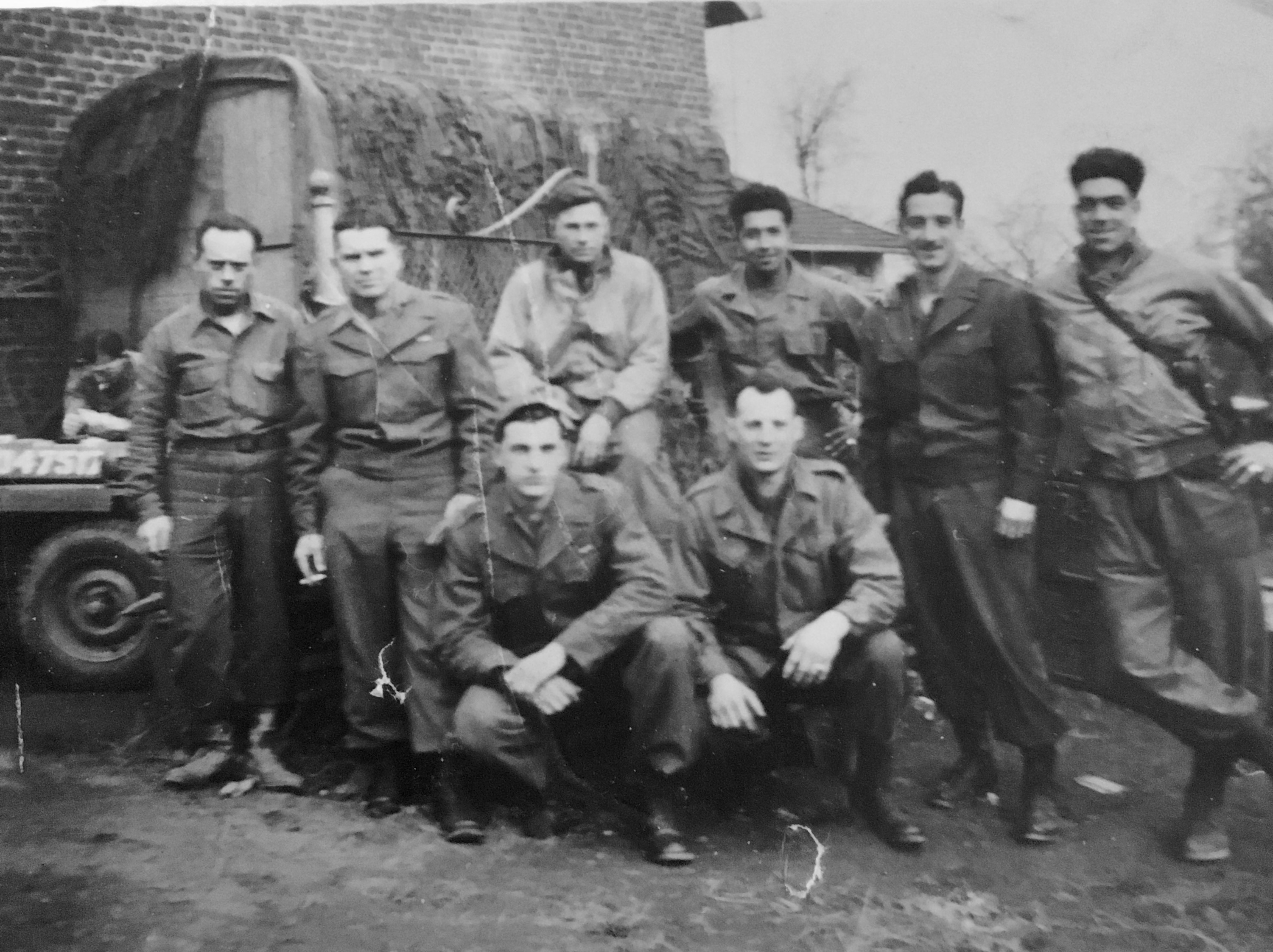
(Joe Tucker, second from left)
When Hitler’s last gamble failed in early 1945, the XIX Corps turned toward the east, battling their way into the Rhineland. Near Katzenfurt, Germany an exhausted Joe Tucker stumbled across an abandoned American tank left by along a roadside. Weary, he crawled inside the hatch, this time falling asleep almost at once. Waking hours later, uncertain of where he was, or the time, Joe bolted to life at the sound of men shouting. He realized at once that the language was German, and that some kind of patrol was approaching his armored sanctuary. Galvanized, Joe clutched the 50 calibre machine gun mounted on the tank and let it rip. His quick action saved his and probably many other GI lives. For his bold conduct Tucker was awarded the Bronze Star.
German resistance began to noticeably give way the deeper into Germany the XIX Corps marched. Reaching the Elbe River, in Southern Germany, the Army encountered the Red Army for the first time. When the German surrender came, and the war officially ended, Joe Tucker received his orders to head home.
Finally back in Spokane by September, 1945, Sergeant Joseph Tucker was formally discharged. His wife Velma finally switched off that kitchen radio. Her Joe had safely returned.
My grandfather once again resumed his job as a switchman at the Great Northern Railroad. And despite his earlier reluctance to activate in 1942, Joe Tucker volunteered for duty with the Washington National Guard.
In the years following the war, Grandpa became an active member of the Spokane Democratic Party. Influenced by his deep Arkansas roots, Joe carried New Deal sensibilities into Eastern Washington politics. His tireless work canvassing neighborhoods for local, state, and national candidates eventually earned notice from across the Cascades from gubernatorial candidate Albert Rosellini in Seattle.
By the late 1950’s Joe Tucker’s modest Spokane home on Boone Avenue became the center of vital party planning. Velma later noted that on one occasion Governor Rosellini, Senators Henry Jackson, and Warren Magnusson all reclined upon her couch among her gingham pillows and crocheted afghans. These giants of post-war policy had come to meet with my grandfather on political strategy. Joe had become a political asset, working city precincts with the same determination that carried him from Normandy to Bavaria.
You see all Joe wanted was a level playing field–that those with position and money would have to follow the same rules everyone else did. Simply put the powerful could not lord over the rest of us. Joe believed the American people were as important as the most powerful.
His wartime experiences reinforced the curse of tyranny, and the evil that comes from the absence of democracy.
You see, Joe Tucker was a foot soldier, nothing more, nothing less.
In war, he committed himself to serve his country–an enlisted guy who carried a rifle for the rest of us. In peace he poured that same devotion to equality and fair play. There was work to do for America, and my grandfather never shirked away from doing his bit.
And that is why Trump will not prevail.
Gail Chumbley is the author of the two-part memoir “River of January,” and “River of January: Figure Eight,” co-writer of the screenplay, “Dancing On Air” based on those books. She has penned three stage plays on history topics, “Clay” on the life of Senator Henry Clay, “Wolf By The Ears” examining the beginnings of American slavery, and “Peer Review” where 47 is confronted by specters of four past presidents.

