The Working End of Tomorrow

815528365b25248630140a659ad44ffa


“A politician looks forward to the next election cycle, while a statesman looks forward to the next generation.” This admirable sentiment has been attributed to a number of speakers including Thomas Jefferson and the 19th Century Reverend James Freeman Clarke. But I heard the quote attached to President Gerald Ford. Whoever uttered these words has my full endorsement.

This morning began well. I awoke from a dream-filled sleep of taking roll, presenting lessons, and interacting with my students. They were all mixed up, hailing from a multitude of graduating classes, but still they were all my kids. I knew them well. In point of fact, most of my nights pass in a flowing narrative of teacher dreams, and I’ve gotten fairly used to this regular occurrence. The joke since retiring is, “I work so hard at night I should still be on the payroll.”

At any rate, after waking up, my mood remained jovial, still dialed in to happy. Tapping on my iPhone a picture appeared of a former student, now in a military uniform singing with three other soldiers. He and his brothers-in-arms were performing a rendition of the National Anthem at a public event. In another post a young lady, newly attending college revealed her fears about losing interest in reading for pleasure—a concern she happily resolved by opening a new book. Scrolling down the wall a bit, a wonderful family picture appeared of one of the kindest student’s I’ve had the pleasure to know. She posed before a Christmas tree with her three little boys, the youngest only two months old. Her husband’s caption clearly revealed his love for her and his boys. These posts are just, well, just so cool!

Not all teaching reminders and memories are as bright as those that I experienced this morning. Still, I wouldn’t have missed my time with these young people for a king’s ransom. Magic occurred in those classrooms; pure joy a guaranteed bi-product of the learning process.

I discovered over the years, that basic to the art of teaching and learning, is a faith in the future, a tangible something waiting ahead for every individual—a realized dream. All the hours of classroom preparation devoted to listening and thinking skills, observation, and problem-solving, were simply a training ground for young people to eventually find their place in the larger world.

While grappling with today’s incessant demands, it is far too easy to gloss over thoughts of the future. Caught up in the crowded moments that make up the present, many lose sight of the certainty of tomorrow. Teachers, however, are not permitted the luxury of settling in the moment. We must skip ahead of the “now,” planning and adjusting, then planning further. Intrinsic to our professional calling is the absolute assurance of a looming future, and we have to get our kids ready.

Perhaps stake holders could gain some perspective by casting aside trivial, momentary agendas—the noisy culture wars taking place across media battlegrounds, jousting in never ending finger pointing. Those distractions impede the progress available to our students, who are rapidly passing through the system. These kids are here today and gone tomorrow, quite literally.

When I assessed my students in class, I often envisioned them as adults, figuring out their individual niche. With that objective as my guide, I tried to design the best methods available to reach practical benchmarks. Even so, in the end, I had to let each class move on, a natural continuation forward to meet their futures, hopefully carrying my small contribution. An act of faith.

With our eyes vigilantly fixed on the countless tomorrows yet to come, would teachers be considered President Ford’s definition of statesmen? I’d like to think so.

Gail Chumbley is a retired educator and author of River of January. Also available on Kindle. Watch for “River of January: Figure Eight” this Fall.

Air Race, Willie Whopper Cartoon, 1933

willie_whop1

https://www.youtube.com/watch?v=S66wOkha0aU

A vintage piece of celluloid from the Golden Age of Aviation. This cartoon has it all: racism, sexism, the boy hero, the hairy villain, and a hot girl (Earhart, sexy?). Reminded me of the pod races in Star Wars. This whimsical cartoon premiered  the year Chum won his air race, “The Darkness Derby.”


River of January is available on Amazon.com and www.river-of-january.com

The Great Silver Fleet

The Silver Fleet in a Golden Age!

gail chumbley's avatarGail Chumbley

The Great Silver Fleet

This photo is a DC3, part of Eastern Airlines “Great Silver Fleet” of passenger liners. The plane is on display in the Air and Space Museum at the Smithsonian. We had suspected that Chum had flown this aircraft, but weren’t quite certain. Finally, I had the chance to look over his logbooks and matched the tail number to this plane. Chum captained this particular aircraft in February, 1946, six months after the war ended. If you find yourself on the National Mall, you can duck into the Air and Space, where you’ll find this beauty still on exhibit.

View original post

Brussels, November, 1932

HVienna0001

From the new memoir, River of January . . .

Booked at the Palace Hotel in Brussels, the show’s new variety lineup fused seamlessly. First the star, Mistinguett, with the ballet troupe opened the evening program. Helen, unable to dance both with her friends and in her solo, chose the latter. Happily, it became a crowd favorite. Though she would have liked to dance with the company, Helen knew the ovations she garnered were well worth watching the opening from the wings. Next on the bill was synchronized dancing from American Earl Leslie and his line of hoofers, followed by the other company entertainers and their specialties.
The program closed with the full cast in a colorful, peacock-inspired, extravaganza. It featured Mistinguett center-stage, supporting a headdress of colossal feathered plumes of blue, turquoise, and purple, shimmering above her blonde hair. Her “Beauties” were costumed in silvery tutus, sequined halters, and tight, sparkling caps, each sprouting over sized silver feathers, flanking their star from both sides.
The male dancers, in black tuxedos, peeked out between each feathered girl. Under the dazzling lights, the symmetrical tableau moved patrons to their feet, applauding and shouting for more.
For a second night more flowers appeared, and this time a note accompanied the gift on Lillian’s dressing room table. As she again picked up the vase and turned toward the trash bin, Carmen stopped her, “At least read the note first, Lillian.”
“Yeah Lil, c’mon!” the other dancers chanted.
“Who wrote it?” asked Grace.
“Is it signed?” wondered Carmen.
Rolling her eyes, the dancer huffed dramatically, then slit open the note with a nail file and read in a flat, monotone:

You were really wonderful in your solo specialty and all through the review and I do want once again to ask you if you will let me pilot you through town in my car when and for as long as you may care. Should you not care to see or know me, please allow these flowers to tell you of my admiration, and remember that you have a person who cares for you in the little city of Brussels.

“But I didn’t have a solo,” Lillian exclaimed. “The only one who had a solo was…”
The girls stood silently, and then all eyes shifted to Helen. Lillian laughed once—a bit annoyed, and handed the vase to her friend, saying, “I believe these belong to you.”
Banter erupted again, now aimed at Helen.
“Jeepers girl, he admires you!” and “Wonder who it is that cares for you in this little city, kid?”
Helen took their teasing in stride, curtsying and blowing kisses. But when the dancers began chatting about the imminent cast party, Helen lowered herself onto a rickety stool and read on. “I feel I must say that I am not an ‘old butter and egg man’ … I am just twenty-eight and not too ugly … My only fault is that I think you are my ideal.”
Her eyes lingered on the words “my ideal.” Unexpectedly charmed, Helen appraised this communiqué with new eyes, and decided to follow the mysterious sender’s written instructions on how and where to meet him.
She dressed quickly and quietly to avoid any friendly needling. Helen hurried out the dressing room, heaving open the steel stage door into the quiet alley behind the theater.
Stepping to the corner of the building, she peeked around to the snow-lined, busy street. Helen carefully studied the faces of the bundled up after-theatre crowd crunching by, and scrutinized moving and parked automobiles. From her vantage point, She soon spied a grey Packard, emitting white-blue exhaust from a quietly idling engine. Scanning the note again, Helen felt certain that the young man would be waiting in that car. Her stomach faintly roiling, she stepped forward, trying to distinguish the driver through his frosty door window.
Helen realized, “Oh, he looks nice,” and shyly continued to approach his vehicle. The driver stepped out of his door, all smiles.
“You must be Lillian,” he beamed, “I am Elie. Elie Gelaki,” he added, bowing to kiss Helen’s gloved hand. She noticed that the young man’s voice formally articulated his clear English.
She bashfully smiled and felt her face grow warm. “Actually, I’m Helen,” she clarified. “I do hope that I am the one the message was meant for…”
Elie Gelaki unexpectedly gazed at her forcefully. “I meant you.”
The two stood self-consciously beside the running automobile.
“Why don’t I take you inside this café? It is quite cold tonight.”
“That would be lovely, Mr. Gelaki,” Helen smiled, more relaxed.
The young man gently took hold of her arm, explaining, “I’m Elie, and this street is quite icy.” He courteously escorted the dancer into a nearby coffee house.
“So you are the Helen Thompson on the bill, not Lillian Ward,” he said after they were seated. “I am sorry about the confusion. I hope it was of no embarrassment to you.”
“No more than usual,” the dancer laughed. “My friends spend more time teasing each other than dancing.” She paused, changing the subject. “Tell me about yourself, Elie.”
“I am a native of Palestine. But now I live here, in Brussels, with my mother and two sisters. My dear father has been for dead for some time.” He noticed Helen suddenly frown. “Did I say something offensive?”
“No. I’m sorry. My father died some years ago, too.” Helen’s own grief abruptly gripped her heart. After Floyd Thompson died, after his funeral, she knew something truly good had vanished forever from her world.
Her frown turned into a sympathetic smile. His face glowed in reply
Elie changed the subject. “I have recently founded a new photo company. I call it Polyfoto International,” he stated proudly. “At this time I am expanding my interests in Europe, across North America, and on into Asia.
“What type of photography do you specialize in?” Helen politely asked.
“ I will accompany you into my studio and photograph your lovely face. Then you will know,” Elie responded.
While he chatted about his life and work, Helen studied the Belgian. He wasn’t terribly tall, and had a clear complexion, subtly suggesting a childhood of freckles. His thick hair ranged from light brown to dark blonde and he combed it back off of his forehead. Elie gazed at her from olive green eyes speckled with glints of brown and gold. Though he seemed a serious man, he smiled broadly as he spoke in his appealing English, and his laughter was deep and friendly.
“Would you consider joining me for lunch tomorrow?” he asked. “I would be happy to guide you on a personal sightseeing tour of the city afterward.”
“Love to,” she answered promptly, drawn toward this young man. Elie thanked her with a happy grin.
The troublesome doubt dawned on her later, as she tiptoed into her dark hotel room.
“He’s Jewish,” she whispered to herself. “My mother would just die if she knew I was seeing a Jew.”
Yet, despite all the prejudice against Jewish people, she liked Elie and decided to give the young man a chance. He seemed nice, and she wanted to see the sights around Brussels.

River of January is available on Amazon and at www.river-of-january.com

The Flemish Bend

HMPlanePic0001

This couple married 78 years ago today. On Friday the 13th. In New York City. Defying traditional convention. Archaic superstitions were of no interest to this modern couple, that kind of thinking belonged to the past.

Mont “Chum” Chumbley, and his bride, Helen Thompson Chumbley only looked forward, challenging and prevailing over old horse and buggy thinking. Theirs was a new era, a dynamic era, one of flight and of film. And this powerful force of optimism rendered one life time together too brief. So now their spirits carry on in my head, and in the pages of my book, River of January.

To say Helen and Chum were happy together would be shallow pandering–and an insult to the complexity of their distinctive temperaments. Still, their story has power, enduring power, pressing me on, returning time after time to their papers, searching for signposts of truth and direction.

A Flemish Bend, the title of this piece, ironically does have its roots in the distant past. The Bend is a sailors knot, also known as a square or figure eight knot. The same shape in mathematics is the symbol for infinity. The love Helen and Chum shared, as imperfect as it seemed at times, was powerful, and proved to be endless.

I too have been snared in those powerful cords, and for better or worse speak for their remarkable lives, lives too dynamic to have died with their passing.

And I’m grateful. It’s an honor. Happy anniversary Helen and Chum.

Order River of January, and enjoy the journey.

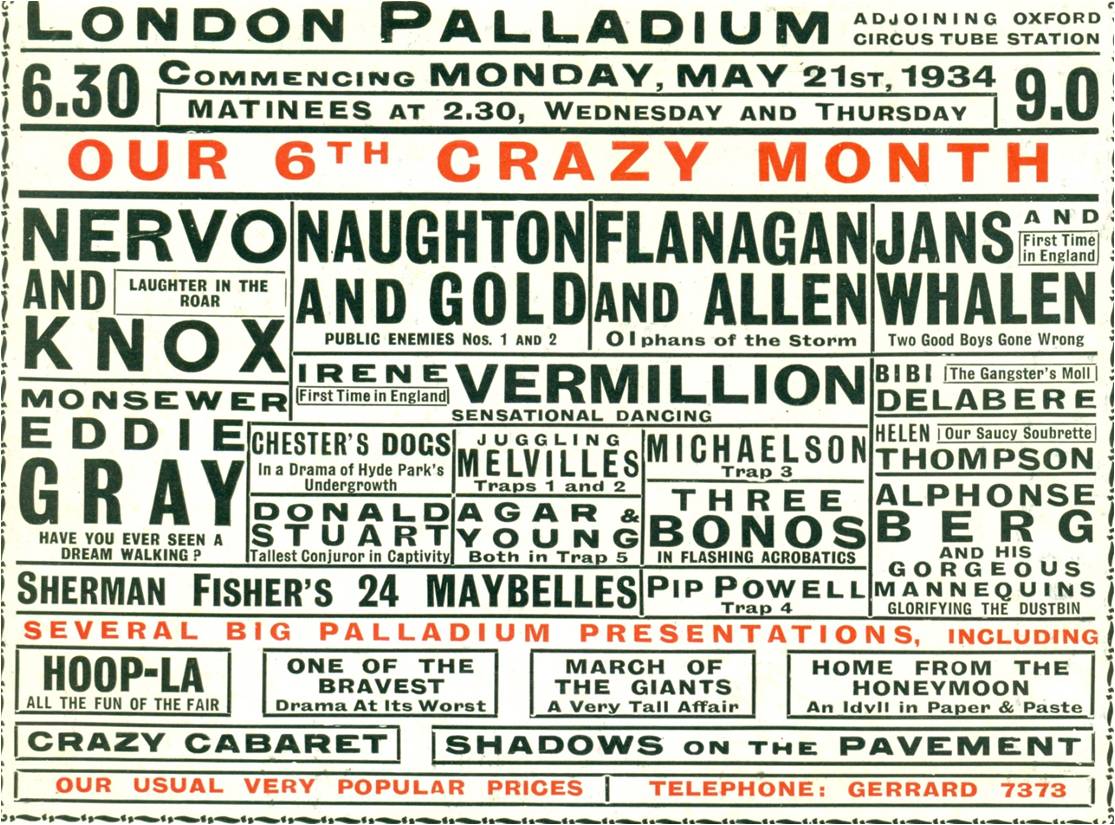
Letters From The London Palladium, 1934

HPalladium0001

The following is an excerpt from River of January, Crossing The Atlantic

Dear Dorothy,
I am sorry to write to you in a crisis, but I have dreadful news. Please keep what I’m about to tell you a secret—not a word to my Mother or my sister, please. We’ve been fired! I know—it’s horrible. I don’t know what we’ll do. Jans says he can fix it, but I’m not so sure. I may have to come home early. I am writing to you because I can’t say a thing to my Mother—you know how she gets. But I may need a little money to get home. I do promise to pay you back when I get on my feet.
We made our first trip to the Palladium, they lettered my name on the billboard “Helen Thompson, Our Saucy Soubrette” whatever that means. I thought it was cute. Anyhow, we entered the theatre through the back entrance and met a lot of the cast. Such nice people, too. They told us that “The Crazy Show,” that’s what they call it, has been coming back to the Palladium for years. This group of comedians is known, together, as the “Crazy Gang” and made us feel very welcome. They explained that the same crowds return each season to see their old friends in the show.
We felt pretty excited opening night when Jans and Whalen took the stage after the all-cast extravaganza and began their routine. Harry Jans told the one about the soldier who had survived mustard gas and pepper spray becoming a seasoned veteran. No on laughed. The audience hated them. No one booed, and they clapped a little when Jans played and sang, “Miss Porkington Would Like Creampuffs.” Remember that silly song? Other than that polite response, not a snicker sounded in the whole house.
Then I went on stage and performed a widow comedy monologue; black gown, the whole bit, and I bombed too. With all those spotlights trained on me, if it hadn’t been for the coughing and murmuring I would have thought the theater empty. It was horrible— nauseating— I couldn’t believe how miserably we failed. WE LAID AN EGG!
After the show some of the regulars took us out for drinks. I wanted to run back to the hotel and hide. They led us to a nice pub, but I felt so shook up I could hardly light my cigarette. They explained that English audiences often don’t understand American humor. In particular, my widow act seemed more offensive than funny.
“Too many widows after the Great War,” one comedian named Eddie Gray told me. “Not funny to families with loved ones who died in the trenches.”
That never crossed my mind, Dot. It’s been almost 15 years, for goodness’ sake. So we were ready to make the changes the boys in the cast suggested. No prohibition jokes, no dead jokes, more songs, and lighter skits. When we arrived for rehearsal the next morning letters were pinned to the dressing room doors that we were to clean our things out—that the management would no longer honor our contract. By the way, the Times critics gave us a lambasting, too. I got to feel mortified all over again.
So, dear Dorothy, that is how the situation stands. Whalen won’t come out of his room. Jans is ready to murder the guy in the front office, and I may drag out my trunk and mail myself home. Just let me know if you can cover my passage. But, don’t do anything yet.
Thanks oodles and oodles and mum’s the word.
Helen

My Dear Friend Dorothy,
Salvation! We have been kept on the bill, at least for a couple of small bits. So thanks for agreeing to help me home, but Jans did take care of things. I swear, Dot, Harry Jans could coax the English rain back into the gray English clouds.
It all happened so quickly, but this is how events turned. We were shocked, and then worried, as I’m sure you could tell. Then Jans remembered that our contract explicitly stated we were to make $1000 dollars a week regardless of circumstances. He marched into the manager’s office and wouldn’t leave until he received a check for $4000 dollars, or our reinstatement to the show. The manager balked and then Jans reiterated that the contract was clear. My partner gets a little fierce when he’s riled and I think he scared the fellow. The manager said he’d discuss it with his investors.
But that’s not the best part. The whole cast refused to go on until we were back on the billing! Their leader, Teddy Knox, told the manager that one night wasn’t fair, and that until we went on again, they would wait. All of them! Bless their hearts! Guess they are crazy. Later, I caught up with Teddy Knox in the green room and told him how grateful I was. I guess I just hugged him and cried.
So all is well, and Bertha still calm. I will tell her, but will word my letter so that she doesn’t blow her stack. Thanks again, Dot. You are such a swell friend!
Helen
Dear Bert,
We have had quite a hectic week. We opened on Thursday night and were fired Friday morning. Can you believe that? But don’t panic, we’re back on the bill now. It was all a misunderstanding; apparently people in England and people in the States laugh at different things, so we changed our act a bit. Should be all right now. Jans and Whalen are keeping a close eye on me so don’t worry. I will send a money order in my next letter and hopefully more news. Don’t worry Mother. Things here are fine. Love to Eileen.
Love,
Wellen
Helen,
I don’t understand how you could take firing lightly. If there are any further problems you catch the first ship home. You tell Harry Jans that I mean it. Now take care, and make sure you keep me informed of any other issues.
Mother

Dear Mother,
I hope that you aren’t too cross with me. We won’t be gone long, and I will be home very soon. The three of us are back in the lineup. Jans and Whalen play toreadors in the opening number, and I am in a black and white feather costume complete with white boots. The outfits are very snazzy. We sing the show’s theme song, “Come Round London with Me,” then “God Save the King.” We had to rehearse them both, and the audience stands up and sings along when “God Save the King” begins. Can you believe it?
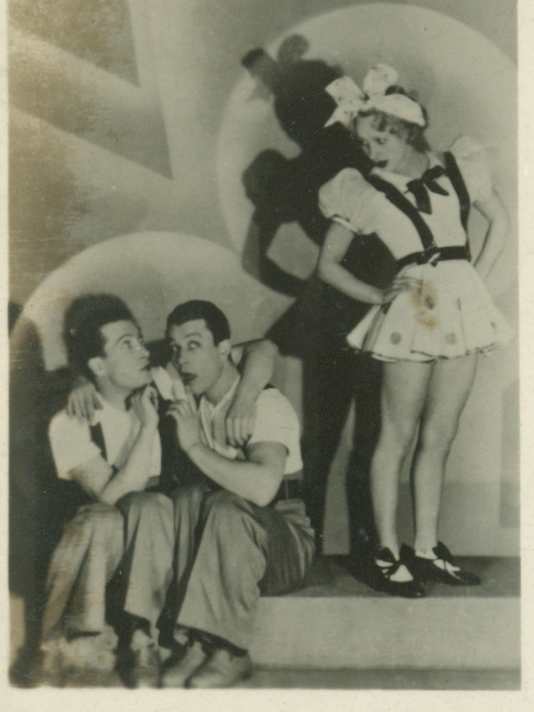
Jans and I finally are doing our own skit. I wear my tap shoes, a short flared skirt with suspenders and a huge pink bow in my hair. On cue I timidly step to center stage (everyone can hear each tap). Under the spotlight Jans, says “Did you come out to sing a song for the nice people?”
I point to my throat and croak out “l-a-r-y-n-g-i-t-i-s.”
Jans answers, “Oh, that’s a shame we all were looking forward to your number.”
I lean over and whisper into Jans’ ear. Jans then says loudly “You want to whisper the words to me, and I sing the song? Yes, yes, a grand idea! I would love to!” He announces “This song is called “Where on Earth could all the Fairies Be?”
I whisper in his ear, he sings a line, next whisper, he sings, and then Jans finishes, arms opened wide belting the out the refrain, “Where on Earth could all the Fairies Be?”
A spotlight quickly hits Jimmy Naughton, (he’s a Brit) planted up in the balcony who calls out in an effeminate voice,
“Oh, my, where aren’t they?” The lights cut to black and the crowd roars with laughter. Cute, huh?
Did you receive the money I mailed?
It won’t be long now,
Little Sister

Picture1

River of January Book 2 Excerpt

Amelia Earhart Plane Fragment Identified : DNews

amelia0001

Bertha eyed the large box with a wary, but inquisitive gaze. “We got this for you. Merry Christmas Mother,” we both hope you’ll like it,” Helen beamed with pride. “Chum?”
Bertha narrowed her eyes, watching as her son-in-law sliced down a cardboard corner with his pocket knife. Revealed inside, a beautiful new Emerson radio, curved corners, blonde wood, featuring inset vertical columns. Mother’s eyes now grew wide as she took in the gift—this radio was the top of the line, as Bertha well knew.
“Oh my heavens,” she exclaimed. “You two must have spent a pretty penny on this!”
Helen grinned happily, her mother seemed honestly pleased, while Chum, hurried to plug the device in, rapidly turning the dial looking for a Christmas broadcast.
Kneeling at a small end table, he twisted the tuner knob—the frequency tone whined and whistled from fuzzy to piercing. Finally, a clear authoritative voice rose, articulating in a clipped urgent cadence. Nineteen hundred and thirty seven has been an eventful year in American news. It was last spring, in May that the Hindenburg, a German dirigible tragically exploded over New Jersey. Celebrated aviatrix Amelia Earhart was lost in July, along with navigator, Fred Noonan in the uncharted expanses of the South Pacific . . .

“No Christmas music, honey?” Helen asked over the broadcaster’s voice.
“That’s really not a surprise,” Chum mumbled, lost in thought.
Bertha quipped, “No Christmas music on Christmas is a surprise?”
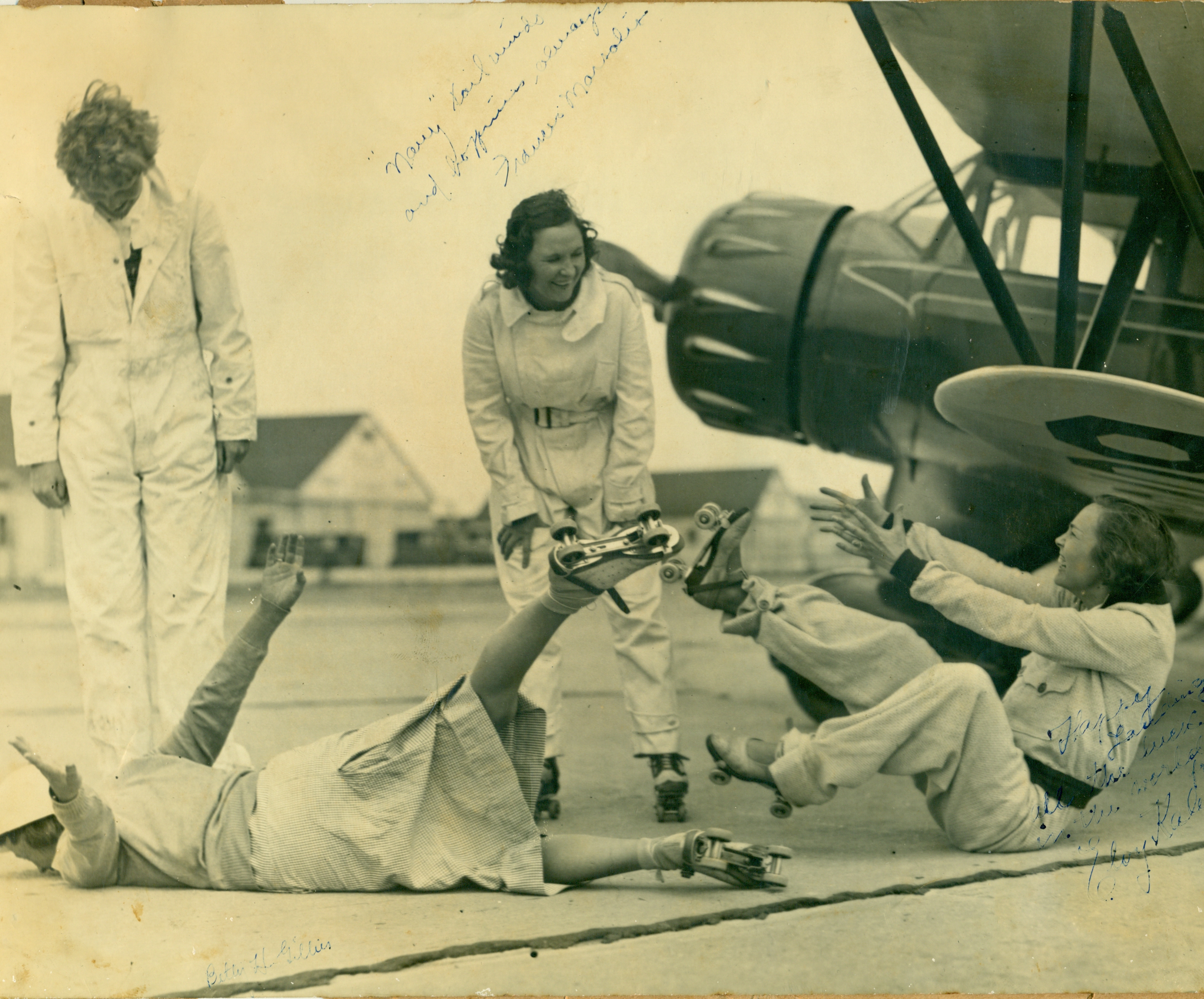
“No. No. Sorry. Amelia Earhart was someone I once knew at the field.
Impressed for once, Helen’s mother pushed for more details. “You knew Amelia Earhart?”
“Oh. Well, yeah I did. She was a friend of a friend.” Suddenly self conscious with all three women staring at him, Chum struggled for words. “You see, Earhart had no training in navigation at all. She could fly just fine, but had to hire navigators to get anywhere. The, eh, other girls—girl-pilots talked about it. They uh, believed it was that husband of hers, George Putnam who inflated her abilities . . . spent money to build up her reputation. Amelia got in over her head on that flight, and the poor kid was killed as a result.
“How do you know this?” This time Eileen piped up, clearly fascinated by his tale.
“Like I said, that Roosevelt Field crew of gals could be a clucky bunch. The other women talked a lot about how shamelessly that husband promoted her career.”
“I’d never heard that before,” Bertha exclaimed, appraising her son-in-law in a new light.
“Me either,” Helen added, not sure she was pleased with his “the other girls at the field” story or not.

Buy River of January Today

Another New York Story

riolist

So caught up in the process of writing River of January I didn’t see much beyond my keyboard and monitor. Focusing intensely on grammar, style, punctuation, research, and every other detail, I failed to see a beautiful New York story take shape before my eyes.

A New York story. The New York of Vaudeville, Tin Pan Alley, Jimmy Walker, and silent films. The New York of Roosevelt Field–Lindbergh lifting off eastward toward Paris, achieving legendary status, and where Amelia Earhart later trundled down that same runway only to meet her mysterious end in the South Pacific.

Mont Chumbley, one of two central figures in River worked at that same storied airfield, braking down runway #1, arriving first in the 1933 Darkness Derby. He had braved inky night skies in his quest, worsened by wind gusts and growing cloud cover.  Pushing through from Los Angeles to New York, Chum prevailed, victorious, He received honors for his achievement at the Capitol Theater, 1645 Broadway, when Actress Helen Hayes presented him with his cash winnings, and an over sized silver trophy. Becoming something of a local celebrity himself, many from the city sought him out for passenger transport or flying lessons. On one instruction flight,Chum found actress Katharine Hepburn in the cabin of his plane, joining her boyfriend, Broadway producer, Leland Hayward.

 Helen’s New York consisted of auditions and productions from the Boulevard Theater, to the Roxy, performing for Billy Rose, finally dancing in “The Harry Carroll Revue.” As if a scene from an old movie, she set sail in April, 1932 on the SS Ille de France. This transatlantic voyage carried the girl from New York Harbor for an extended tour across Europe. Two years later, in 1936 she stepped up the passage way of The American Legion, a steamer on the Munson Line destined for Rio de Janeiro. Joining throngs on the top deck Helen gleefully waved goodbye to her family, smiling back from the Brooklyn docks. And speaking of family, Helen’s home address, 325 West 45th Street, was the third floor of the Whitby Hotel smack-dab in the middle of the Theater District. And though refreshed and remodeled today, that apartment building still stands–a direct link to an earlier era, an earlier New York.

Helen and Chum both lived in Manhattan at the same time. But he had his New York story to fulfill, and so did his future bride. That they crossed paths on the sidewalks, subways, theaters, restaurants, and trains before exchanging their first hello is certain. But as proper New Yorkers the two finally met elsewhere, at the Club Copacabana in Rio, a hemisphere away. There these two New Yorkers finally locked eyes, and fell in love.

Eventually, when circumstances allowed, Helen and Chum returned home to exchanged vows at the Church of the Transfiguration, on East 29th and 5th Avenue. This location is better known to New Yorkers as The Little Church Around the Corner.

I’ve finally come to recognize that River of January has become more than the narrative of two lives in the early days of aviation and show business. This story takes place in the magical metropolis of New York–where Helen and Chum found magic of their own.


I Couldn’t Help Myself

c&hrio0001

River of January

This wasn’t my idea. The completion of River of January has been as much a surprise to me as to anyone. I never presumed to be any kind of writer, ever. In fact, I spent my entire career as an American History teacher who told stories, not wrote them. But when River of January came into my life, the story took root, soon dogging my every step. Forget the fact that I didn’t know how to write, or understand the first thing about publishing–River of January made it clear that those deficiencies were my problem.

This project flowed into motion after meeting and coming to admire my story’s central figure. Mont Chumbley, one of two major characters in the River of January, was a real flesh-and-blood man full of irresistible charm. He was also my father-in-law, and as such generously shared hours of gripping storytelling, regaling tales of his fascinating life. His personal anecdotes exquisitely depicted the golden age of aviation, leaving me humbled and honored—in awe of his singular and astonishing career. Delightful episodes included flyers, Amelia Earhart and Howard Hughes, among many other colorful characters that populated Roosevelt Field. Chum became my own Peter Pan, guiding me on a magical journey to an America full of promise and opportunity.

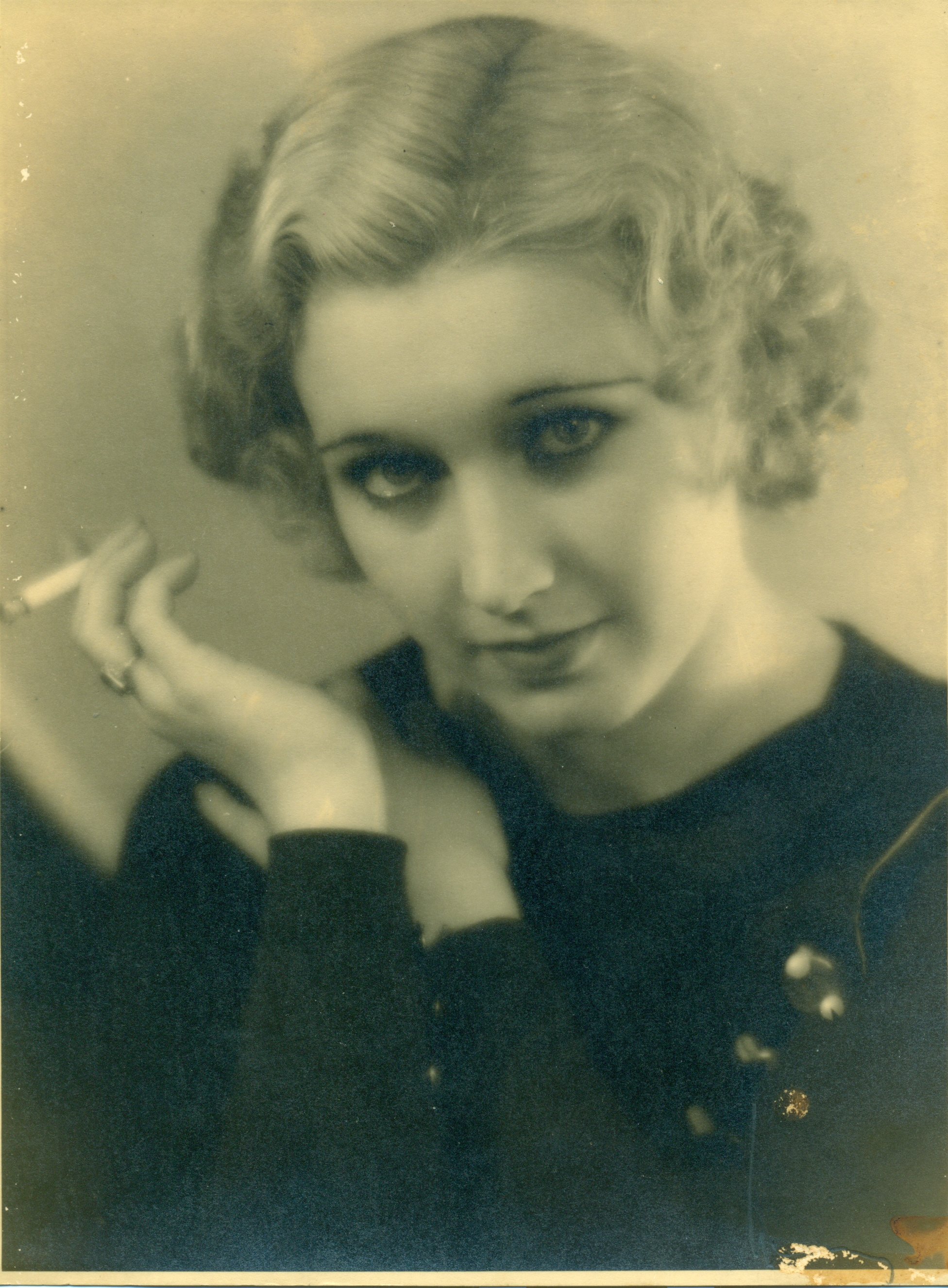
Next a treasure trove of Chumbley memorabilia surfaced that verified his stories. This archive touched not only his life, but that of his wife, Helen Thompson Chumbley. An accomplished dancer, Helen preserved every memento related to her equally remarkable career. Steamship tags, playbills, performance reviews, baggage stickers, and photos of an eager, happy girl costumed in an array of attire for stage productions or film sets. Helen too, aimed to preserve her accomplishments saving pictures, lists of business contacts, and letters home to her mother–all depicting a clear narrative of Helen’s own artistic path. Her passport, for example tells of extended junkets to Europe in 1932, London, 1934, and Brazil in 1936. All journeys illustrated with glossies, more letters home, and snapshots of a young dancer having the time of her life.

Their lives unfolded before me only to shift and refocus with each new piece of evidence. This composition grew so immense that only one book became impossible. Inevitably I had to find a fitting close, and then resume the tale in a second volume. Chum’s early years, for example, required a deeper examination of the aviation industry; complete with the serious obstacles he met attaining his wings. It also became crucial to explore the larger story of America, understanding the national barriers Chum overcame to see through his goals.

The same hurdles held true for Helen. Readers had to be reminded that the decades presented in River of January were years of careless economic boom followed by a devastating bust, leaving her path that much more daunting. Moreover, her mother required financial support in an era with no Social Security or Medicare. The burden fell completely on young Helen and her sister. With talent and fortitude, Helen’s grit loomed large in this story, tinged by a real fear of devastating consequences.

This author had formidable obstacles to overcome, too. The most profound drawback, the greatest obstruction–I had absolutely no idea how to write– not in any vibrant or intimate style. If the truth be told, creating River of January felt much like building a car while driving it down the street. River’s first drafts were so awkward and flat, that my first editor fired me as a lost cause. Mortified, I wanted to crawl under my bed, and never write again. And worse, I couldn’t disagree with this editor because I honestly had no idea what I was doing. Still, the book didn’t care. River wasn’t interested in my shortcomings, and the story refused to go away. Despite feeling an amateur fool, I bravely soldiered on.

Every family has a story waiting to be unveiled. In this instance the flow of narrative arrived from three directions. First, and most significantly, was my marriage to Chad Chumbley, the eldest son of Mont and Helen Chumbley. It was he who initially conveyed there was a tale to tell. With what little Chad knew of his father’s career and his mother’s accomplishments, my husband was certain of an epic waiting to appear.

The abundance of primary documents sealed my fate as my in-laws biographer. And again, though I didn’t recognize the forces at work, sifting through each item from that vast collection boosted the project forward. And this couple saved EVERYTHING! Air show tickets, menus from European eateries, pressed flowers, telegrams, his logbook!

By 2005 we coaxed Chum to come west and take up residence in an assisted living facility. He soon became the most popular, most charming tenant in the place. And it was in his room, 18 months later that we sadly attended his death. A mighty Virginia pine had fallen, and the era of his extraordinary life died with him. For me, that could not stand—Chum’s story deserved to be remembered, and no one else was going to see that job through. Nor could Helen be forgotten. Her qualities of greatness cast as large a shadow as her husband’s. I had no choice but to ignore my doubts and get to work piecing together their lives–from youth to marriage.

Not all members of the family were keen with my project. And I am sensitive to their concerns. But, Chum and Helen lead such astonishing lives, and achieved such great accomplishments, that I decided to forge ahead and make River of January a reality.