A former student, Allison Hawn interviewed me for her blog, Normally Surreal
Thanks Allison.
http://circusplatypus.blogspot.com/2014/03/a-bit-of-january-in-march.html
A former student, Allison Hawn interviewed me for her blog, Normally Surreal
Thanks Allison.
http://circusplatypus.blogspot.com/2014/03/a-bit-of-january-in-march.html
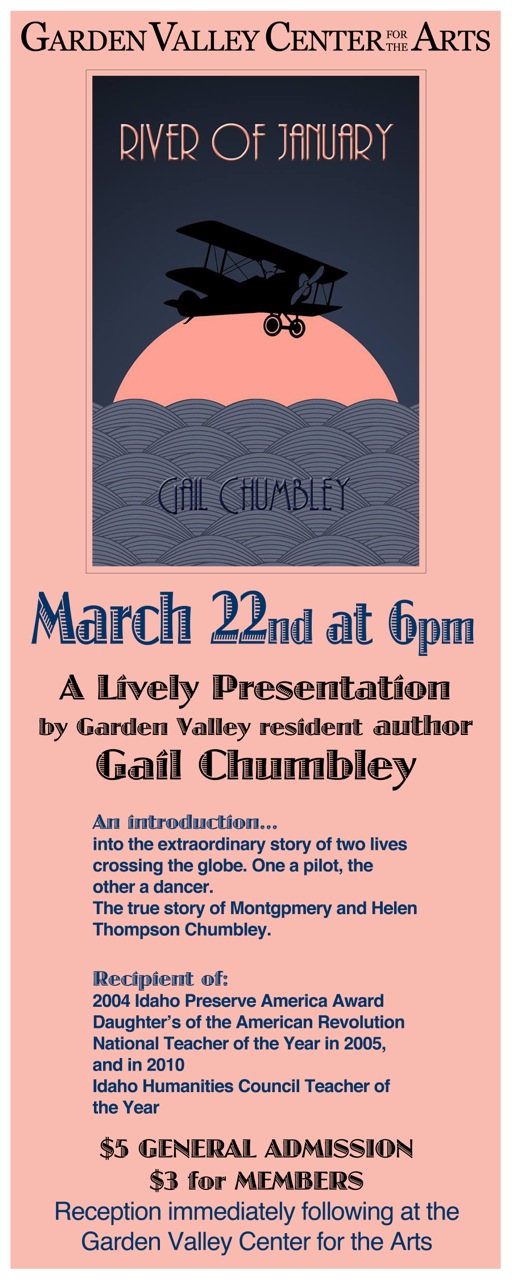
It is with great trepidation that I announce my first book presentation. In front of people. Sitting in front of me. Real people. Watching me. Yikes.
Send up good vibes, please.
http://www.river-of-january.com/ Need some good cold weather reading? Follow the link and relive the adventure of River of January
 PBS ran a series called “Finding Your Roots.” It was hosted by historian Dr. Robert Louis Gates and focused on celebrities and their genealogy. Yo Yo Ma, Meryl Streep, Eva Longoria, etc . . . were featured on the program. The show quickly transitioned beyond the begats of family trees when Dr. Gates added revealing blood tests concerning ethnic group composition. One guest, an African American professor, found that she was actually Caucasian, with little African makeup. The woman looked visibly shaken as she absorbed the news, clearly at a loss to define herself in this new light. It felt almost cruel to watch her grapple with the science.
Identity can be a slippery concept. For thirty three years I was known as teacher. Along with wife and mother, teacher constituted the third leg of my reality. Family concerns and lesson plans ran equally through my thoughts. I listened to my husband’s work problems, worried about classwork my own two had to complete, and prepared for my own lectures. That was my life and my identity.
Any travel, reading, or discussion usually had a connection to history. I attended seminars at Gettysburg, along the Oregon Trail, and touring the grounds at Mt. Vernon, Virginia. After years of historic pursuits, I retired and turned to writing.
The people I am meeting now, while promoting “River of January,” think that I am a writer. A WRITER! I am not settled yet with that new moniker, it feels pretentious to presume the role of author. Does taking a story that fell into my lap, experimenting with sentences to tell the story, adding pictures and a cover make me a writer? This new definition of Gail is going to take a while to break in, like new shoes, or a pair of jeans fresh out of the dryer.
Identity is a funny concept. When exactly does it happen? When does an occupation become an identity? The professor featured on PBS taught African-American studies, considered herself black and then bloodwork betrayed her foundations of reality. What has she done with that new information? Who is she now?
And that reminds me–I hated Metaphysical Philosophy in college. I wasn’t too thrilled with Voltaire, Montesquieu, or the rest of those dudes, either
At our most essential level who are we as people? If another looks to me as a writer, am I indeed what they see? I can counter that notion with thousands of kids who passed through my classroom and see only teacher.
My computer crashed, but I have wonderful neighbors who are IT wonders. The little gadget is now up and working. Progress on all fronts with the book. Speaking engagements are lining up and books should be done by the end of the month.
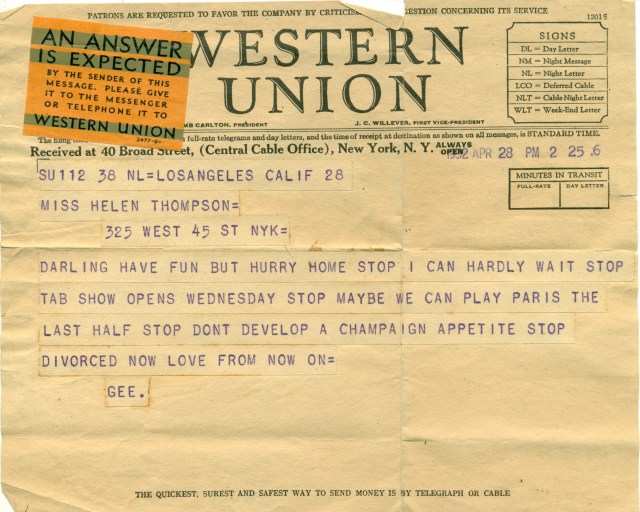
Pictured is a telegram for Helen from an admirer, before she shipped off to Europe in 1932. The story appears in the book.

It’s Sunday, it’s raining, and my husband is watching golf. I have given myself credit for remaining conscious with so many reasons to go back to bed.
But I’m excited. The book talk on the radio yesterday came off smoothly.
Two days ago I spoke with the radio announcer on the phone filling her in a bit on the story. Either she was in a hurry to get back on the air or simply wasn’t impressed. That was okay. I am accustomed to impatience when I start to blather. After all, I taught school for decades.
However, despite her indifference, I decided to bring along some photos of my protagonists, Helen and Chum. Before we went on the air I shared them with the disc jockey. It was awesome. She lit up like a Christmas Tree. “I had no idea,” came out of her mouth. “I love this era, it was so glamorous,” she added. I simply replied “I know.” And the interview began.
All someone has to say is “tell me about your book,” and I am off to the races. She grew as animated as I felt, and brought up the photos a couple of times during the interview for listeners to understand. I think that it was a promising start to my book promotion. Not that everyone will like River of January mind you, but just a chance to explain the story, and how it evolved gave me heart.
My publisher, Yvonne Rousseau at Point Rider Publishing saw what I saw from the beginning. She has championed the book more than once when I was ready to abort the mission. Yvonne has proven very proficient at hand-holding when necessary. And her daughter, Brook Rousseau, the artist behind the cover design, has been nearly mystic in capturing the story in a bold image. I think many books will sell simply because of her exquisite design. A big thanks to Yvonne and Brooke–a true team of pros.
I suppose this promising start to River’s launch is exciting enough to keep my eyes open on this wet, gray day. In spite of listening to soft-spoken analysts murmuring boring commentary from the Cadillac World Golf Championship.

Hi All–Tomorrow is the first big day for River. I have been asked to speak on our local radio station regarding the publication of my book. Yikes!
Wish me luck.

My book, River of January is not, I repeat, not a romance novel. Does it contain a love story? Yes indeed, and a good one too. However, the two destined to find each other, Chum and Helen, meet later in the book.
The manuscript has made a small circle of rounds, either for review or because someone felt they could help promote the work. And of all the folks who have read it, only two readers complained that the romantic part didn’t come soon enough in the story. I have to admit that was frustrating to hear, because so much cool stuff transpires before they meet in the book. Paris, London, Rome, Vienna, dancing, singing, and ocean liners for Helen. Tragedy, endurance, ambition, aviation, air racing, and adventure for Chum. And all of the action is true and verifiable. What do these readers think? Is real life no more than a love story? Is their life no more than a love story?
I understand enough to say that these folks are looking for a marketable formula. They look for the effort to possess the elements that sell in fiction. However my work is creative nonfiction and follows no predictable pattern, just like any persons life. These two people pursued avenues that opened to them, as we all do. It’s just that their paths included vaudeville stages, the silver screen and the golden age of aviation. Isn’t that enough? I wrote the book to chronicle two actual lives. If the work sells on that merit, that will be wonderful. My limit is changing the story up to fit a commercial template. To even think of shuffling the events around feels sleazy and unethical.
It was my son, my sage, who reduced the conundrum down to a simple truth. He explained that once I commit the words to paper I lose control of how readers perceive them. And he is right. After the telling, the tale belongs to each individual and their unique interpretations. And that means letting go of the outcome.
I don’t remember the topic, I think it may have been health care, but a friend loudly complained, “I don’t care about the past, I care about now.” He was annoyed with me for suggesting there was turmoil with the passage of the Social Security Act under FDR and more with Medicare under LBJ. I have to admit that stunned me for a moment because I look behind nearly every current event that crosses the news.
As I am writing, Russian President Vladimir Putin has demanded approval to deploy troops to the Ukraine. The demonstrators in Kiev made use of the Olympic media presence to make their move, and that was smart. But now that the cameras have gone, Putin is laying down some payback for the distraction to his Olympics. All done in the present tense and understandably awful.
But why? What is the back story? Who died and put Russia in command of the Ukraine?
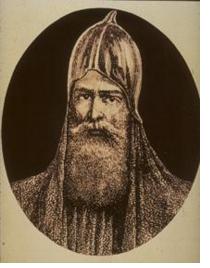
Old story. It began when a Viking named Rurik founded Kievan Rus back in the day. And President Putin claims the same authority for this current invasion in 2014.
I am not trying to write a report for my fifth grade teacher, but the Russians do look at that region as within their sphere of influence. And believe me, I am not an expert on that part of the world–but the impact of Russia’s past claims to the south and west doesn’t require shiny credentials to understand.
After the 1917 Revolution and the First World War, the Ukraine folded into the emerging Soviet Union, it’s boundaries fading from maps for the next seventy years. During Marshall Stalin’s reign of terror in the 1930’s, nearly the entire middle class of Ukrainian farmers, “Kulaks,” were exterminated and the land collectivized.
Russian nationalism, it’s sense of blood and belonging, includes the southwestern region of the Ukraine. And they mean business. I remember the Ukrainian president who suffered mercury poisoning which left him alive, but quite disfigured. Though the proof is circumstantial, the likely perpetrator was the old Soviet KGB, or the agency’s non-Communist replacement. Putin was an operative at that time.
I offer very little in solutions to this aggressive action on the part of the Russian government. We in the West believe the people of the Ukraine deserve their own national integrity and future. Still the pull of history remains overwhelmingly powerful. All I can offer is an understanding of the roots to this conflict. The connection between the two republics stems from a past that is far more complicated and difficult than a headline.To assume that justice and fair play figures into this struggle for freedom is irrelevant. There has never been any such understanding between the Russians and their cousins.
A Russian scholar would certainly shed more historic light on the topic, and flesh out more details and episodes, especially concerning the Romanov Dynasty. However, this iron-clad dynamic exists between the two countries whether the western press examines the connection or not.
For the record, more remote republics are viewed in the same possessive light as the Ukraine, Chechnya for example. If the past provides any guidance, which I believe it does, this story is nowhere near over.
No doubt that one of the primary reasons I retired was burn out. I had worked in secondary classrooms the length of my adult life and struggled the last couple years largely due to growing political pressure. You see, I bought into the idea that hard work paid off and came to realize that I was dead wrong. My hard work didn’t matter. None of my colleagues hard work mattered. My student performance outcomes, though well above the national average didn’t matter. Nothing moved policy makers except that they could hire two new teachers for the price of me, and many of my fellow staffers.
When the mortgage market imploded in 2008, Southwestern Idaho flat-lined economically. While teachers, such as myself, fought draconian budget cuts the legislature didn’t listen. They didn’t care. The brutal impact on classroom numbers and lack of materials made no difference, their ears were closed. In fact, the Great Recession instead provided an opportunity to attack our union and kill protections such as negotiations, due process, and arbitration rights. I found that regardless of my expertise and my kids remarkable growth I was handed more students in class (220 every other day) and less time to teach (down 25% a week).
When I realized I could swing retirement I took it.
I worry about what is behind me in public classrooms. There are enormously bright kids out there begging to be challenged. These young people are smart, but need skills and information to develop their optimum potential. However, as long as law makers settle for cheap, keeping salaries spartan, and classrooms packed, I cannot see America preparing for the future. The results will reflect the dismal investment.
In my state the Superintendent of Education denied that teachers were leaving education due to the perceived oppression from the legislature. And he can tell himself and the entire House and Senate that tale. It’s just not true. Teachers want to succeed, aspire to excellence, wish to see achievement among their students. That is why the miserly funding and lack of support by policy makers has had such a negative impact. No one wants to go into a job already set up to fail.
Teaching as a profession shouldn’t be done at such personal sacrifice.

