Much Obliged

Peacock0002

Thank you for taking part in “River of January’s” free Kindle Weekend! Enjoy the story with my compliments.

Stay in touch. As you finish the book, drop me a line, add a review on Amazon.com, and be sure to tell a friend.

For more, visit the photo gallery at www.river-of-january.com

Book Two, “The Figure Eight” is in progress.

This Week, 1935

IMG_0191

The old pilot’s time with us grew to mean a great deal to me, personally, but made it that much harder to let him go at the end.

Chum’s last years brought him out west to Boise. It was much easier for my husband to care for him than the semi-regular flights to Miami, sorting out some kind of preventable crisis. Once his father settled in here, they were together every day at the assisted living facility. I believe their time together gave both of them a lot of comfort.

As for Me? I just loved to sit and talk to my father-in-law. If he had felt more spry I would have dragged him into my history class for my own version of “Show & Tell.” I mean, really! William Howard Taft was in the White House the year Chum was born! His life was a damn book. (see River of January)

On one particular Sunday we drove over for a visit, and brought him Mexican food . . . Chum’s favorite. I was anxious to talk to him because we had rented “The Aviator” the night before, the film about Howard Hughes, and Chum had worked for the millionaire at one time.

Me: So we watched a movie about your old buddy, last night–Howard Hughes.

Chum: Ha. He kept the Kleenex business in the black.

Me: (Oh, geez! How could he know that?) And your old girl friend, Kathryn Hepburn.

Chum: Yeah. Katy. She was a nice girl.

Me:(Katy? A nice girl?)

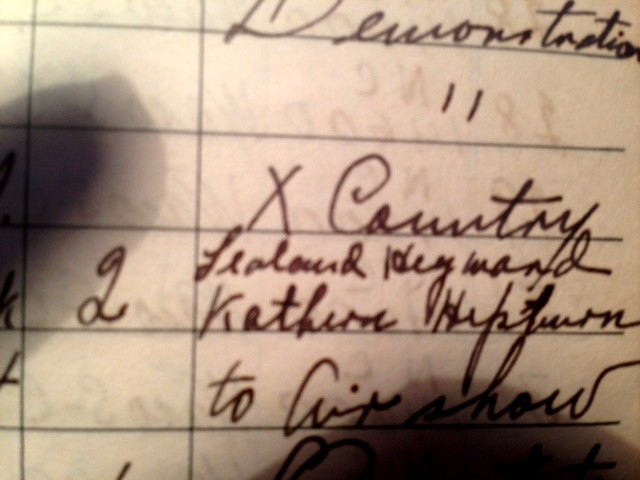
Chum: Her boyfriend, that theater producer, Leland Hayward–I taught him flying lessons, and she came along.

Me: Yeah. (Yeah)

And here it is folks, if you didn’t see at the top. The old history student has to whip out the proof. Have a nice weekend.

  IMG_0192

Gail Chumbley is the author of River of January. Available on Amazon.

Air Race, Willie Whopper Cartoon, 1933

willie_whop1

https://www.youtube.com/watch?v=S66wOkha0aU

A vintage piece of celluloid from the Golden Age of Aviation. This cartoon has it all: racism, sexism, the boy hero, the hairy villain, and a hot girl (Earhart, sexy?). Reminded me of the pod races in Star Wars. This whimsical cartoon premiered  the year Chum won his air race, “The Darkness Derby.”


River of January is available on Amazon.com and www.river-of-january.com

Another New York Story

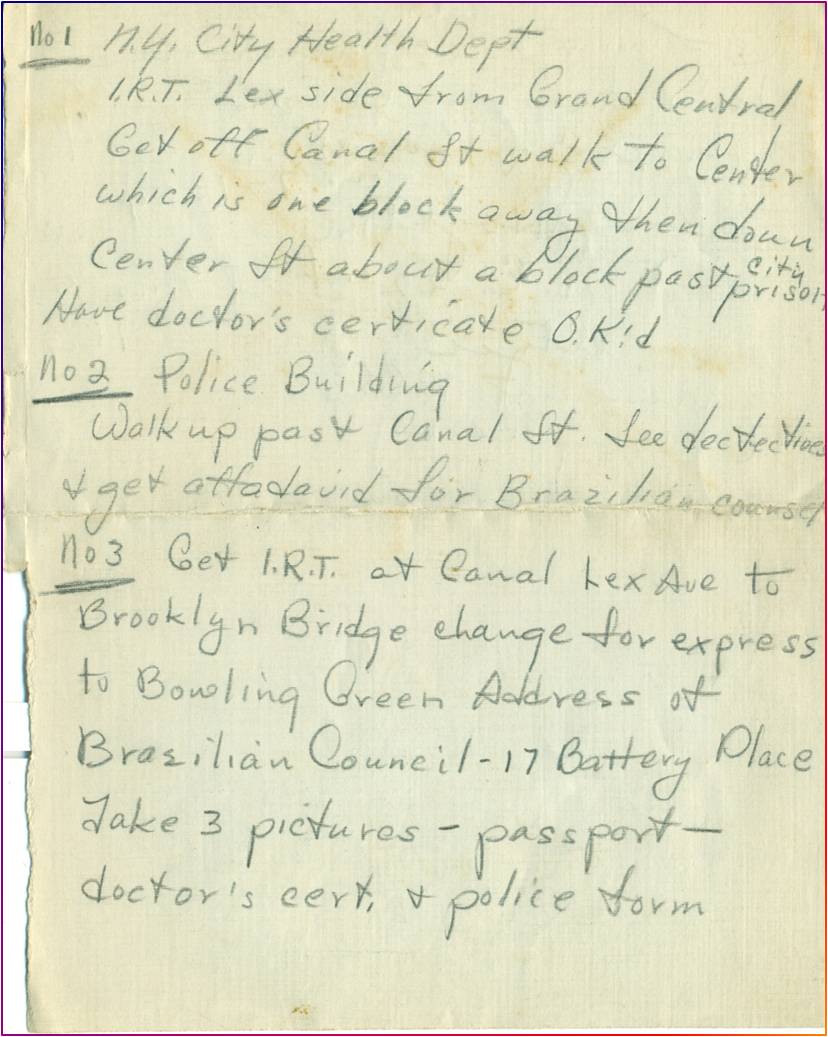
riolist

So caught up in the process of writing River of January I didn’t see much beyond my keyboard and monitor. Focusing intensely on grammar, style, punctuation, research, and every other detail, I failed to see a beautiful New York story take shape before my eyes.

A New York story. The New York of Vaudeville, Tin Pan Alley, Jimmy Walker, and silent films. The New York of Roosevelt Field–Lindbergh lifting off eastward toward Paris, achieving legendary status, and where Amelia Earhart later trundled down that same runway only to meet her mysterious end in the South Pacific.

Mont Chumbley, one of two central figures in River worked at that same storied airfield, braking down runway #1, arriving first in the 1933 Darkness Derby. He had braved inky night skies in his quest, worsened by wind gusts and growing cloud cover.  Pushing through from Los Angeles to New York, Chum prevailed, victorious, He received honors for his achievement at the Capitol Theater, 1645 Broadway, when Actress Helen Hayes presented him with his cash winnings, and an over sized silver trophy. Becoming something of a local celebrity himself, many from the city sought him out for passenger transport or flying lessons. On one instruction flight,Chum found actress Katharine Hepburn in the cabin of his plane, joining her boyfriend, Broadway producer, Leland Hayward.

 Helen’s New York consisted of auditions and productions from the Boulevard Theater, to the Roxy, performing for Billy Rose, finally dancing in “The Harry Carroll Revue.” As if a scene from an old movie, she set sail in April, 1932 on the SS Ille de France. This transatlantic voyage carried the girl from New York Harbor for an extended tour across Europe. Two years later, in 1936 she stepped up the passage way of The American Legion, a steamer on the Munson Line destined for Rio de Janeiro. Joining throngs on the top deck Helen gleefully waved goodbye to her family, smiling back from the Brooklyn docks. And speaking of family, Helen’s home address, 325 West 45th Street, was the third floor of the Whitby Hotel smack-dab in the middle of the Theater District. And though refreshed and remodeled today, that apartment building still stands–a direct link to an earlier era, an earlier New York.

Helen and Chum both lived in Manhattan at the same time. But he had his New York story to fulfill, and so did his future bride. That they crossed paths on the sidewalks, subways, theaters, restaurants, and trains before exchanging their first hello is certain. But as proper New Yorkers the two finally met elsewhere, at the Club Copacabana in Rio, a hemisphere away. There these two New Yorkers finally locked eyes, and fell in love.

Eventually, when circumstances allowed, Helen and Chum returned home to exchanged vows at the Church of the Transfiguration, on East 29th and 5th Avenue. This location is better known to New Yorkers as The Little Church Around the Corner.

I’ve finally come to recognize that River of January has become more than the narrative of two lives in the early days of aviation and show business. This story takes place in the magical metropolis of New York–where Helen and Chum found magic of their own.


A New April

Image

Right now, in classrooms across America, and overseas, thousands 17-year-olds are preparing for the AP US History exam. They, and their instructors are obsessed with cause and effect, analyzing, and determining the impact of events on the course of America’s story.  Moreover, they are crazed beyond their usual teen-angst, buried deep in prep books, on-line quizzes, and flashcards. As a recovering AP teacher, myself, I can admit that I was as nuts as my students, my thin lank hair shot upward from constant fussing.

My hair fell out too, embedding in combs and brushes, as I speculated on essay prompts, that one ringer multiple choice question, and wracking my brains for review strategies. The only significance the month of April held was driving intensity, drilling kids on historic dates; Lexington and Concord, the firing on Fort Sumter, the surrender at Appomattox Courthouse, President Wilson’s Declaration of War in 1917, the battle of Okinawa, MLK’s murder, and the Oklahoma City bombing, That was what April meant in April.

To quote John Lennon, “and now my life has changed, in oh so many ways.”  Today April holds a whole new definition. My husband rises first in the morning, putters in the kitchen, fetches coffee, tends to the dog, and is back in bed, back to sleep. Big plans for my morning include writing this blog, making some calls related to book talks, a three mile walk through the Idaho mountains, then working on Figure Eight, the second installment of River of January. What a difference!  Nowadays, getting manic and crazy is optional. My hair has grown back in, standing up only in the morning, and the only brush with AP US History occurs in my dreams; the responsibility passed on into other capable hands.

This month, at least here in the high country, has been especially beautiful. We have already enjoyed a few 70 plus degree days, and the green is returning to the flora. Our sweet deer neighbors are no longer a mangy grey, emerging from the trees wearing a warm honey coat. With a little snow still on the peaks, the sky an ultra blue, and the pines deep green and rugged, I think sometimes this must be Eden.

My years as a possessed, percolating history instructor provided a gift of passionate purpose that enriched me more than depleted.  But, now . . . I wouldn’t trade this new phase of my life for all the historic dates in April.

Gail Chumbley is the author of River of January also available on Kindle.

Define Truth

One question raised about River of January is,”Are my characters brushes with the famous true?”  The short answer is yes.  Helen dined with Maurice Chevalier, and they performed on the same stage.  Chum crossed paths with Amelia Earhart regularly at Roosevelt Field.   The celebrity passages are factual.  I have their pictures with the famous, references from documents, and proof in aviation logbooks.

Creative non-fiction appears to be a new genre in search of defining itself.  Where exactly is the line between creative and non-fiction?  Though I need to tell this story, I certainly wasn’t alive at the time.  Frankly who knows what the characters precisely uttered to one another at any given time.  I tried to rely on personal and business letters, quoting at length when I could, to add tone, cadence and a feel for the era.  I am adding a lot of pictures for readers to visually connect to the characters, and the sights they photographed on their travels.  Additional color had to come from my imagination, with clues found  in the archive of family memorabilia.

My personal preference in reading is non-fiction history.  I have lived on a strong steady diet of biographies and general histories.  Still I wonder how any scholar concludes their work without feeling uneasily incomplete.  The subtleties of human interaction, the nuances of personal connection are more than left out.  We simply can’t know all facets of historic lives.  Our only alternative is to flesh out the tale with what we understand about the human condition.  And of course every writer struggles with their own blinders, biases, and preconceived notions.

For example the age old question of General Washington’s taciturn exterior has intrigued historians for two centuries.  Was he grave and somber because his teeth hurt?  Possibly.  Did he wish to hide his false teeth due to the fact they were unsightly,  fashioned out of a number of materials–ivory to human–to wood.  Are both theories wrong?  Did Washington remain stoic in appearance to evoke nobility and dignity?  Maybe.  In fact, all of the above could pass scrutiny.  Different historians have differing opinions.

I am not too troubled about shaping feelings in ways I think makes sense.  I’ve fallen in love, held my own in arguments, and felt more regrets than I care to claim.  That is the truth I rely upon to craft the creative element in this historical narrative.

I think all biography and history  possess an element of the unknown.  Whether the history is filtered through professional scholars such as Robert Remini, Doris Kearns Goodwin, or Miss Nobody Gail in her Idaho cabin, we are analyzing viable evidence to apply shape and logic to past lives.

Did Helen meet Sophie Tucker.  Yes.  She told us in a letter.  What did she say to her?  How did she act around her?  I ask myself what would I have said as an American to another famous American performing in London?  That’s the creative portion of this non-fiction format.

All things considered, creative non-fiction is an exciting new canvas for writing.  I feel like a kid in a candy store each time I turn over another photo or letter.

Amelia Earhart?

Image

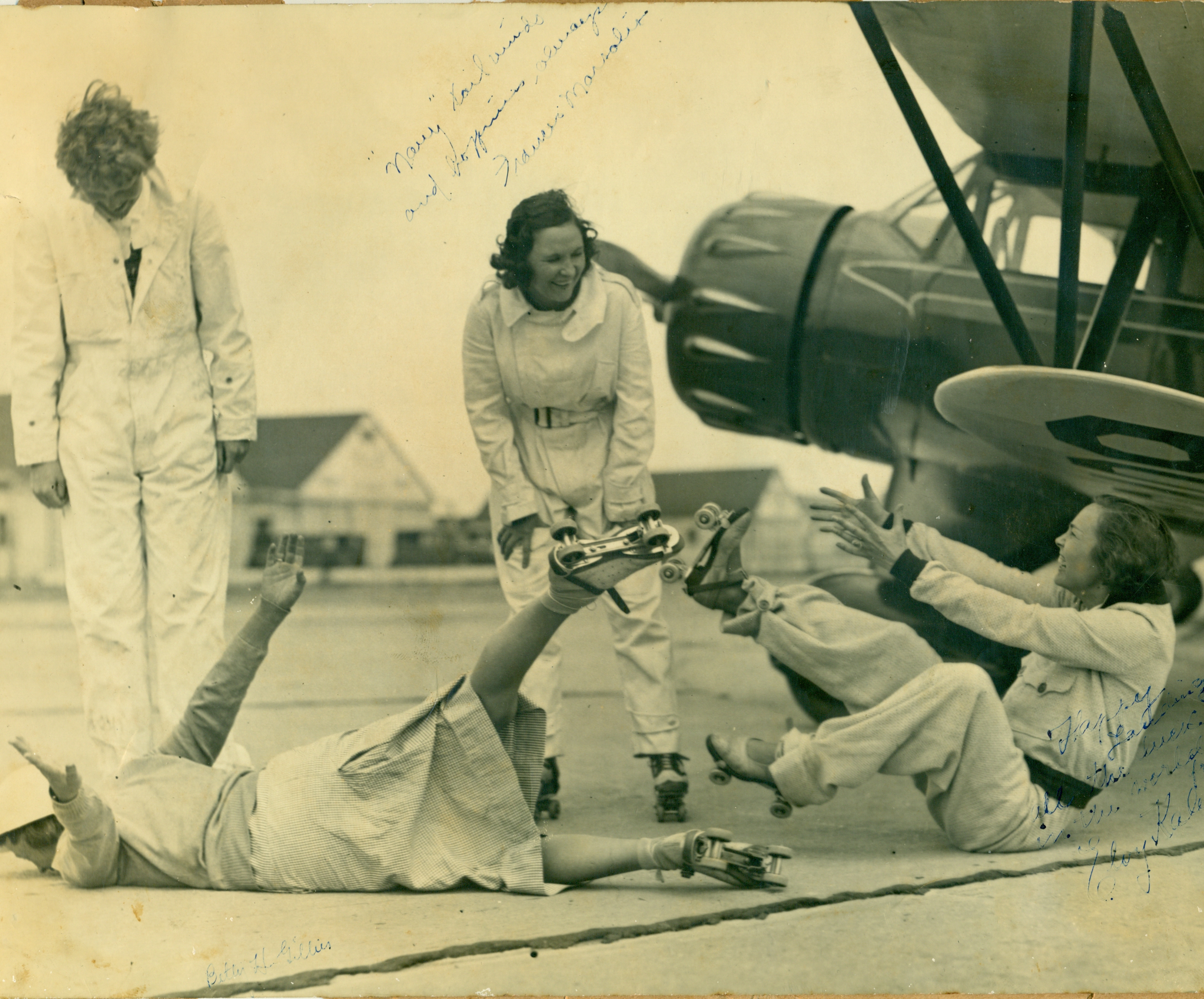
Piecing this story together didn’t come easily.  Though I have had the benefit of volumes of letters, telegrams, and pictures, among other sources, I still have struggled to get the story right.  The picture posted today provides an example of the most exciting finds I’ve made, but still shrouded with some doubt.

The girl in the center, in front of the Waco airplane, is Francis Marsalis Harrell.  From Chum’s thick scrapbook and an interview I conducted with him, I know her to have been his girlfriend.  They dated for a about a year after he left the Navy, and I believe he cared deeply for this young lady.  What brought me to that conclusion was piecework and conjecture.  First, during my interview sessions with Chum he lightly mentioned that his girlfriend used to time his trips into Manhattan from Long Island, but only when he drove female flight students into the city.  Second, when he looked through his ancient scrapbook, coming across her picture, he had to get up and walk around on his old legs, getting water from the kitchen and using the bathroom, before we could begin taping again.  I remember that clearly.

While researching my book, River of January, I gained a brief education in early aviation history.  I learned that there was a group of women who closely gathered in a league known as the “Ninety-Nines.”  This association of female aviators was a tight-knit assemblage, drawn together to survive in the male dominated world of flight.  These women resolutely broke ground for future generations of women to find their place in the cockpit.   These girls were enthusiastic and fearless pioneers.

Returning to the picture again, I found that three of these women pilots, all horsing around on roller-skates signed the photo.  Francis signed it “To Navy,” her pet name for Chum. The girl on her belly and the other one on her rear end are Betty Gilles and Elvy Kalep, other Ninety-Niners.  So the question for me has been, who is the fourth girl wearing her mechanic’s togs?

One morning, staring at this picture for the millionth time, the scales fell from my eyes and I saw Amelia Earhart.  You might see her clearly too and wonder how I missed the obvious, or think I’m nuts for believing it’s her.  So I ask myself, “Is the time right?  Is the place right? Are there other pictures from this publicity shot?”

The answers are all yeses.

This picture came from a google search of Elvy Kalep.

In the effort to reconstruct the past there exists uncertainty and conjecture.  However, thank goodness, also there exists logic and probability.

Boy, this has been fun.

Gail Chumbley is the author of the memoir, River of January. Also available on Kindle