An American Prayer

Whatever your beliefs it’s time to lift your voice and be heard

O beautiful for spacious skies,

For amber waves of grain,

For purple mountain majesties

Above the fruited plain!

America! America!

God shed His grace on thee

And crown thy good with brotherhood

From sea to shining sea!

O beautiful for heroes proved

In liberating strife,

Who more than self their country loved

And mercy more than life!

America! America!

God shed His grace on thee

And crown thy good with brotherhood

From sea to shining sea

Katherine Lee Bates, Samuel Ward

Gail Chumbley is the author of the two-part memoir “River of January,” and “River of January:Figure Eight.” She has also authored three stage plays, “Clay,” “Wolf By The Ears,” and “Peer Review,” all examining moments in American History. In addition, Gail is the co-writer of a screenplay, “Dancing On Air,” based upon the River books.

Beyond The Symbols

Patriotic symbols, music, and the Pledge of Allegiance recited at a solemn ceremony can be deeply moving. A simple presentation of the flag at a formal function can be awe-inspiring. The lone, austere notes of Taps played at a military funeral elevates a moment into sacred reverence.

The sounds and symbols of American devotion are powerful.

Still, as commanding as recitations, patriotic colors, and America the Beautiful can feel, deeper symbols in our shared history can reveal so much more.

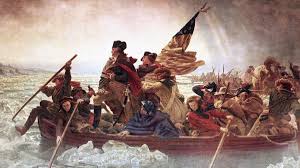
In his book, Washington’s Crossing, historian David Hackett Fischer introduces his volume with a discussion of Emmanuel Leutze’s famous painting of the same name. Fischer guides the reader through elements in the painting, noting passengers figure by figure as they frantically navigate the frozen Delaware River on that long ago Christmas night. 

Why is this particular work especially moving? Because at that juncture, December 25, 1776, the Revolutionary War looked to be flaming out after barely a start. Defeat had dogged Washington’s Continentals after being chased off of Long Island, and driven out of New York City the previous summer. As Washington planned his surprise Christmas attack, victorious Redcoats had settled into winter camp in New York City.

Humiliated, Washington knew he had to strike hard and he had to win.

Viewing his situation with the “clarity of desperation” the General ordered an assault on Hessian (German mercenary) held Trenton, New Jersey. The Continental army would have to use the element of surprise fighting against a better armed and better fed opponent. Risky to the extreme, Washington knew we, meaning America, for all time, was dependent upon his actions that night.

As for the painting, the artist depicts freezing soldiers huddled in a boat with more watercraft in the backdrop. From the starboard side, (to the right of General Washington) sits an oars-man, distinctly Black, putting his back into his strokes, ploughing through dangerous ice floes. Behind him, facing forward at the bow, is another swarthy figure, perhaps a Native American. He is desperately kicking ice with his left boot while handling a sharpened pole to break open a passage through the impossible crust. To the foreground an immigrant (a Scot by the look of his hat) studies the river’s surface closely as he pulls forward to port, while another behind him, in fisherman gear, studies the treacherous water. Others are made up of rustics, one at the tiller, along with a wounded passenger.

General Washington centers the painting as he is the central figure of the drama. Behind the General is Major James Monroe, and another rugged frontiersman by the looks of his garb. Both men are grasping a 13-star (Betsy Ross) flag, in a grip that elicits an attitude of determination and desperation, with perhaps a bit of warmth. Below both flag bearers sits a WOMAN, yes, a woman pulling her oar with an analytic eye upon the clotting water.

Black, Native, white, immigrant, the highborn, the humble, men and women, yesterday, today, and the future: all of our American lives balanced on the gamble played that night in 1776.

The point I believe Leutze is trying to convey is that we all don’t have to be the same. No one has to agree on the details of our beliefs to ride on that boat. The truth is Americans all have and had different realities and ambitions: differing views of liberty. Still, all onboard had to carefully respect each other’s space and not overturn that fragile vessel, Liberty, for we must stay afloat and row in the same direction. It is in all our interests to do so.

And that metaphor of America, that boat, tested our resolve on one of the nation’s most critical nights. Inspiration doesn’t come any better than from Leutze’s allegorical Washington’s Crossing.

Gail Chumbley is the author of the two-part memoir, River of January, and River of January: Figure Eight. Chumbley has also penned two stage plays, Clay, and Wolf By The Ears, concerning the life of Senator Henry Clay, and an in-depth examination of the beginnings of American slavery. Gail is currently working on another piece, Peer Review, best described as Dickens A Christmas Carol meets presidential history.

A Rare Topic

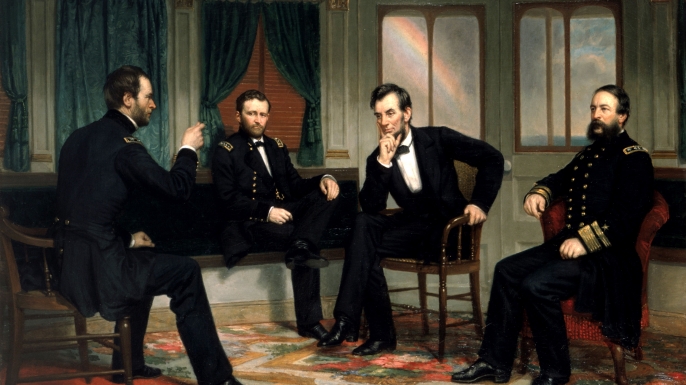
Lincoln, Grant, Sherman, and Gideon Wells aboard the River Queen, 1865

Watching a news host and guest discuss the topic of America’s Reconstruction era, my ears perked up, so rare is this matter presented. 

First of all, Reconstruction was the difficult period following the Civil War. The battles had ended, and the victorious president dead at the hands of an assassin. A new Battle Royale between Congress and the new President, Andrew Johnson, erupted over who would direct the aftermath. 

The thrust of the cable conversation centered on how important this time period remains, and that schools need to teach it. Much like Flo in the insurance ads, I started yelling at the television that I did cover that period, dammit. We all did in my department.

President Lincoln, before his death, had considered the role of newly freed persons as a moral imperative. Subsequent to the Emancipation, he had pushed for passage of the 13th Amendment, as dramatized in the film, “Lincoln.” Throughout the last months of the war Lincoln had revealed his vision of restoring Southern States. Based on the 1860 election records, when 10 percent in the rebellious states swore a loyalty oath, each state could reform their constitutions recognizing the abolition of slavery. President Lincoln believed he possessed the power to pardon, and he would make full use of that Constitutional power. 

Legally speaking, President Lincoln viewed secession as an attempt to leave the Union, and that attempt had failed. The Chief Executive would pardon the ring leaders, and move on to rebuild the nation. But his political opponents, the Radical Republicans, under the leadership of Congressman Thaddeus Stevens, and Senator Charles Sumner, saw the situation differently. 

For these abolitionists punishment was the order of the day. The 1864 Wade-Davis Bill mandated 50% plus of 1860 election rosters took that loyalty oath. To Stevens, Sumner and the like, these Rebel states had committed political suicide. Only after that majority swore the oath, including recognition of the 13th Amendment, would Congress consider readmitting each, as if new states. 

A political fight was brewing as to which branch held the reins to mend the nation, and deal with the lot of Freedmen.

The short answer is Lincoln’s death derailed any compromise. The Radicals held the day, and Southern whites would suffer. And Andrew Johnson was no match for an angry, determined Congress. In 1867 Federal forces occupied the South in political districts. Soon after, the Legislative Branch attempted to impeach the hapless new president. 

Though the 14th Amendment guaranteed citizenship to the newly freed, and the 15th guaranteed the vote, northern opinion drifted into apathy. Enforcing the rights of Freedmen lost popularity, and dropped from the headlines.

The Old South reasserted traditional apartheid rules.

The cost for the newly freed? Desperate people wandered back to the old master. With no protection, lynching became common as domestic terrorists spread fear. Rights of citizenship went unenforced, with sharecropping and the crop lien system replacing legal bondage. 

Perpetual debt chained workers to the land as effectively as if slavery remained legal. 

Poll taxes, vagrancy laws, and literacy tests tyrannized the newly freed, as did threats of violence from the Klan, and the Knights of the White Camelia.

In 1876, Republican Rutherford B Hayes barely won the presidency in a tight election. His campaign officials cut a deal with three Southern electoral delegations. Florida, (of course) South Carolina, and Louisiana. These states agreed to direct their electors to vote Republican, and in return the Hayes people promised to withdraw the bluecoats. Free Blacks were abandoned.

All in all, the promise of liberty lay in ashes.

When the moment arrived for equal justice, the cause died due to a lack of interest.

The cable host and his guest were right.

Gail Chumbley is a history educator and author of the two-part memoir, “River of January” and “River of January: Figure Eight.”

gailchumbley@gmail.com

The Bloody Shirt

Principled soldiers of conscience, the victorious army knew they had served well, defending the Constitution to the last full measure.

May of 1865 witnessed Washington’s Grand Review of the Union Army. Smartly uniformed soldiers filed past crowds, in a river of Union blue. The guns had silenced a mere month earlier at Appomattox, Virginia; the Republic preserved.

A brilliant sun glinted off polished bayonets, and the parade route decorated with miles of silk banners, tattered company colors and patriotic bunting. Rejoicing greeted the passing soldiers in shouts and fluttering handkerchiefs. Flower petals rained down in a fragrant carpet of gratitude. 

The bloody war finally, truly, had ended. 

One year later, near Springfield, Illinois, a group of veterans established a fraternal association, the Grand Army of the Republic. The idea caught fire nationally as other veterans founded their own local chapters; a place men could remember, share, and grieve for lost friends. Soon these war horses got busy extending their service to those they had defended.

First, survivors lent aid to disabled fellow veterans, assistance to widows and their dependents, and orphan homes. Soon preserving battle sites added to the group’s outreach. Before long members began seeking electoral office to further serve the nation.

A story has it General Benjamin Butler, now a Congressman, grew extremely agitated while speechifying, and produced a torn, and bloody shirt he claimed came from the battlefield. Soon the practice of “waving the bloody shirt,” invoking war credentials, became customary for candidates. The saying “vote the way you shot,” launched the careers of numerous politicians. 

Presidents from Ulysses Grant, (1868-1876) through William McKinley (1896-1901) had faced the rebels on the battlefield.*

War memorials and monuments mushroomed, funded with GAR donations. Reunions, benevolent societies, veterans homes, and hospitals kept local chapters busy. In fact, much of GAR efforts were eventually assumed by the Federal Government, particularly pensions for those who had served.

Over time survivors of the Civil War dwindled in number. However, the organization soldiered on until 1956 when it finally faded. Loosely related, though more a coincidence, our last five star general was serving as president when the GAR closed its doors. President Dwight David Eisenhower, who kept a farm in Gettysburg, happened to occupy the White House.

This brotherhood, this Grand Army of the Republic, rose to defend our democracy in the mid-19th Century. This model of valor, and sacrifice shaped the character of the military for years to come. 

But one truth is quite clear, no officer ever advocated for a coup, and there was not one sucker or loser in their ranks.

In 2021 we can do no less.

*Chester Arthur served in the New York Militia, Grover Cleveland did not serve.

Gail Chumbley is a history educator, author and playwright. Her two-part memoir, “River of January,” and “River of January: Figure Eight,” are both available on Kindle.

gailchumbley@gmail.com
Kindred Spirit?

Sen Henry Clay portrait (left of door.)

The word from a Kentucky acquaintance is that Mitch McConnell fancies himself a Henry Clay scholar. That probably means little to most, but Senator Clay (1777-1852) nearly single-handedly held the US together, postponing Civil War for over 40 years.

With a name that epitomizes progress and compromise, it feels odd Mitch McConnell proclaims a kindred spirit in Senator Clay. This earlier Kentucky Senator bent over backwards to protect and promote the vitality of our young republic.

Clay rolled up his sleeves and cultivated coalitions among his fellow law makers to keep the nation from fracturing. He orchestrated the passage of the Missouri Compromise in 1820, the Compromise Tariff of 1833, and the Compromise of 1850; all crafted to maintain the Union. In fact, the Civil War erupted AFTER Clay’s death, as no other Senator possessed the talent and determination to keep Congress talking.

In the interest of full disclosure, yes, Henry Clay owned slaves. And yes, he believed in gradual emancipation, as slavery proved antithetical to economic progress. The Senator’s commitment to America drove his efforts, and Clay worked with all political factions, even those he opposed.

McConnell does nothing, and takes pride in doing nothing. Invoking Senator Clay, who did a lot, is poor cover for an old obstructing politician to presume. Clay did not dig in his heels to impede the opposition party’s efforts to govern.

Henry Clay served his country, McConnell serves himself.

Gail Chumbley is the author of the two-part memoir, “River of January,” and “River of January: Figure Eight,” and the stage play, “Clay.”

gailchumbley@gmail.com

Hysteria and Martyrs

I didn’t care what my students thought. Their opinions were no business of mine. That they knew how to express those ideas, using factual information, was my business.

To introduce point of view, and critical thinking a quick textbook analysis did the trick. In groups (I assigned) students researched various history texts to spot biases in the presentation of historic facts. 

Over the years, a collection of comped survey books had accumulated on my classroom shelf. I used them for my own preparation, but decided to teach the same techniques to the kids. The task was pretty simple. All groups were asked to look up the two same topics: The Salem Witch Trials of 1692, and John Brown’s Raid at Harpers Ferry in 1859. They noted the title of the text, the authors, the publication date, and any particular word choices used to explain or describe each episode.

This was the first day of school, mind you, and holy cow the results rocked these 15-year-olds orderly world.

When each group reported their conclusions, skewed viewpoints abounded. In other words the same facts drew decidedly different conclusions.

One book blamed the Witch Trials on tensions stemming from continuous Native attacks. Another blamed simmering resentment over social class, inheritance disputes, and property ownership. Moldy grain was to blame according to the Prentice Hall book. The good people living north of Boston were tripping on ergot fungus, a hallucinogen spreading on damp wheat baked into bread.

Nearly all texts made use of the terms “fear,” and “hysteria.”

The John Brown case provided even more interesting results. If the book had been published before 2001, Brown generally came off a saint. If after, the language use grew more sinister. In pre-911 America, fighting slavery had a righteous, noble language, that justified the violence. Something to the effect that, in the name of the mighty Jehovah, Brown martyred himself to strike a blow against evil. By contrast, books published after the collapse of the Twin Towers dismiss Brown’s means as unfortunate, though slavery was still bad.

By the end of this exercise students often seemed flummoxed asking “who can we believe?” 

“Yourself, of course, and your analysis skills,” I always replied.

Gail Chumbley is the author of the two-part memoir “River of January,” and “River of January: Figure Eight.” Both titles available on Kindle.

For more explanation on this lesson email at gailchumbley@gmail.com

Humiliated, Angry, and Hurt

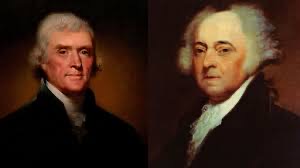
After losing reelection, he left Washington early. Humiliated, angry, and hurt, John Adams boarded a morning coach leaving the Capitol.

The prevailing issue in the campaign of 1800 concerned France, and that nation’s ongoing, and bloody revolution. Moreover, the French had declared war on England, and both belligerents  meddled in American domestic politics to turn public opinion.

As President, Federalist John Adams, had skillfully steered America clear of the European conflict, avoiding the danger of being ensnared between the two superpowers. Proud of his diplomatic accomplishments, Adams still brooded, unhappy with his lack of support from the country. His detractors belittled him, disparaging Adams as a pale substitute to the legendary George Washington.

His political challenger in 1800? The clever and calculating Thomas Jefferson. 

An outspoken critic of the Adams Administration, Jefferson had been hurling plenty of invective toward the sitting President. What had once been a warm friendship between the two men quickly soured. Petulant and  thin-skinned, Adams had lashed out by pushing laws that restricted the free press and cracked down on immigration. Outraged by these policies, Jefferson, and his growing cadre of supporters, challenged the clear violations of the Constitution. 

In only the nation’s third presidential election the moment appeared volatile and uncertain. On one side was the defensive and testy incumbent, and on the other, a political foe intent on replacing him.  

Adding to the turbulence, a political wildcard entered the fray; New Yorker, Aaron Burr.

Burr, like Jefferson, had opposed unpopular and heavy handed Federalist policies, and Jefferson knew the ticket needed an electoral-rich northern state for strength. As party leader, Jefferson assumed Burr understood his lesser place, and only when the electors met did he learned just how wrong he had been. 

In the final tally, poor John Adams not only lost the election, but came in a distant third behind both challengers. Thomas Jefferson garnered 73 Electoral votes, followed by Burr with 73 of his own. Adams came in last with 65. (That tie is another story.)

Humiliated, Adams left Washington DC in a huff, but made no move to challenge the outcome. And though the former President did not greet the President-Elect, and pointedly skipped the inauguration, John Adams did not put his interests above the nation’s. 

He conceded in silence because he valued our country over his own interests. 

There is no precedent for false assertions from the clear loser in 2020.

Gail Chumbley is the author of the two-part memoir, “River of January,” and “River of January: Figure Eight.” Both titles available on Kindle, or at http://www.river-of-january.com.

gailchumbley@gmail.com

Marking Time

2020.

Are the awful events of these last twelve months a once-off, bad patch of misfortune? Or is there a deeper explanation for the emergence of Trump, Covid, economic disaster, and civil unrest?

American History is steeped in a collection of pivotal moments, episodes that molded the nation’s continuing path. Can the events of 1776 stand alone as a turning point, or of 1865? 

A long metaphoric chain links one scenario to the next, marked by momentary decisions, government policies, or beliefs, that surface at one point in time, and voila, America’s story fleshes out to the future.

Add chance circumstances to the narrative and predictability flies out the window. 

Does 2020 stand alone as a singular event, or an inevitable outcome seeded somewhere in the past? Surely the march of history can be much like a chicken-egg proposition.

Mention 1776 and thoughts gravitate to the Continental Congress, the Declaration of Independence, and the emergence of General George Washington. But that struggle for freedom actually began at the end of the French and Indian War. 

As for 1865, when the guns silenced at Appomattox Courthouse, Robert E Lee’s surrender affirmed America as a nation-state. But thirty years earlier, President Andrew Jackson’s administration had sparked the eventual war over the issue of slavery. Thinly disguised as the doctrine of states’ rights, the intractable argument of slavery festered. The “Peculiar Institution” is, was, and always be the cause of that bloodbath. In point of fact the fury of one man, John C Calhoun, South Carolina Senator, and former vice president, lit the fuse of war thirty years before Fort Sumpter.

As to the folly of Trumpism, arguably the roots are deeply burrowed in America’s collective past. Author, and historian Bruce Catton, wrote about a “rowdyism” embedded in the American psyche. Though Catton used that term in the context of the Civil War, his sentiment still resonates in the 21st Century, i.e., Proud Boys, and the like. 

Closer to today, the Cold War seems to have honed much of the Far Right’s paranoia. The John Birch Society, for example, organized in the late 1950’s escalating anti-Communist agitation. Senator Joe McCarthy rode to fame on that same pall of fear, (with Roy Cohen at his elbow) only to fail when he went too far.

But the presidential election of 1964 seems to mark the most distinct shift toward the defiant opposition that fuels Trump-land.

Vietnam, in 1964 had not blown up yet. JFK had been murdered the previous fall, and his Vice President, turned successor, Lyndon Johnson was the choice of a grieving Democratic Party. The GOP fielded four major candidates in the primaries: three moderates and the ultra conservative, Barry Goldwater of Arizona. Senator Goldwater gained the nomination that summer with help from two men, conservative writer Richard Viguerie and actor Ronald Reagan.

Viguerie broke political ground through his use of direct mailing, and target advertising (what today is right wing news outlets). Reagan, once a New Deal Democrat, crossed the political divide and denounced big government in “The Speech,” delivered on behalf of Senator Goldwater. These two men believed Conservatism, and Laissez Faire Capitalism had been wrongly cast aside for liberal (lower d) democratic causes. 

Their efforts struck a cord with legions of white Americans who felt the same resentment. The Liberal Media and Big Government from the Roosevelt years were Socialistic and anti-capitalistic. No urban problem, or racial strife or poverty appeared in their culdesacs or country clubs. And taxes to support Federal programs squandered and wasted personal wealth.

So many other issues shaped the modern New Right. Communism, the Cold War, Civil Rights, Vietnam, and progressive politics alienated the wealthy class. 

But here’s the rub. Ultra conservative ideology is unworkable, an ideal that awards only a small, exclusive few, (today’s 1%). So 2020, and 2016 both have roots running deep in the core of the American experience. 

2020 isn’t about this moment, not really.  

Gail Chumbley is the author of “River of January,” and “River of January: Figure Eight,” a two-part memoir available at http://www.river-of-january.com and on Kindle. Also the stage plays, “Clay,” and “Wolf By The Ears” (the second in progress.)

gailchumbley@gmail.com

Set Their Feet On The Firm And Stable Earth

“Princes’ don’t immigrate” opined the 19th Century American magazine, Puck. The subject of the quote concerned the multitudes of immigrants flooding both American coastlines. Newcomers hailing from Asia and Southern Europe had alarmed American Nativists who considered the influx as nothing more than riffraff, and a danger to good order. Unfortunately this view of the foreign-born still endures today.

News footage over the last few years has chronicled the plight of the dispossessed amassing along southern tiers of both Europe and the US. Frequently victims of repressive governments, criminals, and crippling poverty, risk dangerous journeys, refugee camps, and even cages to escape hardships.

The earliest immigrants to American shores shared similar pressures, escaping the unacceptable familiar for an unknowable future. A brief look at the American Colonial period illustrates this enduring dynamic.

16th and 17th Century England targeted dissident groups in much the same way; exiling nonconformists, petty criminals, while others were lured by the hope of riches and a fresh start.

These emigres shared one common thread-remaining in England was not an option.

Religious challenges to the Catholic Church set in motion a veritable exodus of refugees fleeing England. As the Protestant Reformation blazed from Europe to the British Isles, the bloody transformation of the English Church began. In the 1535 English Reformation, King Henry VIII cut ties with the Vatican, naming himself as the new head of the English Church. This decision triggered a religious earthquake.

The Church still closely resembled Catholicism, and the disaffected pressed for deeper reforms, earning the title, “Puritans.” Ensuing religious struggles were long, bloody, and complicated. Ultimately the discord culminated in the violent repression of Puritans.

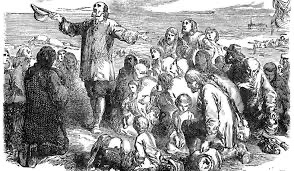
Two phases of reformed believers departed Great Britain for the New World. First was a small sect of Separatists led by William Bradford. These Protestants believed England to be damned beyond redemption. This band of the faithful washed their hands entirely of the mother country. Settling first in Holland, Bradford and other leaders solicited funding for a journey to Massachusetts Bay. Americans remember these religious refugees as Pilgrims.

Nearly a decade later another, larger faction of Puritans followed, making landfall near Boston. More a tsunami than a wave, the Great Puritan Migration, brought thousands across the Atlantic, nearly all seeking sanctuary in New England.

Lord Baltimore was granted a haven for persecuted English Catholics when that faith fell under the ever swinging pendulum of religious clashes. Maryland aimed for religious toleration and diversity, though that ideal failed in practice.

The Society of Friends, or Quakers, made up another sect hounded out of England. Britain’s enforcement of social deference, and class distinction, ran counter to this group’s simple belief in divine equality. Quakers, for example, refused to fight for the crown, nor swear oaths, or remove hats encountering their ‘betters.’ That impudence made the faith an unacceptable challenge to the status quo.

William Penn (Jr.) became a believer in Ireland, and determined the Crown’s treatment of Quakers unjust. After a series of internal struggles, King Charles II removed this group by granting Penn a large tract of land in the New World. Settling in the 1660’s, “Penn’s Woods,” or Pennsylvania settled the colony upon the egalitarian principles of Quakerism.

Scot settlers, known as Scots-Irish had resisted British hegemony for . . ., for . . ., well forever. (Think of Mel Gibson in Braveheart.) First taking refuge in Ireland, this collection of hardy individualists, made their way to America. Not the most sociable, or friendly bunch, these refugees ventured inland, settling along the length of the Appalachian Mountains. Tough and single-minded, this group transformed from British outcasts to self-reliant backcountry folk.

Virginia, the earliest chartered colony, advanced in a two-fold way; as an outpost against Spanish and French incursions, and to make money. At first a decidedly male society cultivated tobacco, rewarding adventurers and their patrons back home by generating enormous profits. Ships sailed up the James and York Rivers depositing scores of indentured servants, not only to empty debtors prisons, but to alleviate poverty and crime prevalent in English cities.

Transporting criminals across the Atlantic grew popular. The Crown issued a proprietary charter to James Oglethorpe, for Georgia. Oglethorpe, a social reformer, envisioned a haven for criminals to rehabilitate themselves, and begin anew.

All of these migrants risked dangerous Atlantic crossings for the same reason. Parliament and the Crown considered the Colonies as a giant flushing toilet. England’s solution to socially unacceptable populations, was expulsion to the New World.

Caution ought to guide current politicians eager to vilify and frame immigrants as sinister and disruptive. No one lightly pulls up roots, leaving behind all that is familiar. (Consider the human drama on April 1, 2021 where two toddlers were dropped over a border wall from the Mexican side).

Americans today view our 17th Century forebears as larger than life heroes, but their oppressors saw these same people as vermin–as dispensable troublemakers who threatened good social order. This human condition remains timeless, and loose talking politicians and opportunists must bear in mind the story of the nation they wish to govern.

*The Middle Passage was the glaring exception of those wishing to emigrate.

Gail Chumbley is the author of the two-part memoir, River of January, and River of January: Figure Eight. Both titles available on Kindle.

gailchumbley@gmail.com