Tag Archives: Gail Chumbley
“Set their Feet on the Firm and Stable Earth”
My mother has made it quite clear that she wants to live at home until the very end. Any member of our family daring to even think ‘assisted living’ can expect a reaming on the scale of a super nova. Mom has no reason to transplant elsewhere. She has her recliner, her adjustable mattress, her crossword puzzles, and her memories in that house. After 53 years under the same roof there is no other place–that home is the center of her universe.
Oddly enough her story somehow broaches the subject of why people do move—in this instance, the story of immigration to America.
The 19th Century American humor magazine, Puck once declared that “Princes’ don’t immigrate,” and that truth has found a lot of support in our historic record. Just a glimpse of current film footage along southern European borders powerfully demonstrate this 19th century truism. The vulnerable from Syria and other destabilized regions of the Middle East grapple with hate, fear and barbed wire to carry their families to safety.
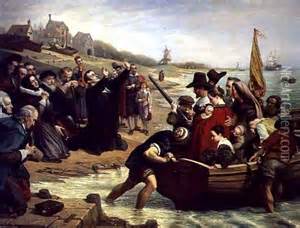
Immigrants to American shores have all shared similar reasons to exchange the familiar, for the unknown. A brief look at America’s earliest settlers well illustrates this dynamic from 1620 to the present.
Some folks were pushed, some were pulled, but all European newcomers set foot on Atlantic shores because there was no reason to remain in the familiar.
Challenges to the Catholic Church provided the first steps toward the flow of populations to leave Great Britain. The Protestant Reformation essentially secularized the English Church, rejecting and replacing the Pope for the British sovereign as leader. Devout believers felt that King Henry’s English Reformation did not go far enough in ridding sacraments for deeper Biblical understanding. This faction became known as “Puritans,” those who wished to cleanse the English Church of all vestiges of Catholicism.
The religious struggle in the British Isles was long and complicated, but ultimately resulted in systematic Puritan persecution. Two phases of believers departed Great Britain as a consequence. First, were the Separatists led by William Bradford, who believed England was damned beyond redemption. This group settled first in Holland, then acquired funding for a journey on the Mayflower to Massachusetts Bay. Americans remember these folks as the Pilgrims.
Almost ten years later another group of mistreated reformers made landfall further north, closer to Boston. This wave of settlers, unlike the small trickle in Plymouth, came to Massachusetts Bay in a metaphoric deluge. Thousands upon thousands of Puritans departed England, driven out by an intolerant, albeit re-Catholicized crown. Called the Great Puritan Migration, refugees from religious bullying settled from Cape Cod, to the Caribbean.
The Quakers, or Society of Friends, made up another group pushed out of England. In a stratified culture of forced deference to one’s “betters,” this faith recognized the innate equality in all people. Quakers, for example, refused to swear oaths or ‘doft’ their hats in the presence of “gentlemen,” and that impudence made the sect an intolerable challenge to the status quo.
William Penn (Jr.) became a believer in Ireland, and found this punitive treatment of Quakers unjust. However, as a wall to wall adherent to peace and brotherhood, Penn used his childhood connections to the aristocracy to depart to America. King Charles II granted Penn a large tract of land in the New World, where Penn and his followers settled in the 1660’s. “Penn’s Woods,” or Pennsylvania set up shop establishing the settlement upon the egalitarian principles of Quakerism.
The father of President Andrew Jackson, Jackson Senior, stands as an excellent example representing another wave of humanity dispensable to the British Crown. Dubbed Scots-Irish, these were Scotsmen who resisted British hegemony and unification for . . ., for . . ., well forever. (Think of Mel Gibson in Braveheart.) First taking refuge in Ireland, this collection of rugged survivors, by the 1700’s, made their way to America. Not the most sociable bunch, these refugees found their path inland, eventually settling along the length of the Appalachian Mountains. Tough and single minded this group transitioned from exiles to backcountry folk.
Now the settlers in Jamestown and Georgia offer a different explanation for permanent human migration.
The London Company of Virginia, a corporation, funded an expedition to Jamestown in 1607. Soldier of Fortune, Captain John Smith and his compatriots crossed the Atlantic to get rich. Inspired by the example of Spanish finds in Mexico, these English mercenaries were hopeful of finding golden cities of their own. Almost a disastrous failure, the Jamestown colony survived, not by precious metals, but from cultivating a Native crop . . . tobacco. Eventually arrivals outnumbered departures in the stabilizing Virginia settlement, and the addictive crop paid handsome dividends for London investors.
Georgia, the most southern colony came last, founded in 1732. The brain child of social reformer, James Oglethorpe, this colony of red clay became a dumping ground for victims of England’s byzantine criminal codes. Those of the lowest rungs of English society, from petty pickpockets to hardened felons found themselves “transported” to Oglethorpe’s colony for second chances, and out of the hair of English jailers.
On a side note, slavery explicitly was forbidden in the Georgia charter. And that raises the issue of the last group forced to American shores; African slaves. These unfortunate souls did not want to leave their homes in West Africa. Much like my mother, this group did not wish a new life in a new land. Economic demands brought about this “Middle Passage,” the despicable trade in human cargo, kidnapped for the New World. Force, brutality, and exploitation wrenched these people from their lands to serve those who for contrasting reasons came to live in America. The injustice of this “African Diaspora” still plagues an American society grappling to resolve this age-old injustice.
Caution ought to guide current politicians eager to vilify and frame immigration as an inherent evil and subverting occurrence. No one lightly pulls up roots. Leaving all that is familiar is an act of desperation, a painful and difficult human drama.
Americans today view our 17th Century forebears as larger than life heroes, but their oppressors saw these same people as vermin–as dispensable troublemakers who threatened good social order. This human condition remains timeless, and loose talking politicians and opportunists must bear in mind the story of the nation they wish to lead.
Oh, and my 84-year old mother just remodeled the house, keeping her Eden fresh and new.
Gail Chumbley is the author of River of January, and the newly published River of January: Figure Eight.
Excerpt Saturday: A Cultured Gentleman

Europe
1932
After Brussels, Elie visited nearly every town Helen played, frequently heralding his arrival with a spray of flowers waiting for her at each hotel.
“Please, please invite your friends to join us on our outing,” Elie cheerfully encouraged Helen.
In Paris, where Voila was performing, Elie motored a carload of Beauties to the countryside, stopping at the Bourbon Palace of Versailles. The American girls strolled amid the recovering gardens, the graceful flowing fountains, and grand buildings that had been severely neglected during the Great War, not so long before.
“Elie, this place is magical!” Helen exclaimed. “Have you been here before?”
“Only once,” the young man replied. “We—my mother, two sisters and I, traveled to Paris after the funeral of my father in northwest France. Perhaps I will take you up there another time.”
They toured the ornate grand salons including Marie Antoinette’s Petit Trianon, the queen’s palace. Helen lost herself, dazzled with the elaborate ivory and gold friezes along the walls and ceilings, and the gold-framed paintings hung in arched cornices.
Later, standing before a vast mirror in the Hall of Mirrors, the couple caught their reflection together—Elie smiling tenderly while Helen felt an inexplicable pang of regret.
In Strasbourg, on another day trip, the pair enjoyed a 12:00 tour of the town’s beautiful Gothic cathedral.
“Oh!” Helen exclaimed, captivated by the cathedral’s ornate astronomical clock inside the transept.
Elie whispered, “Wait my dear, it gets better.”
After only a few moments, small figurines emerged from above the blue and gold clock, within a square opening of the sandstone wall. The carvings represented the phases of life, holy saints, and culminated with statuettes of Jesus and his twelve apostles. While absorbed in the intricacy of the synchronized whirring, Helen felt a touch on her hand, as Elie took her arm. Together, the two silently contemplated this majestic tribute to the Almighty’s dominion over time.
On another stop Elie caught up with Helen by driving to Geneva. In the morning, before rehearsals, the Belgian escorted the dancer on a visit to the League of Nations.
“How did you manage passes, Elie? Charlotte and Grace were told they needed a sponsor to attend,” Helen whispered in the vast paneled halls, watching Elie retrieve the official cards from his pocket.
“I have a business contact here in the city who agreed to endorse us,” Elie quietly responded.
Finding their seats in the public gallery, Helen listened as one prominent gentleman after another eloquently spoke of a peaceful world. Moved by the solemn atmosphere in the chamber, the dignified proceedings, and the sincerity of all the delegates’ remarks, she whispered to her new friend, “These men sound determined to spare the world from another war.”
“My dearest girl, I truly hope they are successful,” Elie answered emotionally, gazing at the proceedings with brimming eyes.
*
Elie was in London on business, unable to attend Helen’s ballet performance in Erba, a town in northern Italy which was a holdover obligation from the Gambarelli contract. Mistinguett permitted the rest of the cast time off while the girls rehearsed for the somber ballet—Goethe’s Faust. This dark saga, a morality tale of the man who sold his soul to the devil for worldly power, puzzled the ballerinas.
“Ballet is a serious dance form, it’s true,” complained Una, “but this performance is so grim, I’ll bet there’s no belly laughs, or knee slappers in the aisles tonight.”
A murmur of assent echoed in the dressing room.
*
The cast party after the program proved to be anything but grim or serious. Accompanied by two Italian boys, Eddie and Nikko—young men the dancers had met earlier—the crowd left the theater in a cacophony of chatter and laughter.
Parading to a nearby café, the American girls swarmed around small tables on the stone terrace. Under a garland of dim light bulbs strung around the courtyard, clouds of rising blue cigarette smoke, laughter, and chinking glasses animated the softly lit oasis, the celebration flowing easily against the night.
“Have you tasted cognac, Miss Helene?” Nikko asked, in an innocent tone.
“No, Nikko. It’s bourbon for this girl.”
“My dear, cognac is the nectar of the heavens. You must try a sip.”
Helen reluctantly stared at the cognac the Italian pushed in front of her. She cautiously raised the snifter, appraised the aroma warily, and sipped. Choking a bit, she concluded, “This isn’t bad.”
Nikko, grinning, ordered another. The more cognac she consumed, the more earnestly the dancer explained how she was properly instructed to perform Ballet spotters back in New York.
Eddie sat, enchanted, listening to the pretty American girl. He suddenly asked, “Lovely Helene, would you permit me the privilege of observing your spotters?”
Nikko winked at his friend, and then added, “I have never seen a New York spotter.”
“Go on, Helen, show us how your Mr. Evans says it should be done,” egged on Grace, weaving unsteadily around the table to watch.
“New York spotters!” demanded several voices. Looking blearily around at her audience, Helen wobbled to her feet. The little crowd applauded.
“Hop up on the table, Helen. We can’t see your footwork from here,” shouted Carmen. Helen warily looked at the tabletop. She carefully placed her knee onto the edge, testing its strength, and satisfied it wouldn’t tip or collapse, awkwardly clambered up.
She clumsily rose to her toes. Lightheaded from the alcohol, the dancer tried to focus on a fixed spot, but just couldn’t pinpoint one. One rotation she turned, then another, and Helen began to gather speed. Inevitably, and all too soon, the girl tottered, losing her footing and equilibrium. Luckily for her, spectators surrounded the table and as she listed at a dangerous angle, the boys caught her before she hit the unforgiving flagstones.
Sick and sore the next morning, the no-longer-graceful ballerina retching in the bathroom, gasped, “Nectar for the gods? Tasted more like lighter fluid. I—hate—everyone.”
*
Elie caught up with the Mistinguett Company when Helen and her friends returned to Paris. Pleased to be reunited with the lovely American girl, he offered the group another afternoon tour in his Packard.
“I have my automobile, and you can decide our destination,” he invited.
“We’ve been to The Louvre.” Carmen mentioned.
“I loved the Mona Lisa, remember, Helen?” added Charlotte.
“The Winged Victory was wonderful, too. Plus we have visited the Arch de Triomphe and the Eiffel Tower,” Helen finished. “I think that today it’s your choice, Elie.”
The Belgian looked the girls over, gazing mostly at Helen. “I believe I have an idea. Climb in. We will motor north.”
The party journeyed under a cloudless blue sky to the northeast. Eventually, after passing through some small villages, Elie veered onto a narrow road, parking his Packard in a field.
“This is the battle area known as the Marne,” he announced soberly.
The girls quietly climbed out of his vehicle almost reverently at the familiar name of the legendary site. The young man guided the group over the ribbons of scarred landscape left by the many futile attacks that made up the Marne Campaign in the Great War.
“Was your father killed here, Elie?” Helen whispered.
“No, Helen, he died later, further northwest near the Somme River. That is where he is buried.”
It wasn’t a topic she gushed over in her letters to New York. That afternoon excursion made the wreckage of war too real for a dancer from faraway America.
*
Back in Paris Helen was astonished to find a letter postmarked from Los Angeles, California. Grant’s letter seemed from another world, another lifetime. Helen slowly opened the envelope and read,
My Dearest Little Nell
As you can see I am still residing in the City of Angels. Your silence took the starch out of a booking to South America and I took a pass. I am waiting patiently for my partner to return from her world travels. Shall play nary a date till you arrive… will continue to play my hunches instead… and never doubt me even when I am not with you.
Below his note, Grant had sketched a whimsical map of the routes he planned to book for her return.
He cleverly illustrated the stops with leaning snowy mountains in Denver, oversized, smiling cactus in Phoenix, and swaying skyscrapers back in New York.
“Oh Grant Garrett, you are a charmer, and I do miss you,” she murmured, feeling a little sentimental.
“Helen, did you say something?” Grace asked, glancing up from her bed.
“Oh—no. Sorry, Grace. I didn’t mean to wake you,” the girl murmered.
Lying back on her pillow she mused, I can hardly believe it, but Grant hasn’t crossed my mind since I sailed in April. The tour has been so fast and so thrilling. For now, she yawned, I’m just glad to be here. I’m far enough away from those who spend all of their time planning my life.
Gail Chumbley is the author of River of January
A Modest History of American Labor
gailchumbley@gmail.com
I grew up in a union household. And truth be told, the benefits of the Steel Workers Union saw me through childhood, high school, and college, making possible my life’s work as an educator. With a combination of post-war prosperity, cheap hydro power from the Columbia River, and full industrial production at Kaiser Aluminum, my ambitions became possible.
Of course, at the time, I didn’t grasp the real cost paid by earlier generations for my opportunities. That is until I earned my degree in American History and began teaching. What I found in lesson preparation was a grim drama of determined people facing intimidation and violence. Eventually their valor made possible the emergence of America as a global economic power.
Labor strikes in the 19th Century were especially violent, frequently bathed in bloodshed, betrayal and cruelty. Functioning under the doctrine of “The Gospel of Wealth,” industrialists viewed workers as nothing more than a minor component in mass production. Government at all levels reliably sided with owners to quash any attempts labor made to realize better conditions.
Andrew Carnegie in particular detested unions, and to curb organizing dispersed immigrant workers of different tongues aside one another on the production lines. Language barriers minimized the threat of unionizing.
Another handy device, the Injunction, permitted state governors to legally use State or Federal troops in crushing workers efforts. A governor could claim interstate commerce was impeded, meaning rail carriers couldn’t get mail or goods transported. Once troops were deployed, guns blazing, strikers stood no chance.
One memorable use of the injunction concerned the Pullman Strike of 1894. Employees of the Pullman Palace Car Company endured lives dominated by the company’s powerful owner, George Pullman.
Workers lived in the company town of Pullman, Illinois. All utilities, rents, and other fees were set by the the powerful industrialist, George Pullman himself. Following the onset of the Panic of 1893, Mr. Pullman cut hourly wages, but held the line on municipal fees. Supported by the American Railway Union, (the ARU) workers voted to strike, demanding fairness during the economic downturn.
Strike leaders knew that they must, at all costs, avoid a federal injunction. To bypass any possibility of inviting trouble, the strikers took care that trains continued to move through the state. Rail workers aiding the Pullman strikers detached Pullman Cars, parked them on side tracks, and reconnected the trains.
George Pullman was not amused.
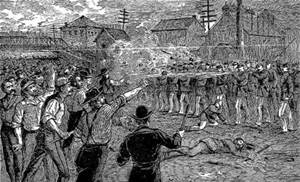
Soon enough the U.S. Attorney General issued the inevitable injunction, permitting federal troops to enter the fray. Some thirty strikers died at the hands of troopers, with many more wounded.
The Pullman Strike ended in government-sponsored violence, but this time the heavy-handed tactics used by Pullman left the general public uneasy. For a country that touted liberty and freedom, the authoritarian power flexed by the industrialist felt rather un-American.
Other labor disputes followed the same pattern; The Haymarket Riot in 1886, the Homestead Strike of 1892, all broken up by militias, soldiers, the police, or hired guns. In 1914 the Ludlow Massacre witnessed the Colorado militia using machine guns to mow down striking miners, women, and children.
Today unions remain controversial. However the role labor has played in America’s development is essential to remember. Labor Unions, in partnership with Capital, built the American middle class, and in return the middle class made the prosperity of this nation possible.
Have a thoughtful Labor Day
Gail Chumbley is the author of the two-part memoir “River of January,” and “River of January: Figure Eight.” Both titles available on Kindle.
For Your Labor Day Weekend
 Travel the globe on Labor Day Weekend!
River of January is $2.99 on Kindle!
Familiar Faces

The Oregon City Library is a beautiful building. A legacy of Andrew Carnegie’s committment to philanthropy, the library looks as it did a hundred years ago. All in all a perfect spot for a talk on “River of January.” The best part was seeing former students from way back, and friends from home. Big Thanks to Maureen Cole, and the staff of the old OC Library. And a thanks to my boys for the help and cheering section.
Remember, But Move Forward

General Robert E. Lee’s Amnesty Oath
He encouraged his former Army of Northern Virginia to follow his example.
That’s All

Colonel Clark used to bring his young son down to the dojo where my brothers took judo lessons. My grandfather had enrolled my older brother first, and then my two younger brothers when they were old enough. I sometimes came along to watch these lessons because, first of all, it was something to do on a boring school night, and I liked to look at the cute boys dressed in their gi (white gear).
My Grandpa Ray always sat with Colonel Clark, if the old gent happened to be present. That meant I sat with Colonel Clark, too, not fun for a twelve-year-old, boy-crazy girl. The two old men would talk and talk, seated next to one another, though their eyes remained on their boys training on the mats. They never seemed to look each other, but still seemed absorbed in their conversation.
My own attention span, something close to that of a hummingbird, only caught snippets of the quiet discussion. “MacArthur, Wainwright, and Bataan,” were among the many utterances exchanged by my Grandpa and the Colonel. And despite my commitment to shallow-minded teen angst, I sensed something grave, something momentous had happened in the back and forth of these two old men.
My brother later translated the mysterious conversation I unwillingly witnessed. Colonel Clark had been left on the Bataan Peninsula when General Douglas MacArthur was evacuated from the Philippines in 1942. Under the new command of General Jonathan Wainwright some 22,000 Americans surrendered to Japanese occupiers, among them young Clark. The Japanese forced this defeated army on a death march (along with their Filipino comrades) some sixty miles in the jungle. The men suffered from heat exhaustion, and dehydration, staggering on, hat-less and barefoot. When a captive stumbled, or fainted, the penalty meant an immediate beheading.
Colonel Clark had witnessed this nightmarish brutality, forced to suffer in ways words fail to recreate.
In defiance of considerable odds, Colonel Clark survived his ordeal. And that was the ordinary older man who spoke quietly with my Grandfather, watching a young son he should never, in reality, have sired.
I am a much better listener today, and recognize that valiant warriors everywhere are frequently disguised as harmless old men. Listening to these elderly gents has enriched my understanding of the past far more than I thought possible.
For example there was George, the high school janitor. For many years he pushed a mop down the halls where I taught American history. Sporting two hearing aids, this diminutive man wielded a mop that was wider that he was tall. All told, George looked like a gentle and harmless grandfather.
I’d often find George standing outside my classroom door listening to me blather on about the Second World War, as if I understood. Later I discovered that that mild mannered 80-year-old had once packed a M-1 Garand, shivering aboard one of those Higgins boats motoring toward Omaha Beach in 1944.
“So George, what do you remember most about D-Day?”
“It was awful early, and the water was awful cold.”
Then there was Roy. Smiling, white-haired Roy.
As a teenager he had gone straight from the Civilian Conservation Corps right into the US Army.
“What do you remember most about D-Day, Roy?”
“I lost everyone in my outfit. I was real scared. Later I was regrouped with survivors from other platoons. You see that was bad because I’m Mexican, and my first platoon got used to me, and stopped calling me Juan or Jose. I had to start all over with the new bunch. For days, as we moved inland, these new boys were giving me the business. One guy said, ‘Mexicans can’t shoot.’ I said that I could. So he said, ‘Ok Manuel. Show me you can shoot. See those birds on that tree branch up ahead? Shoot one of those birds.’ I lifted up my rifle and aimed at the branch and pulled the trigger.” Roy begins laughing.
“I missed the branch, the birds flew away, and twelve Germans came out of the grove with their hands up.”
Astounded, I couldn’t speak. Roy simply chuckled.
Colonel Clark, George, and Roy. They were just boys who found their lives defined in ways we civilians can never comprehend. They were scared, and hot, and cold, and hungry, and suffering, and ultimately lucky. They returned home.
That’s All.
Gail Chumbley is the author of River of January, and River of January: Figure Eight, a two-part memoir. Also available on Kindle.
Partly The Mob
The room was hot, and humid, but the old man would not turn on the air. He said that it cost too much money. The fact that this was Miami and July made no difference,that ancient swamp cooler remained silent in the living room window. To emphasize his granite determination to deny Florida Power and Light an extra penny, Chum dressed each morning in long pants, a belt, and a long sleeve shirt, cuffs buttoned. Mont Chumbley did not project the South Beach image favored by the city’s Chamber of Commerce.
However his strict rules of economy were cast aside the summer I flew down to record his story. And I do mean record, as in tape recorded interviews which lasted, in all, five days. And when I needed quiet the most (for quality purposes,) he decided to switch on that neglected, thundering swamp cooler, providing a Phil Specter-esque ‘wall of sound’ which muffled his fascinating story.
We were both nervous. I hadn’t been married to his son long, and my husband hadn’t come along on this trip. It was just the two of us: new father-in-law talking with new daughter-in-law. But I couldn’t let the awkwardness get in the way, I had traveled three time zones to get the story, and we had to soldier on despite our mutual jitters.
I hit record on the tape player, and immediately he began anxiously whacking a nearby phone book with a pencil. We now had a beat to the swamp cooler’s roar. And he did that for my comfort. How courteous.
I tried to play back the sessions right away to transcribe the contents. It’s safe to say that deciphering his voice from the background clatter grew to be a problem. Imagine the musical “Stomp,” with people trying to converse over crashing trashcan lids.
After a couple of days of this fidgeting he settled down, and to be completely honest, I did too. Chum even forgot to turn on the air once or twice. And his story in aviation began to unfold, carrying us away from noisy appliances; to days before there were such things as air conditioners–to the skies of another era.
Wow.
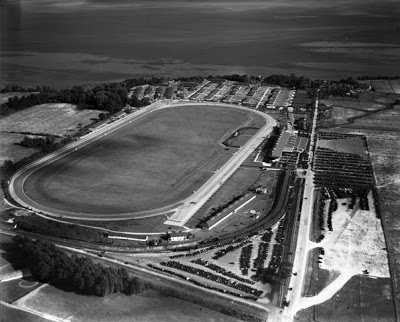
One story that made it into the book tells of his hair raising landing on the infield of a Maryland horse track. Later I had to hit the replay button a half dozen times to get the name right, listening hard to his phonetic pronunciation, buried beneath screeching layers of white noise. Shaped by his Virginia drawl, I deciphered, Har-Day-Graw.
I typed HardayGraw into a search engine. “Do you mean Havre de Grace?” quickly popped up . Hmm. Well, I guess I do. Maybe.
Lo and behold, Havre de Grace was a horse racing track between Washington DC and Philadelphia, tucked into the Maryland countryside. The web site indicated that this track evolved as a joint venture, owned partly by the town of the same name, and partly by the mob.
Partly by the Mob? Are you serious? And everybody knew? I had to look a little deeper.
Apparently in an agreement with the Governor of Maryland, and a former congressman, in a partnership with mobster, Arnold Rothstein, Havre de Grace came to life. And this was no small time nag fest, either. Among the thoroughbreds who graced, Havre de Grace were legends, Man ‘o War, his son, War Admiral, and the indomitable, Seabiscuit, You can’t make this stuff up.
That week in hot, sticky Miami has grown into one of the most pivotal of my life. I felt like Wendy clasping Peter’s hand for her flight to Neverland. But in my case Chum piloted the yoke to “Yesteryearland.”
This Havre de Grace anecdote, with Arnold Rothstein, and a hair raising unauthorized landing from the sky, merged with many, many other episodic rivulets that flowed into this fascinating river of narrative. This “River of January.”
Gail Chumbley is the author of the memoir, River of January
#riverofjanuary
The Outside World
My mom took a job in the early sixties with the US Postal Service. At first it was part-time, mostly needed at Christmas, but by 1966 she hired on full time.
There were four kids, a house, and a yard, and Mom probably was pretty overwhelmed—something today I fully understand. For help my parents decided to host a student each term who attended a secretarial school in Spokane, called Kinman Business University. Lord knows what kind of credential awaited these young ladies after completion, but students did acquire skills such as shorthand, typing, filing, and other tasks.
The first girl who who came to stay with us was named Corrine. I can’t remember exactly the year, most likely around 1965 or 1966. I was in fourth grade.
Corrine came to us from Alaska, and I remember she told me she was part Filipino or Native American, or both. I thought that pretty cool, Corrine to me symbolized the wonder of the outside world.
Our house was constantly in a state of chaos, with quarrels, messes, a blaring TV, with people coming and going—chaos. But to walk into Corrine’s small quarters felt like a completely different world. All of her things were neatly stowed away, her bed carefully made, and the space even smelled differently than the rest of the house. I loved visiting her room, as it felt like an oasis of tranquility in a sea of crazy disarray. And it was in her little sanctuary that serene Corrine shared her life with me just a little.
A picture sat on her dresser of a boy. When I asked who he was, she told me his name was Ty, and that they planned on getting married in a few years. Married! I never knew a girl who had plans to get married! The only people I knew who were married were parents, and they were boring.
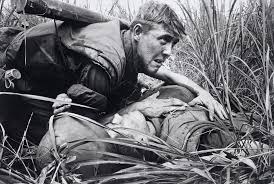
He was called Ty, short for Tyrone, and he was visiting Spokane soon. Ty had received his draft notice and following basic training in the Army, he would ship out to a country called Vietnam. Corrine clearly missed him very much, and was anxious to see Ty before he flew to Southeast Asia.
My memories of his first visit are a little vague. I do recall that they sat on the couch in our living room and held hands in front of my parents. That moment struck me as fascinatingly real.
Looking back I am sure that there were much deeper emotions at play, but whatever vibes filled the room zoomed over my 10-year-old radar.
And then Ty was gone.
The school term ended, and Corrine packed up most of her things and returned to Cordova for the summer. I’m not sure of the details or decisions, but she did return to us the next fall. Once again her room became that wonderful respite from the anarchy of the rest of the house. Ty’s picture again graced her dresser.
Letters began to arrive to our house written on onion-skin parchment, marked AIR MAIL, bearing Corrine’s name. I’d never seen stationary like that, and she explained that was the cheapest way she and Ty could exchange letters. The paper was light blue, and felt like stiff tissue, but held its shape without creasing. Corrine had stacks of it, both fresh and received—the only sign of clutter in her neat little world.
Finally Ty came back to our house, and this visit was very different from the first meeting. The couple did not sit on the couch and hold hands. Not this time. My pre-teen sensibilities were shocked to see a grown man lying across her lap on the couch sobbing like his heart had broken.
Poor Corrine! She, too, was dissolved in tears; red, puffy eyes behind her glasses. Ty couldn’t seem to help himself, or compose himself, and he wouldn’t let go of her. The whole situation felt very surreal. I didn’t understand. How could this orderly girl, and her once orderly fiancé come apart like this, and in front of all of us?
That chapter occurred a very long time ago. My mother still worked, and there were other girls we housed. Still sweet Corrine and Ty live on in my memory as if only yesterday.
I grew up, went away to college, earned a degree in American History, becoming a teacher.
For years and years I taught a unit on the Vietnam War to high school juniors. I recited the facts surrounding America’s entrance into that long, long, conflict. But in all my experience with those lesson plans, the veterans who visited my class describing their personal war, the analysis by historians we studied, nothing affected me more than the tragic transformation of that broken young man from Alaska.
Gail Chumbley is the author of the two-part memoir “River of January,” and “River of January: Figure Eight.”
Chumbley has also authored two stage plays, “Clay” on the life of Statesman Henry Clay, and “Wolf By The Ears” an exploration of American racism and slavery.
gailchumbley@gmail.com
 Gail Chumbley