A Modest History of American Labor

gailchumbley@gmail.com
th

I grew up in a union household. And truth be told, the benefits of the Steel Workers Union saw me through childhood, high school, and college, making possible my life’s work as an educator. With a combination of post-war prosperity, cheap hydro power from the Columbia River, and full industrial production at Kaiser Aluminum, my ambitions became possible.

Of course, at the time, I didn’t grasp the real cost paid by earlier generations for my opportunities. That is until I earned my degree in American History and began teaching. What I found in lesson preparation was a grim drama of determined people facing intimidation and violence. Eventually their valor made possible the emergence of America as a global economic power.

Labor strikes in the 19th Century were especially violent, frequently bathed in bloodshed, betrayal and cruelty. Functioning under the doctrine of “The Gospel of Wealth,” industrialists viewed workers as nothing more than a minor component in mass production. Government at all levels reliably sided with owners to quash any attempts labor made to realize better conditions.

Andrew Carnegie in particular detested unions, and to curb organizing dispersed immigrant workers of different tongues aside one another on the production lines. Language barriers minimized the threat of unionizing.

Another handy device, the Injunction, permitted state governors to legally use State or Federal troops in crushing workers efforts. A governor could claim interstate commerce was impeded, meaning rail carriers couldn’t get mail or goods transported. Once troops were deployed, guns blazing, strikers stood no chance.

One memorable use of the injunction concerned the Pullman Strike of 1894. Employees of the Pullman Palace Car Company endured lives dominated by the company’s powerful owner, George Pullman.

Workers lived in the company town of Pullman, Illinois. All utilities, rents, and other fees were set by the the powerful industrialist, George Pullman himself. Following the onset of the Panic of 1893, Mr. Pullman cut hourly wages, but held the line on municipal fees. Supported by the American Railway Union, (the ARU) workers voted to strike, demanding fairness during the economic downturn.

Strike leaders knew that they must, at all costs, avoid a federal injunction. To bypass any possibility of inviting trouble, the strikers took care that trains continued to move through the state. Rail workers aiding the Pullman strikers detached Pullman Cars, parked them on side tracks, and reconnected the trains.

George Pullman was not amused.

Soon enough the U.S. Attorney General issued the inevitable injunction, permitting federal troops to enter the fray. Some thirty strikers died at the hands of troopers, with many more wounded.

The Pullman Strike ended in government-sponsored violence, but this time the heavy-handed tactics used by Pullman left the general public uneasy. For a country that touted liberty and freedom, the authoritarian power flexed by the industrialist felt rather un-American.

Other labor disputes followed the same pattern; The Haymarket Riot in 1886, the Homestead Strike of 1892, all broken up by militias, soldiers, the police, or hired guns. In 1914 the Ludlow Massacre witnessed the Colorado militia using machine guns to mow down striking miners, women, and children.

Today unions remain controversial. However the role labor has played in America’s development is essential to remember. Labor Unions, in partnership with Capital, built the American middle class, and in return the middle class made the prosperity of this nation possible.

Have a thoughtful Labor Day

Gail Chumbley is the author of the two-part memoir “River of January,” and “River of January: Figure Eight.” Both titles available on Kindle.


Familiar Faces

OregonTalk.php

The Oregon City Library is a beautiful building.  A legacy of Andrew Carnegie’s committment to philanthropy, the library looks as it did a hundred years ago. All in all a perfect spot for a talk on “River of January.” The best part was seeing former students from way back, and friends from home. Big Thanks to Maureen Cole, and the staff of the old OC Library. And a thanks to my boys for the help and cheering section.

Night Flight

Night Flight

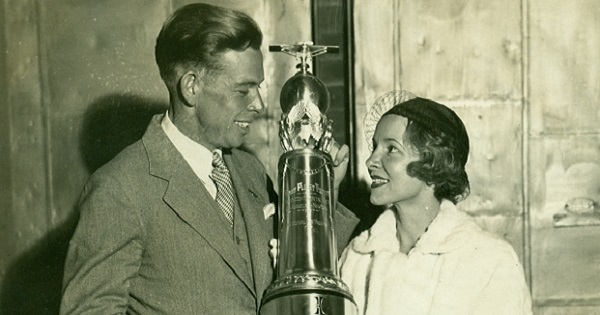
 “Night Flight,” an MGM drama premiered October 6, 1933 at New York’s Capitol Theater.

Star Helen Hayes presented Chum his hard-won first place trophy as a part of the evening’s program.

Read River of January.

helenhayes600w

Buy River of January by Gail Chumbley, also available on Amazon.

A French Legend

Miss2

“Rumor has it that Mistinguett served as a spy for the French government during the Great War while she was dancing across the continent. They may be watching her again because of that new leader in Germany,” Lillian remarked as the company sunned themselves on exclusive Larvotto Beach.
“Who told you such a thing, Lillian?” Una, another dancer, asked skeptically.
“Didier, the older stage manager at the Terminus—he seems to know all about Miss.”
Charlotte’s eyes grew large. “How thrilling!”
“And she’s had many affairs with younger men,” Lillian continued, enjoying the attention. “You’re familiar with Maurice Chevalier?”
“Of course.”
“Supposedly they shared a passionate, very public romance. Miss launched his career when she plucked him from a music hall chorus line and cast him into his first film, La Valse Renversante.”
“No!” Charlotte blurted.
“Oh, yes!”
“Isn’t he a lot younger?”
“Thirteen years, according to Didier.”
“Lucky woman!” Charlotte said. The rest of the girl’s laughed at her response.

Page 75, River of January

Much Obliged

Peacock0002

Thank you for taking part in “River of January’s” free Kindle Weekend! Enjoy the story with my compliments.

Stay in touch. As you finish the book, drop me a line, add a review on Amazon.com, and be sure to tell a friend.

For more, visit the photo gallery at www.river-of-january.com

Book Two, “The Figure Eight” is in progress.

This Week, 1935

IMG_0191

The old pilot’s time with us grew to mean a great deal to me, personally, but made it that much harder to let him go at the end.

Chum’s last years brought him out west to Boise. It was much easier for my husband to care for him than the semi-regular flights to Miami, sorting out some kind of preventable crisis. Once his father settled in here, they were together every day at the assisted living facility. I believe their time together gave both of them a lot of comfort.

As for Me? I just loved to sit and talk to my father-in-law. If he had felt more spry I would have dragged him into my history class for my own version of “Show & Tell.” I mean, really! William Howard Taft was in the White House the year Chum was born! His life was a damn book. (see River of January)

On one particular Sunday we drove over for a visit, and brought him Mexican food . . . Chum’s favorite. I was anxious to talk to him because we had rented “The Aviator” the night before, the film about Howard Hughes, and Chum had worked for the millionaire at one time.

Me: So we watched a movie about your old buddy, last night–Howard Hughes.

Chum: Ha. He kept the Kleenex business in the black.

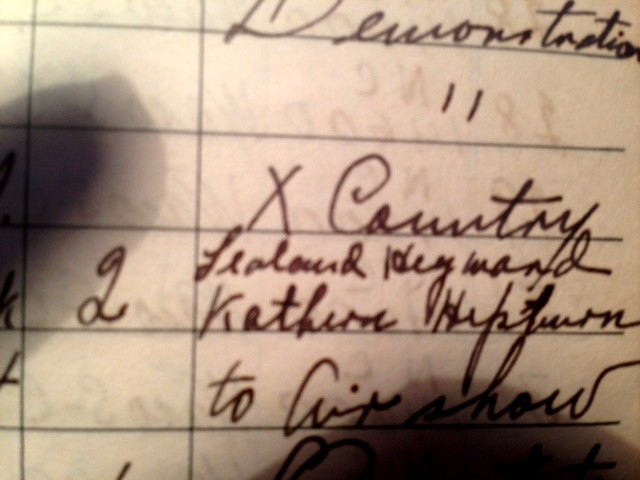
Me: (Oh, geez! How could he know that?) And your old girl friend, Kathryn Hepburn.

Chum: Yeah. Katy. She was a nice girl.

Me:(Katy? A nice girl?)

Chum: Her boyfriend, that theater producer, Leland Hayward–I taught him flying lessons, and she came along.

Me: Yeah. (Yeah)

And here it is folks, if you didn’t see at the top. The old history student has to whip out the proof. Have a nice weekend.

  IMG_0192

Gail Chumbley is the author of River of January. Available on Amazon.

That’s All

th

Colonel Clark used to bring his young son down to the dojo where my brothers took judo lessons. My grandfather had enrolled my older brother first, and then my two younger brothers when they were old enough. I sometimes came along to watch these lessons because, first of all, it was something to do on a boring school night, and I liked to look at the cute boys dressed in their gi (white gear).

My Grandpa Ray always sat with Colonel Clark, if the old gent happened to be present. That meant I sat with Colonel Clark, too, not fun for a twelve-year-old, boy-crazy girl. The two old men would talk and talk, seated next to one another, though their eyes remained on their boys training on the mats. They never seemed to look each other, but still seemed absorbed in their conversation.

My own attention span, something close to that of a hummingbird, only caught snippets of the quiet discussion. “MacArthur, Wainwright, and Bataan,” were among the many utterances exchanged by my Grandpa and the Colonel. And despite my commitment to shallow-minded teen angst, I sensed something grave, something momentous had happened in the back and forth of these two old men.

My brother later translated the mysterious conversation I unwillingly witnessed. Colonel Clark had been left on the Bataan Peninsula when General Douglas MacArthur was evacuated from the Philippines in 1942. Under the new command of General Jonathan Wainwright some 22,000 Americans surrendered to Japanese occupiers, among them young Clark. The Japanese forced this defeated army on a death march (along with their Filipino comrades) some sixty miles in the jungle. The men suffered from heat exhaustion, and dehydration, staggering on, hat-less and barefoot. When a captive stumbled, or fainted, the penalty meant an immediate beheading.

Colonel Clark had witnessed this nightmarish brutality, forced to suffer in ways words fail to recreate.

In defiance of considerable odds, Colonel Clark survived his ordeal. And that was the ordinary older man who spoke quietly with my Grandfather, watching a young son he should never, in reality, have sired.

I am a much better listener today, and recognize that valiant warriors everywhere are frequently disguised as harmless old men. Listening to these elderly gents has enriched my understanding of the past far more than I thought possible.

For example there was George, the high school janitor. For many years he pushed a mop down the halls where I taught American history. Sporting two hearing aids, this diminutive man wielded a mop that was wider that he was tall. All told, George looked like a gentle and harmless grandfather.

I’d often find George standing outside my classroom door listening to me blather on about the Second World War, as if I understood. Later I discovered that that mild mannered 80-year-old had once packed a M-1 Garand, shivering aboard one of those Higgins boats motoring toward Omaha Beach in 1944.

“So George, what do you remember most about D-Day?”

“It was awful early, and the water was awful cold.”

Then there was Roy. Smiling, white-haired Roy.

As a teenager he had gone straight from the Civilian Conservation Corps right into the US Army.

“What do you remember most about D-Day, Roy?”

“I lost everyone in my outfit. I was real scared. Later I was regrouped with survivors from other platoons. You see that was bad because I’m Mexican, and my first platoon got used to me, and stopped calling me Juan or Jose. I had to start all over with the new bunch. For days, as we moved inland, these new boys were giving me the business. One guy said, ‘Mexicans can’t shoot.’ I said that I could. So he said, ‘Ok Manuel. Show me you can shoot. See those birds on that tree branch up ahead? Shoot one of those birds.’ I lifted up my rifle and aimed at the branch and pulled the trigger.” Roy begins laughing.

“I missed the branch, the birds flew away, and twelve Germans came out of the grove with their hands up.”

Astounded, I couldn’t speak. Roy simply chuckled.

Colonel Clark, George, and Roy. They were just boys who found their lives defined in ways we civilians can never comprehend. They were scared, and hot, and cold, and hungry, and suffering, and ultimately lucky. They returned home.

That’s All.

Gail Chumbley is the author of River of January, and River of January: Figure Eight, a two-part memoir. Also available on Kindle.

New York, 1933

HOWARD-AILOR HOWARD-AILOR-SALES-CORP

“So you’ve been to see all the big boys, eh?” commented a sales representative from Long Island who was seated behind a battered old desk. Airplane distributor Howard Ailor of Waco Aircraft studied the young man’s face. “And by the looks of you they all turned you down.”
“That is about right, Mr. Ailor.” Chum responded, trying to look confident. “I was hoping you might know of something out here, maybe something at Roosevelt Field.”
“I don’t know you, son, but let me give you some advice. Don’t dawdle around hoping for that phone call. This is no economy to sit by and wait for miracles. You’ll starve first. Push your way into the air business with your own equipment, that‘s what I say, and I can help you with that. We have some beauties right here on site.”
Chum listened to the silver-tongued salesman, surprised that he agreed with all Ailor had to say.
Chum also realized that he had returned to an America deep in the throes of financial depression.
Economic life in the 1920s had played out as a frenzied, unregulated party. By all appearances the country had embraced infinite prosperity. Insider trading and other shady practices reigned on Wall Street, where market manipulators pooled cash and bought up stock, artificially driving up values. Regular folk, believing they were on to something big, bought these tainted stocks as crooked investors dumped them, reaping fabulous profits.
Indiscriminate buying, using easy credit, pumped the overblown Dow Jones to ballooning artificial heights. Even private banks joined the frenzy, wagering the savings of their account holders to increase their own bottom line.
This facade of spreading affluence ensured the “hands off” economic policies accepted in Washington. Then the market imploded. On October 29, 1929, “Black Tuesday,” the savings of a nation disappeared with the steepest financial crash in American history. Thousands upon thousands of people were ruined and the enterprise of a nation dried up.
Young Mont Chumbley had resigned from the Navy without another job, and now found there were none. The pilot’s only and best assets were his optimism, his pluck, and an old Chevy.
“Over here,” Ailor directed Chum, as they walked toward a hangar housing a red-with-black-trim Waco cabin biplane. “This baby’s a real beauty, right? We can take it up for a spin, if you like, but you can’t have this one—it’s spoken for. Still cough up a down payment and we’ll order you a new one. It’d be here in only six weeks.
“I came here looking for a job—and you want to sell me an airplane?” Chum blurted in disbelief.
Ailor continued to rattle on as though the pilot had not spoken. “Hell! I’m feeling generous. I’ll even let you rent office space right here on Roosevelt Field for a percentage of whatever you earn as you get your footing.”
Chum realized he had never encountered such a smooth operator. Ailor finally faced the boy. “Look, you can’t negotiate with reality, son. And the reality is that there are no jobs. The country’s flat busted.”
Chum knew his mouth hung open in reaction to the salesman’s bald audacity. But he also knew he agreed. Ailor was absolutely right.
Chum needed to find a way to buy that airplane. It appeared to be the only real option open to him. With little money left from his dwindling resources, he found a Western Union office and cabled his mother in Pulaski for help. He hadn’t written or visited much since joining the service and felt badly his note only asked her for money. However, Martha didn’t complain or hesitate.
“I’ll run down to our bank in town—still solvent, doors open,” she wired him right away. “A thousand, Mont? Is that enough? Where should I wire it?” Martha would still do anything to help her boy.

River of January by Gail Chumbley available at www.river-of-january.com and Amazon.com