The Flemish Bend

HMPlanePic0001

This couple married 78 years ago today. On Friday the 13th. In New York City. Defying traditional convention. Archaic superstitions were of no interest to this modern couple, that kind of thinking belonged to the past.

Mont “Chum” Chumbley, and his bride, Helen Thompson Chumbley only looked forward, challenging and prevailing over old horse and buggy thinking. Theirs was a new era, a dynamic era, one of flight and of film. And this powerful force of optimism rendered one life time together too brief. So now their spirits carry on in my head, and in the pages of my book, River of January.

To say Helen and Chum were happy together would be shallow pandering–and an insult to the complexity of their distinctive temperaments. Still, their story has power, enduring power, pressing me on, returning time after time to their papers, searching for signposts of truth and direction.

A Flemish Bend, the title of this piece, ironically does have its roots in the distant past. The Bend is a sailors knot, also known as a square or figure eight knot. The same shape in mathematics is the symbol for infinity. The love Helen and Chum shared, as imperfect as it seemed at times, was powerful, and proved to be endless.

I too have been snared in those powerful cords, and for better or worse speak for their remarkable lives, lives too dynamic to have died with their passing.

And I’m grateful. It’s an honor. Happy anniversary Helen and Chum.

Order River of January, and enjoy the journey.

River of January Book 2 Excerpt

Amelia Earhart Plane Fragment Identified : DNews

amelia0001

Bertha eyed the large box with a wary, but inquisitive gaze. “We got this for you. Merry Christmas Mother,” we both hope you’ll like it,” Helen beamed with pride. “Chum?”
Bertha narrowed her eyes, watching as her son-in-law sliced down a cardboard corner with his pocket knife. Revealed inside, a beautiful new Emerson radio, curved corners, blonde wood, featuring inset vertical columns. Mother’s eyes now grew wide as she took in the gift—this radio was the top of the line, as Bertha well knew.
“Oh my heavens,” she exclaimed. “You two must have spent a pretty penny on this!”
Helen grinned happily, her mother seemed honestly pleased, while Chum, hurried to plug the device in, rapidly turning the dial looking for a Christmas broadcast.
Kneeling at a small end table, he twisted the tuner knob—the frequency tone whined and whistled from fuzzy to piercing. Finally, a clear authoritative voice rose, articulating in a clipped urgent cadence. Nineteen hundred and thirty seven has been an eventful year in American news. It was last spring, in May that the Hindenburg, a German dirigible tragically exploded over New Jersey. Celebrated aviatrix Amelia Earhart was lost in July, along with navigator, Fred Noonan in the uncharted expanses of the South Pacific . . .

“No Christmas music, honey?” Helen asked over the broadcaster’s voice.
“That’s really not a surprise,” Chum mumbled, lost in thought.
Bertha quipped, “No Christmas music on Christmas is a surprise?”
“No. No. Sorry. Amelia Earhart was someone I once knew at the field.
Impressed for once, Helen’s mother pushed for more details. “You knew Amelia Earhart?”
“Oh. Well, yeah I did. She was a friend of a friend.” Suddenly self conscious with all three women staring at him, Chum struggled for words. “You see, Earhart had no training in navigation at all. She could fly just fine, but had to hire navigators to get anywhere. The, eh, other girls—girl-pilots talked about it. They uh, believed it was that husband of hers, George Putnam who inflated her abilities . . . spent money to build up her reputation. Amelia got in over her head on that flight, and the poor kid was killed as a result.
“How do you know this?” This time Eileen piped up, clearly fascinated by his tale.
“Like I said, that Roosevelt Field crew of gals could be a clucky bunch. The other women talked a lot about how shamelessly that husband promoted her career.”
“I’d never heard that before,” Bertha exclaimed, appraising her son-in-law in a new light.
“Me either,” Helen added, not sure she was pleased with his “the other girls at the field” story or not.

Buy River of January Today

Another New York Story

riolist

So caught up in the process of writing River of January I didn’t see much beyond my keyboard and monitor. Focusing intensely on grammar, style, punctuation, research, and every other detail, I failed to see a beautiful New York story take shape before my eyes.

A New York story. The New York of Vaudeville, Tin Pan Alley, Jimmy Walker, and silent films. The New York of Roosevelt Field–Lindbergh lifting off eastward toward Paris, achieving legendary status, and where Amelia Earhart later trundled down that same runway only to meet her mysterious end in the South Pacific.

Mont Chumbley, one of two central figures in River worked at that same storied airfield, braking down runway #1, arriving first in the 1933 Darkness Derby. He had braved inky night skies in his quest, worsened by wind gusts and growing cloud cover.  Pushing through from Los Angeles to New York, Chum prevailed, victorious, He received honors for his achievement at the Capitol Theater, 1645 Broadway, when Actress Helen Hayes presented him with his cash winnings, and an over sized silver trophy. Becoming something of a local celebrity himself, many from the city sought him out for passenger transport or flying lessons. On one instruction flight,Chum found actress Katharine Hepburn in the cabin of his plane, joining her boyfriend, Broadway producer, Leland Hayward.

 Helen’s New York consisted of auditions and productions from the Boulevard Theater, to the Roxy, performing for Billy Rose, finally dancing in “The Harry Carroll Revue.” As if a scene from an old movie, she set sail in April, 1932 on the SS Ille de France. This transatlantic voyage carried the girl from New York Harbor for an extended tour across Europe. Two years later, in 1936 she stepped up the passage way of The American Legion, a steamer on the Munson Line destined for Rio de Janeiro. Joining throngs on the top deck Helen gleefully waved goodbye to her family, smiling back from the Brooklyn docks. And speaking of family, Helen’s home address, 325 West 45th Street, was the third floor of the Whitby Hotel smack-dab in the middle of the Theater District. And though refreshed and remodeled today, that apartment building still stands–a direct link to an earlier era, an earlier New York.

Helen and Chum both lived in Manhattan at the same time. But he had his New York story to fulfill, and so did his future bride. That they crossed paths on the sidewalks, subways, theaters, restaurants, and trains before exchanging their first hello is certain. But as proper New Yorkers the two finally met elsewhere, at the Club Copacabana in Rio, a hemisphere away. There these two New Yorkers finally locked eyes, and fell in love.

Eventually, when circumstances allowed, Helen and Chum returned home to exchanged vows at the Church of the Transfiguration, on East 29th and 5th Avenue. This location is better known to New Yorkers as The Little Church Around the Corner.

I’ve finally come to recognize that River of January has become more than the narrative of two lives in the early days of aviation and show business. This story takes place in the magical metropolis of New York–where Helen and Chum found magic of their own.


I Couldn’t Help Myself

c&hrio0001

River of January

This wasn’t my idea. The completion of River of January has been as much a surprise to me as to anyone. I never presumed to be any kind of writer, ever. In fact, I spent my entire career as an American History teacher who told stories, not wrote them. But when River of January came into my life, the story took root, soon dogging my every step. Forget the fact that I didn’t know how to write, or understand the first thing about publishing–River of January made it clear that those deficiencies were my problem.

This project flowed into motion after meeting and coming to admire my story’s central figure. Mont Chumbley, one of two major characters in the River of January, was a real flesh-and-blood man full of irresistible charm. He was also my father-in-law, and as such generously shared hours of gripping storytelling, regaling tales of his fascinating life. His personal anecdotes exquisitely depicted the golden age of aviation, leaving me humbled and honored—in awe of his singular and astonishing career. Delightful episodes included flyers, Amelia Earhart and Howard Hughes, among many other colorful characters that populated Roosevelt Field. Chum became my own Peter Pan, guiding me on a magical journey to an America full of promise and opportunity.

Next a treasure trove of Chumbley memorabilia surfaced that verified his stories. This archive touched not only his life, but that of his wife, Helen Thompson Chumbley. An accomplished dancer, Helen preserved every memento related to her equally remarkable career. Steamship tags, playbills, performance reviews, baggage stickers, and photos of an eager, happy girl costumed in an array of attire for stage productions or film sets. Helen too, aimed to preserve her accomplishments saving pictures, lists of business contacts, and letters home to her mother–all depicting a clear narrative of Helen’s own artistic path. Her passport, for example tells of extended junkets to Europe in 1932, London, 1934, and Brazil in 1936. All journeys illustrated with glossies, more letters home, and snapshots of a young dancer having the time of her life.

Their lives unfolded before me only to shift and refocus with each new piece of evidence. This composition grew so immense that only one book became impossible. Inevitably I had to find a fitting close, and then resume the tale in a second volume. Chum’s early years, for example, required a deeper examination of the aviation industry; complete with the serious obstacles he met attaining his wings. It also became crucial to explore the larger story of America, understanding the national barriers Chum overcame to see through his goals.

The same hurdles held true for Helen. Readers had to be reminded that the decades presented in River of January were years of careless economic boom followed by a devastating bust, leaving her path that much more daunting. Moreover, her mother required financial support in an era with no Social Security or Medicare. The burden fell completely on young Helen and her sister. With talent and fortitude, Helen’s grit loomed large in this story, tinged by a real fear of devastating consequences.

This author had formidable obstacles to overcome, too. The most profound drawback, the greatest obstruction–I had absolutely no idea how to write– not in any vibrant or intimate style. If the truth be told, creating River of January felt much like building a car while driving it down the street. River’s first drafts were so awkward and flat, that my first editor fired me as a lost cause. Mortified, I wanted to crawl under my bed, and never write again. And worse, I couldn’t disagree with this editor because I honestly had no idea what I was doing. Still, the book didn’t care. River wasn’t interested in my shortcomings, and the story refused to go away. Despite feeling an amateur fool, I bravely soldiered on.

Every family has a story waiting to be unveiled. In this instance the flow of narrative arrived from three directions. First, and most significantly, was my marriage to Chad Chumbley, the eldest son of Mont and Helen Chumbley. It was he who initially conveyed there was a tale to tell. With what little Chad knew of his father’s career and his mother’s accomplishments, my husband was certain of an epic waiting to appear.

The abundance of primary documents sealed my fate as my in-laws biographer. And again, though I didn’t recognize the forces at work, sifting through each item from that vast collection boosted the project forward. And this couple saved EVERYTHING! Air show tickets, menus from European eateries, pressed flowers, telegrams, his logbook!

By 2005 we coaxed Chum to come west and take up residence in an assisted living facility. He soon became the most popular, most charming tenant in the place. And it was in his room, 18 months later that we sadly attended his death. A mighty Virginia pine had fallen, and the era of his extraordinary life died with him. For me, that could not stand—Chum’s story deserved to be remembered, and no one else was going to see that job through. Nor could Helen be forgotten. Her qualities of greatness cast as large a shadow as her husband’s. I had no choice but to ignore my doubts and get to work piecing together their lives–from youth to marriage.

Not all members of the family were keen with my project. And I am sensitive to their concerns. But, Chum and Helen lead such astonishing lives, and achieved such great accomplishments, that I decided to forge ahead and make River of January a reality.

Oh, That’s Today!

helenhayes600w

There were times when I’d be blathering along on some historical subject, and in a sudden epiphany realize, “and it happened today!” One time, displaying a before-and-after photo of the USS Maine in a lecture on the Spanish-American War, it dawned on me that the date was February 15, 1898–that very day. “Oh, that’s today!” sprang from my mouth. Various reactions crossed the many faces of my students. Ranging from, “she really needs a life,” to “that might be mildly interesting, but it’s not.” My kids seemed to exude more sympathy than interest in my sudden, self-induced enthusiasm. “Geez, don’t all hop up all at once,” was my usual sardonic response. Then they would laugh.

December 7th got a nod, September 17th, Constitution Day, and my personal favorite, “The Seventh of March Speech.” That one you ought to look up. Finest speech made in the Senate to my way of thinking. I made a practice of asking a baritone-voiced student to read Daniel Webster’s words if March 7th fell on a school day. There’s May 8th, V-E Day, September 11th, March 5th, Boston Massacre–all acknowledged and more to boot.

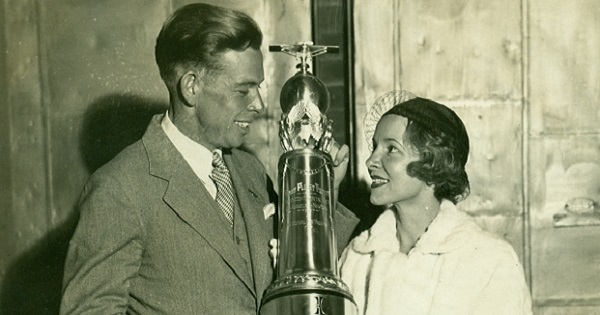
Today I presented a book talk on River of January for a local service club. I shared the story of Chum’s epic, 1933 air race, (that he won) soaring through the night sky from Los Angeles to New York. Chattering happily I flipped to the slide pictured above. This is the actress Helen Hayes awarding Chum his first place trophy at the Capitol Theater on October 4, 1933. The Capitol was premiering Miss Hayes’ new film, Night Flight, and the race was somehow wound up with the movie. Well, that was 81 years ago today. So of course, I grew just as ridiculously excited as I used to in my history classes. “Oh. My. Gosh. That’s today!” And I will commend this group of adults for not judging me as harshly as my eye-rolling students. These fine people laughed–as happy as I felt with the coincidence.

So there it is. Chum won the “Darkness Derby” on October 3, 1933 and Miss Hayes handed over cash and a trophy the following evening in New York.

It was a Wednesday night, October 4th, that Chum’s life dramatically changed exiting that theater. He now had award money, and a trophy that proved his merit as an up-and-coming pilot holding his own in the Golden Era of Aviation.

But I Had Other Plans!

HospitalI

This post comes from last year. Not much of a throw back Thursday, but a powerful reminder for those of us affected by cancer.

gail chumbley's avatarGail Chumbley

I clearly remember the day my husband told me he had throat cancer.  The news was so impossible to believe that I honestly wanted to reply, “No, Chad, you don’t, we don’t have time for cancer.”  I tend to resist any emergency that I can’t package up and manage, or eliminate by a force of will.

As he stood in the kitchen, his hands resting on the sides of the sink, tears filled his eyes.  I read in those tears that he had given up and accepted his medical condition, and that made me mad.  We weren’t going to lay down and admit that the big scary C-word would take center stage in our lives.  It wasn’t convenient–medical procedures would be scheduled when I had to work, or had other commitments to fulfill.

I couldn’t see past the treatments, the financial burden, or the fear a cancer diagnosis leaves in…

View original post 159 more words

A New April

Image

Right now, in classrooms across America, and overseas, thousands 17-year-olds are preparing for the AP US History exam. They, and their instructors are obsessed with cause and effect, analyzing, and determining the impact of events on the course of America’s story.  Moreover, they are crazed beyond their usual teen-angst, buried deep in prep books, on-line quizzes, and flashcards. As a recovering AP teacher, myself, I can admit that I was as nuts as my students, my thin lank hair shot upward from constant fussing.

My hair fell out too, embedding in combs and brushes, as I speculated on essay prompts, that one ringer multiple choice question, and wracking my brains for review strategies. The only significance the month of April held was driving intensity, drilling kids on historic dates; Lexington and Concord, the firing on Fort Sumter, the surrender at Appomattox Courthouse, President Wilson’s Declaration of War in 1917, the battle of Okinawa, MLK’s murder, and the Oklahoma City bombing, That was what April meant in April.

To quote John Lennon, “and now my life has changed, in oh so many ways.”  Today April holds a whole new definition. My husband rises first in the morning, putters in the kitchen, fetches coffee, tends to the dog, and is back in bed, back to sleep. Big plans for my morning include writing this blog, making some calls related to book talks, a three mile walk through the Idaho mountains, then working on Figure Eight, the second installment of River of January. What a difference!  Nowadays, getting manic and crazy is optional. My hair has grown back in, standing up only in the morning, and the only brush with AP US History occurs in my dreams; the responsibility passed on into other capable hands.

This month, at least here in the high country, has been especially beautiful. We have already enjoyed a few 70 plus degree days, and the green is returning to the flora. Our sweet deer neighbors are no longer a mangy grey, emerging from the trees wearing a warm honey coat. With a little snow still on the peaks, the sky an ultra blue, and the pines deep green and rugged, I think sometimes this must be Eden.

My years as a possessed, percolating history instructor provided a gift of passionate purpose that enriched me more than depleted.  But, now . . . I wouldn’t trade this new phase of my life for all the historic dates in April.

Gail Chumbley is the author of River of January also available on Kindle.

Wounds

th

Rereading the original draft of my book, River of January, I reviewed the back story that propelled the book’s creation. An impossible crisis pushed me to write the work, but that narrative was cut out of the main manuscript due to length. But I still believe that the story behind the published story is important to share.

The Intensive Care Unit was the largest department on the third floor of the hospital. Reflecting back I never did figure out which direction the ward faced. Was it north toward Boise’s golden foothills or south over the blue turf of the football stadium? Someone needed to open the blinds.

The floor plan in the ward ovaled around like a carpeted arena, anchored by a nurses’ station in the infield. Three quarters of the broad ring had been segmented into tiny stalls–narrow spaces housing mechanical beds. My husband’s particular nook, squeezed into a curved corner, remained either open or sealed by simply sliding a glass door and a privacy curtain. Each morning I instinctively gauged his condition by the disposition of that entrance. Coding patients were afforded some semblance of privacy.

The sparse decor inside clearly signaled “no nonsense.” Two chairs flanked the entrance, with one small footstool. I once tried pulling out that stool to attempt a nap, but sleeping was reserved for the critical only; the nursing staff’s frenzied laps around his bed made sleep impossible.

Unconscious, bloated, with a swollen torso and bulging arms, my husband lingered on the crinkly mattress. Tubes protruded from nearly every square inch of his upper body, pumping in liquid meds and below, pumping out liquid waste material. Attached monitors loudly measured his heart and pulse rates, racketing in a relentless beeping.  I was afraid to ask the meaning of the numbers blinking on the monitor, the din adding to my fatigue. Eventually, I inquired what a normal cardio reading looked like, and the answer wasn’t reassuring. I froze in that nondescript chair, dazed, almost hypnotized, willing his numbers to improve. Still indifferent, that monitor shifted erratically, frequently setting off an alarm drawing in medical reinforcements. 

The cocktail of fluids pumped into his arms overnight had left him bloated to the point that his nose had flattened across his full, stretched cheeks. Fingers that had earlier held my hand from the stretcher now swelled to the size of cooked kielbasa—triggering thoughts of his wedding ring and his watch. My next random reflection recalled both pieces being handed to me the night before, and hopefully safe in my purse. It was a dreamy recollection. 

The worst feature of his bare torso was the ragged, opened split from his naval to his groin, sealed by a stiff grey foam substance, and a thin membrane of clear film covering the diagonal wound. I was told his body was so contaminated in septic debris that the stitches closing the incision would have healed before the toxic substances beneath had cleansed.  So this vacuum packed dressing over his wound kept the area draining and that tube, too had an attached little box, stowed under the bed that beeped and flashed. 

He looked too rubbery and inflated to be real, but with the aid of artificial ventilation forcing his breath, I could clearly hear his intake of air. 

Clinging to these subtle signs I began the litany of phone calls that had to be made to the rest of the family.  His son, my parents, his siblings . . . I hated to upset them all, but knew these relatives had to be kept in the loop. Listening quietly on the phone, my 78-year-old father finally spoke; he and my mom would pack up and come down to Boise from Spokane. I wasn’t prepared for that offer, and asked them to give me a little time. I still wasn’t convinced my husband was going to live. At that moment I had no energy for company, all my focus concentrated on watching his vital signs.

Desperation is a funny emotion. The intensity of it burns on the inside, and we fool ourselves in believing the conjured up power somehow changes reality. Maybe the instinct to inflict mental suffering on ourselves is a primal manifestation of empathy for our loved ones. He bore the physical wounds, while mine lashed and scorched my insides. Over the course of his lengthy critical care, and his slow road to recovery, I had to do something with all the bile stuffed into my psyche. Out of this pain came the healing therapy of River of January and my own recovery through writing.

Gail Chumbley is the author of the memoir River of January


Hat In The Ring

Hat In The Ring

This image represents the 94th Aero Squadron, made famous by their aviation daring in World War One. Commanded by Colonel Raoul Lufbery, the 94th formed from the earlier American volunteer unit, the Lafayette Escadrille. The 94th counted in their ranks, Captain Eddie Rickenbacker. Rickenbacker became the most decorated American pilot of that war, with 26 verified German kills over France, and earning the Congressional Medal of Honor.
Later, Rickenbacker purchased Eastern Airlines, lending his famous insignia to the Great Silver Fleet. Chum was proud to have known Rickenbacker and proud to have been a part of Eastern. In retirement, Chum stenciled the “Hat” insignia on his competitive aerobatic plane in honor of his earlier career. Today REPA, the Retired Eastern Pilots Association maintains the memory of Rickenbacker and the storied days of Eastern Airlines.

An Anchor in a Whirlwind

Image

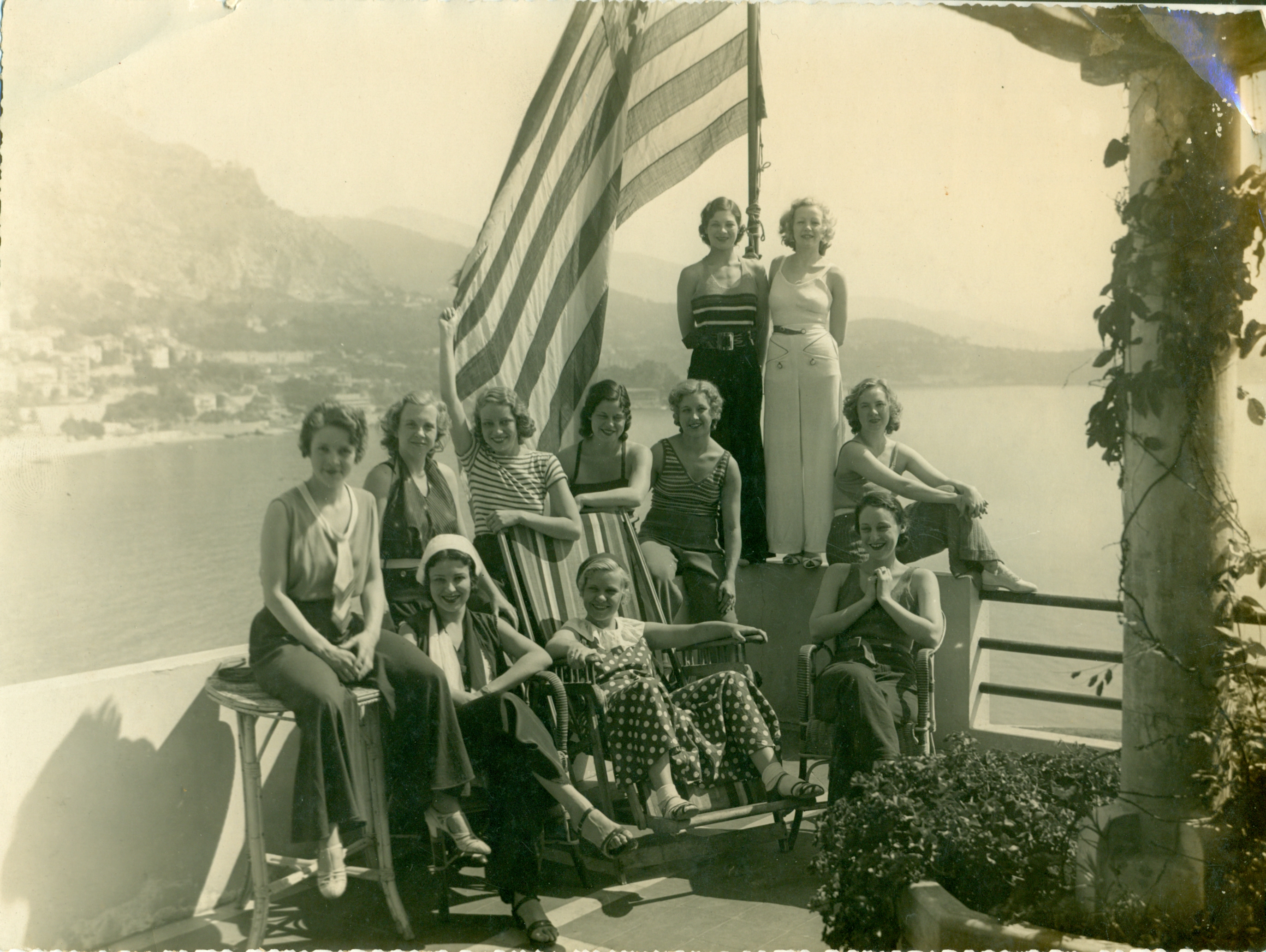
Helen seated below flag in stripped tank and blond hair-Monte Carlo 1932

Chum once told me that he never suffered from jet lag.  And he later flew jets.  The early flights didn’t reach ten thousand feet in altitude and the duration was relatively short.  Time zone hopping took a lot longer from the east to the west, and back again.  Flights landed before the body or even the mind was too zapped.  I asked him how he sustained himself waking up in a different place nearly every day.  He looked at me with a perplexed expression, as though he couldn’t fathom the question.  “I never had any problems,” he’d repeat.  “I never struggled to sleep, and my appetite was always good.”

Those few, still living when I began River of January told me, amused, that Chum made a habit of standing on his hands, heels against the hotel wall every morning on turnaround flights.  The man maintained his vitality with rigorous exercise, and few vices.  He knew himself well, and held his life together with discipline and purpose.

In a bit of a contrast, Helen, who also traveled a great deal, found her center in a circle of friends.  It seems her friendships melded easily and had staying power.  Despite waking up in Milan one day and Vienna the next, her fellow dancers provided a niche where she securely fit.  On the voyage to Rio, Helen made a friend of her cabin-mate and the two remained close during, and after the engagement.  Her place among others provided Helen a context in which she functioned well.

And in all her travels, she always knew her mother waited back in New York, expectant for the girl’s return.

As the scenery from the rail cars constantly shifted, the theaters and hotels changed, and managers varied, Helen never appeared to suffer from insecurity or alienation.  She didn’t waste time agonizing about her talent or if the company had a place to perform.  The girls had each other.

Despite the chaos inherent in their chosen careers, (flying and show business) plus living in the fall-out of the Great Depression and the ominous rise of fascism–the two appeared to cope with continuous change gracefully.  Young and excited, they both seemed to revel in the novelty of each new day.  The pilot found strength in the fullness of himself, and Helen among her fellow entertainers.  In a world torn by strife at home and abroad, they had little time for indecision, or hesitation.  Chum and Helen cultivated their own strong sense of certainty.  That inner strength lead to purposeful and consequential lives.