The Pitch

Long rows of rectangular tables, draped and decorated, filled the hall. Cellophane covered baskets, revealing festive gifts sat inches apart, attracting hopeful bids from the browsers wandering about the silent auction. Attendees seemed to understand the drill, strolling from basket to basket, pen in hand, increasing the previous bid. And the purpose behind this auction? The IEA Children’s Fund; a statewide account to help Idaho kids with food, clothing, supplies, shoes, and any other need disadvantaged students face.

I squeezed in between colorful, refugee-sewn bags and wallets, and a boxed WiFi yoga program, complete with a mat and ready-to-use internet software. My books sat displayed below eye level, requiring some adjustments to attract possible buyers.

Both “River of January,” and “River of January: Figure Eight” are rich with archival images. However, space limitations left the usual eye catchers tucked in a satchel, under my chair. Though dismayed at first, I remembered that the books have photo galleries inside, and my tactic instantly shifted. “Are you a reader?” I begin. And what’s cool about teachers is that 99.9% told me ‘yes.’ (Of course they are, we teachers are the champions of literacy.) Then I whipped out the photos in book one.

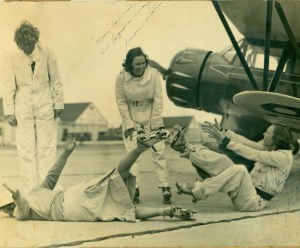
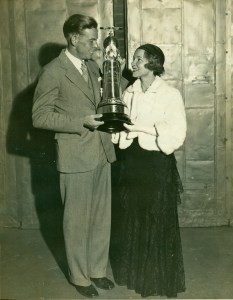
I begin . . . “River of January is a true story, a memoir, that I have written in a novelized style. Here is my main charter, a pilot, who won an air race in 1933. Here he is receiving the winning trophy from actress Helen Hayes at the premier of her newest movie, Night Flight co-starring Clark Gable.” (The listener looks mildly interested. I go on.)

helenhayes0001


The girl in the middle, laughing, was his girlfriend, she was a pilot too. On the left is Amelia Earhart, the president of the female flying group called The 99’s.”  (I hear an audible WOW. We’re getting somewhere.)

Image

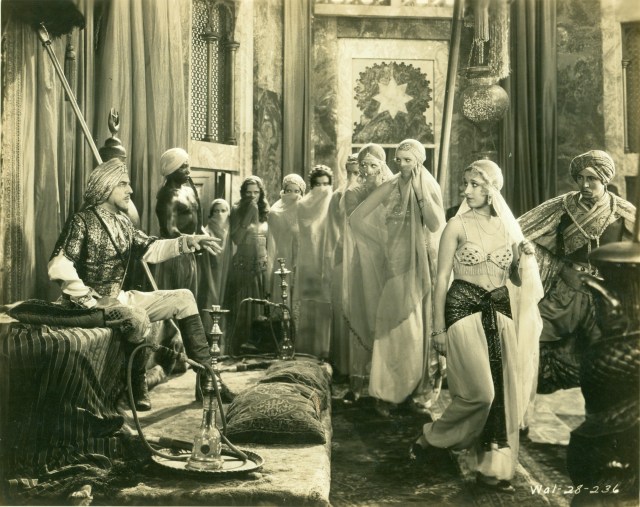
“And this girl is the other main character, and she was a show girl, dancer, and actress. The picture is a clip from a 1931 movie she appeared in called Women of All Nations. Not much of a film, but she had a closeup. Oh, that’s Bela Lugosi in the turban.” (Now I hear a ‘that’s amazing.’)

Women0001

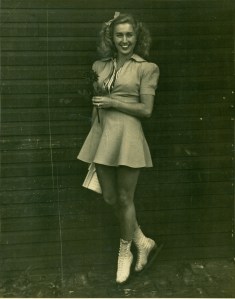
“Yeah,” I agree. “And it’s only the first book. In book two, he ships out to the Pacific, and she becomes a professional ice skater in a Sonja Henie Ice Show.”

helenskates0001

(I reach for the second book, “Figure Eight.”). Here he is with the head of Eastern Airlines, Captain Eddie Rickenbacker. You know, the WWI flying ace?” Now they want to know the price, and would I take a debit card?

Rickenbaker0001

“Would you like me to sign the books?” They would. And I thank the purchaser, and ask for feedback on Amazon.

What is nice is that all teachers share an innate sense of wonder. My natural fascination with the story easily connected to like-minded listeners among the professional educators circling that hall.

And that’s my pitch. I let the two main characters sell the memoir because they were nothing short of amazing.

Plus I , too, happily made a donation for each book sold to the IEA Children’s Fund.


Gail Chumbley is the author of the two-part memoir, “River of January” and “River of January: Figure Eight.” Both books are available at www.river-of-january.com, or on Amazon.


Words of Honor

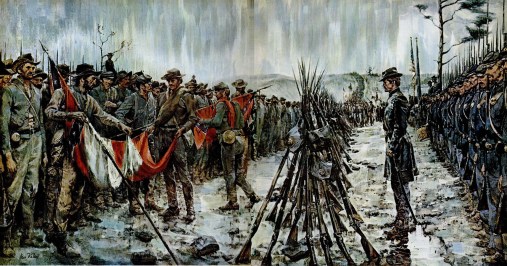
appomattoxprintlarge2

Union General, Joshua Lawrence Chamberlain, in a 1901 interview for a Boston newspaper, shared his recollections of the Confederate Army’s surrender at Appomattox Courthouse, Virginia.  Tasked by General Ulysses S. Grant with the formal 1865 surrender of Rebel arms and military gear, Chamberlain described that April day in remarkably vivid detail, despite the passage of over 30 years.

“At a distance of possibly twelve feet from our line, the Confederates halted and turned face towards us. Their lines were formed with the greatest care, with every officer in his appointed position, and thereupon began the formality of surrender.

“Bayonets were affixed to muskets, arms stacked, and cartridge boxes unslung and hung upon the stacks. Then, slowly and with a reluctance that was appealingly pathetic, the torn and tattered battleflags were either leaned against the stacks or laid upon the ground. The emotion of the conquered soldiery was really sad to witness. Some of the men who had carried and followed those ragged standards through the four long years of strife, rushed, regardless of all discipline, from the ranks, bent about their old flags, and pressed them to their lips with burning tears.

“And it can well be imagined, too, that there was no lack of emotion on our side, but the Union men were held steady in their lines, without the least show of demonstration by word or by motion. There was, though, a twitching of the muscles of their faces, and, be it said, their battle-bronzed cheeks were not altogether dry. Our men felt the import of the occasion, and realized fully how they would have been affected if defeat and surrender had been their lot after such a fearful struggle.
. . . “But, as I was saying, every token of armed hostility having been laid aside, and the men having given their words of honor that they would never serve again against the flag, they were free to go whither they would and as best they could. In the meantime our army had been supplying them with rations. On the next morning, however, the morning of the 13th, we could see the men, singly or in squads, making their way slowly into the distance, in whichever direction was nearest home, and by nightfall we were left there at Appomattox Courthouse lonesome and alone.”

Gail Chumbley is the author of the two-part memoir, River of January and River of January: Figure Eight. Also available on Amazon.com

A History Teacher on 911

I cannot recall the words I used to soothe my juniors on that horrible day. However, the soul-deep pain remains remarkably sharp in my emotional memory.

Vaguely I can see my son, a senior at the same high school, enter my classroom to check on his mom, the American History teacher. Seeing his face, I wanted to go to pieces.

It was later, in the local newspaper, that I discovered not only the words I shared with my students but the transforming pain they endured watching their country attacked.

(For the writer’s privacy I’ve deleted their identity)

911editorial0001

Gail Chumbley is the author of the two-part memoir, “River of January,” and “River of January: Figure Eight,” both available on Kindle. Chumbley has also composed two history plays: Clay on the life of Henry Clay and Wolf By The Ears a study in racism.

gailchumbley@gmail.com

And He Stood Up

th

Asked by my old high school, I had the privilege of speaking to young people on the eve of Veterans Day. My remarks appear below.

Thank You for inviting me today—It’s good to be back at Eagle High.

On October 23rd, a few weeks ago, U.S. Master Sergeant Joshua Wheeler of Oklahoma was fatally wounded in a rescue mission freeing Isis-held hostages in Iraq. He died after rushing into a firefight to support the allied Kurdish soldiers he had trained and advised. Secretary of Defense, Asthon Carter, later described the chaotic events that cost this soldier’s his life.

“As the compound was being stormed, the plan was not for U.S. … forces to enter the compound or be involved in the firefight. However, when a firefight ensued, this American did what I’m very proud that Americans do in that situation . . . he ran to the sound of the guns and he stood up. All the indications are that it was his actions and that of one of his teammates that protected those who were involved in breaching the compound and made the mission a success.”

The death of Master Sergeant Wheeler spared the lives of 70 Isis prisoners scheduled for mass execution the following morning.

Wheeler ran to the sound of the guns. Now I can’t speak for our service men and women, and when I was asked to give this talk, I had to confer with those who have made that solemn commitment. My questions were misleadingly simple . . . why did you choose a military career? What persuaded you to risk yourself for potentially dangerous service?
I wanted to try and understand that burning force of purpose, of unquestioned focus to duty, detach from self preservation for the welfare of others. I wondered how personal fear could be swallowed when, as Secretary Carter explained, “Wheeler involved himself in the firefight.” Where does this nobility of character draw from? Where do these individuals come from—the few that can’t sit on the sideline when duty calls them from their homes?

The answer, strikingly enough, is right here, in this auditorium. Home. Here. No, not someone else from somewhere else. Here. And people, that is where America has always found It’s defenders, from every town and city.

A number of Eagle students have, from many graduating classes, chosen the disciplined military life. Once wiggly kids who, warming the same seats you now occupy, resisting, as you most surely are, the urge to check your cell phones, daydream about the newest version of Halo, or wonder if Bogus Basin ski hill will open before Thanksgiving. They were kids just like you.
Now I don’t pretend to know the name of every Eagle Mustang who has volunteered for service, but I’d like to mention a few.

After earning a college degree as a civilian, 2004 EHS graduate Captain Greg Benjamin was commissioned an Infantry Officer, sending him north to Ft. Wainwright in Fairbanks, Alaska. From this first posting, Greg has served, so far, two Central Asian tours, first in southern, then in eastern Afghanistan. He wants you to know that he loves the training opportunities he’s experienced so far–Ranger School, Airborne, and Air Assault Schools, and leadership training. When I asked Greg, now married with small children why he chose to place himself in harm’s way, he replied, “I want to take the fight to our country’s enemies, leading America’s finest young men and women in combat and training. And change the lives of people in some of the worst places on the planet.”

Captain Joe Peterson, EHS class of 2005, made his decision after high school too. “I had a number of teammates from Eagle’s Lacrosse team one year ahead of me go to a service academy . . . and this kicked-off my thought process in a serious manner. I’d always held the belief of service, but this made the choice tangible for me . . . I received an invitation to visit the University of San Francisco and their ROTC department. I decided to accept.” Joey was posted in installations ranging from Fort Sill, Oklahoma, to Ft. Lewis, Washington, across the Pacific to South Korea, and Central Asia as a platoon leader in Kandahar, Afghanistan overseeing all aircraft and artillery surrounding that area. Reflecting for this talk Joe added, “It was trying at times, but . . . I am proud of my service and it added a value and perspective to my life . . . it has opened doors that are unbelievable.”

Second year West Point Cadet, Colt Sterk described his heartfelt desire to be part of something he termed, “Larger than myself.” Cadet Sterk, EHS class of 2013 explained, “When I was 14 I was given the honor of presenting a wreath at the Tomb of the Unknown Soldier, (in Arlington Cemetery). The nameless soldier in that tomb willingly lay down his life for me, a stranger. I felt a debt of gratitude. Since then I’ve always felt I was called to serve. A senior cadet told me when I was a freshman, ‘Colt in everything you do leave a footprint.’ By that he meant make an impact even if it’s only a little bit. Is it hard? Absolutely. But I know it’s where I’m meant to be.” Colton wants you to know that he visited Israel last summer for ten days studying the Israeli Palestinian conflict, and the implications in that region for the United States, and for the US Army. This semester Colt is attending the US Air Force Academy in Colorado Springs, Colorado on cadet exchange—jumping out of airplanes, and on gliding tactics. He just earned his jump wings after completing the requisite five jumps.

Colby Hyde, EHS Class, 2010 shared a different response. He said, “We are fortunate in this country that military service is not an obligation. We are unfortunate, however, in that we do not often appreciate the sacrifice of those who volunteer on our behalf. Eventually I realized that I didn’t want to be comfortable. Comfort leads to boredom and ignorance, I thought, and life is too short to accept either of those. When someone suggested applying to West Point, I could not resist. I applied, was accepted, and have never left. My life now is not comfortable by any means, and I know the hardships are yet to come. That said, I am more satisfied with my life than I ever was before. I have taken part in New York City memorials for fallen 9/11 responders, and traveled with active duty units to the deserts of Death Valley to help them prepare for combat in Afghanistan. I have traveled across Southern China, can speak, read, and write Mandarin Chinese.

I am thankful for everyone who has served me along the way, from my parents to my teachers, and I only hope I can return the favor in the years to come.” At the end of his letter, Colby added, “I have not done anything for our country yet, but I promise I will. Cadet Colby Hyde graduates from the Military Academy at West Point in 2016.

Tomorrow is Veterans Day. Now I am not here to tell anyone to enlist in military service. Truly, the life of a soldier, marine, or sailor isn’t suited for everybody. At this point in your life you should be dreaming about double diamond ski runs, video games, and Harry Potter marathons with your best friends. And also, to be frank with you, that depth of courage and commitment to duty blooms in the hearts of only an extraordinary few.

What I do want you to reflect upon when you exit this auditorium is that Captain Greg Benjamin, Captain Joey Peterson, Second year Cadet, Colton Sterk, and third year Cadet, Colby Hyde, and many, many other Eagle High School alum have solemnly sworn to protect you. And consider as well, that this oath assures these few will run toward the sound of danger–for us—just as Master Sergeant Josh Wheeler of Oklahoma.

We have remained the land of the free, because we are also the home of the brave.

Gail Chumbley is the author of River of January, a memoir.
A Modest History of American Labor

gailchumbley@gmail.com

th

I grew up in a union household. And truth be told, the benefits of the Steel Workers Union saw me through childhood, high school, and college, making possible my life’s work as an educator. With a combination of post-war prosperity, cheap hydro power from the Columbia River, and full industrial production at Kaiser Aluminum, my ambitions became possible.

Of course, at the time, I didn’t grasp the real cost paid by earlier generations for my opportunities. That is until I earned my degree in American History and began teaching. What I found in lesson preparation was a grim drama of determined people facing intimidation and violence. Eventually their valor made possible the emergence of America as a global economic power.

Labor strikes in the 19th Century were especially violent, frequently bathed in bloodshed, betrayal and cruelty. Functioning under the doctrine of “The Gospel of Wealth,” industrialists viewed workers as nothing more than a minor component in mass production. Government at all levels reliably sided with owners to quash any attempts labor made to realize better conditions.

Andrew Carnegie in particular detested unions, and to curb organizing dispersed immigrant workers of different tongues aside one another on the production lines. Language barriers minimized the threat of unionizing.

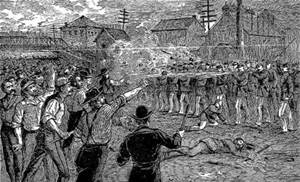
Another handy device, the Injunction, permitted state governors to legally use State or Federal troops in crushing workers efforts. A governor could claim interstate commerce was impeded, meaning rail carriers couldn’t get mail or goods transported. Once troops were deployed, guns blazing, strikers stood no chance.

One memorable use of the injunction concerned the Pullman Strike of 1894. Employees of the Pullman Palace Car Company endured lives dominated by the company’s powerful owner, George Pullman.

Workers lived in the company town of Pullman, Illinois. All utilities, rents, and other fees were set by the the powerful industrialist, George Pullman himself. Following the onset of the Panic of 1893, Mr. Pullman cut hourly wages, but held the line on municipal fees. Supported by the American Railway Union, (the ARU) workers voted to strike, demanding fairness during the economic downturn.

Strike leaders knew that they must, at all costs, avoid a federal injunction. To bypass any possibility of inviting trouble, the strikers took care that trains continued to move through the state. Rail workers aiding the Pullman strikers detached Pullman Cars, parked them on side tracks, and reconnected the trains.

George Pullman was not amused.

Soon enough the U.S. Attorney General issued the inevitable injunction, permitting federal troops to enter the fray. Some thirty strikers died at the hands of troopers, with many more wounded.

The Pullman Strike ended in government-sponsored violence, but this time the heavy-handed tactics used by Pullman left the general public uneasy. For a country that touted liberty and freedom, the authoritarian power flexed by the industrialist felt rather un-American.

Other labor disputes followed the same pattern; The Haymarket Riot in 1886, the Homestead Strike of 1892, all broken up by militias, soldiers, the police, or hired guns. In 1914 the Ludlow Massacre witnessed the Colorado militia using machine guns to mow down striking miners, women, and children.

Today unions remain controversial. However the role labor has played in America’s development is essential to remember. Labor Unions, in partnership with Capital, built the American middle class, and in return the middle class made the prosperity of this nation possible.

Have a thoughtful Labor Day

Gail Chumbley is the author of the two-part memoir “River of January,” and “River of January: Figure Eight.” Both titles available on Kindle.

Doesn’t Change Anything

Washington's-Farewell-to-his-Officers

There are folks out there in America who object to the term bellicose when describing Ronald Reagan’s foreign policy. The Texas State School Board a few years ago objected to the term “capitalism,” deeming it too loaded with negative meaning. Okay, play with terminology, putty up and pretty up the image of the past on state standards and guides, because it really makes no difference in the classroom.

Recently the College Board acquiesced to political pressure on AP US History curriculum objectives. I can understand the thinking behind this move by those who design and correct the yearly three hour exam. Those designers simply don’t need the controversy, nor do they need states to eliminate AP US from American classrooms. But the compromise actually actuates few modifications in day to day lessons, speedily delivered by harried AP teachers. Reality dictates the content of the course, and limited by time and the massive content, most are lucky to reach bellicose Ronald Reagan before the annual May exam.

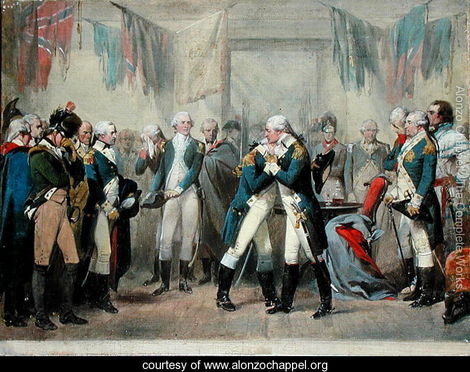
The painting above depicts General Washington’s Farewell to his Officers at Fraunces Tavern in New York. The work was the creation of artist Alonzo Chappel, and commemorates a party hosted by the victorious, but solemn Washington. This same picture, over a century later, was viewed by teetotalers with dismay. Prohibitionists, concerned by the tavern setting, especially with the wine carafe and goblet resting the table simply scrubbed the image out. Easy enough. Adjust the past to fit today’s present.

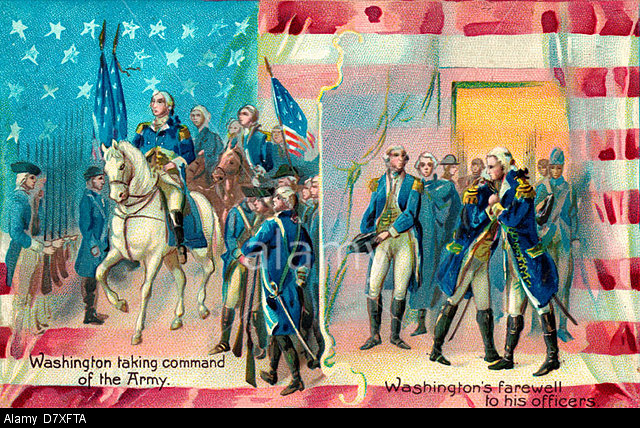
D7XFTA Washington taking command of the Army and Washington's farewell to his officers - two scenes from George Washington's Military life

D7XFTA Washington taking command of the Army and Washington’s farewell to his officers – two scenes from George Washington’s Military life

Yet, resurfacing the past, doesn’t actually change anything. Alcohol played a huge role in Colonial America. It just did. In fact, with reference to the 1980’s, all an instructor has to do is produce a couple of line graphs of military spending from 1981 to 1989. Any kid can deduce the trend in military expenditures. Read a couple of speeches in class–Ike’s Farewell Address to the country for example, and students certainly understand the deafness of the Reagan Administration to General Eisenhower’s cautionary words on the perils of the military-industrial complex.

And all those critics who scorn the notion of teaching higher level thinking haven’t spent a moment working with high school students. You can’t fool these young people, they are a lot smarter than you think. Any examination at primary materials, aside from textbooks, or any other ancillary stuff reveals a truth sans any political spin.

So go ahead and bleach the course objectives. Go ahead and whitewash topics such as the genocide of Native peoples, or the insider manipulation that has torpedoed the stock market over and over. It doesn’t matter really. I always told my students that the greatest thing about American History is that we examine it, warts and all, with eyes bravely open. That’s is the source and the strength of our nation’s greatness.

Gail Chumbley is the author of the memoir, River of January

We All Knew

th

One-eighth of the whole population were colored slaves, not distributed generally over the Union, but localized in the southern part of it. These slaves constituted a peculiar and powerful interest. All knew that this interest was somehow the cause of the war . . . .If we shall suppose that American slavery is one of those offenses which, in the providence of God, must needs come, but which, having continued through His appointed time, He now wills to remove, and that He gives to both North and South this terrible war as the woe due . . .Lincoln’s Second Inaugural, March 4, 1865

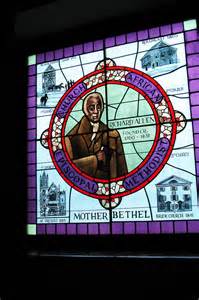
Richard Allen and Absalom Jones founded the African Methodist Episcopal Church in the early 19th Century. Both men, devout followers of the Methodist faith, often found personal worship disrupted by white parishioners, bent on limiting black presence and participation. Enduring decades of bullying by white clergy, these men and their followers established their own church in Philadelphia, “Mother Bethel.” At this site Allen and Jones, with their congregation witnessed the racial turbulence of the antebellum period, with the rise of Abolitionism, and finally culminating in bloody Civil War.

Richard Allen and his congregation were forced to draw away from the established Church because they longed for freedom of worship. And though this schism seems small today, the move toward religious independence indicated the real need for black equality in all spheres of life, but especially in this case of spirituality. “Mother Bethel,” and many more churches like it supplied the moral courage to risk all in the pursuit of public justice.

It was from African-American Churches, (all rooted in rejection by white congregations) that real advances began. Richard Allen and the AME is one example. But Dr. King provided the same succor for the next social-political push in the Civil Rights era of the 1950-1960’s. Faith and song propelled this hopeful movement forward, lead by blacks for blacks.Though a Lutheran, Rosa Parks was approached by the leaders of Dexter Avenue Baptist Church to ride that bus in Montgomery and not be moved.

The African-American church was the anchor feeding the spirit of justice.

But yesterday a serpent was welcomed (with love) in to this timeless sanctuary of solace. This lost soul, channeling the rage of hundreds of years of hate, sprayed deadly venom to try and kill the timeless promise of hope. The message registered–we know hate still runs riot among the fearful. The church is no safe place from the legacy of ignorance and racism in America.

President Lincoln grasped that truth–slavery presented the worst kind of sin, a sin of such magnitude that oceans couldn’t wash America clean. He states in his Second Inaugural that “we all somehow knew.” And we indeed do know that racism is the defect that turns us into monsters. The president implored Americans to accept that racial conflict is our nation’s Achilles Heel, and it won’t go away without courageous action.

We must deal with inequality on a national level, a state level, and each in our own hearts. White and Black. Folks, the strife will not go away on it’s own–it never has.

And, yeah, maybe Rachel Dolezal has identity issues, maybe she acted the fool in front of us all. But I would suggest that we could all make a little effort to generate some empathy for the guy next to us.

If you enjoyed this message, please share.

Gail Chumbley is a historian and author of River of January

That’s All

th

Colonel Clark used to bring his young son down to the dojo where my brothers took judo lessons. My grandfather had enrolled my older brother first, and then my two younger brothers when they were old enough. I sometimes came along to watch these lessons because, first of all, it was something to do on a boring school night, and I liked to look at the cute boys dressed in their gi (white gear).

My Grandpa Ray always sat with Colonel Clark, if the old gent happened to be present. That meant I sat with Colonel Clark, too, not fun for a twelve-year-old, boy-crazy girl. The two old men would talk and talk, seated next to one another, though their eyes remained on their boys training on the mats. They never seemed to look each other, but still seemed absorbed in their conversation.

My own attention span, something close to that of a hummingbird, only caught snippets of the quiet discussion. “MacArthur, Wainwright, and Bataan,” were among the many utterances exchanged by my Grandpa and the Colonel. And despite my commitment to shallow-minded teen angst, I sensed something grave, something momentous had happened in the back and forth of these two old men.

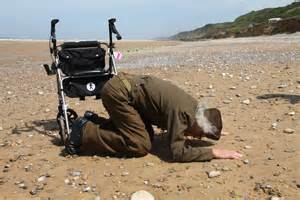
My brother later translated the mysterious conversation I unwillingly witnessed. Colonel Clark had been left on the Bataan Peninsula when General Douglas MacArthur was evacuated from the Philippines in 1942. Under the new command of General Jonathan Wainwright some 22,000 Americans surrendered to Japanese occupiers, among them young Clark. The Japanese forced this defeated army on a death march (along with their Filipino comrades) some sixty miles in the jungle. The men suffered from heat exhaustion, and dehydration, staggering on, hat-less and barefoot. When a captive stumbled, or fainted, the penalty meant an immediate beheading.

Colonel Clark had witnessed this nightmarish brutality, forced to suffer in ways words fail to recreate.

In defiance of considerable odds, Colonel Clark survived his ordeal. And that was the ordinary older man who spoke quietly with my Grandfather, watching a young son he should never, in reality, have sired.

I am a much better listener today, and recognize that valiant warriors everywhere are frequently disguised as harmless old men. Listening to these elderly gents has enriched my understanding of the past far more than I thought possible.

For example there was George, the high school janitor. For many years he pushed a mop down the halls where I taught American history. Sporting two hearing aids, this diminutive man wielded a mop that was wider that he was tall. All told, George looked like a gentle and harmless grandfather.

I’d often find George standing outside my classroom door listening to me blather on about the Second World War, as if I understood. Later I discovered that that mild mannered 80-year-old had once packed a M-1 Garand, shivering aboard one of those Higgins boats motoring toward Omaha Beach in 1944.

“So George, what do you remember most about D-Day?”

“It was awful early, and the water was awful cold.”

Then there was Roy. Smiling, white-haired Roy.

As a teenager he had gone straight from the Civilian Conservation Corps right into the US Army.

“What do you remember most about D-Day, Roy?”

“I lost everyone in my outfit. I was real scared. Later I was regrouped with survivors from other platoons. You see that was bad because I’m Mexican, and my first platoon got used to me, and stopped calling me Juan or Jose. I had to start all over with the new bunch. For days, as we moved inland, these new boys were giving me the business. One guy said, ‘Mexicans can’t shoot.’ I said that I could. So he said, ‘Ok Manuel. Show me you can shoot. See those birds on that tree branch up ahead? Shoot one of those birds.’ I lifted up my rifle and aimed at the branch and pulled the trigger.” Roy begins laughing.

“I missed the branch, the birds flew away, and twelve Germans came out of the grove with their hands up.”

Astounded, I couldn’t speak. Roy simply chuckled.

Colonel Clark, George, and Roy. They were just boys who found their lives defined in ways we civilians can never comprehend. They were scared, and hot, and cold, and hungry, and suffering, and ultimately lucky. They returned home.

That’s All.

Gail Chumbley is the author of River of January, and River of January: Figure Eight, a two-part memoir. Also available on Kindle.

The Outside World

My mom took a job in the early sixties with the US Postal Service. At first it was part-time, mostly needed at Christmas, but by 1966 she hired on full time. 

There were four kids, a house, and a yard, and Mom probably was pretty overwhelmed—something today I fully understand. For help my parents decided to host a student each term who attended a secretarial school in Spokane, called Kinman Business University. Lord knows what kind of credential awaited these young ladies after completion, but students did acquire skills such as shorthand, typing, filing, and other tasks.

The first girl who who came to stay with us was named Corrine. I can’t remember exactly the year, most likely around 1965 or 1966. I was in fourth grade. 

Corrine came to us from Alaska, and I remember she told me she was part Filipino or Native American, or both. I thought that pretty cool, Corrine to me symbolized the wonder of the outside world. 

Our house was constantly in a state of chaos, with quarrels, messes, a blaring TV, with people coming and going—chaos. But to walk into Corrine’s small quarters felt like a completely different world. All of her things were neatly stowed away, her bed carefully made, and the space even smelled differently than the rest of the house. I loved visiting her room, as it felt like an oasis of tranquility in a sea of crazy disarray. And it was in her little sanctuary that serene Corrine shared her life with me just a little.

A picture sat on her dresser of a boy. When I asked who he was, she told me his name was Ty, and that they planned on getting married in a few years. Married! I never knew a girl who had plans to get married! The only people I knew who were married were parents, and they were boring. 

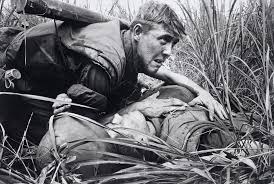
He was called Ty, short for Tyrone, and he was visiting Spokane soon. Ty had received his draft notice and following basic training in the Army, he would ship out to a country called Vietnam. Corrine clearly missed him very much, and was anxious to see Ty before he flew to Southeast Asia.

My memories of his first visit are a little vague. I do recall that they sat on the couch in our living room and held hands in front of my parents. That moment struck me as fascinatingly real. 

Looking back I am sure that there were much deeper emotions at play, but whatever vibes filled the room zoomed over my 10-year-old radar.

And then Ty was gone.

The school term ended, and Corrine packed up most of her things and returned to Cordova for the summer. I’m not sure of the details or decisions, but she did return to us the next fall. Once again her room became that wonderful respite from the anarchy of the rest of the house. Ty’s picture again graced her dresser. 

Letters began to arrive to our house written on onion-skin parchment, marked AIR MAIL, bearing Corrine’s name. I’d never seen stationary like that, and she explained that was the cheapest way she and Ty could exchange letters. The paper was light blue, and felt like stiff tissue, but held its shape without creasing. Corrine had stacks of it, both fresh and received—the only sign of clutter in her neat little world.

Finally Ty came back to our house, and this visit was very different from the first meeting. The couple did not sit on the couch and hold hands. Not this time. My pre-teen sensibilities were shocked to see a grown man lying across her lap on the couch sobbing like his heart had broken. 

Poor Corrine! She, too, was dissolved in tears; red, puffy eyes behind her glasses. Ty couldn’t seem to help himself,  or compose himself, and he wouldn’t let go of her. The whole situation felt very surreal. I didn’t understand. How could this orderly girl, and her once orderly fiancé come apart like this, and in front of all of us?

That chapter occurred a very long time ago. My mother still worked, and there were other girls we housed. Still sweet Corrine and Ty live on in my memory as if only yesterday.

I grew up, went away to college, earned a degree in American History, becoming a teacher. 

For years and years I taught a unit on the Vietnam War to high school juniors. I recited the facts surrounding America’s entrance into that long, long, conflict. But in all my experience with those lesson plans, the veterans who visited my class describing their personal war, the analysis by historians we studied, nothing affected me more than the tragic transformation of that broken young man from Alaska.

Gail Chumbley is the author of the two-part memoir “River of January,” and “River of January: Figure Eight.”

Chumbley has also authored two stage plays, “Clay” on the life of Statesman Henry Clay, and “Wolf By The Ears” an exploration of American racism and slavery.

gailchumbley@gmail.com