The Die was Cast

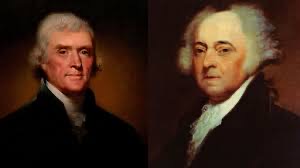
The threat of disunion appeared long before either the Civil War, or the insurrection on January 6, 2021. The architects laying the chaotic cornerstone? President John Adams, and his Vice President, Thomas Jefferson.

David McCullough in his celebrated biography, John Adams, portrayed this Founding Father as a brilliant man, and that is true. However, his self righteous streak succeeded in undercutting his talent and better judgement. As the second president of the United States, John Adams, proved to be a prickly, and thin-skinned chief executive. A dour Yankee, Adams could not tolerate public criticism, and as many later presidents, came to view the press as an adversary—enemies of the government.

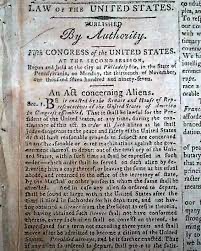
In a rage over newspapers excoriating his administration, Adams shepherded the Sedition Act through Congress in 1798. Opposition editors soon found themselves in the President’s cross hairs, and some were actually jailed. The Alien Act, also passed in 1798, aimed to delay new voters, by lengthening time for naturalization, as immigrants were certain to vote against Adams and his Federalist Party. (Hmm. The press, immigrants, and voting rights. Imagine that).

Jefferson, (still Adams’ Vice President), promptly took action to counter Adams’ wrong-headed legislation.

Launching a full out, but anonymous denunciation of the Adams Administration, Vice President Jefferson published tracts vilifying Adams, and emphasized the sovereignty of the states guaranteed under 10th Amendment.

Returning from France, where he had served as American ambassador, Jefferson had been appalled by the powerful Federal Constitution created in his absence. As a ‘natural aristocrat,’ and slave master, Jefferson was unwilling to cede power to any higher authority than himself, and his fellow patricians. Instead the “Sage of Monticello,” asserted the right of states not to obey laws they didn’t like.

Two state legislatures agreed to debate Jefferson’s counter measures, Virginia and Kentucky. Penned secretly by Jefferson, and Madison, these resolutions insisted the states were the final arbiters of what was legally binding. A new term emerged from this controversy—Nullification.

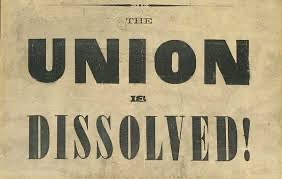
The die was cast, the seeds of disunion sown. In the years following, nullification intensified, fertilized particularly in 1832 by John C. Calhoun, a South Carolina Senator. That that state became the first to secede in 1861, sparking the US Civil War, is no coincidence.

The traitors who invaded the halls of Congress last January took their cue from Jefferson, as if they, too, battled the evils of John Adams. Scapegoating the media, immigrants and the Federal government has left a long, bloody stain on American history. As I write, the States of Georgia, and Texas among others, are attempting to limit voting rights once again. Texas has also taken a nullifying stance, limiting a woman’s right to her own body, despite Federal protections.                        

No government has a self-destruct button, none. John Adam’s pique, and Thomas Jefferson’s reaction stamped an incompatibility that still, today, inflames American politics. 

Gail Chumbley is the author of the two-part memoir, “River of January,” and “River of January: Figure Eight.”

gailchumbley@gmail.com
It’s Only Fair

In his 1975 book, “The Russians,” author Hedrick Smith tells a story about a domestic fire in Moscow. He noticed passersby strolling along without a glance, despite urgent smoke and water damage. Neither Tass, nor Pravda covered the story–for Soviets, there was no bad news. This lack of public reaction, Smith concluded came from weary resignation. Citizens had long ago given up on honesty from Party authorities.

In stark contrast, an informed electorate founded the American system; information an essential component of our democracy. Cynical will not do. Without facts reported by a free press, it is game over.

Recognizing the influence of television as a news source, Congress, in 1949, codified equal time when broadcasts touched on public policy. The Fairness Doctrine the second of its kind (the first governed radio) was enforced by the Federal Communications Commission (FCC) mandating broadcasters to present equal sides of public information, or lose their license to operate.

And that doctrine governed news coverage until killed by the smiling, ever popular Ronald Reagan in 1987. His personal charm camouflaged the catastrophe his administration lobbed against journalism and, in turn, our democracy.

In 1968 when the most revered news anchor of his day, Walter Cronkite, returned from assignment in Vietnam, he broke with precedent by publicly admitting Vietnam a lost cause. Later the anchor conceded Woodward and Bernstein were probably on to something with Watergate. Cronkite’s statements spelled the end for both the war, and the Nixon Administration.

The modern GOP hasn’t cared much about the equal time component since Richard Nixon crashed and burned in 1974. From his earliest days “Tricky Dickey” gained attention as a ruthless Communist-hunter, first in the House, as a Senator, and then as Vice President. Following his 1960 loss to JFK, Nixon loathed the press and like Trump saw the media as “The Enemy of the People.” In Nixon V The New York Times, the White House challenged publication of the Pentagon Papers, and lost, then in US V Nixon, ruled the release of the disastrous tapes proving Nixon’s Watergate coverup.

Nixon and other Republicans believed reporters, the networks, and the media, in general, was out to get them.

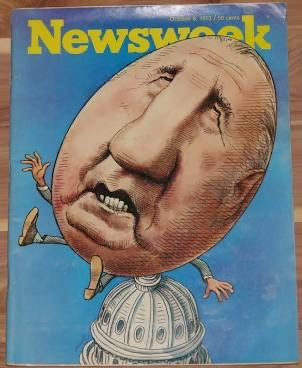
Before his own 1973 resignation in a separate scandal, Vice President Spiro Agnew did not mince words concerning the press. Agnew referred to the media as the “Nattering Nabobs of Negativity.” Soon the press found there was quite a bit to natter on, when Agnew pleaded guilty to bribery and resigned.

Today, the far Right has capitalized on the end of the Doctrine, manipulating facts, and generally reporting misinformation, without even a blush.

In some respects the end of the Fairness Doctrine has set a course for gutting American democracy.

To hear about it now, the fiasco of January 6, 2021, according to the right-wing media, was no more than a pleasant tour group visiting the nation’s capitol. That violence we all witnessed, is just a misunderstanding. Bear spray, tear gas, and baseball bats used against the D.C police didn’t actually happen. The “Liberal” press exaggerates.

Perhaps before 1987 Americans actually wanted to know whether or not a national fire was raging.

Gail Chumbley is the author of the two-part memoir, “River of January,” and “River of January: Figure Eight.” Both titles are available on Kindle.

gailchumbley@gmail.com

An America To Believe In

Religion in politics presumes all citizens essentially hold to the same beliefs. This premise also insists that religious conformity assures civic virtue and good order. However, in practice theocracies actually run counter to effective government because invoking God in public debate stymies any exchange of thoughts. Without a “free market of ideas,” our society cannot advance, condemning the nation to decline, (See Middle Ages).   

The Constitution’s framers did not lightly pen any Article, Section, or Clause without study or debate, and that especially includes the later admission of the Bill of Rights. James Madison, in particular examined other government systems, from the Greek City States through the Age of Reason. What Madison discovered was politics combined with religion inevitably sows public conflict; damaging both political and religious institutions. Madison’s purposeful language in drafting the First Amendment, (free exercise and establishment clauses) signaled that the United States would not repeat those fruitless mistakes. 

Lessons existed in America’s past as well. In Colonial New England Puritan dissenters, such as Roger Williams, and Anne Hutchinson publicly rejected mandatory church compliance. Williams, later exiled to Rhode Island, defended his religious principles writing,

Enforced uniformity confounds civil and religious liberty and denies the principles of Christianity and civility. No man shall be required to worship or maintain a worship against his will.

As the first Catholic-Presidential candidate, John F Kennedy later echoed the same idea stating,

. . .it is apparently necessary for me to state once again not what kind of church I believe in — for that should be important only to me — but what kind of America I believe in.

And that was the point. American citizens must choose to worship freely, or not. That is the essence of American liberty. Law cannot dictate conscience, as our individual thoughts are as unique as our finger prints.

Despite the secular legacy of American law, religious prerequisites still surface from one era to another. In the earliest years of the Republic a fervor of evangelism blazed hot, recognized today as the Second Great Awakening. Beginning around 1800, and lasting until the Civil War, endless, exhausting revivals criss-crossed the country.

Choosing a faith among many churches began early and today is an American tradition.

Loosely paralleling “The Age of (Andrew) Jackson,” politics followed a similar evangelicalism, giving every person a choice in both their faith and their vote. As Americans migrated west voting rights followed, extending to the lower classes. Increasing numbers of farmers and tradesmen could cast their ballots and follow their understanding of Jesus with the same passion. 

Another unexpected outcome of the Second Great Awakening came in the form of countless spinoffs. Rural isolation cultivated a veritable Garden of Eden in new Protestant sects. For example William Miller of upstate New York forecasted the return of Christ as urgent and imminent. He, and his followers believed Jesus would reappear sometime between 1843-1844. After the dates passed with no rapture, the church regrouped becoming today’s Seventh Day Adventists.

Methodists dispatched “circuit riders” into America’s interior. Men like Peter Cartwright, the epitome of a frontier “stump speaker,” could preach the Word of God, while beating the hell out of any heckler. 

Presbyterians split a couple of times before the Civil War. First regarding whether or not untrained missionaries could lead revivals, or only seminary-trained ministers. This controversy split churches and brought about schisms.

The most profound issue for Presbyterians and other denominations sprouted from the growing controversy over slavery. North of the Mason-Dixon Line believers felt their duty was to take action and cleanse America of this national sin. Southerners, however countered that God made no mistakes, and it was God who appointed masters, and placed the slaves beneath them. Rather a handy absolution, that. It took a war to change the politics of slavery, but churches first led the way.

Perhaps the best advice on separation of church and state came from Justice William O Douglas in the court’s ruling, Engel V Vitale, 1962.

“once government finances a religious exercise it inserts a divisive influence into our communities.”

Dictating conscience is a fools errand, and a liberated conscience is the essential foundation of America.

Oh, and Christian Nationalism is neither Christian nor national. Quite to the contrary, that brand of absolutism does not promote public virtue, nor good order, but does lead to national decline, (see Holy Roman Empire)

Gail Chumbley is a history educator, blogger, and author of the two-part memoir, “River of January,” and “River of January: Figure Eight. Both titles are available on Kindle. Chumbley has authored three stage plays, “Clay,” “Peer Review”, and Wolf ByTheEars.” examining America’s past and present.

Humiliated, Angry, and Hurt

After losing reelection, he left Washington early. Humiliated, angry, and hurt, John Adams boarded a morning coach leaving the Capitol.

The prevailing issue in the campaign of 1800 concerned France, and that nation’s ongoing, and bloody revolution. Moreover, the French had declared war on England, and both belligerents  meddled in American domestic politics to turn public opinion.

As President, Federalist John Adams, had skillfully steered America clear of the European conflict, avoiding the danger of being ensnared between the two superpowers. Proud of his diplomatic accomplishments, Adams still brooded, unhappy with his lack of support from the country. His detractors belittled him, disparaging Adams as a pale substitute to the legendary George Washington.

His political challenger in 1800? The clever and calculating Thomas Jefferson. 

An outspoken critic of the Adams Administration, Jefferson had been hurling plenty of invective toward the sitting President. What had once been a warm friendship between the two men quickly soured. Petulant and  thin-skinned, Adams had lashed out by pushing laws that restricted the free press and cracked down on immigration. Outraged by these policies, Jefferson, and his growing cadre of supporters, challenged the clear violations of the Constitution. 

In only the nation’s third presidential election the moment appeared volatile and uncertain. On one side was the defensive and testy incumbent, and on the other, a political foe intent on replacing him.  

Adding to the turbulence, a political wildcard entered the fray; New Yorker, Aaron Burr.

Burr, like Jefferson, had opposed unpopular and heavy handed Federalist policies, and Jefferson knew the ticket needed an electoral-rich northern state for strength. As party leader, Jefferson assumed Burr understood his lesser place, and only when the electors met did he learned just how wrong he had been. 

In the final tally, poor John Adams not only lost the election, but came in a distant third behind both challengers. Thomas Jefferson garnered 73 Electoral votes, followed by Burr with 73 of his own. Adams came in last with 65. (That tie is another story.)

Humiliated, Adams left Washington DC in a huff, but made no move to challenge the outcome. And though the former President did not greet the President-Elect, and pointedly skipped the inauguration, John Adams did not put his interests above the nation’s. 

He conceded in silence because he valued our country over his own interests. 

There is no precedent for false assertions from the clear loser in 2020.

Gail Chumbley is the author of the two-part memoir, “River of January,” and “River of January: Figure Eight.” Both titles available on Kindle, or at http://www.river-of-january.com.

gailchumbley@gmail.com

Heartfelt Objections

We couldn’t find a seat on the Washington Metro. In truth, we couldn’t see the Metro station, just a mass of humanity.

This gathering challenged the notion of enormous. The moment was historic.

Dumb luck came to our aid. A city bus hissed to a stop at the curb, and my friend and I hopped aboard, joined by a couple hundred of our new best friends. The atmosphere crackled with joy, solidarity and diesel fumes. I nearly busted out with “99 Bottles of Beer on the Wall.”

The driver seemed to catch our enthusiasm and peppered us with questions about the Women’s March. What time, where, how long would it last? She smiled realizing her shift would end before the speakers began, and I still wonder if she made it.

Nearly five hundred thousand of us convened on the National Mall, and expressed our heart-felt objections concerning the newly elected president. We marched as one.

By the way, no one violently attacked the halls of government. Though, if memory serves, I did flip off the Trump Hotel.

In October, 1969, 250,000 opponents of the Vietnam War descended upon Washington DC. In an event called Moratorium Day no one violently attacked the halls of government.

In the swelter of a 1963 Washington summer, Dr King convened the “Poor People’s” March on Washington. 250,000 Americans petitioned their government for a voting rights bill. No one even considered attacking the halls of government.

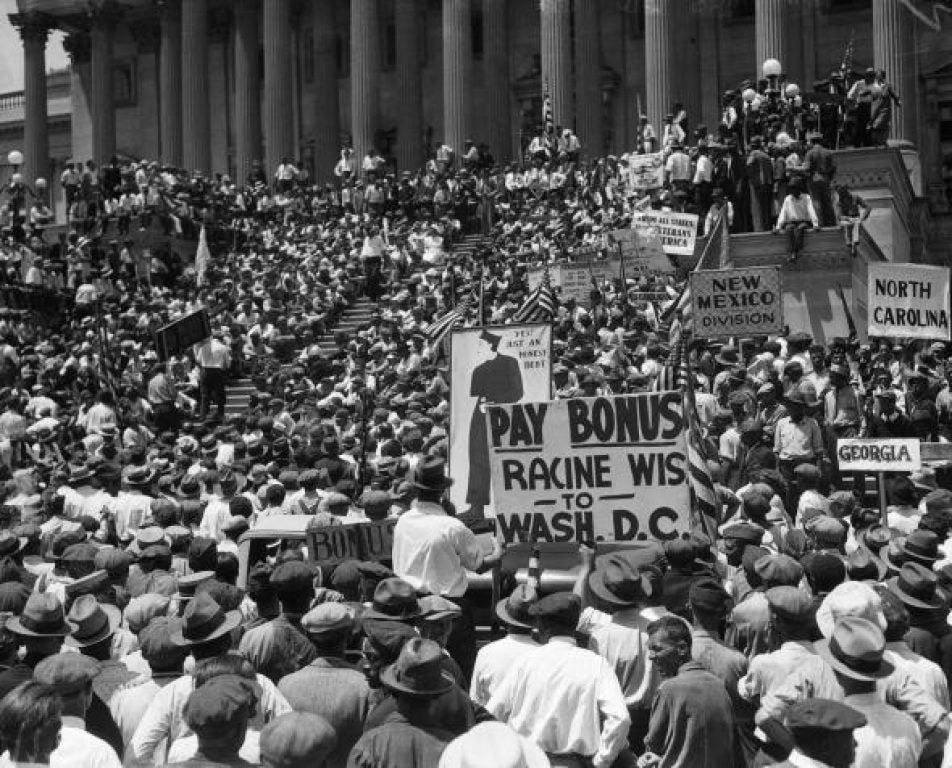
In the Spring and Summer of 1932 during the depth of the Great Depression, somewhere around 20,000 desperate men, some with their families in tow, marched on Washington DC as part of the Depression-era Bonus Army. For their trouble the marchers were attacked by Douglas McArthur, and an army detachment, who instead, burned out the shanties of the desperate. Again, no one attacked the halls of government.

On March 3, 1913, the day before the inauguration of Woodrow Wilson, nearly 10,000 women paraded down Pennsylvania Avenue promoting women’s suffrage. Though they were attacked by angry men along the route, not one woman attacked the halls of government.

Nearly 10,000 American’s joined Jacob Coxey’s Army in May of 1894. An extended economic depression caused mass unemployment, and the “Army,” demanded a public works bill to create jobs. Though the marchers reached the Capitol, and Coxey, himself leaped up the stairs to read his public works bill, the police opened up some heads, and the crowd dissolved. No one entered the Capitol.

Public protest is as American as baseball. The difference lies in our use of free speech. On January 6, 2021 a mindless, misguided, and dangerous mob hijacked the right to assemble, instead escalating into a violent attack on our center of government. There is no middle ground; this was an attempted coup to seize power.

We were correct in 2017, as were those in 1894, 1932, 1963, and 1968. Marchers were seeking “the blessings of liberty” within the rule of law. None of us ignored nor defiled the spirit of protest.

And that sense of heart-felt objection, to that president proved accurate.

Gail Chumbley is the author of the two-part memoir, “River of January,” and “River of January: Figure Eight.” Both titles available on Kindle.

gailchumbley@gmail.com

Peer Review #3

The military choir filed out of the Entrance Hall in a precise formation, trailed with a warm wave of applause. The President had enjoyed the evening performance, and bristled that no reporter had stayed to detail the concert for the public. “This is the kind of story real Americans would like to see on the news,” he complained, as he shook hands and chatted with departing well-wishers. 

The grand chamber soon emptied and the White House staff swept in, quickly stacking chairs, breaking down risers, and disconnecting sound equipment. The President turned from the racket, and headed toward the white Doric columns separating the hall and staircase. And it was there, beside an alabaster column, that the President stumbled upon a most unexpected visitor.

Lounging against the smooth white marble leaned a tall, lanky gentleman dressed in an antiquated silk dressing gown, white hose, and embroidered slippers. The man cooly assessed the stunned President.

“Are you familiar with the story of John Peter Zenger” the intruder murmured in a soft drawl. 

“Why are you still here? The entertainment left that way,” the President snapped, thumbing toward the side entrance.

“Zenger, a German immigrant, edited and printed a newspaper in New York,” the visitor continued, calmly shifting his position against the pillar. “Zenger had published an unflattering editorial of New York’s Colonial Governor, and the testy royal had the journalist jailed, charged with libel.”

The President, annoyed by the imposition, wanted to hurry up the stairs to his living quarters, but his legs remained stubbornly rooted in place. 

“Well, that Zenger character deserved it, he barked, unable to control his tongue. “Reporters need to watch what they write, and who they offend—like me. I’m the President, and they say terrible things about me, all lies and more lies.”

The tall figure crossed his arms and looked evenly at the President. “A jury of Zenger’s peers acquitted him, opining that if truth was stated, there is no libel,” the stranger subtly smiled. “That particular case established freedom of the press in this country, a principle I later insisted appear in the Bill of Rights.” 

“Do you understand how much I could accomplish if . . .”

The apparition spoke quietly over the President. “I, too criticized a president bent on stifling  free expression” the visitor thoughtfully paused. “President John Adams supported passage of the Sedition Act in 1798 to silence critical voices such as mine.” 

The oddly dressed gentleman began drifting through the pillars into the Entrance Hall, as if floating on a sudden breeze. Unwillingly, the President followed. “I’m particularly fond of this room,” the visitor whispered, “it was the only finished room in my time.”

“The press wants to destroy my administration,” this time the President spoke over his visitor. “With their unlimited snooping, the constant leaks, and the treasonous things they say about me on cable tv.”

The apparition appeared indifferent to the President’s complaints. “A particular writer, James Callender, cast enough aspersions upon Mr. Hamilton and Mr. Adams, that he found himself jailed under the Sedition Act. Once I moved into this House, I pardoned Callender, and hired him to again take up his poison pen.” The spirit seemed sadly amused, “when I refused to appoint Callender to a government post, his pen turned full force upon me, exposing my deepest, most safeguarded secret.”

“The Sedition Act. I like that,” the President beamed, indifferent to the visitor’s revelation. “What’s the matter with my lawyers. They never told me we have that law.”

Instantly the apparition jutted his face directly into the startled President’s. “You must not respond,” he breathed.  “You must ignore what is written and reported regarding your administration. Never, never challenge the freedom of the press, to do so diminishes the office of chief executive, exposing you as petty and small.”

“But the Sedition Act says . . .” the President squeaked, unnerved.

“Is unconstitutional,” the visitor finished the sentence. “I, too, resented what appeared in the press, besmirching my personal life, and my family. However, I resolutely remained aloof to the reports. And so must you.” 

The visitor began to sound weary, worn by the conversation. “I once stated that if I had to choose among the freedoms enumerated in the First Amendment, I would preserve Freedom of the Press. With that liberty secure, all others are assured.

As the visitor finished his statement, he lifted his eyes to some mysterious point above, and vanished. 

Dismayed by the experience, the President scrambled up the stairs.

Gail Chumbley is the author of the two-part memoir “River of January,” and “River of January: Figure Eight.” Both books available on Kindle, or at http://www.river-of-january.com.

gailchumbley@gmail.com

The Unforgivable Curse

Many of us have read JK Rowling’s Harry Potter books and/or watched the films. The author created a wondrous world of spells, incantations, and even included law and order via three unforgivable curses. 

There are guardrails in this tale, and a bit of a messiah storyline. Harry willingly sacrifices himself, as had his parents and many others before. However, the “Boy Who Lived,” does, and returns to fight and vanquish wickedness. 

Love, too, permeates the storyline, and the righteous power of good over evil. 

But that’s not my take.

As a career History educator I came to a different conclusion; Harry Potter told me that failing to understand our shared past can be lethal. And that was the metaphor I preached to my History students.

Harry rises to the threat and defends all that is good and valuable in his world. If he didn’t, Harry could have been killed and his world destroyed.

It’s so apropos at this moment in our history to grasp our collective story as Americans.

Honest differences within the confines of our beliefs is one thing. Obliterating the tenants of democracy is quite another. 

Americans cannot surrender our country to this would-be dictator, the things that have cost our people so dearly. Freezing soldiers at Valley Forge did not languish to enable DJT to trademark his brand to hotels, steaks or a failed university. The fallen at Gettysburg, and the suffering in Battle of the Bulge was not to pave the way for DJT to get us all killed from a ravaging plague. The girls who perished in the Triangle Shirtwaist Fire, the miners murdered in the Ludlow Massacre, or humiliated Civil Rights workers beaten at the Woolworth’s lunch counter was not for Donald Trump to validate racism and sexism and undo labor laws. 

He doesn’t know our nation’s history, and as George Santayana warned us, we are condemned to sacrifice all over again. 

Vote. 

Gail Chumbley is the author of the two-part memoir, “River of January,” and “River of January: Figure Eight.

gailchumbley@gmail.com

Peer Review #4

Just My Imagination, Running Away With Me.

*Whitfield & Strong

The President fumed, crushing buttons on his cell phone, as if each tab detonated an explosion. On the big screen Wolf Blitzer, voice flat and controlled, droned on how the President continued to lag in the polls. 

“Fake news,” he muttered out of habit, and switched the channel.

Perched on the edge of an upholstered armchair, he clutched his remote in one hand, and his cellphone in the other, seething at the unfairness of the coverage.The broadcast cut to a political commercial; a carefully spliced montage of his public faux pas, ending with an endorsement from his adversary. 

“Ukraine,” he muttered, “Got to talk to Mitch and Kevin about a new Ukraine investigation.” 

“You cannot coerce them, you know.” The voice came from behind. “The people. They cannot all be manipulated, much as you might try. Most are not fools, and any goodwill must be earned.”

Not accustomed to direct insolence, the President twisted around in his chair snapping, “Just who the hell are . . .,” then trailed off. A tall, painfully angular man stood near a richly paneled door. Attired in a long black coat with tails, the visitor sported whiskers along his jawline.

“And they will never all love you. Ever. Such is the raucous nature of American democracy.”

The apparition paused a long moment. “Sowing divisions through fear and vitriol is not governing, and you shall surely fail.” The visitor stepped closer as he spoke, prompting the President to spring out of his chair, phone and remote forgotten on the carpet. 

“I recognize you . . .,” the President sputtered.

“We, all of us, sought this office fueled with purpose and ambition,” the visitor continued in a prairie twang. “However, once under oath, the campaign is over. A president faces the duty of serving all Americans, a challenge in the best of circumstances.

From the flickering screen a news anchor admonished, “Aides have confirmed that the President knew of the virus as early as February.” 

“It’s those hacks,” the President stabbed his finger accusingly at the big screen. The press is out to. . .”

His visitor laughed without humor. “Criticism of elected officials is as natural as the sun rising, and as perpetual. ‘Baboon’ was the nicest insult slung my way . . .by a serving general, no less. Then he up and ran against me in 1864.” The visitor chuckled lightly. “Still, the truth is we are all better with free speech than without. In our differing views we discover our deepest truths.”

By now the President began tuning out much of what the visitor was saying, his irritation making him bold. “You need to leave,” he snapped. “I have a busy schedule.” 

Unruffled, the unwelcome guest studied the President intently. “In my time an entire section of the nation disputed the results of my election.”

“You lost the popular vote, but won the Electoral?” The President couldn’t help but ask.

“Indeed. Eleven southern states chose the battlefield over a peaceful transfer of power.” 

“What did you do?” 

“I defended the Republic.”

His visitor continued sadly. “However the butcher’s bill for this unity came dearly; 700,000 American lives.” The visitor heaved a weary sigh. “And that delicate balance has endured through all national crises, preserved only through considerable effort and executive leadership. A unity you undermine at every opportunity. ” 

“Wrong, wrong, wrong. My supporters all love me. You should see the crowds at my rallies.”

“And the rest of America?” The visitor peered intently at the President. “Remember sir, we are friends, not enemies. We must not be enemies.” His voice quietly trailed off in an echo, and he was gone.

Gail Chumbley is the author of the two-part memoir, “River of January,” and “River of January: Figure Eight.” Both titles are available on Kindle.

gailchumbley@gmail.com

Peer Review #3

The military choir filed out of the Entrance Hall in precise formation, trailed with a warm wave of applause. The President had enjoyed the evening performance, and bristled that no journalists had reported on the concert for his base. “This is the kind of story real Americans would like to see on the news,” he complained, as he shook hands and chatted with departing well-wishers. 

The grand chamber soon emptied and the White House staff swept in, quickly stacking chairs, breaking down risers, and disconnecting sound equipment. The President turned from the racket, and headed toward the white Doric columns separating the hall and staircase. And it was there, beside an alabaster column, that the President stumbled upon a most unexpected visitor.

Lounging against the smooth white marble leaned a tall, lanky gentleman dressed in an antiquated silk dressing gown, white hose, and embroidered slippers. The man cooly assessed the stunned President.

“Are you familiar with the story of John Peter Zenger” the intruder murmured in a soft drawl. 

“Why are you still here? The entertainment left that way,” the President snapped, thumbing toward the side entrance.

“Zenger, a German immigrant, edited and printed a newspaper in New York,” the visitor continued, calmly shifting his position against the pillar. “Zenger had published an unflattering appraisal of New York’s Colonial Governor, and the testy royal had the journalist jailed, charged with libel.”

The President, annoyed by the imposition, wanted to hurry up the stairs to his living quarters, but his legs remained stubbornly stuck in place. 

“Well, that Zenger character deserved it, he barked, unable to control his tongue. “Reporters need to watch what they write, and who they offend—like me. I’m the President, and they say terrible things about me, all lies and fake news.”

The tall figure crossed his arms and looked evenly at the President. “A jury of Zenger’s peers acquitted him, opining that if truth was stated, there is no libel,” the stranger subtly smiled. “That particular case established freedom of the press in this country, a principle I later insisted appear in the Bill of Rights.” 

“Do you understand how much I could accomplish if . . .”

The apparition spoke quietly over the President. “I, too criticized a president bent on stifling  free expression” the visitor thoughtfully paused. “President John Adams supported passage of the Sedition Act in 1798 to silence critical voices such as mine.” 

The oddly attired gentleman began drifting through the pillars into the Entrance Hall, as if floating on a sudden breeze. Unwillingly, the President followed. “I’m particularly fond of this room,” the visitor whispered, “it was the only finished room in my time.”

“The press wants to destroy my administration,” this time the President spoke over his visitor. “With their unlimited snooping, the constant leaks, and the treasonous things they say about me on cable tv.”

The apparition appeared indifferent to the President’s complaints. “A particular writer, James Callender, cast enough aspersions upon Mr. Hamilton and Mr. Adams, that he found himself jailed under the Sedition Act. Once I moved into this House, I pardoned Callender, and hired him to again take up his poison pen.” The spirit seemed sadly amused, “when I refused to appoint Callender to a government post, his pen turned full force upon me, exposing my deepest, most safeguarded secret.”

“The Sedition Act. I like that,” the President beamed, ignoring the visitor’s revelation. “What’s the matter with my lawyers. They never told me we have that law.”

Instantly the apparition jutted his face directly into the startled President’s. “You must not respond,” he breathed.  “You must ignore what is written and reported regarding your administration. Never, never challenge the freedom of the press, to do so diminishes the office of chief executive, exposing you as petty and small.”

“But the Sedition Act says . . .” the President squeaked, unnerved.

“Is unconstitutional,” the visitor finished the sentence. “I, too, resented what appeared in the press, besmirching my personal life, and my family. However, I resolutely remained aloof to the reports. And so must you.” 

The visitor began to sound weary, worn by the conversation. “I once stated that if I had to choose among the freedoms enumerated in the First Amendment, I would preserve Freedom of the Press. With that liberty secure, all others are assured.

As the visitor finished his statement, he lifted his eyes to some mysterious point above, and vanished. 

Dismayed, the President scrambled up the stairs.

Gail Chumbley is the author of the two-part memoir “River of January,” and “River of January: Figure Eight.” Both books available on Kindle, or at http://www.river-of-january.com.

gailchumbley@gmail.com

gailchumbley@gmail.com

Beware Of Darkness

we-the-people

Vote, but don’t vote in fear. Ignore the thugs who intend to intimidate.

If alarm guides your trip to the polls, clarify what frightens you. Whether it’s authoritarianism, climate change, or even attacks on our democracy, pull yourself together and vote with thoughtful purpose.

The former president thrives on doubt, lies and chaos.

While the GOP points to crime, and minorities as a threat, understand this distraction provides cover for greed and incompetence. This crowd is motivated by power, not service to country.

Many high officials have been indicted for conspiring to hack the 2016 Presidential election. This is not theory, it is fact. Of those thirty-five, four convicted conspirators “flipped” and were cooperating with Federal Prosecutors to shorten their sentences. These scoundrels rescinded their agreements and the previous Attorney General supported that effort. At the end almost all were granted a presidential pardon.

That is a concern.

Russia, under Cold Warrior and former KGB operative, Vladimir Putin, has unleashed powerful ‘oligarchs’ to perpetrate cyber sabotage against the United States. Never forget that. This is treason-providing aid and comfort to America’s enemies. At this writing the GOP have declared if they retake Congress they will give Ukraine to Russia.

To silence his critics, Putin has quite publicly dispatched hit squads of assassins, at home in Russia, and abroad. For example, executioners brazenly used military grade nerve agents to silence opponents. Though the Russian leader has denied authorizing any such thing, the former president willfully refuses to accept that, all too, obvious fact.

That is a grave concern.

Friendship extended from that White House to other totalitarian regimes similar to Putin’s. Kim Jong Un, North Korea’s butcher of  not only family members, but masses of his own people, Rodrigo Deterte of the Philippines, who has pursued extralegal measures to kill “criminals,” and Tayyip Erdogan of Turkey who demanded Trump deport a  Turkish journalist, critical of the strong arm regime in Ankara.

The previous president’s family still maintains business ties with the Saudi Prince, MBS, despite the grisly murder of a Washington Post journalist by Saudi assassins.

That is a concern.

Then came January 6th, that violent crescendo of the Trump years. This party is a plague.

Fear is a powerful and toxic impulse to rush the polls on Election Day. However, we must all understand what we fear. Do we focus on the bedlam promoted by that defeated administration, or do we ignore the noise and pinpoint the real threat?

Vote like a boss.

Gail Chumbley is the author of the two-part memoir, “River of January” and “River of January: Figure Eight.” Both books are available on Kindle. Chumbley has also penned two historical plays, “Clay” concerning the life of Kentucky Senator Henry Clay, and “Wolf By The Ears,” and exploration of racism and slavery in America.

gailchumbley@gmail.com