Duty Faithfully Performed

th

April 9th, today marks the 151st anniversary of General Lee’s surrender to General Grant at Appomattox Courthouse, Virginia, ending the Civil War.

Lee didn’t want to to do it. He remarked to his aides that he’d rather ride his horse, Traveler, into a meadow and be shot by the Yankees, than surrender. But the General didn’t relinquish his burden that way, instead he did his duty.

Even General Grant sat in awe of his most worthy foe. Poor Grant seemed to have felt his social inferiority even in the midst of his greatest military victory. Grant informed Lee he had seen him once in the Mexican War, almost stalling, avoiding the business at hand. The Ohio-born Grant came from humble beginnings becoming one of the most unlikely warrior-heroes in history. Graciousness and duty impelled the Union Commander to receive General Lee with quiet, somber respect.

I would bet that though all participants ardently desired peace, no one exactly wanted to be in that room on that April 9th. The war had cost too much, more than any nation should have to bear. So many losses, so much blood; the cream of the Confederate command only memories to the bowed Lee. Grant, musing the thousands he ordered into the murderous fire of Rebel cannon and shot. The deadly dance, just ended, between two worthy foes, from the Wilderness, to Cold Harbor, to Yellow Tavern, to Petersburg, and finally to the quiet crossroads of Appomattox, and peace.

These two generals, and the loyal armies they commanded had set aside all personal concerns, steeled themselves and did their duty, in Lee’s words, faithfully.

Gail Chumbley is the author of the memoir, River of January  Also available on Kindle.

“Set their Feet on the Firm and Stable Earth”

th

My mother has made it quite clear that she wants to live at home until the very end. Any member of our family daring to even think ‘assisted living’ can expect a reaming on the scale of a super nova. Mom has no reason to transplant elsewhere. She has her recliner, her adjustable mattress, her crossword puzzles, and her memories in that house. After 53 years under the same roof there is no other place–that home is the center of her universe.

Oddly enough her story somehow broaches the subject of why people do move—in this instance, the story of immigration to America.

The 19th Century American humor magazine, Puck once declared that “Princes’ don’t immigrate,” and that truth has found a lot of support in our historic record. Just a glimpse of current film footage along southern European borders powerfully demonstrate this 19th century truism. The vulnerable from Syria and other destabilized regions of the Middle East grapple with hate, fear and barbed wire to carry their families to safety.

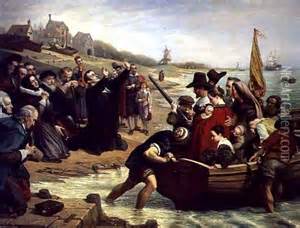
Immigrants to American shores have all shared similar reasons to exchange the familiar, for the unknown. A brief look at America’s earliest settlers well illustrates this dynamic from 1620 to the present.

Some folks were pushed, some were pulled, but all European newcomers set foot on Atlantic shores because there was no reason to remain in the familiar.

Challenges to the Catholic Church provided the first steps toward the flow of populations to leave Great Britain. The Protestant Reformation essentially secularized the English Church, rejecting and replacing the Pope for the British sovereign as leader. Devout believers felt that King Henry’s English Reformation did not go far enough in ridding sacraments for deeper Biblical understanding. This faction became known as “Puritans,” those who wished to cleanse the English Church of all vestiges of Catholicism.

The religious struggle in the British Isles was long and complicated, but ultimately resulted in systematic Puritan persecution. Two phases of believers departed Great Britain as a consequence. First, were the Separatists led by William Bradford, who believed England was damned beyond redemption. This group settled first in Holland, then acquired funding for a journey on the Mayflower to Massachusetts Bay. Americans remember these folks as the Pilgrims.

Almost ten years later another group of mistreated reformers made landfall further north, closer to Boston. This wave of settlers, unlike the small trickle in Plymouth, came to Massachusetts Bay in a metaphoric deluge. Thousands upon thousands of Puritans departed England, driven out by an intolerant, albeit re-Catholicized crown. Called the Great Puritan Migration, refugees from religious bullying settled from Cape Cod, to the Caribbean.

The Quakers, or Society of Friends, made up another group pushed out of England. In a stratified culture of forced deference to one’s “betters,” this faith recognized the innate equality in all people. Quakers, for example, refused to swear oaths or ‘doft’ their hats in the presence of “gentlemen,” and that impudence made the sect an intolerable challenge to the status quo.

William Penn (Jr.) became a believer in Ireland, and found this punitive treatment of Quakers unjust. However, as a wall to wall adherent to peace and brotherhood, Penn used his childhood connections to the aristocracy to depart to America. King Charles II granted Penn a large tract of land in the New World, where Penn and his followers settled in the 1660’s. “Penn’s Woods,” or Pennsylvania set up shop establishing the settlement upon the egalitarian principles of Quakerism.

The father of President Andrew Jackson, Jackson Senior, stands as an excellent example representing another wave of humanity dispensable to the British Crown. Dubbed Scots-Irish, these were Scotsmen who resisted British hegemony and unification for . . ., for . . ., well forever. (Think of Mel Gibson in Braveheart.) First taking refuge in Ireland, this collection of rugged survivors, by the 1700’s, made their way to America. Not the most sociable bunch, these refugees found their path inland, eventually settling along the length of the Appalachian Mountains. Tough and single minded this group transitioned from exiles to backcountry folk.

Now the settlers in Jamestown and Georgia offer a different explanation for permanent human migration.

The London Company of Virginia, a corporation, funded an expedition to Jamestown in 1607. Soldier of Fortune, Captain John Smith and his compatriots crossed the Atlantic to get rich. Inspired by the example of Spanish finds in Mexico, these English mercenaries were hopeful of finding golden cities of their own. Almost a disastrous failure, the Jamestown colony survived, not by precious metals, but from cultivating a Native crop . . . tobacco. Eventually arrivals outnumbered departures in the stabilizing Virginia settlement, and the addictive crop paid handsome dividends for London investors.

Georgia, the most southern colony came last, founded in 1732. The brain child of social reformer, James Oglethorpe, this colony of red clay became a dumping ground for victims of England’s byzantine criminal codes. Those of the lowest rungs of English society, from petty pickpockets to hardened felons found themselves “transported” to Oglethorpe’s colony for second chances, and out of the hair of English jailers.

On a side note, slavery explicitly was forbidden in the Georgia charter. And that raises the issue of the last group forced to American shores; African slaves. These unfortunate souls did not want to leave their homes in West Africa. Much like my mother, this group did not wish a new life in a new land. Economic demands brought about this “Middle Passage,” the despicable trade in human cargo, kidnapped for the New World. Force, brutality, and exploitation wrenched these people from their lands to serve those who for contrasting reasons came to live in America. The injustice of this “African Diaspora” still plagues an American society grappling to resolve this age-old injustice.

Caution ought to guide current politicians eager to vilify and frame immigration as an inherent evil and subverting occurrence. No one lightly pulls up roots. Leaving all that is familiar is an act of desperation, a painful and difficult human drama.

Americans today view our 17th Century forebears as larger than life heroes, but their oppressors saw these same people as vermin–as dispensable troublemakers who threatened good social order. This human condition remains timeless, and loose talking politicians and opportunists must bear in mind the story of the nation they wish to lead.

Oh, and my 84-year old mother just remodeled the house, keeping her Eden fresh and new.

Gail Chumbley is the author of River of January, and the newly published River of January: Figure Eight.

A Modest History of American Labor

gailchumbley@gmail.com

th

I grew up in a union household. And truth be told, the benefits of the Steel Workers Union saw me through childhood, high school, and college, making possible my life’s work as an educator. With a combination of post-war prosperity, cheap hydro power from the Columbia River, and full industrial production at Kaiser Aluminum, my ambitions became possible.

Of course, at the time, I didn’t grasp the real cost paid by earlier generations for my opportunities. That is until I earned my degree in American History and began teaching. What I found in lesson preparation was a grim drama of determined people facing intimidation and violence. Eventually their valor made possible the emergence of America as a global economic power.

Labor strikes in the 19th Century were especially violent, frequently bathed in bloodshed, betrayal and cruelty. Functioning under the doctrine of “The Gospel of Wealth,” industrialists viewed workers as nothing more than a minor component in mass production. Government at all levels reliably sided with owners to quash any attempts labor made to realize better conditions.

Andrew Carnegie in particular detested unions, and to curb organizing dispersed immigrant workers of different tongues aside one another on the production lines. Language barriers minimized the threat of unionizing.

Another handy device, the Injunction, permitted state governors to legally use State or Federal troops in crushing workers efforts. A governor could claim interstate commerce was impeded, meaning rail carriers couldn’t get mail or goods transported. Once troops were deployed, guns blazing, strikers stood no chance.

One memorable use of the injunction concerned the Pullman Strike of 1894. Employees of the Pullman Palace Car Company endured lives dominated by the company’s powerful owner, George Pullman.

Workers lived in the company town of Pullman, Illinois. All utilities, rents, and other fees were set by the the powerful industrialist, George Pullman himself. Following the onset of the Panic of 1893, Mr. Pullman cut hourly wages, but held the line on municipal fees. Supported by the American Railway Union, (the ARU) workers voted to strike, demanding fairness during the economic downturn.

Strike leaders knew that they must, at all costs, avoid a federal injunction. To bypass any possibility of inviting trouble, the strikers took care that trains continued to move through the state. Rail workers aiding the Pullman strikers detached Pullman Cars, parked them on side tracks, and reconnected the trains.

George Pullman was not amused.

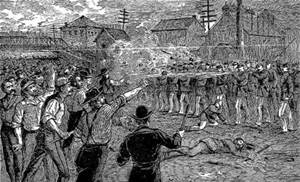
Soon enough the U.S. Attorney General issued the inevitable injunction, permitting federal troops to enter the fray. Some thirty strikers died at the hands of troopers, with many more wounded.

The Pullman Strike ended in government-sponsored violence, but this time the heavy-handed tactics used by Pullman left the general public uneasy. For a country that touted liberty and freedom, the authoritarian power flexed by the industrialist felt rather un-American.

Other labor disputes followed the same pattern; The Haymarket Riot in 1886, the Homestead Strike of 1892, all broken up by militias, soldiers, the police, or hired guns. In 1914 the Ludlow Massacre witnessed the Colorado militia using machine guns to mow down striking miners, women, and children.

Today unions remain controversial. However the role labor has played in America’s development is essential to remember. Labor Unions, in partnership with Capital, built the American middle class, and in return the middle class made the prosperity of this nation possible.

Have a thoughtful Labor Day

Gail Chumbley is the author of the two-part memoir “River of January,” and “River of January: Figure Eight.” Both titles available on Kindle.

Talk Back Wednesday

rojcover10

You’ve read the book, now share your reflections or questions.

Finish this sentence, ‘Chum’s greatest personal asset had to be . . . ‘

or

‘Helen traveled across the US and around the Atlantic world because?’

Post your responses and we’ll talk.

I would love to hear from you,

Gail

Doesn’t Change Anything

Washington's-Farewell-to-his-Officers

There are folks out there in America who object to the term bellicose when describing Ronald Reagan’s foreign policy. The Texas State School Board a few years ago objected to the term “capitalism,” deeming it too loaded with negative meaning. Okay, play with terminology, putty up and pretty up the image of the past on state standards and guides, because it really makes no difference in the classroom.

Recently the College Board acquiesced to political pressure on AP US History curriculum objectives. I can understand the thinking behind this move by those who design and correct the yearly three hour exam. Those designers simply don’t need the controversy, nor do they need states to eliminate AP US from American classrooms. But the compromise actually actuates few modifications in day to day lessons, speedily delivered by harried AP teachers. Reality dictates the content of the course, and limited by time and the massive content, most are lucky to reach bellicose Ronald Reagan before the annual May exam.

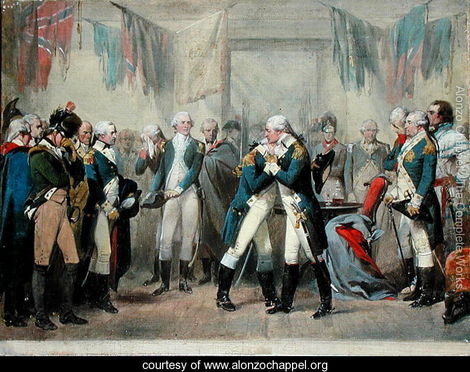
The painting above depicts General Washington’s Farewell to his Officers at Fraunces Tavern in New York. The work was the creation of artist Alonzo Chappel, and commemorates a party hosted by the victorious, but solemn Washington. This same picture, over a century later, was viewed by teetotalers with dismay. Prohibitionists, concerned by the tavern setting, especially with the wine carafe and goblet resting the table simply scrubbed the image out. Easy enough. Adjust the past to fit today’s present.

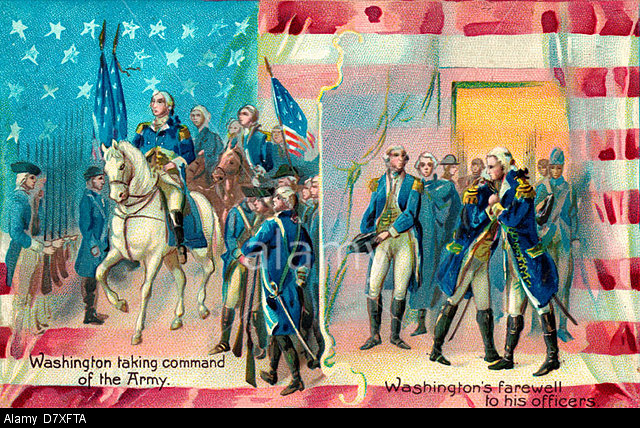
D7XFTA Washington taking command of the Army and Washington's farewell to his officers - two scenes from George Washington's Military life

D7XFTA Washington taking command of the Army and Washington’s farewell to his officers – two scenes from George Washington’s Military life

Yet, resurfacing the past, doesn’t actually change anything. Alcohol played a huge role in Colonial America. It just did. In fact, with reference to the 1980’s, all an instructor has to do is produce a couple of line graphs of military spending from 1981 to 1989. Any kid can deduce the trend in military expenditures. Read a couple of speeches in class–Ike’s Farewell Address to the country for example, and students certainly understand the deafness of the Reagan Administration to General Eisenhower’s cautionary words on the perils of the military-industrial complex.

And all those critics who scorn the notion of teaching higher level thinking haven’t spent a moment working with high school students. You can’t fool these young people, they are a lot smarter than you think. Any examination at primary materials, aside from textbooks, or any other ancillary stuff reveals a truth sans any political spin.

So go ahead and bleach the course objectives. Go ahead and whitewash topics such as the genocide of Native peoples, or the insider manipulation that has torpedoed the stock market over and over. It doesn’t matter really. I always told my students that the greatest thing about American History is that we examine it, warts and all, with eyes bravely open. That’s is the source and the strength of our nation’s greatness.

Gail Chumbley is the author of the memoir, River of January

This Week, 1935

IMG_0191

The old pilot’s time with us grew to mean a great deal to me, personally, but made it that much harder to let him go at the end.

Chum’s last years brought him out west to Boise. It was much easier for my husband to care for him than the semi-regular flights to Miami, sorting out some kind of preventable crisis. Once his father settled in here, they were together every day at the assisted living facility. I believe their time together gave both of them a lot of comfort.

As for Me? I just loved to sit and talk to my father-in-law. If he had felt more spry I would have dragged him into my history class for my own version of “Show & Tell.” I mean, really! William Howard Taft was in the White House the year Chum was born! His life was a damn book. (see River of January)

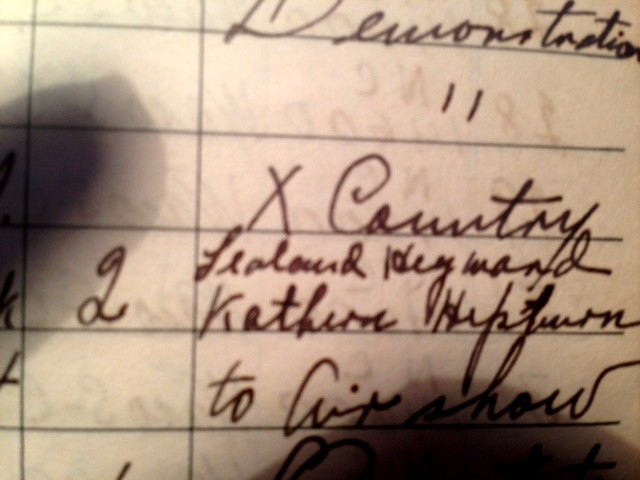
On one particular Sunday we drove over for a visit, and brought him Mexican food . . . Chum’s favorite. I was anxious to talk to him because we had rented “The Aviator” the night before, the film about Howard Hughes, and Chum had worked for the millionaire at one time.

Me: So we watched a movie about your old buddy, last night–Howard Hughes.

Chum: Ha. He kept the Kleenex business in the black.

Me: (Oh, geez! How could he know that?) And your old girl friend, Kathryn Hepburn.

Chum: Yeah. Katy. She was a nice girl.

Me:(Katy? A nice girl?)

Chum: Her boyfriend, that theater producer, Leland Hayward–I taught him flying lessons, and she came along.

Me: Yeah. (Yeah)

And here it is folks, if you didn’t see at the top. The old history student has to whip out the proof. Have a nice weekend.

  IMG_0192

Gail Chumbley is the author of River of January. Available on Amazon.

We All Knew

th

One-eighth of the whole population were colored slaves, not distributed generally over the Union, but localized in the southern part of it. These slaves constituted a peculiar and powerful interest. All knew that this interest was somehow the cause of the war . . . .If we shall suppose that American slavery is one of those offenses which, in the providence of God, must needs come, but which, having continued through His appointed time, He now wills to remove, and that He gives to both North and South this terrible war as the woe due . . .Lincoln’s Second Inaugural, March 4, 1865

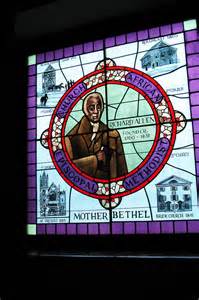
Richard Allen and Absalom Jones founded the African Methodist Episcopal Church in the early 19th Century. Both men, devout followers of the Methodist faith, often found personal worship disrupted by white parishioners, bent on limiting black presence and participation. Enduring decades of bullying by white clergy, these men and their followers established their own church in Philadelphia, “Mother Bethel.” At this site Allen and Jones, with their congregation witnessed the racial turbulence of the antebellum period, with the rise of Abolitionism, and finally culminating in bloody Civil War.

Richard Allen and his congregation were forced to draw away from the established Church because they longed for freedom of worship. And though this schism seems small today, the move toward religious independence indicated the real need for black equality in all spheres of life, but especially in this case of spirituality. “Mother Bethel,” and many more churches like it supplied the moral courage to risk all in the pursuit of public justice.

It was from African-American Churches, (all rooted in rejection by white congregations) that real advances began. Richard Allen and the AME is one example. But Dr. King provided the same succor for the next social-political push in the Civil Rights era of the 1950-1960’s. Faith and song propelled this hopeful movement forward, lead by blacks for blacks.Though a Lutheran, Rosa Parks was approached by the leaders of Dexter Avenue Baptist Church to ride that bus in Montgomery and not be moved.

The African-American church was the anchor feeding the spirit of justice.

But yesterday a serpent was welcomed (with love) in to this timeless sanctuary of solace. This lost soul, channeling the rage of hundreds of years of hate, sprayed deadly venom to try and kill the timeless promise of hope. The message registered–we know hate still runs riot among the fearful. The church is no safe place from the legacy of ignorance and racism in America.

President Lincoln grasped that truth–slavery presented the worst kind of sin, a sin of such magnitude that oceans couldn’t wash America clean. He states in his Second Inaugural that “we all somehow knew.” And we indeed do know that racism is the defect that turns us into monsters. The president implored Americans to accept that racial conflict is our nation’s Achilles Heel, and it won’t go away without courageous action.

We must deal with inequality on a national level, a state level, and each in our own hearts. White and Black. Folks, the strife will not go away on it’s own–it never has.

And, yeah, maybe Rachel Dolezal has identity issues, maybe she acted the fool in front of us all. But I would suggest that we could all make a little effort to generate some empathy for the guy next to us.

If you enjoyed this message, please share.

Gail Chumbley is a historian and author of River of January

That’s All

th

Colonel Clark used to bring his young son down to the dojo where my brothers took judo lessons. My grandfather had enrolled my older brother first, and then my two younger brothers when they were old enough. I sometimes came along to watch these lessons because, first of all, it was something to do on a boring school night, and I liked to look at the cute boys dressed in their gi (white gear).

My Grandpa Ray always sat with Colonel Clark, if the old gent happened to be present. That meant I sat with Colonel Clark, too, not fun for a twelve-year-old, boy-crazy girl. The two old men would talk and talk, seated next to one another, though their eyes remained on their boys training on the mats. They never seemed to look each other, but still seemed absorbed in their conversation.

My own attention span, something close to that of a hummingbird, only caught snippets of the quiet discussion. “MacArthur, Wainwright, and Bataan,” were among the many utterances exchanged by my Grandpa and the Colonel. And despite my commitment to shallow-minded teen angst, I sensed something grave, something momentous had happened in the back and forth of these two old men.

My brother later translated the mysterious conversation I unwillingly witnessed. Colonel Clark had been left on the Bataan Peninsula when General Douglas MacArthur was evacuated from the Philippines in 1942. Under the new command of General Jonathan Wainwright some 22,000 Americans surrendered to Japanese occupiers, among them young Clark. The Japanese forced this defeated army on a death march (along with their Filipino comrades) some sixty miles in the jungle. The men suffered from heat exhaustion, and dehydration, staggering on, hat-less and barefoot. When a captive stumbled, or fainted, the penalty meant an immediate beheading.

Colonel Clark had witnessed this nightmarish brutality, forced to suffer in ways words fail to recreate.

In defiance of considerable odds, Colonel Clark survived his ordeal. And that was the ordinary older man who spoke quietly with my Grandfather, watching a young son he should never, in reality, have sired.

I am a much better listener today, and recognize that valiant warriors everywhere are frequently disguised as harmless old men. Listening to these elderly gents has enriched my understanding of the past far more than I thought possible.

For example there was George, the high school janitor. For many years he pushed a mop down the halls where I taught American history. Sporting two hearing aids, this diminutive man wielded a mop that was wider that he was tall. All told, George looked like a gentle and harmless grandfather.

I’d often find George standing outside my classroom door listening to me blather on about the Second World War, as if I understood. Later I discovered that that mild mannered 80-year-old had once packed a M-1 Garand, shivering aboard one of those Higgins boats motoring toward Omaha Beach in 1944.

“So George, what do you remember most about D-Day?”

“It was awful early, and the water was awful cold.”

Then there was Roy. Smiling, white-haired Roy.

As a teenager he had gone straight from the Civilian Conservation Corps right into the US Army.

“What do you remember most about D-Day, Roy?”

“I lost everyone in my outfit. I was real scared. Later I was regrouped with survivors from other platoons. You see that was bad because I’m Mexican, and my first platoon got used to me, and stopped calling me Juan or Jose. I had to start all over with the new bunch. For days, as we moved inland, these new boys were giving me the business. One guy said, ‘Mexicans can’t shoot.’ I said that I could. So he said, ‘Ok Manuel. Show me you can shoot. See those birds on that tree branch up ahead? Shoot one of those birds.’ I lifted up my rifle and aimed at the branch and pulled the trigger.” Roy begins laughing.

“I missed the branch, the birds flew away, and twelve Germans came out of the grove with their hands up.”

Astounded, I couldn’t speak. Roy simply chuckled.

Colonel Clark, George, and Roy. They were just boys who found their lives defined in ways we civilians can never comprehend. They were scared, and hot, and cold, and hungry, and suffering, and ultimately lucky. They returned home.

That’s All.

Gail Chumbley is the author of River of January, and River of January: Figure Eight, a two-part memoir. Also available on Kindle.