My Work, My Calling


th

Senate – May 12, 2005)

Congressional Record, 109th Congress, Vol. 151, No 62


A LIFE OF TEACHING, A LOVE OF LEARNING, A HEART FOR CHILDREN


Mr. CRAPO. Mr. President, I am honored to recognize a truly remarkable individual today. Gail Chumbley is a history teacher at Eagle High School in Eagle, ID. A high school history teacher; there are many individuals who can claim this job title but few who have done so much. Gail is an amazing teacher, passionately devoted to teaching our American experience to her students. Not only does she teach about events in our Nation’s history, she has ventured into the next realm, moving the tenets of American citizenship into the real world for her students.

I first heard of Gail’s efforts 4 years ago when she became actively involved in the Library of Congress’s Veterans Oral History Project four years ago. At that time, she had organized the recording of over 300 oral histories for Eagle High School’s library alone. She expanded the effort to include other Idaho schools and collaborated with local civics groups to record literally hundreds more interviews that went to both the Eagle High School archives and the Idaho Oral History Center. One of the most significant accomplishments of Gail and her students was their participation in the Veterans Stand Down in Boise where homeless veterans were given the opportunity to record interviews. Her efforts were not confined to veterans of past wars. Gail and her students also have sent gift boxes and cards to our current service women and men in Iraq and Afghanistan since 2002. She was instrumental in making Eagle High School the top school donor for the World War II Memorial, with a donation of close to $25,000. The list of her accomplishments, enhanced further with her national recognition by the Daughters of the American Revolution this year is long, but that is not the focus of my remarks today.

Gail has turned the teaching of history and civics into the action of patriotism. Perhaps the most compelling and significant accomplishment of Gail Chumbley is not her esteemed list of awards and honors, which are many and richly-deserved. Her most important contribution is her role in creating a sense of citizenship within the hearts and intellect of many Idaho young people. This citizenship lives on in these students as they grow into adulthood and manifests itself in their actions, commitments and convictions. It is an entity that grows exponentially and of its own volition, eclipsing plaques, certificates and statuettes. These gather dust, but what they represent are the pillars upon which our country stands firm. This living citizenship is immortalized by the marbled statues of men and women not far from here,

and in words carved of the same.

I honor Gail Chumbley today: American patriot, exemplary citizen and

role model for all of us.


Gail Chumbley is the author of River of January, a memoir, also available on Kindle. The second volume in the epic, River of January: The Figure Eight is coming this fall.


New Book Coming Soon!

Captain Eddie Rickenbacker & Chum           Helen performs in NYC

“River of January: The Figure Eight,” is coming soon. Look for the release this Fall!

The Ice Vanities


Hruba0001

1939

Arms twined around skaters on each side, Helen balanced nervously in the shadows. In V-shape formation, costumed in tall Hussar caps, and military jackets resplendent with gold brocade, the line stood expectantly in the dark. She shivered from a combination of excitement and the frigid draft wafting from the ice. Her ears thudded, inundated by the echoing din from the impatient audience. Much louder than a theater, she absently noted.

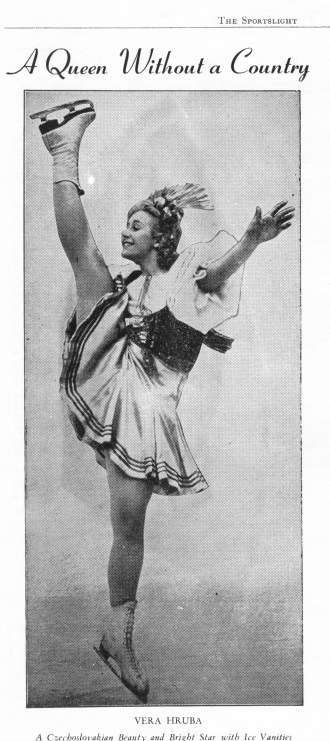
Positioned at the apex of the two wings stood Czech Olympian, Vera Hruba—one of three women headliners in the new production. When the last measures of an orchestral stringed overture faded to a close, the house lights darkened, and the arena fell silent for an expectant moment. With a commanding flourish, the opening bars of a military march surged to all corners of the house. Spotlights swept over the glittering skate-line, as Helen pushed off her left foot, in sync with the tempo. Following two more beats, Hruba burst from the crux of the V, and raced the circumference of the rink, spotlights holding tight to her revolutions. The audience roared in appreciation with waves of echoing applause. Helen’s first ice show had begun.

If rehearsals were any gauge, she already felt great confidence in the show’s success. The dance line often lingered along the rail, chatting, stretching—waiting for the director to call them onto the ice. “That’s ViVi-Anne Hulton, she’s Swedish,” Clara Wilkins leaned in whispering, both studying the soloist on the ice. “She’s been skating since she was ten,” Clara nodded, as Hulton executed a perfectly timed waltz jump. “Boy, that little Swedish meatball knows her footwork.” The girls standing nearby murmured in awed agreement.

Chestnut-haired Lois Dworshak sprinted past the attentive chorus line. Helen automatically glanced again at her well-informed friend and Clara didn’t disappoint. “She, Lois there, is a bit of a prodigy. She skated a little as a kid in Minnesota but, actually hasn’t skated professionally all that long. She’s good too, huh?”

“Jeepers, you can say that again,” Helen muttered.

“But, the real story in this cast is Vera Hruba.” This time, May Judels, head line-skater, spoke up from the other side of Eileen. Listening eyes shifted toward May. “Vera met Hitler, just like Sonja Henie did, at the Olympics in Berlin. She finished her freestyle routine, and came in pretty high, I think. Vera didn’t medal or anything, but still skated a pretty good program.

“So what happened?” asked another girl, Margo.

“Hitler says to her, ‘How would you like to skate for the swastika?’ And Vera, (she doesn’t much like Germans), told him she’d rather skate on a swastika!” Heads turned in unison, watching as Hruba completed a flying camel. “So,” May sighed, “to make a long story longer, Vera and her mother left Prague in ’37 as refugees, the Hun’s marched in, and Hitler made a public statement that Vera shouldn’t wear Czech costumes or skate to Czech folk songs. He said Czechoslovakia was gone, never rise again. Vera then responded, publicly rejecting the Fuehrer’s comments, saying she’d always be a Czech, and that Hitler could, in so many words, go fly a kite.”

“Their own little war . . . now that’s guts,” Helen’s eyes returned to center ice. “Makes Henie even more of an apple polisher.”

“A swastika polisher,” Margo corrected, as the director motioned the giggling chorus to center ice.

Gail Chumbley is the author of River of January, also available on Kindle. The second volume, The Figure Eight is due out in September 2016

The Running Joke

th

Each school year, by spring break, my history classes had completed their study of the Kennedy years, 1961-1963. We discussed the glamor, the space program, civil rights, his charisma and humor with the press, and most importantly, JFK’s intense struggle with Soviet leader, Nikita Khrushchev.

In a provocative challenge to America, Khrushchev had ordered the building of the Berlin Wall, and construction of nuclear missile sites in Cuba. This second and more dangerous challenge prompted the 1962 Missile Crisis.

We probed further into the delicate diplomacy that, after 13 days settled that perilous moment peacefully.

For years I closed the unit joking, “aren’t you glad Andrew Jackson wasn’t president?” That line always drew a good laugh.

But really high stakes foreign crises is no longer funny. Not in today’s political climate.

America’s seventh president was a mercurial character. He loved blindly and hated passionately. If convinced his honor had been besmirched, the man dueled—sometimes with pistols, sometimes with knives. It all depended upon his mood.

The provocation behind most of these confrontations touched upon Jackson’s wife, Rachel, who had a complicated past.

A murderer, the author of the Trail of Tears, a plantation and slave holder–Jackson was deadly dangerous.

No financial wizard, he went on to destroy the Second Bank of the United States, the central financial institution of the young country. Old Hickory then deposited the government’s money into pet banks, local private, unregulated concerns across the country. Mismanaged, these banks collapsed, propelling America into one the longest, deepest depressions in American history.

Jackson ignored the Court, and he used the military for his own political gain.

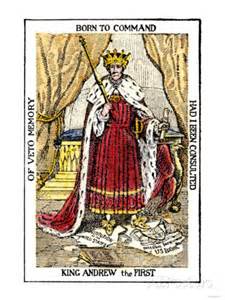
The power King Andrew exercised rivaled the Almighty’s.

So the joke regarding the Cuban Missile Crisis of 1962 resonated with high school juniors. JFK’s skillful restraint in that perilous moment would certainly have resolved differently in the hands of the hotheaded, autocratic, Andrew Jackson.

Again, the joke is no longer funny.

Now America is saddled with an impulsive autocrat whose hunger for authority tramples our time honored liberties. He is attacking our communities, and arresting neighbors for his political gain. Moreover, this petty Napoleon shows little understanding of America’s legal tradition–basic high school history,, or civics. Then there are the ill-advised tariffs playing hell with the economy. Like Andrew Jackson, this current “president” carries himself as another absolute monarch.

The pertinent question this tale raises is this; what could this current, petty president, with little impulse control do in the turmoil of a similar crisis?

Tonight, June 21, 2025 we now know. This cannot end well.

Gail Chumbley is the author of the two-part memoir, “River of January,” and “River of January: Figure Eight.” Chumbley is also the author of three plays set in American history, and co-authored a screenplay based upon her books.

gailchumbley@gmail.com

Relive Rio

ROJAd

SELF-e_AmbassadorBadge_Web-Red

I Said YES!

SELF-e_AmbassadorBadge_Web-Red

Hi Gail,

To start, I want to congratulate you on having your book River of January chosen by Library Journal for inclusion in SELF-e Select.


Since your book has been chosen to be a part of SELF-e Select, Meridian Library would like to invite you to be a featured author at an event they are hosting as a part of Indie Author Day on October 8th. During this event, the local writing community will be coming together in the library to celebrate local authorship and will then join the larger indie community through a digital presentation of industry leaders that will take place at 2 pm EST.


The event will be taking place in Meridian, ID. If you are interested in attending and speaking on a panel about indie publishing, please let me know and I will get you in touch with the librarian who is coordinating the event.

Best,

Allie
Allie McKinney
Content Project Operations Manager
BiblioLabs
100 Calhoun Street, Suite 200
Charleston, SC 29401

Image

Gail Chumbley is the author of River of January. Also available on Kindle

Preview: ROJ;The Figure Eight

th

Feeling Alone

New York

1943-44

“Put that thing down, Helen. You’re not listening!” Eileen reached over, and snatched the pencil from her hand. “Let’s go to the show.”

“Hmm? What? A movie? Well, I don’t know. I need to finish this . . . “

“How many letters have you written this week? Honestly, Helen, you can take some time to go to see a film.”

Helen leaned back and stretched; glancing around toward her mother who was busy feeding the baby wiggling in her highchair. “What do you think, B?”

“Go. Go. We’re fine here. I’ll finish this, give her a bath and put her down.”

She turned back to her sister. “Okay, Eileen. What did you have in mind? What’s playing at Loew’s?”

Eileen smiled satisfied, spreading out a newspaper over Helen’s stationary. “Let’s see . . . Journey into Fear? I suppose not. Oh, here, Sahara. Your pal Bogart stars in that one.”

“Aren’t they both war pictures? I don’t know. I need to think about something else, actually anything else, but the war.”

Song of Bernadette? Jennifer Jones pulls off a couple of slick miracles. That one ring your chimes?”

“Aren’t there any musicals or comedies? I really could use a giggle or two.” Eileen sighed and hunkered down on her elbows, and the sisters scanned the theater section, side by side.

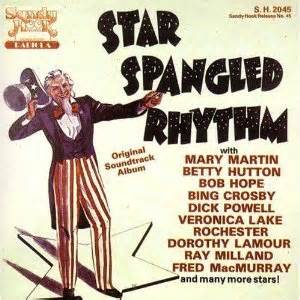
“Here—it’s your lucky day—we have two selections. Girl Crazy with Mickey Rooney, and Star Spangled Rhythm, starring Crosby, Hope, and Betty Hutton.” The older sister turned her face to Helen.

“I like Bing Crosby.”

“Then kiss your baby and grab your purse. In that order,” Eileen smiled, delighted that she convinced her sister to get out of the apartment.

They dashed into the movie house just as the overhead lights dimmed and the red satin curtains opened. A white light flickered and beamed from above the balcony, and the audience applauded. Distinct images filled the screen and the auditorium resounded in rich sound—a Disney cartoon flashed on the screen, “The Three Little Pigs.” Helen had to chuckle when a hand reached from the house of bricks, offering the huffing wolf a bottle of Listerine.

Quickly following, another clip opened in a solemn choral arrangement of Silent Night. Actress Bette Davis, seated before a Christmas tree, presented her children with war bonds as gifts. She kindly reminded them of the American fighting men, sacrificing their lives overseas while the family enjoyed the holiday in safety. Turning directly to the camera, Miss Davis encouraged those in the tiers to buy bonds as a way to win the war. Helen silently vowed to make a purchase in the morning.

United Newsreels boldly lettered the width of the screen, featuring a talon-bearing eagle, and a forceful marching tune. Hungry for actual footage of battlefronts, patrons waited eagerly for news updates. When the subtitle, War News from the Pacific projected, Helen nearly bolted from her seat, Eileen quickly grasping her sister’s arm—a gentle gesture telling her to stay. Reluctantly she viewed thick disarrayed hammocks of destroyed island palms, battle cruisers spinning turret guns toward exotic beaches, and endless rows of stretchers loading onto hospital ships. She felt slightly nauseous. Only her sister’s hand, and a reluctance to make a scene kept Helen seated. Finally, in what felt like forever an upbeat melody commenced and Star Spangled Rhythm splashed before her eyes. Relieved she literally exhaled her pent up anxiety.

“Holy mackerel sis! I thought I would have to tackle you to keep you in your seat.” The two girls hurried through the wet and chilly evening. “You know Chum is just fine, honey. We would be notified right away if anything had happened to him.”

“I’m awfully sorry Tommy. And I do appreciate you taking me out. But I need to get away from the war, not a firsthand eyeful of the Pacific front.” She frowned for a moment, then managed a grateful smile. “I did like the picture, though. Hope and Crosby were a good choice.”

“Good. Stop worrying. You’ll go gray.” The two continued down the sidewalk silently emitting small clouds of breath. Eileen spoke again, “You know we’ve had similar conversations before. Just like this. Walking home from somewhere.”

“I guess we have. But in those days you quizzed me about boys, passing flirtations. I’m honestly concerned about Chum . . . he is my husband. We have a baby.”

“Oh, I understand that, Helen. And I like Chum, too. Unlike Mother, I think you found yourself a good man. But do you ever wonder about the others? About Grant Garrett or Elie? I mean what they’re doing now.”

“Oh, well, yes. Sometimes. I think Grant is his third marriage, and still in Hollywood. He’s done some film work for Paramount, you know, adding jokes to dialog.” She smiled, remembering. “I don’t recall the movie but you could tell the jokes were Grant’s. Something like, ‘did you shoot the victim through anger—no, I shot him through the heart.’” She chuckled. “I think Grant is doing well, for Grant. As for Elie? I simply don’t know what became of him, and that bothers me. The last I heard he lived in Japan, and now the Japanese are fighting us. He might be back in Belgium, but the Germans have taken over. And considering how Hitler feels about Jews—yellow stars, camps, poor Elie has it coming at him either place.”

“Oh Helen. You’re right! That hadn’t occurred to me. Either place, he is in a mighty dangerous situation. Gosh, I hope he makes it through the war . . . if this war ever ends.”

“I worry, too. And I feel pretty guilty about how things ended with him. Not that I think lousing things up with Elie put him in danger. But we ended on bad terms, I had met Chum, and we were engaged. Still I hope he and his family are safe.”


Gail Chumbley is the author of River of January, and sequel, River of January; The Figure Eight..

Lucky Thirteen

discharge330001

In River of January and the sequel, The Figure Eight, (in progress) Mont Chumbley repeatedly insists the number 13 is lucky for him. In that spirit “Chum” left the US Navy on June 13, 1933, his 24th birthday, to pursue a career in civilian aviation. Today would be the pilot’s 107th birthday. For more of his fascinating story read River of January, available in hard copy and on Kindle.

1944

A Christmas card from a weary GI to the students of Garfield School.

From France to Spokane Washington, 1944

Gail Chumbley is the author of River of January, a memoir. Available on Kindle.

Strike Up the Band-a few more hours!

th

River of January‘s Free Kindle Weekend!

Enjoy a read on the house compliments of Kindle. Available from Saturday morning through Monday night.

When you’re done tell a friend, and say something nice on Amazon Reviews!

Gail Chumbley is the author of the memoir, River of January. Also available on Kindle.