History of an Era

airclip0001

October, 1933

By luck or accident the review below popped up on the internet. It’s nearly a year old, and a bit of a nice surprise. Thank you Connie Daugherty wherever you are.

Recommended Reading: River Of January

Posted By: idahosrind

by CONNIE DAUGHERTY

River of January by Gail Chumbley; 2014

Mont “Chum” Chumbley is a pilot. He’s a natural, and he lives to fly. Helen Thompson is a dancer. She’s a natural, and she lives to dance. They come from different worlds and have nothing in common. Yet they are very much alike and destined to be together.

In her 2014 award-winning biography, River of January, Gail Chumbley follows the lives of her husband’s parents from 1927 through 1936. Using their letters, shared stories, and interviews, along with her own storytelling skills, Chumbly has created an informative and entertaining book that reads more like a novel than a biography. It details the struggles of not only the individual characters, but of the world through the Great Depression and events leading to WWII.

River of January includes historical details of the entertainment business from the decline of vaudeville to the emergence of talkies (motion pictures with sound). As well, the book reveals how developments in aviation also moved quickly in the 1930s. Chumbly adeptly follows those drastic historical changes.

Having both come from humble beginnings, Helena and Chum each choose career paths eventually lead them to their first meeting.

At 18, Chum joins the Navy with the hopes of becoming a pilot. He works his way through the military bureaucracy, getting assignments everywhere, it seems, other than at flight school. His lack of education holds him back, but he’s determined to fly.

He has something to prove to his family, to himself. So, when an opportunity presents itself Chum accepts it.

“A nervous and sleep-deprived Mont Chumbley reported for flight elimination exercises.” Everyone expects him to wash out; after all, he has failed the entrance exams more than once. But Chum knows all he needs is a chance to prove himself.

Meanwhile, Helen has her own struggles. While confident and self-assured on stage, off stage she is a pawn of her controlling mother’s insecurities and personal dreams. The only way Helen seems able to escape—while keeping her mother at least somewhat satisfied—is to accept jobs that take her away from her New York home. She finds herself traveling with dance troops throughout Europe.

This need to escape home and family in order to discover and develop their true potential is one thing Helen and Chum have in common, though the way they deal with it is very different.

Eventually, the stock market crash throws the whole world into economic turmoil, which leads to political turmoil, and Helen and Chum are caught up in it all as the entertainment business and the technology of aviation transform.

Chum finds himself, restless and bored, with a job in West Palm Beach, Fla. He jumps at an opportunity to demonstrate Waco Aircraft Company’s new fighter plane for the Brazilian government down in Brazil.

Meanwhile, Helen is back in New York as 1934 slides into 1935, working in a three–person act under her mother’s watchful and domineering presence. Helen, too, is getting restless and ready for change. “She also knew her time had come to move on from their partnership. She hoped her mother would see it the same way.”

Helen flees New York on a ship to Brazil and lands a gig dancing in a club regularly frequented by Americans. “Three young men seated near the dance floor caught her eye, clearly American by their dress and relaxed posture.” One of those young men is Chum, and he catches her attention immediately.

“This new girl, this sparking, compelling blonde on the stage, radiated a magnetism that surprised him.” In a moment, as their eyes meet, the pilot and the dancer connect. And although they try to be together as much as possible, they each have careers and obligations that take them in different directions.

Eventually, Chum proposes, and Helen accepts. They plan to live in Rio de Janerio, but it isn’t that simple.

Between Helen’s mother, who disapproves of their union, and the war, the young couple’s letter transcripts reveal their struggle against seemingly unmovable objects to continue their love and establish a life together.

In 2016, Chumbley published River of January: Figure Eight, picking up where the award-winning River of January dramatically left off. In the sequel, she tells the story of their continued courtship, marriage, and struggle to keep their love intact, despite the challenges of WWII and the unrelenting interference of Helen’s mother. It is the realism of the story—the struggles and successes, the bad times and the good, as well as the author’s narrative—that keeps readers enthralled and turning pages. These two books are more than a family biography. In telling the story of these two intriguing and imperfect people, Chumbley has captured and preserved the history of an era.

Chumbley is a retired history teacher. In 2005, she received the Outstanding Teacher of American History from National Daughters of the American Revolution in Washington DC. A native of the Pacific Northwest, the author was born and raised in Spokane, Wash., and earned a history degree from Western Washington University in Bellingham, Wash. Chumbley and her husband currently live near Boise, Idaho. She received the 2016 Idaho Author’s Award for Memoirs and Biography for River of January.

https://idahoseniorindependent.com/recommended-reading-river-january/

Gail Chumbley is the author of the two-part memoir River of January and River of January: Figure Eight. Available at http://www.river-of-january.com, and on Kindle.

gailchumbley@gmail.com
Mont Chumbley: Night Flyer

chumrio2


Sure he was far behind, Mont Chumbley pushed his Waco Cabin C through the night sky. Fresh from the Navy, the young aviator found himself wondering why in the world he’d agreed to enter this “Darkness Derby” competition in the first place.

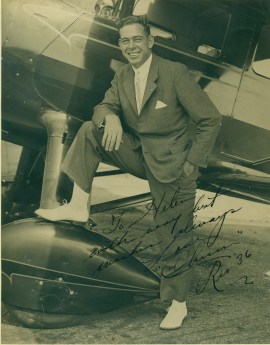
Called “Chum” by his friends at Roosevelt Field, the pilot had begun a civilian career out of a Western Aircraft Company (Waco) hangar near Mineola, Long Island. Transporting press photographers and reporters to breaking news locations, plus teaching flight to the rich and famous, including Jaqueline Cochrane and Kathryn Hepburn, he found his niche. A 1933 flight to a horse track in Maryland set Chum’s course for the night race he now anxiously questioned.


Richard Ross, a financier who held a seat on the New York Stock Exchange, was the horse fancier who hired Chum. Ross needed a quick hop to Harve De Grace Track outside Baltimore, Maryland for a horse he had going on the afternoon card. Extremely impressed by the young pilot’s skill, (Chum landed his Waco in the track’s infield) Ross soon offered to pay for modifications to Chum’s Waco if the flyer would agree to enter the transcontinental Darkness Derby. Considering $1,500 in prize money that could really help him out, the young aviator agreed to enter.

Chum set off on September 29th, heading west, flying cross-country to his final destination—Glendale California’s Grand Central Terminal, the starting point for the air race.

Seeded second in a slate of seven planes, positions rated by horsepower and speed, Chum lifted into the growing dusk on October 1, 1933. Guided by a compass and tracking a full moon, the determined young pilot found conditions perfect, the clear night air permitting his Waco a smooth passage.

Before takeoff, Chum studied his competitors, becoming familiar with the pilots and aircraft he had to beat. Merle Nelson of Los Angeles flew a Stinson Cabin powered by a 200 hp Lycoming engine, and looked tough. Frank Bowman of El Paso, Texas in his 90 hp Lycoming engine Monocoupe appeared to be a contender as well. His own Waco Cabin purred with a 210 hp Continental engine, and Chum knew he could open it up to over 130 miles an hour, if necessary.

The moon as his guide, the Mojave Desert illuminated below, the little Waco pushed onward. Setting the aircraft down in Albuquerque, the pilot dutifully checked in with the ground judges, and then hurried to re-fuel. Making small talk with the teenager servicing his plane, Chum was told someone else had already landed and gone. Panic stricken, he cut the conversation short, and returned to the air as fast as he could. It was now that he pushed that plane full bore, resolved to catch up and beat any opponent.

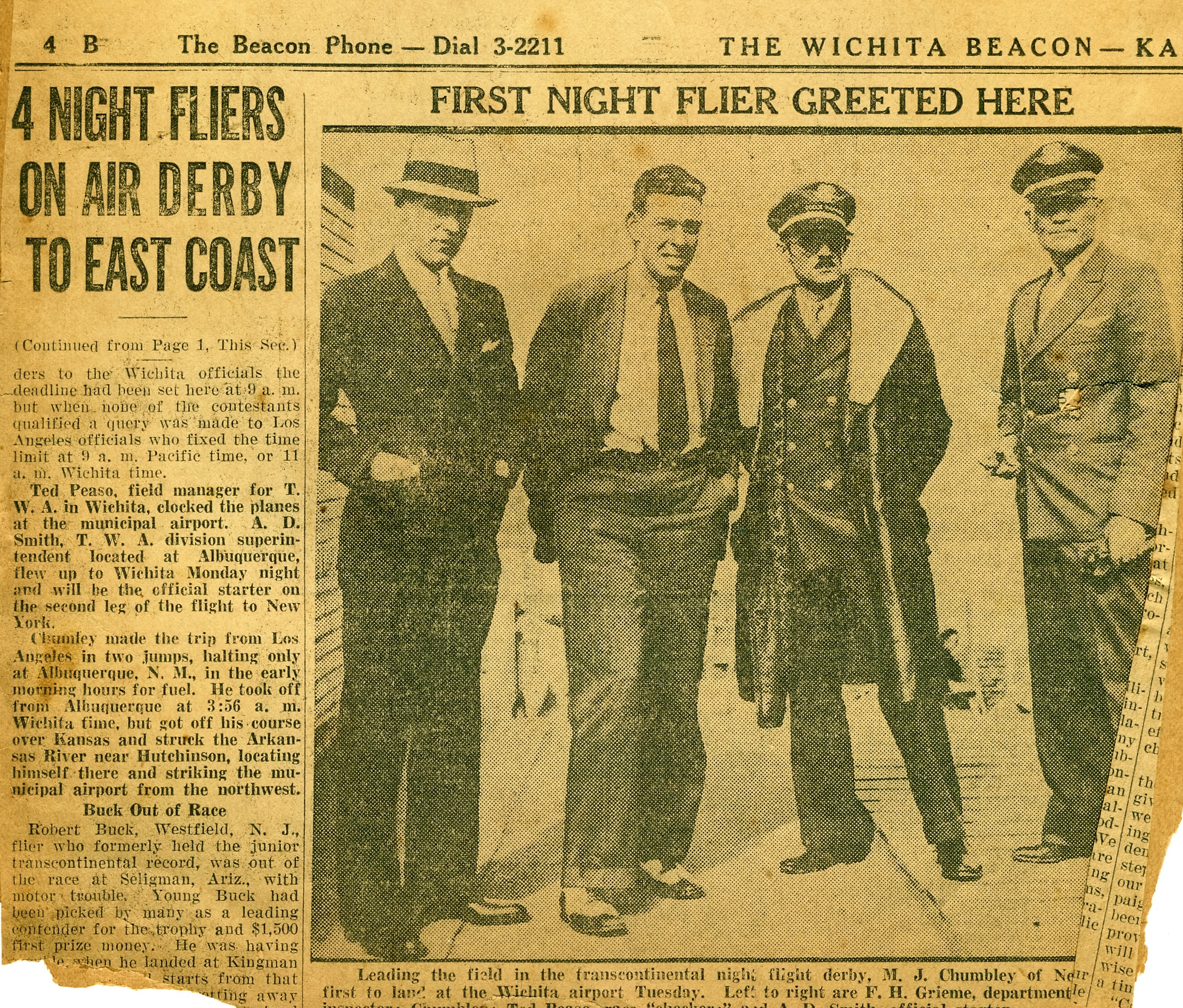
At 9:37am, Mont Chumbley taxied onto the ground in Wichita, completing the first leg of the race in 12 hours and 17 minutes. There had been no other plane, at least not in this race. The kid in Albuquerque had been wrong. Four hours later Nelson arrived, and three other planes still in contention lagged far behind. Following a bit of rest at the field, then carefully inspecting the soundness of his equipment, the derby leader once again rolled down the runway, lifting off into the eastern sky.

Following another quick stop in Indianapolis to check in and fuel his Waco, the pilot learned he still held on to the lead. Satisfied, he returned to the darkness, fairly certain of a pending victory. However, that assurance evaporated when layers of cloud-cover compounded with darkness convinced the pilot that he had become utterly lost. Pushing on, buffeted about by worsening conditions, Chum began to worry he was squandering valuable time. Wracking his brains for deliverance, his aviator eyes suddenly spotted a break in the thick swirling mist. Not hesitating a moment, the Waco slipped through the hole that fortune had sent his way.

Underneath, clearly defined in the infinite blackness beamed a tiny, dim light. One. Chum decided to take his chances and try to figure out where he was. The landing didn’t go well. In swells of bumps, the Virginia farm boy realized his wheels were pounding on furrows of newly cleared fields. Drawing closer to that isolated light, Chum made out the side of a house, with an extended porch. Someone had to be inside.


He rapped on the weathered door, and waited. Sounds of scraping and thumping grew louder until the door opened revealing an equally weathered farmer, and his disheveled wife holding a candle. Chum smiled through the entryway, and in a friendly voice explained his dilemma. The farmer stared a moment, measuring the stranger’s sincerity, then decided to let him in.

As the wife poked the coals in the wood stove, and reached for the coffee pot, the farmer spread out maps on the table. Chum soon learned he had landed in western Pennsylvania, and wasn’t too far off course. Profoundly relieved, the young man stuffed cake in his mouth, downed a cup of coffee, and in a rush of heart-felt thanks again bumped over the dark fields back into the sky.

airclip0001

The darkness soon transformed to early morning, and Chum wondered again where his fellow competitors were located. He knew he hadn’t lost too much time with his unexpected stop, but still fretted, uncertain about the status of the other flyers. Worried about the constant cloud cover that didn’t want to clear, he decided, as a last resort, he’d head out over the Atlantic, look for another break, and duck through. But once again luck smiled, and in the perfect light of morning, a providential clearing appeared and Chum took advantage.

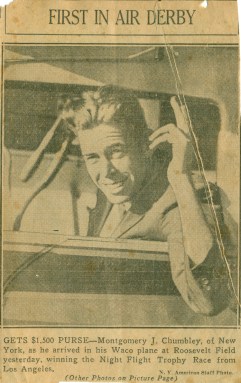
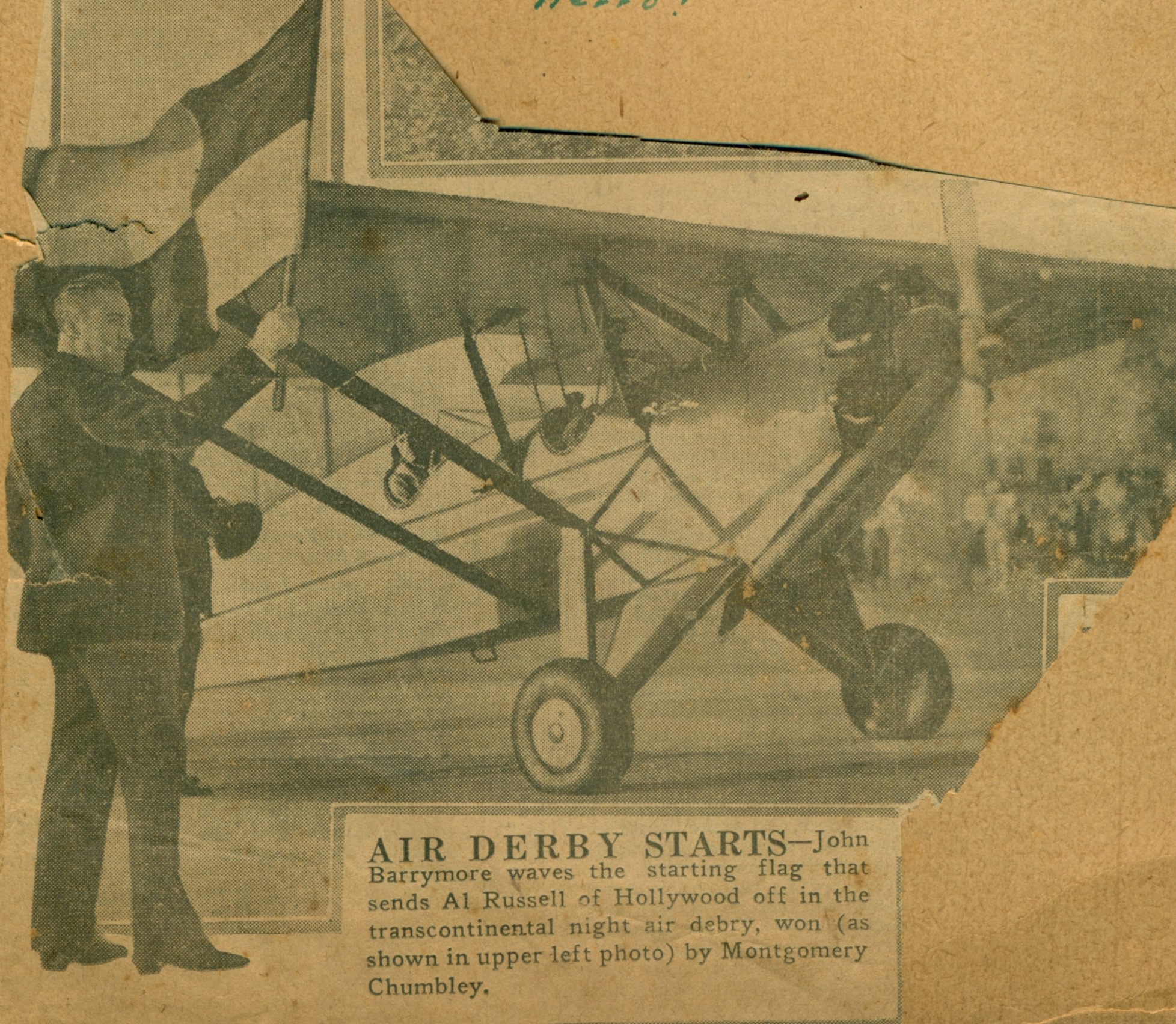
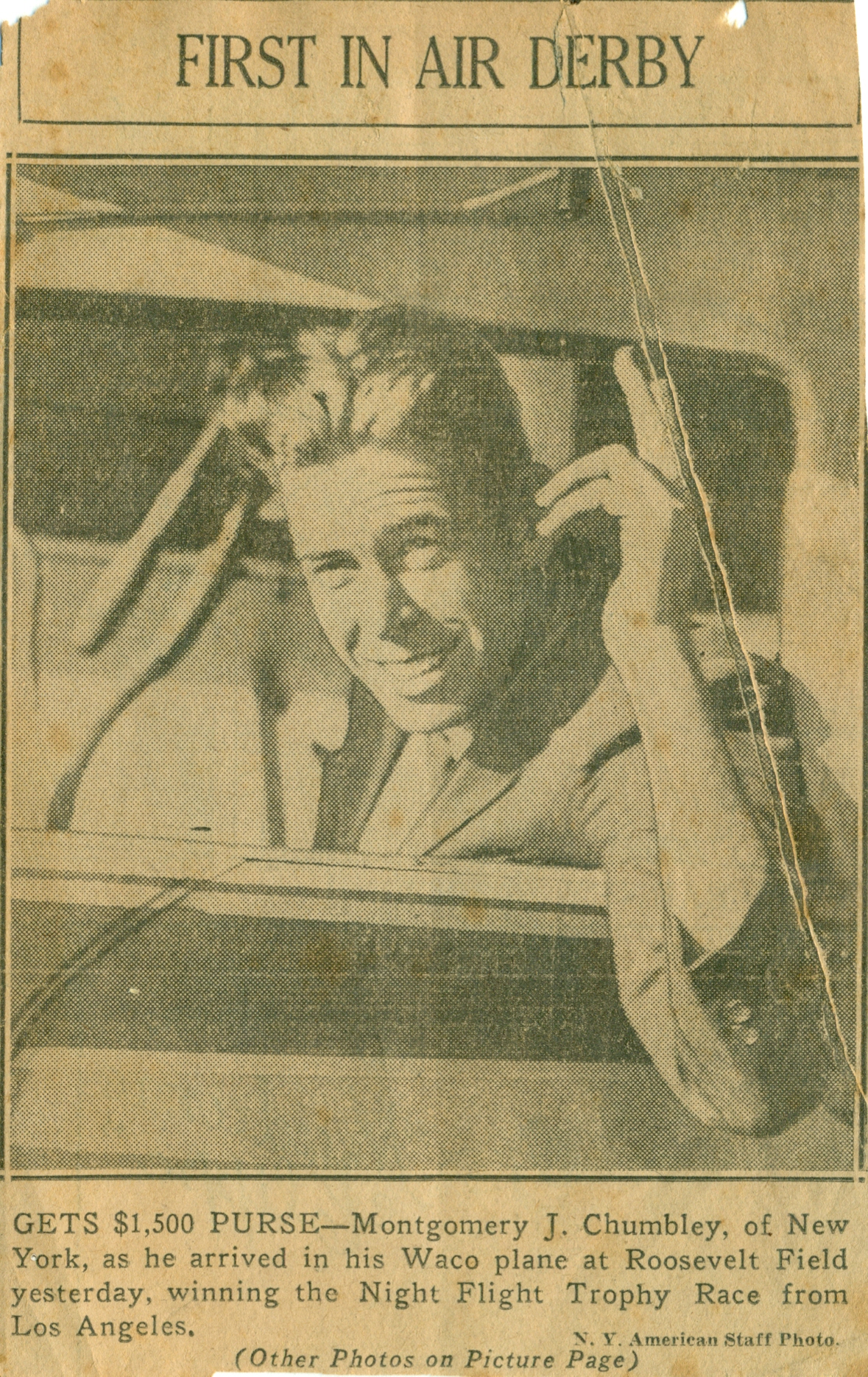
On October 4, 1933 Montgomery Chumbley landed on Roosevelt Field #2, seeming the winner of the 2006 miles long Darkness Derby. However, judges and spectators rushed the plane, arms waving, and clipboards flashing to warn him he’d landed on the wrong strip! Shutting down his plane would have meant disqualification. Without a pause, Chum quickly taxied to Field #1, then turned off his engine, and in 24 hours, 12 minutes (two added for the last minute taxi) won the transcontinental air race.


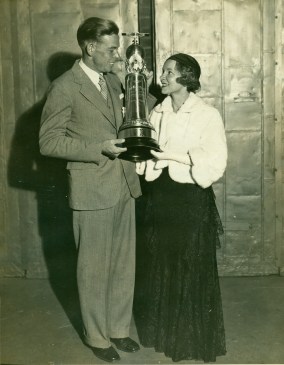
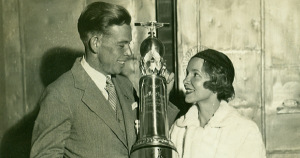
The competition had been set as a preliminary event leading to Roosevelt Field’s National Air Pageant. The widely lauded landing launched the festivities planned for the rest of the week, including an exhibition by German stunt pilot, Ernst Udet. Mrs. Eleanor Roosevelt chaired the pageant, with proceeds earmarked for her charities, and Warner Brothers shared by premiering their newest film “Night Flight,” starring Helen Hayes and Clark Gable. On the evening of October 5, in a theater filled with flyers, Miss Hayes presented Chum with a trophy and his winnings, before screening the film. (Merle Nelson received $750 for second place, and Bowman $500 for coming in third.)


As for Chum in the days and weeks after the race? He became a minor New York celebrity, with aspiring students and eager press lining up for his flying services. In 1934 Waco hired him sending him to Rio de Janeiro to sell equipment to the Brazilian, and Argentine air ministries. By the time the Night Flight winner returned to the States in 1936, Mont Chumbley was the most prolific overseas salesman Waco employed.

helenhayes0001


Gail Chumbley is the author of “River of January,” a memoir. Look for “River of January: Figure Eight” out in November, 2016. Visit “River’s: home page at http://www.river-of-january.com.   


Thanks for Noticing

“River of January,” and “River of January:Figure Eight” have garnered some recognition. Find out why today. Click this link www.river-of-january.com, and order your own copies, personally signed by the author.

Award winning history instructor, Gail Chumbley is the author of the two-part memoir River of January and Figure Eight.

To Capture War

th

I came of age during the lengthy era of the Vietnam War.

This so called “police action” began quietly as a post-WWII policy challenging Communist expansion. Vietnam had been divided as had Germany, China, and Korea, leaving a divide of western leaning democracies pitted against Communist dominated systems. America’s commitment to the Vietnam conflict officially began in 1959, with US aid to the South, and officially ended with the Paris Peace Accords in 1973. Said another way, I was a preschooler when Ike dispatched advisers, and in my first year of college when Nixon ordered troops home.

Though almost moot today, opinions vary on why this war became so universally unpopular. One assessment claims the intense media coverage, particularly on American television, soured the public on the war, while others claim support declined when the draft expanded to middle class, college-bound sons. Not that it matters. In retrospect, whether soldiers were poor or affluent, the draft sent them hell in Southeast Asia.

The view that more affluent Americans across the country grew alienated, does hold some merit. the days, weeks, months, and years of guerrilla assaults, deadly fire fights in the jungle, and the daily tally of “body counts,”* drained public support for this sweltering nightmare.

I recall many evenings washing dishes from dinner, watching a little black and white Sony portable tv. The network didn’t seem to matter; Cronkite, Huntley-Brinkley, or Frank Reynolds, all showed the same harrowing footage. Sweating soldiers slogging through a blur of elephant grass, the wounded medevaced onto thundering Huey’s, then wrapping up with an updated casualty count.

The Vietnam War was not presented through paintings, photographs, or sanitized movie newsreels. Instead the American public, including this growing girl from Spokane, Washington, absorbed the unfolding drama as a grim reality program, years before that term was coined. And that little 10 inch window to the world told me, as young and unsophisticated as I was, that this war was awful. That war is altogether an awful ordeal.

Film crews exposed the jarring horror of  surgical personnel splattered with blood, fighting their own war to save lives. The desperate Marines being interviewed while under assault at a stone wall in the ancient Vietnamese capitol of Hue; the massacre at My Lai, all of it awful. Americans watched firsthand their native sons give what Lincoln called “the last full measure.”

So many years have passed, and this “little girl” is now officially a graying Grandmother. Yet, as I type, my  recollections of fifty years ago remains vivid. And I know that, at this very moment, young people in battle zones face the exact same hell as the lethal jungles of Vietnam. And current American commitments have dragged on far longer than my childhood.

Still, the human cost of war has not changed–not one bit. And though the the draft is inactive, and the American public distracted, the price of conflict remains the same for those young souls presently in harms way.

In the spirit of comforting the disturbed, and disturbing the comfortable, I would like to finish this piece by reprinting a poem by WWI soldier and poet, Siegfried Sassoon. With words alone, Sassoon captures the true degree of awful, using no film crew, photographer, or painter.

Dreamers

By Siegfried Sassoon

Soldiers are citizens of death’s grey land,
Drawing no dividend from time’s to-morrows.
In the great hour of destiny they stand,
Each with his feuds, and jealousies, and sorrows.
Soldiers are sworn to action; they must win
Some flaming, fatal climax with their lives.
Soldiers are dreamers; when the guns begin
They think of firelit homes, clean beds and wives.
I see them in foul dug-outs, gnawed by rats,
And in the ruined trenches, lashed with rain,
Dreaming of things they did with balls and bats,
And mocked by hopeless longing to regain
Bank-holidays, and picture shows, and spats,
And going to the office in the train.
 
*Covid 19 deaths are currently presented in the same visual manner. Grim statistics take a toll.
Gail Chumbley is the author of the two-part memoir, “River of January,” and “River of January: Figure Eight.” Both titles are available on Kindle.

The Twelve Days of River


“River of January: Figure Eight” is nearing it’s November 1st release. Get ready to continue the adventure. Order details coming soon!

finale

Center Theater Ice Show

Rockefeller Center, 1943

See more at www.river-of-january.com. Book one, “River of January” still available on Kindle.

Premier Sunday

Ladies and gentleman! Today, October 2, 2016 I proudly present the cover art for book two of River of January.

Please welcome River of January: Figure Eight, available for purchase one month from today, November 2, 2016.

mock3

Huge thanks go out to the talented Brooke Rousseau, and her brilliant mother, Yvonne at Point Rider Publishing.

Perorders available at gailchumbley@gmail.com.

To catch up with book one, River of January is available at www.river-of-january.com or at Amazon.com. Also found on Kindle.

Author Gail Chumbley can be found at gailchumbley@gmail.com or at http://www.river-of-january.com

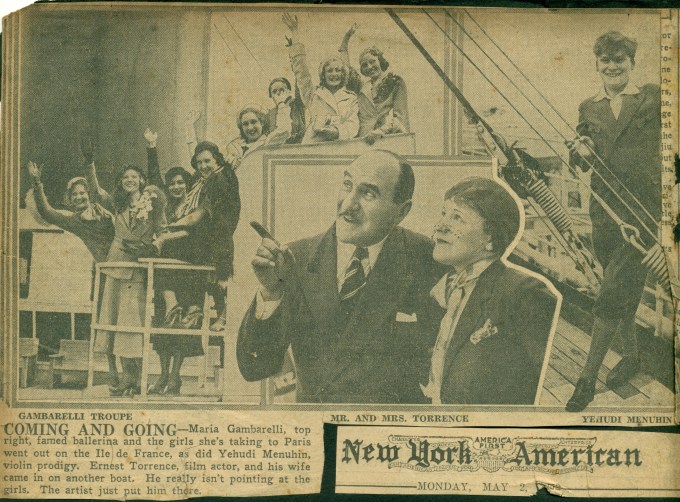
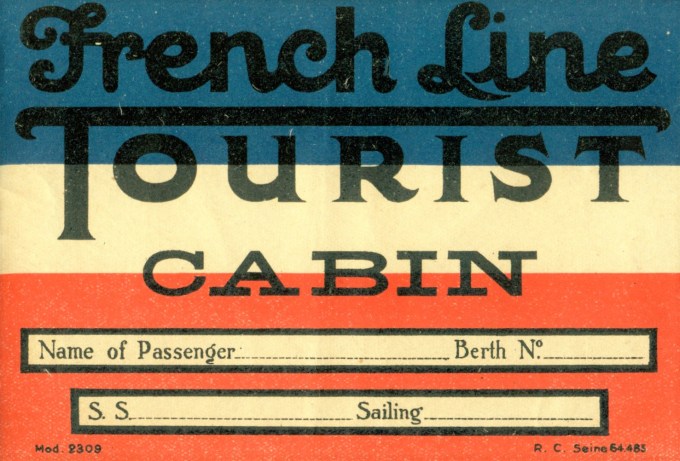
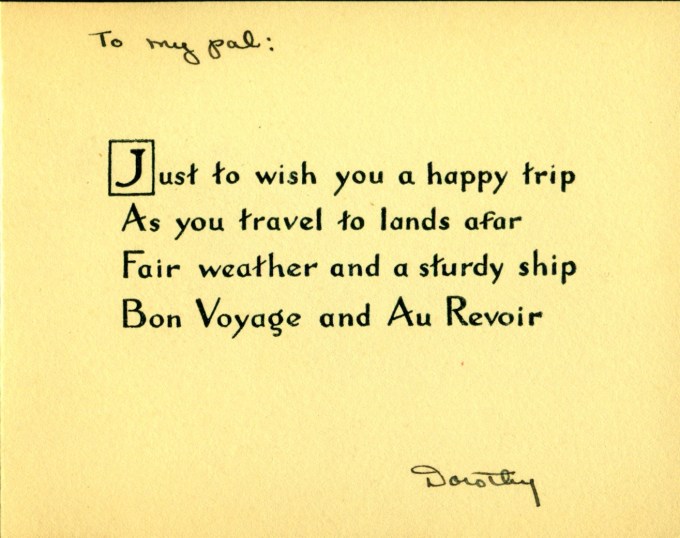
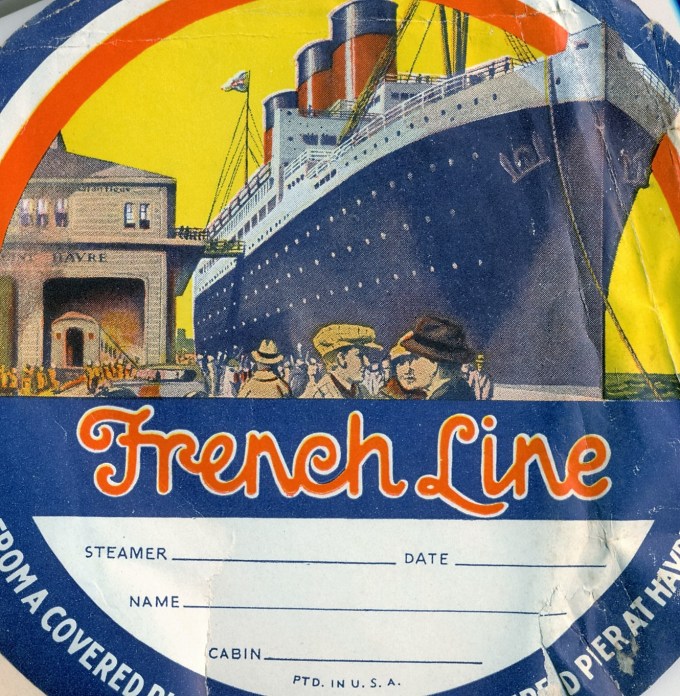
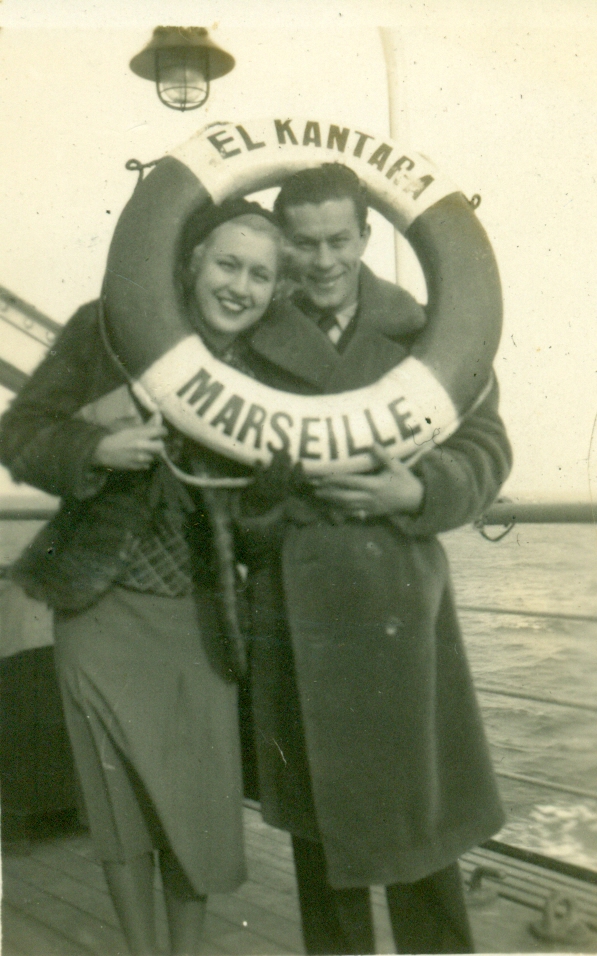
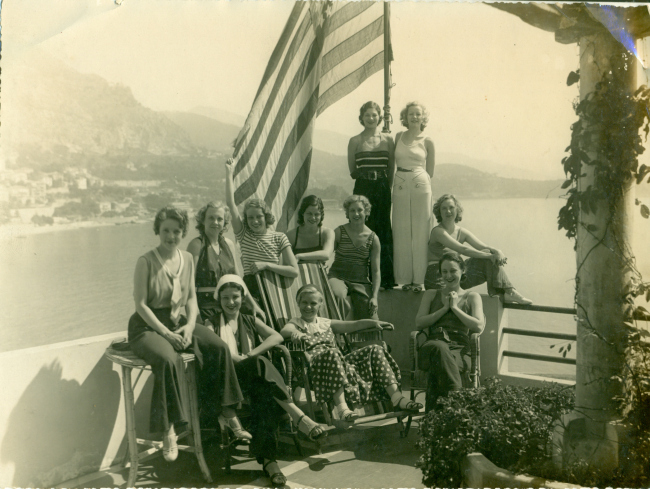
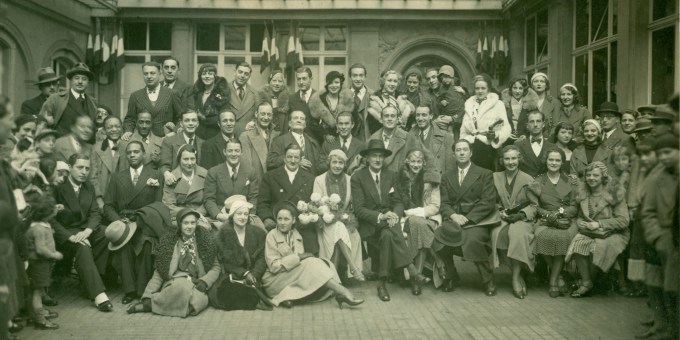
An American Girl Abroad, 1932

newgamby0001

frenchsticker0001

bonvoyagecard10001  bonvoyagecard20001

frenchlines0001    lakecomo0001

hotelhapsburg0001  hotelbasel0001

boattoafrica0001  hotelalgiers0001

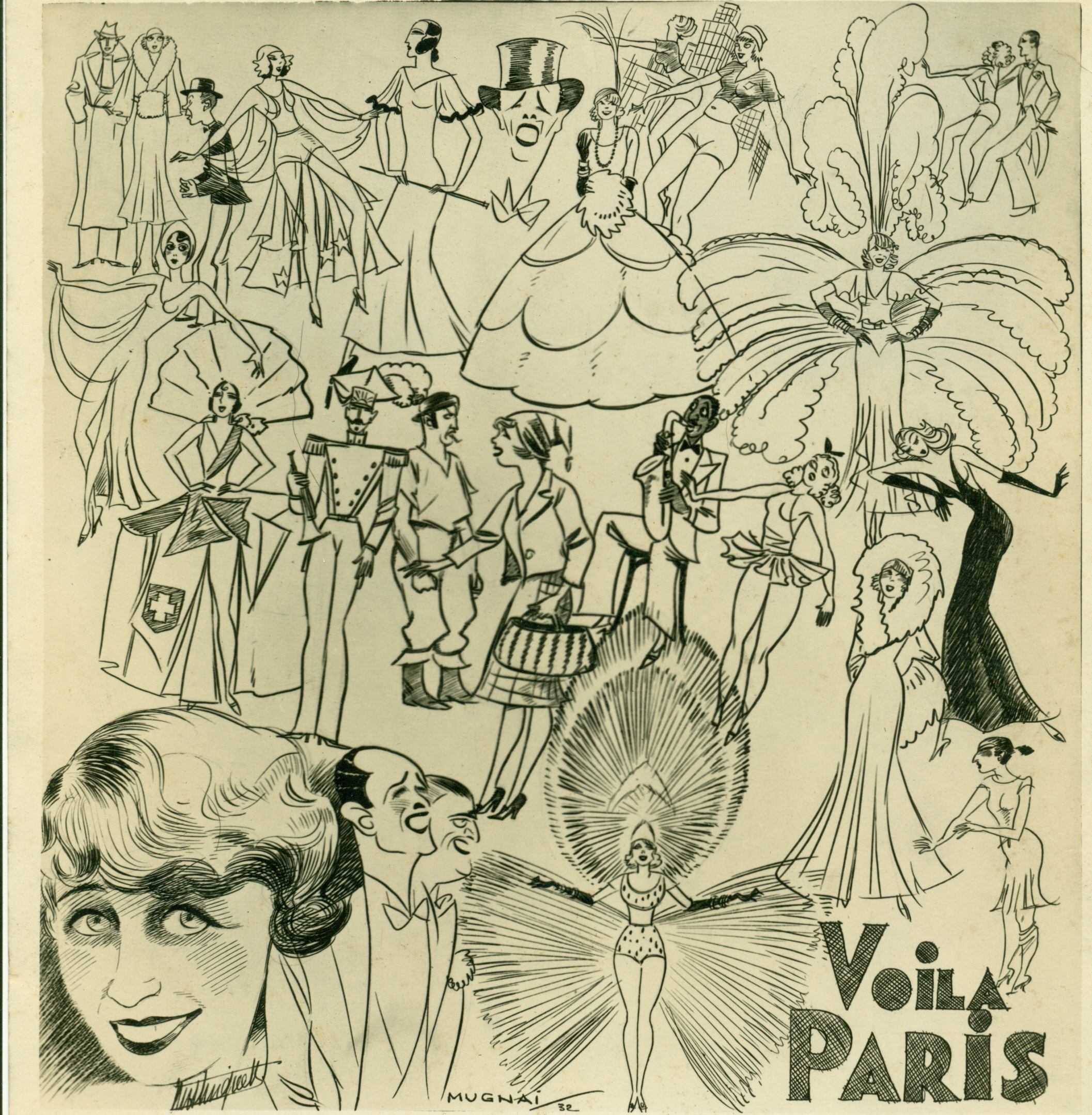
Image  voila0001missgroup0001

Read River of January for the story behind the pictures.

Gail Chumbley is the author of River of January, a memoir, also available on Kindle. Watch for the sequel, “River of January: Figure Eight” out in November.

A Story in Three Pictures

Eighty-three years ago.

glendale10001 Glendale, California

wichita20001Wichita

airclip0001 New York

Gail Chumbley is the author of River of January, a memoir. Also available on Kindle.

Watch for River of January: Figure Eight in November.

A Wave of Enthusiasm

img_1644

A visitor with the “Darkness Derby” trophy


Reno is situated in a golden bowl below mountains that separate Nevada from California. This enormous basin pulsates with life; upscale strip malls, flashy casinos, and relentless traffic following endless suburban growth.

To the north, off the beltway circling the “Biggest Little City,” sits Stead, Nevada, a locale clearly not touched by the same affluence as the rest of the region. A boarded up Catholic church, a Title-I elementary school and a Job Corps Center secured behind a grim, chain link fence, indicate that the very poor live world’s away from the prosperous south.

But at the end of this impoverished section of road, the world changes. Parachutists drift overhead in swatches of white, zigzagging through a deep blue autumn sky. Aircraft of every model and engine size wait, tied down on the asphalt, wing to wing. Vintage bi-planes, silvery jets, oddly shaped experimental aircraft, and muscly aerobatic planes flash in the brilliant sunlight. Thrilled attendees weave through the rows, admiring and discussing these miracles of flight. The owners relax inside the shade of hangars–a protective eye on their aircraft, monitoring visitors with a mixture of casual diligence and satisfied pride.

We, my husband and I, watch the action from inside a tented gift shop in the pits. How the gods of fortune placed us among the elite of the Reno Air Races, in the pits, is a miracle of another kind. In waves, the chosen, carrying pit passes, ebb and flow from our tent. When the Blue Angels blast down the runway, rising in a series deafening concussions, the tent empties. As the spectacle comes to a roaring close, and these seraphs return to earth, the shop once again fills with customers.

These pilots can’t seem to keep themselves from staring at our table. The oversized trophy Chum won in 1933, placed at the center of our book display, captivates these Twenty-first Century flyers. “Can I get a picture of this?” one man asks. “How much would you take for the trophy?” asks another. “They don’t make them like this anymore,” says another. “You need to take care of this one.”

Conversations soon turn to the race itself, 1933’s “Darkness Derby.” For this Depression-era contest pilots flew, one by one, into the eastern twilight. Beginning in Glendale California, nearly twenty intrepid aviators ascended, stopping first in Albuquerque, then north to Wichita, then sprinting to the finish at Roosevelt Field, Long Island. This event celebrated both “Roosevelt Field Days,” and a new Helen Hayes, Clark Gable film titled, “Night Flight.”

Beside the tarnished trophy, we display a framed glossy of Miss Hayes presenting Derby winner, Mont Chumbley, with the very same trophy, at her movie’s premier.

helenhayes600w

Reactions varied. One pilot gushed that my father-in-law was a bonafide aviation pioneer. Enthused the admirer added, that your father-in-law managed to find his way through the blackness and win the race was incredible–he had no flight instruments. I smile because I already know, and this visitor’s wonder matches my own. I also smile because for the first time, since publishing “River of January,” I’m with people who understand the profound significance of his victory.

Another visitor tells us he edits an aviation magazine out of Ohio, and would like me to submit a piece regarding the “Darkness Derby.” This editor promises us that he will see to it that the race is officially recorded for posterity. My husband and I are very pleased with this assurance, as well. We’d always hoped to get Chum’s accomplishment recognized by fellow aviators and officially recorded.

Happily, Chum isn’t the only recipient of accolades. Equal attention and interest are directed to Chum’s future wife, a lovely girl also named Helen, Helen Thompson. Her photograph lights up our table with timeless beauty and glamor. She smiles from a vintage, Hollywood glossy emitting a radiance that seems to add to Chum’s luster. I quickly add that this girl’s glamor masked her own courage and ambition in the world of entertainment. Helen Thompson too, took enormous professional risks, performing across three continents during the tumult of the early 1930’s. It was in Rio de Janeiro, in 1936, while dancing at the Copacabana Casino, she met her dashing aviator.

In Reno my husband and I stepped into the world of avid flyers, and they understood our purpose in sharing “River of January.” With all the adulation paid to our exhibit, all the books we sold and signed, Chum and Helen’s story is carried on to inspire future generations of adventurers.

Image

Gail Chumbley is the author of the memoir, River of January and River of January: Figure Eight. Book one is available on Kindle.


Saturday Market

event5564da65621ed

“River of January” is flying into the Eagle Saturday Market. Come by and say hello. Join the many who have read and loved this exciting, true adventure. Gail Chumbley, the author will be on hand to sign books from 9:30 to 2:00pm.

River of January is available online at www.river-of-january.com, at Amazon.com, and on Kindle. Look for  the sequel, “River of January: The Figure Eight,” this Fall.