 Travel the globe on Labor Day Weekend!
River of January is $2.99 on Kindle!
Travel the globe on Labor Day Weekend!
River of January is $2.99 on Kindle!

The Oregon City Library is a beautiful building. A legacy of Andrew Carnegie’s committment to philanthropy, the library looks as it did a hundred years ago. All in all a perfect spot for a talk on “River of January.” The best part was seeing former students from way back, and friends from home. Big Thanks to Maureen Cole, and the staff of the old OC Library. And a thanks to my boys for the help and cheering section.

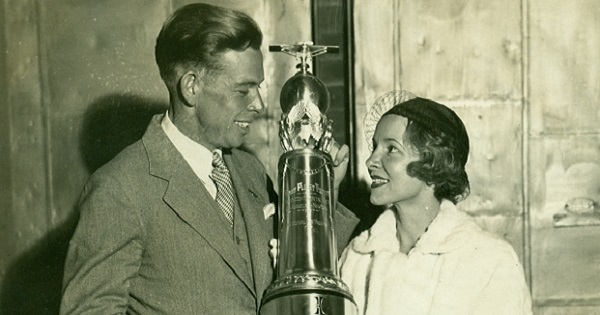
“Night Flight,” an MGM drama premiered October 6, 1933 at New York’s Capitol Theater.
Star Helen Hayes presented Chum his hard-won first place trophy as a part of the evening’s program.
Read River of January.
Buy River of January by Gail Chumbley, also available on Amazon.

“Rumor has it that Mistinguett served as a spy for the French government during the Great War while she was dancing across the continent. They may be watching her again because of that new leader in Germany,” Lillian remarked as the company sunned themselves on exclusive Larvotto Beach.
“Who told you such a thing, Lillian?” Una, another dancer, asked skeptically.
“Didier, the older stage manager at the Terminus—he seems to know all about Miss.”
Charlotte’s eyes grew large. “How thrilling!”
“And she’s had many affairs with younger men,” Lillian continued, enjoying the attention. “You’re familiar with Maurice Chevalier?”
“Of course.”
“Supposedly they shared a passionate, very public romance. Miss launched his career when she plucked him from a music hall chorus line and cast him into his first film, La Valse Renversante.”
“No!” Charlotte blurted.
“Oh, yes!”
“Isn’t he a lot younger?”
“Thirteen years, according to Didier.”
“Lucky woman!” Charlotte said. The rest of the girl’s laughed at her response.
Page 75, River of January

Thank you for taking part in “River of January’s” free Kindle Weekend! Enjoy the story with my compliments.
Stay in touch. As you finish the book, drop me a line, add a review on Amazon.com, and be sure to tell a friend.
For more, visit the photo gallery at www.river-of-january.com
Book Two, “The Figure Eight” is in progress.

The old pilot’s time with us grew to mean a great deal to me, personally, but made it that much harder to let him go at the end.
Chum’s last years brought him out west to Boise. It was much easier for my husband to care for him than the semi-regular flights to Miami, sorting out some kind of preventable crisis. Once his father settled in here, they were together every day at the assisted living facility. I believe their time together gave both of them a lot of comfort.
As for Me? I just loved to sit and talk to my father-in-law. If he had felt more spry I would have dragged him into my history class for my own version of “Show & Tell.” I mean, really! William Howard Taft was in the White House the year Chum was born! His life was a damn book. (see River of January)
On one particular Sunday we drove over for a visit, and brought him Mexican food . . . Chum’s favorite. I was anxious to talk to him because we had rented “The Aviator” the night before, the film about Howard Hughes, and Chum had worked for the millionaire at one time.
Me: So we watched a movie about your old buddy, last night–Howard Hughes.
Chum: Ha. He kept the Kleenex business in the black.
Me: (Oh, geez! How could he know that?) And your old girl friend, Kathryn Hepburn.
Chum: Yeah. Katy. She was a nice girl.
Me:(Katy? A nice girl?)
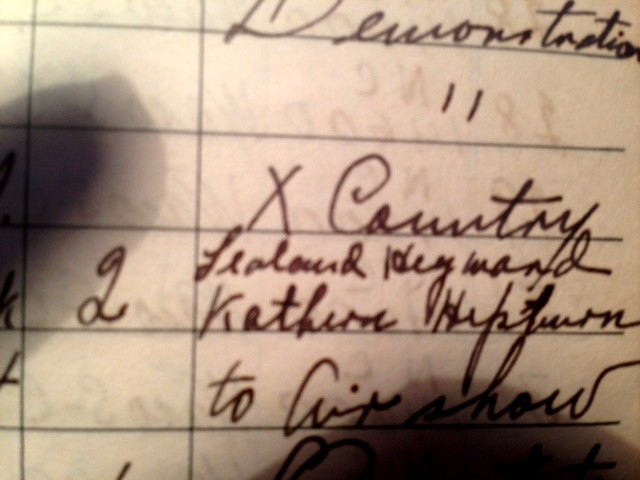
Chum: Her boyfriend, that theater producer, Leland Hayward–I taught him flying lessons, and she came along.
Me: Yeah. (Yeah)
And here it is folks, if you didn’t see at the top. The old history student has to whip out the proof. Have a nice weekend.
Gail Chumbley is the author of River of January. Available on Amazon.


“So you’ve been to see all the big boys, eh?” commented a sales representative from Long Island who was seated behind a battered old desk. Airplane distributor Howard Ailor of Waco Aircraft studied the young man’s face. “And by the looks of you they all turned you down.”
“That is about right, Mr. Ailor.” Chum responded, trying to look confident. “I was hoping you might know of something out here, maybe something at Roosevelt Field.”
“I don’t know you, son, but let me give you some advice. Don’t dawdle around hoping for that phone call. This is no economy to sit by and wait for miracles. You’ll starve first. Push your way into the air business with your own equipment, that‘s what I say, and I can help you with that. We have some beauties right here on site.”
Chum listened to the silver-tongued salesman, surprised that he agreed with all Ailor had to say.
Chum also realized that he had returned to an America deep in the throes of financial depression.
Economic life in the 1920s had played out as a frenzied, unregulated party. By all appearances the country had embraced infinite prosperity. Insider trading and other shady practices reigned on Wall Street, where market manipulators pooled cash and bought up stock, artificially driving up values. Regular folk, believing they were on to something big, bought these tainted stocks as crooked investors dumped them, reaping fabulous profits.
Indiscriminate buying, using easy credit, pumped the overblown Dow Jones to ballooning artificial heights. Even private banks joined the frenzy, wagering the savings of their account holders to increase their own bottom line.
This facade of spreading affluence ensured the “hands off” economic policies accepted in Washington. Then the market imploded. On October 29, 1929, “Black Tuesday,” the savings of a nation disappeared with the steepest financial crash in American history. Thousands upon thousands of people were ruined and the enterprise of a nation dried up.
Young Mont Chumbley had resigned from the Navy without another job, and now found there were none. The pilot’s only and best assets were his optimism, his pluck, and an old Chevy.
“Over here,” Ailor directed Chum, as they walked toward a hangar housing a red-with-black-trim Waco cabin biplane. “This baby’s a real beauty, right? We can take it up for a spin, if you like, but you can’t have this one—it’s spoken for. Still cough up a down payment and we’ll order you a new one. It’d be here in only six weeks.
“I came here looking for a job—and you want to sell me an airplane?” Chum blurted in disbelief.
Ailor continued to rattle on as though the pilot had not spoken. “Hell! I’m feeling generous. I’ll even let you rent office space right here on Roosevelt Field for a percentage of whatever you earn as you get your footing.”
Chum realized he had never encountered such a smooth operator. Ailor finally faced the boy. “Look, you can’t negotiate with reality, son. And the reality is that there are no jobs. The country’s flat busted.”
Chum knew his mouth hung open in reaction to the salesman’s bald audacity. But he also knew he agreed. Ailor was absolutely right.
Chum needed to find a way to buy that airplane. It appeared to be the only real option open to him. With little money left from his dwindling resources, he found a Western Union office and cabled his mother in Pulaski for help. He hadn’t written or visited much since joining the service and felt badly his note only asked her for money. However, Martha didn’t complain or hesitate.
“I’ll run down to our bank in town—still solvent, doors open,” she wired him right away. “A thousand, Mont? Is that enough? Where should I wire it?” Martha would still do anything to help her boy.
River of January by Gail Chumbley available at www.river-of-january.com and Amazon.com
 This lovely lady is Maria Gambarelli, prima ballerina. Miss Gambarelli was well known to New York audiences in the 1930’s for her dazzling performances at the Roxy Theater. In addition, she regularly appeared on Roxy Rothafel’s popular radio program, “Roxy’s Friends.” In 1932 the dancer organized a troupe of New York ballerinas for a grand tour of European cities, to promote America’s cultural image. Helen auditioned for Miss Gambarelli and won a part in the production.
Arriving in Paris the company, christened the “American Beauties,” opened at the exclusive “Le Ambassadeurs” dinner theater to favorable reviews. However, in a contract dispute with the William Morris Agency in New York, in association with the Lartique Agency in Paris, Miss Gambarelli abruptly quit. The eleven American ballerinas were left abandoned, facing an uncertain future on the continent.
For more of the story read River of January, available at www.river-of-january.com
The room was hot, and humid, but the old man would not turn on the air. He said that it cost too much money. The fact that this was Miami and July made no difference,that ancient swamp cooler remained silent in the living room window. To emphasize his granite determination to deny Florida Power and Light an extra penny, Chum dressed each morning in long pants, a belt, and a long sleeve shirt, cuffs buttoned. Mont Chumbley did not project the South Beach image favored by the city’s Chamber of Commerce.
However his strict rules of economy were cast aside the summer I flew down to record his story. And I do mean record, as in tape recorded interviews which lasted, in all, five days. And when I needed quiet the most (for quality purposes,) he decided to switch on that neglected, thundering swamp cooler, providing a Phil Specter-esque ‘wall of sound’ which muffled his fascinating story.
We were both nervous. I hadn’t been married to his son long, and my husband hadn’t come along on this trip. It was just the two of us: new father-in-law talking with new daughter-in-law. But I couldn’t let the awkwardness get in the way, I had traveled three time zones to get the story, and we had to soldier on despite our mutual jitters.
I hit record on the tape player, and immediately he began anxiously whacking a nearby phone book with a pencil. We now had a beat to the swamp cooler’s roar. And he did that for my comfort. How courteous.
I tried to play back the sessions right away to transcribe the contents. It’s safe to say that deciphering his voice from the background clatter grew to be a problem. Imagine the musical “Stomp,” with people trying to converse over crashing trashcan lids.
After a couple of days of this fidgeting he settled down, and to be completely honest, I did too. Chum even forgot to turn on the air once or twice. And his story in aviation began to unfold, carrying us away from noisy appliances; to days before there were such things as air conditioners–to the skies of another era.
Wow.
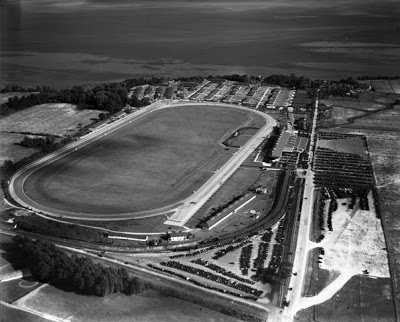
One story that made it into the book tells of his hair raising landing on the infield of a Maryland horse track. Later I had to hit the replay button a half dozen times to get the name right, listening hard to his phonetic pronunciation, buried beneath screeching layers of white noise. Shaped by his Virginia drawl, I deciphered, Har-Day-Graw.
I typed HardayGraw into a search engine. “Do you mean Havre de Grace?” quickly popped up . Hmm. Well, I guess I do. Maybe.
Lo and behold, Havre de Grace was a horse racing track between Washington DC and Philadelphia, tucked into the Maryland countryside. The web site indicated that this track evolved as a joint venture, owned partly by the town of the same name, and partly by the mob.
Partly by the Mob? Are you serious? And everybody knew? I had to look a little deeper.
Apparently in an agreement with the Governor of Maryland, and a former congressman, in a partnership with mobster, Arnold Rothstein, Havre de Grace came to life. And this was no small time nag fest, either. Among the thoroughbreds who graced, Havre de Grace were legends, Man ‘o War, his son, War Admiral, and the indomitable, Seabiscuit, You can’t make this stuff up.
That week in hot, sticky Miami has grown into one of the most pivotal of my life. I felt like Wendy clasping Peter’s hand for her flight to Neverland. But in my case Chum piloted the yoke to “Yesteryearland.”
This Havre de Grace anecdote, with Arnold Rothstein, and a hair raising unauthorized landing from the sky, merged with many, many other episodic rivulets that flowed into this fascinating river of narrative. This “River of January.”
Gail Chumbley is the author of the memoir, River of January
#riverofjanuary

