River Of January and River of January: Figure Eight available on Kindle till Sunday the December 8th.

River Of January and River of January: Figure Eight available on Kindle till Sunday the December 8th.

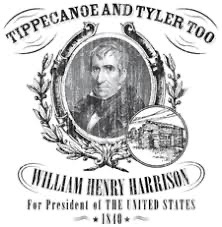
This was the situation in April, 1841. Newly inaugurated president, William Henry Harrison died after only a month in office. The 68-year-old Harrison apparently succumbed to pneumonia after delivering an exceptionally long inaugural address in foul weather. Harrison, the first Whig to win the presidency, was also the first chief executive to die in office, and the Constitutional protocol of succession had never before been exercised.
Harrison’s Vice President, John Tyler, moved quickly upon learning of the President’s demise. He located a judge to administer the oath of office, and moved into the White House. When members of Harrison’s cabinet informed Tyler they would take care of the daily business of governing, he cooly responded that they could either cooperate, or resign.
Tyler had been an odd choice for Vice President. The Whig Party had gelled during the Jackson administration, proposing financial and internal developments over sectionalism and states rights. The Whigs further found slavery not only inconsistent with liberty, but also an obstacle to the growth of a modern economy.
Foremost among the Whigs was the Party’s greatest voice, Senator Henry Clay of Kentucky. Clay had first been a presidential candidate in 1824, and again in 1836. However, in 1840 when the Whigs met in Harrisburg, PA to nominate their candidate, Clay failed to gain the top spot, and then declined the offer of the vice-presidency. Clay later regretted his momentary pique.
Though John Tyler had been a Virginia Democrat, he had publicly broken with Andrew Jackson over Jackson’s misuse of presidential power. In particular, Tyler objected to Jackson’s threats against South Carolina in the Nullification Crisis, leading Tyler to forsake the Democrats, but not the philosophy of states’ rights, or the institution of slavery.
The Whigs decided that Tyler’s opposition to Jackson was good enough to offer him the second spot on the Whig ticket, and Tyler accepted. Then a month into his term, Harrison died, and this Southern Democrat, a wall-to-wall sectionalist assumed the presidency.
From there, Whig policies quickly unraveled.
If the Whig’s aimed to realize their platform of national economic growth, their hopes died under President Tyler’s veto pen. Predictably, the Whig cabinet soon grew frustrated, then disgusted with presidential obstruction. Members began to resign. Only Secretary of State Daniel Webster hung on, as he was in the middle of boundary discussions with the British. Then he, too, submitted his resignation. Shortly after the cabinet fled, and the Whigs formally expelled Tyler from the party.
To their credit the Whig leadership didn’t excuse Tyler, or defend his contrary actions. No one said ‘let Tyler be Tyler.’ They publicly broke and denounced the President’s antics, though the cost, for the Whigs, came due ten years later when they disbanded.
Yet, the story doesn’t end with the demise of the Whigs, but begins anew with a stronger and more principled political movement. For, from the ashes came the birth of the Republican Party, much like a rising Phoenix. And that party still exists today, for now. That is, if they haven’t already submerged their once decent name in the cesspool of Trumpism.
Gail Chumbley is the author of the two-part memoir, “River of January,” and “River of January:Figure Eight,” and “Clay,” a play in three acts. Books are available on Kindle and at http://www.river-of-january.com.
gailchumbley@gmail.com

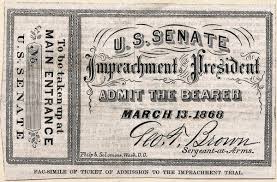
On a cable news program a while back a guest argued that the impeachment of Donald Trump resembled that of 19th Century President, Andrew Johnson. Though the position may be true to the extent that Johnson was under attack from the opposition party, the events that brought about the trial did not center on presidential corruption.
Abraham Lincoln had invited Tennessee Democrat, Andrew Johnson, onto his 1864 ticket as a conciliatory gesture toward the South. As Senator, Johnson had remained staunchly loyal to the Union, though Tennessee had been the final state to secede in 1861. Lincoln made clear with this VP choice that he intended to deal judicially with erring brothers below the Mason-Dixon Line.
During the final year of the war, a philosophical rift widened between President Lincoln and the Radicals in his party. Lincoln believed that Southern States had only attempted to secede, but had failed in that effort, and General Lee’s surrender put paid to the attempt. Since secession had been thwarted, Lincoln argued his pardoning power gave him authority to deal with Confederate leaders.
Countering that argument were Radical Republicans, led by Thaddeus Stevens in the House, and Charles Sumner in the Senate. This faction insisted that when Southern states seceded, they had, indeed, committed political suicide. This, Congress insisted, granted them the power to shape post-war policy.
Per the Constitution, Article One admitted new states.
The mounting dispute between the Executive and Legislative branches erupted in mid-April of 1865, when Abraham Lincoln died at the hands of an assassin. Andrew Johnson inherited the power struggle between the Presidency, and the Congress.
When it came to interpreting the Constitution, Johnson not only agreed with Lincoln over Reconstruction policy, but was also a traditional ‘strict-constructionist’. In other words, Johnson’s understanding of the law did not reach past the Twelfth Amendment. Johnson viewed the 14th and 15th Amendments as beyond Congress’ legal authority.
Vetoing many Radical bills, including legislation for the new Freedmen’s Bureau, Johnson refused to enforce civil rights for freed slaves. Still, as fast as Johnson vetoed such Republican bills, Congress overrode him.
Born in poverty, and illiterate most of his life, Johnson’s malice also included the Planter aristocracy. Keeping somewhat to Lincoln’s view, Johnson enjoyed nothing better than reading letters from Southern leaders pleading for his pardon.
Rubbing nearly everyone the wrong way, Andrew Johnson plainly was not a savvy politician, and became an ever increasing nuisance to the Radical majority. The Republican Party fully intended to punish the white South, and protect the lives of Freedmen.
The inevitable clash came when Congress passed the “Tenure of Office Act” in 1867. This legislation aimed to tie the President’s hands by prohibiting the removal of any members of Abraham Lincoln’s cabinet. Armed with his own knowledge of the Constitution, Johnson knew this bill didn’t pass legal scrutiny, and promptly fired Secretary of War, Edwin Stanton.
The House immediately fired back with eleven articles of impeachment.
Once the inevitable impeachment reached the Senate for trial, equivocating Senators felt the heat from their Radical colleagues. Various hold-outs, uncomfortable with the flimsy case, proved difficult to sway. The central sticking point was that the Act was no more than a trap for a President who refused get out of the Radical’s way. To one Kansas Senator, Edmund Ross, the whole episode was an undeniable setup. Ross believed that there was too much noise, too much turmoil, and not enough evidence.
Sensing reluctance in the ranks, the Republican majority bought more time by taking a ten-day delay on the vote. Members like Ross and other hesitant Senators, were threatened with investigations for bribery if they didn’t toe the line. However, neither stalling, nor threats changed any minds. In the end the vote to convict failed, 35-19, not the 2/3 majority required by law.
Andrew Johnson was broken by the ordeal. He quietly waited out the remainder of his term, replaced by Ulysses S Grant in 1869. (Johnson had been correct. The Tenure of Office Act was found unconstitutional in 1926).
That Andrew Johnson proved unequal to the task of governing goes without question. He was bigoted, petty, and stubborn. But this man was not corrupt, and his impeachment was more a product of tragedy, turmoil, and a power struggle. No overseas hotels, no bowing to foreign dictators, no obstruction of subpoenas. No armed invasion of the Capitol.
Update: Never before has a president been impeached twice. This time Republican obstructionists claim no moral high ground at all, just a gutless blind allegiance to a flawed cult figure.
Gail Chumbley is the author of the two-part memoir, “River of January,” and “River of January: Figure Eight.” Books are available at http://www.river-of-january.com and on Kindle. For more email Gail at gailchumbley@gmail.com
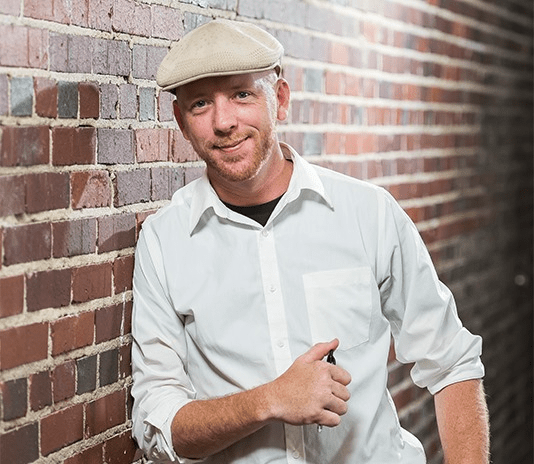
Some of you may know that we signed a film option a while back with Falls Park Entertainment in South Carolina. Brett Kanea, the executive producer, read our script, “Dancing On Air,” then my two books that inspired “Dancing.” Brett found it original and exciting and anticipated producing a successful film. Unexpectedly dear Brett died before any filming began. As you can see he from this pic, he was too young to leave us, and our hearts go out to his family and loved ones.
The morning he first called to discuss the property I thought he was the cable guy expected later that morning. We laughed about that snafu for months after.
Though our future in film is unclear, Brett’s warmth, humor, and confidence lingers on.
Godspeed Brett, the almost cable guy.

Gail Chumbley is the author of the two-part memoir, “River of January,” and “River of January: Figure Eight.” Both are available on Kindle.
gailchumbley@gmail.com

It been over thirty years, but the memory is vividly clear. I leveled a stereo needle onto a record, then an ethereal voice crooned,
“Heavenly shades of night are falling
It’s twilight time
Out of the mist your voice is calling
‘Tis twilight time . . .”
All at once a bedroom door blew open, and my grandmother waltzed into the living room, cigarette balanced in her fingers. She smiled at me as she swirled. “Your grandfather and I danced to this,” she explained, and glided off in her reverie. I watched, amused, enjoying my grandmother’s response to the music, wondering why the melody had her behaving so out of character.
A similar, unexpected episode occurred a few years later, this time concerning my daughter. It was afternoon, after school, when I heard the front door open, and little feet tromp down the hall. While calling out, how was your day? her bedroom door slammed, and deep wailing erupted from her bedroom. Alarmed I opened the door, and found her face down on her bed. She could hardly speak, issuing huge sobs, so I rocked her until she settled down. When I asked her what happened, what upset her, she gasped out that they were studying Native Americans in class, and watched the film, “I Will Fight No More Forever.” This movie depicts the Nez Perce Wars in Idaho. And what had set her off was the patent injustice suffered by America’s first peoples. She had encountered a long ago atrocity, and intuitively understood the grave wrong doing. She was only eight.
Two distinct generations impacted by the power of music and film.
In John Vogel’s superb new book, A Spiritual Exploration Of The Literary And Performing Arts, Volume I: Philosophy, I found some answers. In a lively, brief 100 pages Vogel literally defined magic.
A seeker of truth, the author methodically offers a case for the transformative power of the Arts; how film, the stage, and music calls to us, elevates our spirits, and imparts universal lessons. In clear language Vogel asserts persuasively that, as human beings, we are made better by embracing the sentiment intended for our souls.
This book takes on the task of explaining inspiration through the works of the masters. Vogel considers standards such as the musical Show Boat, assorted characters from Shakespeare, the Greek poet, Homer, and even Jimi Hendrix to provide object lessons. Each example is fleshed out to illuminate the dynamic power of performance- a realm where imagination, intuition, morality and spirituality reside. Particularly poignant to this reader was author’s discussion of a scene from the film Gandhi, and its lesson on personal redemption.
Lively and fascinating, A Spiritual Exploration is also a cautionary tale. Vogel reminds us through the performing arts that a lust for temporal power and wealth is spiritually lethal, as revealed in the tragedy of Macbeth. More timeless examples are offered reiterating that hate produces nothing of value, and worse restricts our humanity; the essential lessons of humility, reason, spirituality, and justice. Moreover, Vogel makes a persuasive case that the Arts are the guardrails of orderly society, imparting the message that through literature and music were a taught to be human.
This is a short read with a long title, made even weightier for the philosophy it imparts. As I read Vogel’s words I intuitively knew that he was right about the sublime power of the unseen.
A Spiritual Exploration is a work that speaks to the timeless and universal.
John Vogel’s book is available at:
Gail Chumbley is a playwright and author of the two-part memoir, “River of January,” and “River of January: Figure Eight.” Both books are available at http://www.river-of-january.com and on Kindle.
gailchumbley@gmail.com

We were supposed to start our exploration of The Vagabond King today. It is a wonderful operetta that is based on the life of Francois Villon, a French poet who allegedly rallied the people of Paris to defend the city against the attack of the Duke of Burgundy. In saving the city, Villon also preserved the monarchy in France, in the person of Louis XI.
My plan has been interrupted by an interesting turn of events. I have just finished reading two books, River of January, Part One, and River of January, Figure Eight. If you love history and a rollicking good romance, you need to read these two books, written by Gail Olson Chumbley.
But well you may ask, how did I come to know about these books and its author?
Shortly after I started posting comments and music on this FB page, I noticed a new visitor to the page, Gail Olson Chumbley. I looked her up and found out that she was an award-winning teacher at Eagle High School, Toppenish, Washington before she retired. She met her second husband, Chad Chumbley, in 1994, and Chad regaled her with stories about his parents, Chum and Helen Chumbley. Eventually, Gail, the history teacher, became curious and dug through boxes of old correspondence and pictures and finally interviewed Chum before his death in 2006. What she found was even more impressive than Chad’s stories, because the lives of Montgomery (“Chum”) Chumbley and Helen Thompson Chumbley were intertwined with key events in American history from 1925 to 1955.
Not ever having written a book before, Gail started the arduous task of translating dead archives back into living human beings. This daunting task was made easier because of her two love affairs: she loved Chum and Helen and she loved their son, Chad. Her writing was a labor of love.
I promised I would read her books one day, but my schedule was busy and “one day” kept moving to the right. Gail ended my procrastination by mailing me both books; and at night before I went to sleep, I would read through 30 or 40 pages. Gail didn’t start to write until she wrote these two splendid books, but what comes through is a historian’s love for detail and context. Gail gives the reader both the overview of history (the big picture) and the personal details of the two people she follows. We follow both Chum and Helen separately until 1936, when they met in Rio de Janeiro and fell in love.
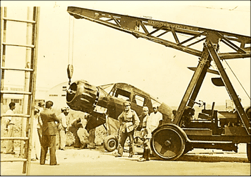
Chum enlisted in the Navy and eventually won a spot in Flight Training in Pensacola, FL. He stayed in the Naval Reserves, even after he left active duty, and began a career that revolved around Waco Aircraft, an early pioneer in aircraft design and manufacturing. Chum was one of the few early aviators who came after WWI but was ready to serve once WWII came into focus. He was one of a handful of pilots who started in planes made of wood and ended in the jet age.
Another pilot, who trained at the Army base at Brooks Field, Texas, was Alexis Klotz. Lex also was involved in delivering the mail, although Lex started on the West Coast. Lex ended his career with TWA and offered to show me around the cockpit of the new Constellation when they went into service. Flying the mail from west to east in the winter was hazardous, and many good but not great mail pilots went down in bad weather. In winter, forced landings almost always resulted in death.
When Chum and Lex flew airplanes, the cockpits were open (it got cold at higher altitudes), and the planes had little if any navigation or communication equipment. Many pilots learned the ground terrain, the railroad tracks and other identifying ground markers to guide them during their many hours in the air. Flying was more art than science.
One the other hand, as Gail explains to us, these pilots loved to fly and may have been more comfortable in the air than on the ground.
But that is only half of the story. The other half of the story involves Helen Thompson who, from an early age, was pushed by her mother, Bertha, into dance. Luckily, Helen learned to love to dance and to perform, in general. From ballet, Helen moved into vaudeville routines and eventually ice skating with skating stars like Sonja Henie.
But Helen’s career is only part of her story. At each turn in her career, she met famous people and witnessed key events. Coming home from a European tour, Helen performed onboard at the Captain’s request, alongside another performer named Maurice Chevalier. What was more important was the fact that both performers sat at the Captain’s table. Helen dined with the former President of France, Edward Herriot, on his way to Washington DC to confer with FDR in the mid-1930’s.
It is this constant integration of the big picture of history (Chevalier jokingly asking Herriot if he could save the world from Hitler) with the details of Helen’s dance program that make the two books so charming and engaging. We are reading history from the bottom up, living through periods of time through the eyes of Chum and Helen. And it is a wonderful way to learn and was used successfully by Kenneth Roberts in his many books on the American revolution.
For all of you history buffs who like a good romance story, put away David McCullough for a bit and pick up River of January, Part One, and River of January, Figure Eight.
For more from John Vogel visit Preserve Old Broadway on Facebook.
Gail’s books are available at http://www.river-of-january.com, and on Kindle.
gailchumbley@gmail.com
Colonel Clark used to bring his young son down to the dojo where my brothers participated in judo lessons. Judo had been my grandfather’s idea and he faithfully chauffeured the boys, and I sometimes came along too.
My Grandpa Ray always sat with Colonel Clark, if the old gent happened to be present. That meant I sat with Colonel Clark too. The two old men would talk and talk, seated next to one another, though their eyes remained fixed on their boys on the mats. They never seemed to look each other, but remained absorbed in their conversation.
My own distracted attention span only caught snippets of the murmuring discussion. “MacArthur, Wainwright, and Bataan,” came up in their exchanges And despite my youth, I understood something grave, something momentous lay behind the back and forth of these two men.
Later my older brother filled in the substance of what I reluctantly overheard.
Colonel Clark had been left on the Bataan Peninsula with around 12,000 American soldiers when General Douglas MacArthur evacuated the Philippines in 1942. Under the new command of General Jonathan Wainwright the Americans surrendered to superior Japanese force, among them young Clark. The Japanese summarily ordered this defeated army to march some sixty miles through the dense, humid and scorching jungle. The purpose of the Bataan Death March was cruel attrition; death by exposure, heat exhaustion, dehydration, and starvation. American numbers dwindled. When a captive stumbled, or fainted from heat stroke, or dehydration, the penalty was an immediate beheading. Young Clark bore witness to this historic moment of living hell, and he clearly never separated himself from that ordeal.
Bataan had fused forever into his being.
And that that same ordinary old gent who chatted quietly with my grandfather had a young son was a miracle. In light of his wartime ordeal, Clark should never have survived much less sired a child.
The valiant are everywhere.
For example there was George, the high school janitor.
For many years this little old fellow cleaned the litter-strewn halls where I taught American history. Equipped with two hearing aids, this diminutive man pushed an immense dust mop, wider than he was tall.
To a passing eye George moved about nearly invisible. Just a friendly, gentle, and harmless grandfather.
As I pontificated about D-Day, Tarawa, and the Bulge to sleepy Juniors, a foot or so of mop often slid and stopped by the open classroom door. Silent, George hid as I blathered on about the Second World War. A short time later I learned this quiet 80-something had once handled a M-1 Garand, shivering aboard one of those heaving and crashing Higgins boats, churning toward destiny on Omaha Beach. George had been in that first wave in June, 1944.
Humbled to learn our little janitor was a living, breathing hero, I became the student. “So George, what do you remember most about that morning?”
The old warrior rasped in a high, faded voice, “It was awful early, and the water was awful cold.”
So understated.
Another veteran crossed my path at the high school by the name of Roy Cortes. His son, our school Resource Officer brought Roy by to visit with my students. And another narrative of a remarkable life unfolded.
As a teenager Roy was hired by FDR’s Civilian Conservation Corps. In the forests of Idaho Roy Cortes fought fires, built campsites and lookout towers for the US Forest Service. But in late December, 194, after Pearl Harbor, Roy headed straight to the recruiting office, and was sworn into the US Army.
Roy, too, had ferried over from Southampton England, the afternoon of that bloody June day.
“What do you remember most about the invasion, Sir?” a student asked.
The affable elder smiled slightly, then a cloud passed over his expression. “I lost everyone in my outfit. I was real scared. Then I had orders to regroup with other survivors on the beach. You see, that was bad because I’m Mexican-American, and my first platoon got used to me, and the bullying had stopped. Now I had to start all over with the slurs.”
“For days, as we moved inland, these fellas giving me the business. One time this guy says, ‘Mexicans can’t shoot.’ I said that I could. So he said, ‘Ok Manuel, Jose, or whatever your name is. Show me you can shoot.”
“See those birds on that tree branch up ahead? The guy pointed. Shoot one of those.’ I lifted up my rifle and aimed at the branch and pulled the trigger.”
At that Roy again begins chuckling. “I missed the branch, the birds all flew away, and twelve Germans came out of a grove with their hands up.”
Astounded, no one spoke. Then a huge wave of warm laughter filled the classroom. Roy simply smiled and shrugged.
Colonel Clark, George the Janitor, and Roy Cortes. They were just kids whose lives became defined in ways we civilians can never fathom. They were scared, and hot, and cold, and hungry, and suffering, and ultimately lucky enough to come home to America.
They married, raised families, and move on with life.
That’s All.
Gail Chumbley is the author of the two-part memoir “River of January,” and “River of January: Figure Eight,” co-writer of the screenplay, “Dancing On Air” based on those books. She has penned three stage plays on history topics, “Clay” on the life of Senator Henry Clay, “Wolf By The Ears” examining the beginnings of American slavery, and “Peer Review” where 47 is confronted by specters of four past presidents.

This excerpt comes from River of January, the first volume of the two-volume memoir available on Kindle, and at http://www.river-of-january.com
Two weeks later, a nervous and sleep-deprived Mont Chumbley reported for flight elimination exercises. He joined 125 other candidates; smartly lined up on a long dock, facing the gray, choppy seas of Hampton Roads. From this windy spot would-be pilots underwent demanding instruction in ten-hour heats on various flight maneuvers. Day one: morning-takeoff, afternoon-landings. Day Two: mornings- turns, including the figure-eight, afternoon-climbing and descending turns—all in Curtiss NC4 seaplanes. Their instructors rated them at each step, either passing or failing, with no second chances. The pool of candidates became smaller with each roll call.
Feeling the pressure, the young sailor took special pains to follow protocol. Climbing around on wet pontoons fixed to the underside, Chum examined the biplane as it bobbed on the rolling water. He talked himself through each required procedure, so he wouldn’t overlook any step.
“Oil leaks? Negative,” Chum recited as he performed his pre-flight inspection. “Rudder locks off? Affirmative.”
He continued crawling around the aircraft until he was sure his check was thorough. After the meticulous exterior inspection, he settled into the cockpit.
“Controls? Check. Stick?” He jockeyed the stick left to right then up to down, “Check.” “Ailerons? He wagged the panels, “Check. Gauges?” He examined the calibrations closely. “Check.”
Concluding the pre-flight list, the student-pilot ignited the motor as another crewman propped the biplane’s propulsion blades, quickly, hopping back to the dock.
Chum, still repeating all he was taught, lifted the plane from the rollicking waves and then leveled the wings using the needle ball as he reached altitude. Momentarily surprised with the ease of his lift, Chum relaxed, in control of the little trainer.
“This isn’t that complicated!” the astonished young man marveled. The thrum of the engine seemed calming, and he could practically feel the buoyant pontoons below the fuselage.
“Flying makes sense,” he reflected. “Pull the stick this way, up, reverse the stick that way, down.”
A sense of wonder filled the young man. As if born to fly he intuitively grasped the mechanics. “Flight requires gravity, logic, instinct, and sound equipment.”
The Curtiss biplane read Chum’s mind, rising on a line, descending on an angle, turning on an invisible anchor point. The little aircraft did what he desired.
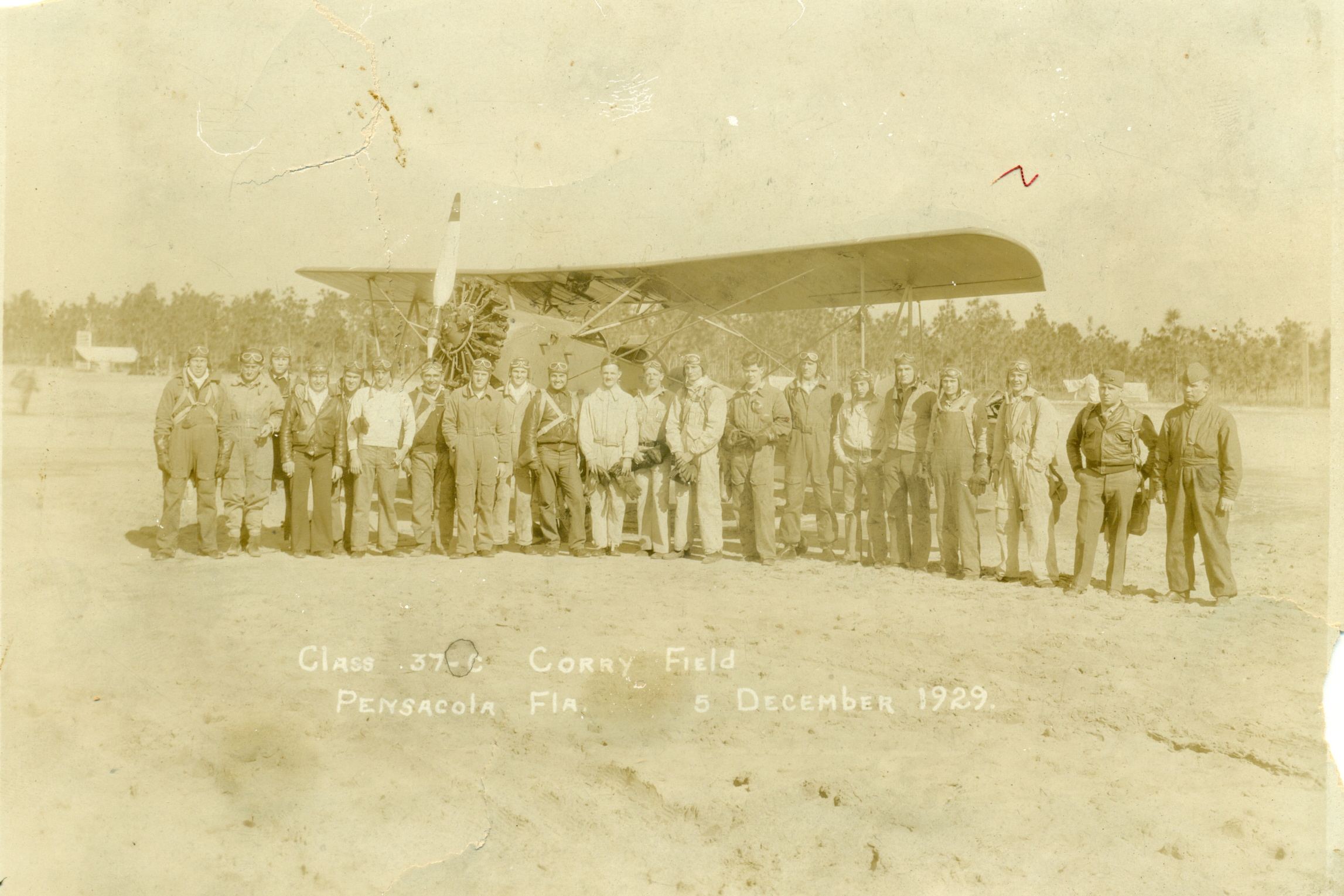
Of the 126 flight hopefuls, only nineteen succeeded— including Mont Chumbley. The washouts returned to Norfolk to ship out to sea, to labor on the hellacious coal burning tugboats or other maritime duties. Chum gratefully headed for warmer climates—flight training with his class, 37C, in Pensacola, Florida.
Thinking of Commander Seymour Chum had to smile, “Radio school would probably have been too difficult.”
Gail Chumbley is the author of “River of January,” and “River of January: Figure Eight.” Hard copies are available at http://www.river-of-january.com, and on Kindle.
gailchumbley@gmail.com
A former student posted pictures yesterday of a cadet event at West Point. In a formal ceremony he and his classmates were presented with gold class rings in what looked like an annual military tradition. According to the post these rings were made from gold melted down from deceased former cadets, and shavings from the remains of the Twin Towers. A moving and inspiring affair for sure.
Parades on Veterans Day, Memorial Day, The Fourth of July, festooned with waving flags, highlight the modern veneration Americans feel for their warriors, past and present. But this honor and respect wasn’t always held for our fighting forces. In fact from the close of World War One in 1918 until the attack on Pearl Harbor in 1941, Americans across the country roundly rejected and criticized anything to do with the armed forces.
As I go about the Northwest, speaking on “River of January,” folks are consistently surprised with the contempt the public held for soldiers and sailors in the book’s setting. The central figure in the memoir, Mont Chumbley shared with me before his death that at the time he enlisted in Norfolk Virginia, signs appeared in city parks warning, “dogs and sailors keep off the grass.” And it is that quote that draws stunned reactions from listeners.
The killing fields of World War One dragged on for three bloody years until America joined on the side of the Allies. Woodrow Wilson, the sitting President betrayed his earlier campaign promise of, “He kept us out of the war,” quickly changing his mind about Europe. He ultimately asked Congress for a declaration of war in April, 1917 to “Make the World Safe for Democracy.” This idealist Chief Executive sent American boys across the Atlantic to remake the world in the image of America’s republican system.
American soldiers, “doughboys,” weren’t in any way ready to deploy, quickly activated and barely trained. Still the recruits and draftees were promptly loaded onto troop ships landing in time to stave off a final German offensive. Gung ho and naïve, US forces made the difference almost at once, charging enemy trenches in blind innocence, with a faith in their youthful invincibility. The exhausted, war-weary combatants, particularly the German “Huns,” soon collapsed, requesting an armistice in November of 1918, ending hostilities.
World War One had unleashed unthinkable horrors in tactics and weaponry. Foul sewage-filled trenches, poison gas, machine guns, aerial bombing, torpedo launching u-boats, tanks, barbed wire, and “no man’s land,” sickened the American people. An outraged sense of being duped into war by big business and self-serving politicians became universal.
Beleaguered President Wilson attempted to salvage purpose from the unspeakable carnage with his “Fourteen Point” peace plan, including his “League of Nations,” a forerunner to the United Nations. Citizens universally rejected Wilson’s efforts to remake a peaceful world. In fact, Americans rejected any form of internationalism whatsoever. War was pointless, and the nation resolved to never venture abroad again, period.
An attitude of isolation gelled and hardened into popular opinion for years to come. Any boy who joined the service was considered a no account scoundrel with no ambition, or self respect. It was in this hostile atmosphere Mont Chumbley bucked popular opinion choosing to join the Navy and ultimately fly airplanes.
It came as no surprise that his family vehemently opposed his enlistment plans. The entire clan closed ranks, certain the family name and reputation was at stake, and the boy could not be permitted to sully the rest of them. And that is only a single anecdote of one family in a nation appalled by anything military.
All three branches faced draconian budget cuts in the 1920’s, with more slashed during the Great Depression. Military leaders hustled to find ways to justify their shrinking budgets before Congress. Military planners were met with answers such as that concluded by Congressman Gerald Nye. Results of Representative Nye’s study determined the US only entered the World War to enrich munitions manufacturers and bankers. The Navy had already taken an earlier hit when a moratorium was placed on building any new battleships. America didn’t need them anymore, the country would never go to war ever again.
And that attitude persisted from 1919 to 1939 until Hitler’s blitzkrieg shattered the peace. But even then the US did not involved itself, even as England stood alone before the Nazi onslaught. Instead Congress passed Neutrality Acts tying the President’s hands to help the English. American entry into that war didn’t occur until the Japanese attack at Pearl Harbor two years later, in December of 1941.
The “Long Weekend” starved America’s military for twenty years. That Mont Chumbley managed to join at all, and managed to fly the few aircraft the Navy possessed is nothing less than a miracle. That farm boy from Virginia overcame immense barriers; stiff family opposition, social ridicule, and crossing an immense chasm to become a Navy pilot.
But he did.
Gail Chumbley is the author of the memoir River of January and River of January: Figure Eight. Both are available in hard copy at http://www.river-of-january.com and on Kindle.
Any questions? Reach me at gailchumbley@gmail.com

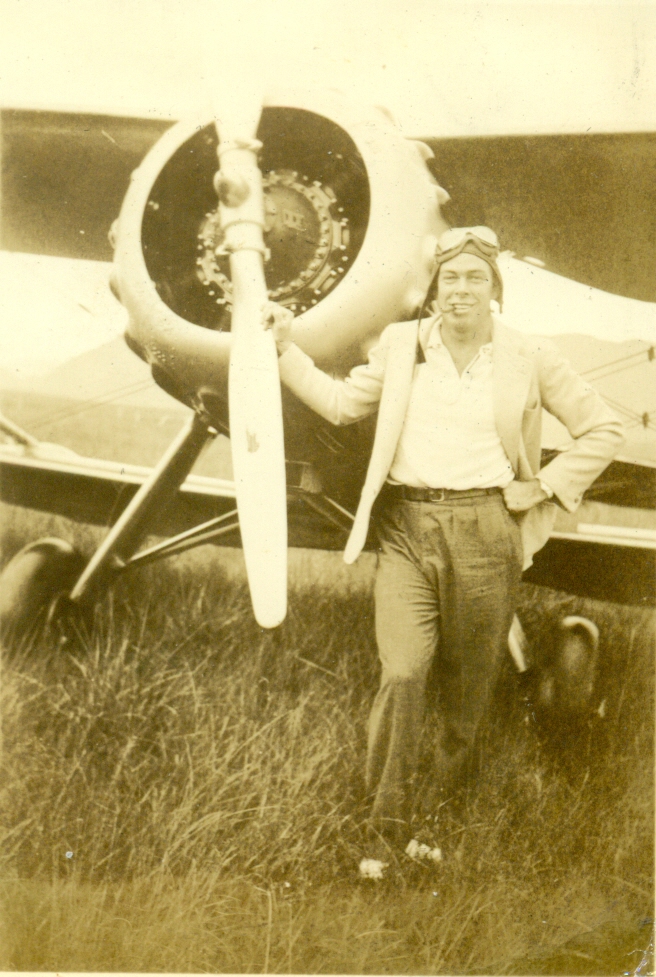
Author Note: The following excerpt was drawn from extended interviews with veteran aviator Mont Chumbley (1909-2006), discussing his training in the interwar Navy. For the rest of the story read “River of January” available on Kindle.
Later, with his flight training securely behind him, Seaman Montgomery Chumbley received his first official orders. He and his class were assigned to Torpedo Squadron 3, located in Coco Solo, on the Atlantic coast of Panama. Chum joined his fellow novices as they shipped out southward aboard the USS Shawmont.
Watching from the deck as the Florida base vanished, the pilot silently rejoiced at this milestone. He also celebrated the fact that he didn’t have to return in disgrace to Virginia. That euphoric detail made the sky somehow bluer, the clouds somehow more feathered and graceful. The young man felt nearly giddy.
After two pleasant days at sea, the Shawmont cruised into the Naval Station at Guantanamo Bay in Cuba to refuel. Chum was enchanted by the beauty of the jungle and continued to marvel at the colorful sea life and assortment of exquisite birds circling the ship for handouts. The vast horizons he used to imagine, were becoming reality.
The Squadron’s final destination lay near Colon, Panama. Coco Solo was a vast, busy American naval installation, surprising the young pilot with its colossal size. The arrivals boarded a transport for delivery to their quarters, gawking out their bus windows in wonder at the enormity of the American base.
His awe continued after he and the boys were escorted to the adjacent submarine facility to tour that installation.
Returning to the field, the group sat through their initial military briefing, Chum, next to Win, listened as the instructor addressed the new aviators. The captain explained that a 1929 War Department directive assigned the US Navy the task of protecting the Atlantic zone of the Panama Canal from hostile threats.
“The Army’s Fort Gulick sits adjacent to us in Coco Solo, and shares our same mission,” he explained. “As some of you may already know, to the southwest, other military bases dot the entire 51 miles of the canal—all the way to where it meets the Pacific.
After the session, Chum remarked to his buddy, “I feel strangely noble defending the canal. It’s as though we all are part of a bigger picture, with America expanding into both oceans.”
“But what country would be nuts enough to attack us?” Win wondered.
War games made up much of Chum’s Panama duty. The flyers were the “red” team, attacking from the air, while the “blue” team lay in wait, aboard ships “guarding” the canal. The pilots executed their orders during these simulations, but off-duty they grumbled about the Navy’s outdated and seriously flawed maritime battle plans.
“I can’t believe they have us flying so near enemy ships!” Chum groused, crunching over a gravel path after morning exercises. Win paced alongside as they headed toward the base canteen.
“So near? What do you mean? How else could we release our torpedoes?” His friend asked as they ordered sodas at the commissary’s cafeteria.
“Think about it, Win. A torpedo aims more accurately if it detaches directly above the ocean’s surface. And it’s not the steep dive on approach that’s fatal—it’s pulling up after releasing the torpedo. That maneuver is potentially fatal. The belly of the plane is too close to enemy guns. Any surface ship could blow us to kingdom come.” He smacked his palms loudly for effect.
“But, Chum, hold on! There’s smoke laid down on the surface by the first two T3M’s. That smoke blankets us.”
“Yeah, if all goes as planned. If the smoke is laid down close enough to the water, if it doesn’t rise too fast, and if the wind doesn’t blow in too hard. That’s a lot of ifs. Think about it. We approach in low formation, drop our payload and bank, while dangerously showing our undersides to the enemy. We’d be lucky to keep our asses dry, Win. Makes me wonder what desk genius dreamed up this idea. It’s a suicide mission.”
The two flyers stared at their icy drinks. Perhaps Win could see his own plane exploding into the cold depths, just as Chum had already envisioned.
“Anyhow, the scuttlebutt says the brass is taking a second look at that line of attack,” Win disclosed. “The Navy wants to remodel the torpedo bombers into patrol biplanes, replacing the ordnance with fuel tanks. Can’t come fast enough for me—you’ve made me a believer,” his friend admitted.
Gail Chumbley is the author of “River of January,” and “River of January: Figure Eight.” Both are available at http://www.river-of-january.com or on Kindle.
gailchumbley@gmail.com