Lay Down His Burdens

th

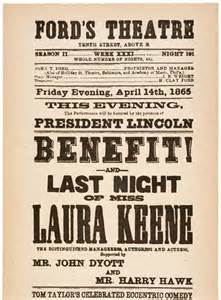
April 14, 1865 fell on Good Friday. It had been five days since General Lee’s surrender to General Grant at Appomattox Courthouse, and a good, Good Friday for President Lincoln. In high spirits, the President escorted his wife, Mary Todd Lincoln to Ford’s Theater for the final curtain of the comedy, “Our American Cousin,” starring Laura Keene. From his seat in the presidential viewing box, Lincoln was murdered at point blank range by an assassin sneaking from behind.

This famous scenario provides quite the ironic twist considering the high opinion Lincoln held for actors and plays. In a cruel irony, President Lincoln sought refuge from his storm of troubles in Washington theaters, a setting where he could lay down his burdens.

From his earliest days in the White House, Lincoln avidly sought out the Capitol’s many stages. An enthusiast, he fell into the dangerous habit of sneaking out of the mansion, without his wife, without any protection detail, determined to take in any new production advertised in Washington papers. Members in various audiences, who spied the President playing hooky, reported that Lincoln watched these plays transfixed, as absorbed as if he was alone rather than seated in a crowd. Apparently his determination in attending Washington City theaters seemed to eclipse even concern for his own safety and in a city ripe with rebel sympathizers looking to inflict harm on the President.

What could impel a Chief Executive to take such risks in wartime, when many wished him ill? Why would Lincoln place himself in such peril?

Neither a drinking man, nor much interested in other vices, the President instead relished stories, either written or dramatized, where he found the distraction and solace he so desperately needed. A prolific story-teller himself, Lincoln appreciated a well turned tale, either in the books he voraciously consumed, or the yarns regaled on a late night near a warm wood stove. This president hungered for diversions to ease his troubled mind weighted by his intractable problems.

And Lincoln’s burdens, both personal and those of the presidency reached far beyond terrible. A protracted and bloody Civil War, the pain-in-the-neck generals who consistently failed in their duty, his difficult wife, Mary, the tragic loss of two young sons, and an unending flow of reverses from irascible members of Congress. That a well-crafted drama or comedy seemed to salve Mr. Lincoln’s soul must have made the temptation of escaping the White House irresistible, and a nightmare for those Pennsylvania troopers assigned to protect him.

Wilkes Booth knew Lincoln would attend the closing night at Ford’s Theater. The owner of Ford’s Theater had advertised that fact earlier in the day. Booth had, in fact, visited the site to prepare for his ‘greatest’ performance. The narrative in the actor’s deranged thoughts, screamed vengeance and duty to the lost cause of the Confederacy.

But I would like to offer another perspective on those same last moments in President Lincoln’s life.

The narrative Lincoln likely played touched more upon hope and delight. Slavery that April night, existed no more in America, and the battlefields had grown quiet. Much work lay ahead for the nation, but Lincoln knew he would attend to those matters as they emerged. For that one night the President did what he loved most—attended a theatrical production, and even better for his rising spirits, a comedy.

At the moment Booth pulled that derringer’s trigger, Lincoln was laughing. The whole audience, in fact, had erupted in guffaws, at an expertly delivered punch line. Perhaps that is how we ought to frame the horrific murder of our greatest commander in chief. While the murderer fumed in hate and revenge, Lincoln over flowed with concentrated joy, reveling in all that was good.

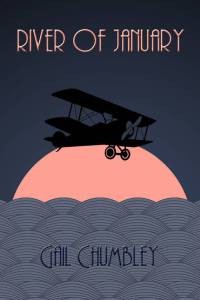
Gail Chumbley is the author of River of January, also available on Kindle

Duty Faithfully Performed

th

April 9th, today marks the 151st anniversary of General Lee’s surrender to General Grant at Appomattox Courthouse, Virginia, ending the Civil War.

Lee didn’t want to to do it. He remarked to his aides that he’d rather ride his horse, Traveler, into a meadow and be shot by the Yankees, than surrender. But the General didn’t relinquish his burden that way, instead he did his duty.

Even General Grant sat in awe of his most worthy foe. Poor Grant seemed to have felt his social inferiority even in the midst of his greatest military victory. Grant informed Lee he had seen him once in the Mexican War, almost stalling, avoiding the business at hand. The Ohio-born Grant came from humble beginnings becoming one of the most unlikely warrior-heroes in history. Graciousness and duty impelled the Union Commander to receive General Lee with quiet, somber respect.

I would bet that though all participants ardently desired peace, no one exactly wanted to be in that room on that April 9th. The war had cost too much, more than any nation should have to bear. So many losses, so much blood; the cream of the Confederate command only memories to the bowed Lee. Grant, musing the thousands he ordered into the murderous fire of Rebel cannon and shot. The deadly dance, just ended, between two worthy foes, from the Wilderness, to Cold Harbor, to Yellow Tavern, to Petersburg, and finally to the quiet crossroads of Appomattox, and peace.

These two generals, and the loyal armies they commanded had set aside all personal concerns, steeled themselves and did their duty, in Lee’s words, faithfully.

Gail Chumbley is the author of the memoir, River of January  Also available on Kindle.

A New April

Yeah, still holds true. Like and share if you like this post and want to share it.

gail chumbley's avatarGail Chumbley

Image

Right now, in classrooms across America, and overseas, thousands 17-year-olds are preparing for the AP US History exam. They, and their instructors are obsessed with cause and effect, analyzing, and determining the impact of events on the course of America’s story.  Moreover, they are crazed beyond their usual teen-angst, buried deep in prep books, on-line quizzes, and flashcards. As a recovering AP teacher, myself, I can admit that I was as nuts as my students, my thin lank hair shot upward from constant fussing.

My hair fell out too, embedding in combs and brushes, as I speculated on essay prompts, that one ringer multiple choice question, and wracking my brains for review strategies. The only significance the month of April held was driving intensity, drilling kids on historic dates; Lexington and Concord, the firing on Fort Sumter, the surrender at Appomattox Courthouse, President Wilson’s Declaration of War in 1917, the…

View original post 276 more words

Smoke Gets in Your Eyes

Such a romantic time period.

gail chumbley's avatarGail Chumbley

th

She is bent over a small Mercury outboard, hoisting the little motor in and out of the water. Her hair is wrapped in a kerchief, much as it had been when she wired mine sweepers at the Bremerton shipyards during the war. Ailene has a cigarette in her pressed lips, Humphrey Bogart style. Her black and white knit shirt has a small pocket on the left sleeve, over her bicep, and tucked inside is a pack of cigarettes–her brand, Kent. At the end of her day on the lake, my grandmother regularly downed a couple of high balls of Canadian Club, on the rocks.

My life with my grandmother has aided tremendously with the writing of River of January.  and the sequel, The Figure Eight. She, like Helen and Chum held lifetime memberships in the “Greatest Generation,” so her attitudes, word choices, and music preferences shape my thinking while…

View original post 308 more words

Hey, I’ve Got a Better Idea

hilarious-really-lazy-people-fail13

You’re on vacation! Kick back and read River of January on Kindle!

HC Lippiatt and Mr. King

In May, 1940, as British and French troops gathered on the beaches of Dunkirk waiting for a miracle, America remained lulled in complacency. Mont Chumbley, the primary figure in the memoir, “River of January: Figure Eight,” continued his sales flights for Waco Aircraft Company. The war came to the US a year and a half later.

IMG_0573(2)

This is Mont Chumbley’s logbook, recorded in early May, 1940. Two fellow pilots appear in this ledger, inscribed nearly 76 years ago. First, HC Lippiatt of Los Angeles, was best known as the largest aircraft distributor on the West Coast. Lippiatt specialized in Waco airplanes, and that fact frequently brought Waco sales representative, Chumbley to Lippiatt’s Bel Air “Ranch.” Another historic figure was Hollywood director, Henry King, best known for films such as “Twelve O’Clock High,” “The Sun Also Rises,” and “Carousel.” Chum explained that he sold King a Waco plane, and in the transaction the two men became fast friends.

For one week in May of 1940, Chum spent time with both airplane enthusiasts.

Henry King (with Tyrone Power & Patsy Kelly)    The grand “ranch” of HC Lippiatt

The story behind this logbook entry appears in “River of January, The Figure Eight,” part two of the story, out this summer.

Gail Chumbley is the author of River of January, a memoir. Also available on Kindle. River of January: Figure Eight, part two of the story can be found at www.river-of-january.com

The Laundry Room

Almost finished with book two, River of January, “The Figure Eight.”

gail chumbley's avatarGail Chumbley

th

Initially this post was supposed to discuss what a slob I’ve become since I began writing. I planned on stressing how my story, told in River of January has consumed my days and has trumped any other daily concern–in particular bothering to cook meals or even getting dressed each morning. Then I happened to catch Tina Fey in an interview on Inside the Actors Studio. I like Tina Fey. She reveals her honest opinions with no airs or pretense, openly laughing at her own shortcomings. This particular episode was clearly a rerun, with James Lipton discussing and sharing a clip from her newest film “Admission,” released back in 2013.

This taped exchange between Lipton and Fey eventually transitioned from her many successes on the big and small screens to authoring her first book, Miss Bossy Pants. She confessed that the writing process was surprisingly more difficult and caused her…

View original post 426 more words

A Brussels Thanksgiving

FullSizeRender(2)

Hand lettered menu from The Palace Hotel in Brussels, Belgium, celebrating an American Thanksgiving,  1932

Brussels#1

The dance company all autographed the occasion on the back side.

Note Mistinguett’s signature in the lower left quadrant. Many of these figures appear in River of January

Gail Chumbley is the author of the memoir, River of January, also available on Kindle