

Captain Eddie Rickenbacker & Chum Helen performs in NYC
“River of January: The Figure Eight,” is coming soon. Look for the release this Fall!
Captain Eddie Rickenbacker & Chum Helen performs in NYC
“River of January: The Figure Eight,” is coming soon. Look for the release this Fall!
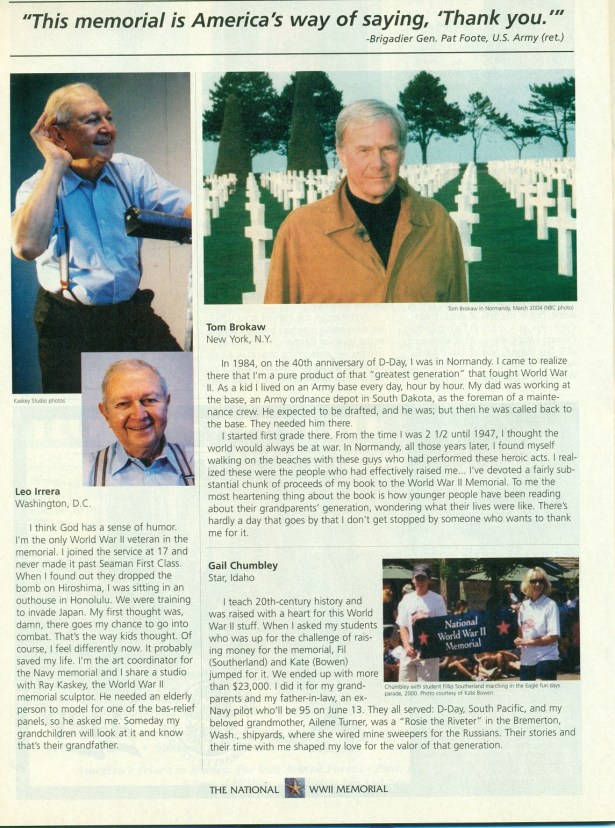
You know, that time the kids and I appeared in the Washington Post Sunday Magazine.
Gail Chumbley is the author of River of January, a memoir. Also available on Kindle.
Look for volume two, “River of January: The Figure Eight,” due out this Fall.
1939
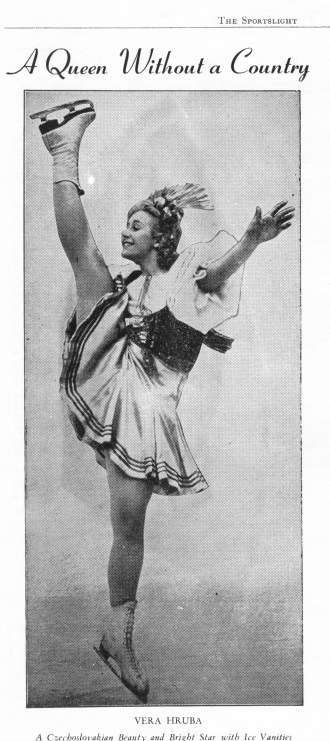
Arms twined around skaters on each side, Helen balanced nervously in the shadows. In V-shape formation, costumed in tall Hussar caps, and military jackets resplendent with gold brocade, the line stood expectantly in the dark. She shivered from a combination of excitement and the frigid draft wafting from the ice. Her ears thudded, inundated by the echoing din from the impatient audience. Much louder than a theater, she absently noted.
Positioned at the apex of the two wings stood Czech Olympian, Vera Hruba—one of three women headliners in the new production. When the last measures of an orchestral stringed overture faded to a close, the house lights darkened, and the arena fell silent for an expectant moment. With a commanding flourish, the opening bars of a military march surged to all corners of the house. Spotlights swept over the glittering skate-line, as Helen pushed off her left foot, in sync with the tempo. Following two more beats, Hruba burst from the crux of the V, and raced the circumference of the rink, spotlights holding tight to her revolutions. The audience roared in appreciation with waves of echoing applause. Helen’s first ice show had begun.
If rehearsals were any gauge, she already felt great confidence in the show’s success. The dance line often lingered along the rail, chatting, stretching—waiting for the director to call them onto the ice. “That’s ViVi-Anne Hulton, she’s Swedish,” Clara Wilkins leaned in whispering, both studying the soloist on the ice. “She’s been skating since she was ten,” Clara nodded, as Hulton executed a perfectly timed waltz jump. “Boy, that little Swedish meatball knows her footwork.” The girls standing nearby murmured in awed agreement.
Chestnut-haired Lois Dworshak sprinted past the attentive chorus line. Helen automatically glanced again at her well-informed friend and Clara didn’t disappoint. “She, Lois there, is a bit of a prodigy. She skated a little as a kid in Minnesota but, actually hasn’t skated professionally all that long. She’s good too, huh?”
“Jeepers, you can say that again,” Helen muttered.
“But, the real story in this cast is Vera Hruba.” This time, May Judels, head line-skater, spoke up from the other side of Eileen. Listening eyes shifted toward May. “Vera met Hitler, just like Sonja Henie did, at the Olympics in Berlin. She finished her freestyle routine, and came in pretty high, I think. Vera didn’t medal or anything, but still skated a pretty good program.
“So what happened?” asked another girl, Margo.
“Hitler says to her, ‘How would you like to skate for the swastika?’ And Vera, (she doesn’t much like Germans), told him she’d rather skate on a swastika!” Heads turned in unison, watching as Hruba completed a flying camel. “So,” May sighed, “to make a long story longer, Vera and her mother left Prague in ’37 as refugees, the Hun’s marched in, and Hitler made a public statement that Vera shouldn’t wear Czech costumes or skate to Czech folk songs. He said Czechoslovakia was gone, never rise again. Vera then responded, publicly rejecting the Fuehrer’s comments, saying she’d always be a Czech, and that Hitler could, in so many words, go fly a kite.”
“Their own little war . . . now that’s guts,” Helen’s eyes returned to center ice. “Makes Henie even more of an apple polisher.”
“A swastika polisher,” Margo corrected, as the director motioned the giggling chorus to center ice.
Gail Chumbley is the author of River of January, also available on Kindle. The second volume, The Figure Eight is due out in September 2016
Late in the school year, by spring break, my history classes had completed their study of the Kennedy years, 1961-1963. We discussed the glamor, the space program, civil rights, his charisma and humor with the press, and most importantly, JFK’s formidable struggle with Soviet leader, Nikita Khrushchev.
In a provocative challenge to America, Khrushchev had ordered the building of the Berlin Wall, and construction of nuclear missile sites in Cuba. This second and more dangerous challenge prompted the 1962 Missile Crisis.
We probed further into the delicate diplomacy that, after 13 days settled that perilous moment peacefully.
For years I closed the unit joking, “aren’t you glad Andrew Jackson wasn’t president?” That line always drew a good laugh.
But really high stakes foreign crises is no longer funny. Not in today’s political climate.
America’s seventh president was a mercurial character. He loved blindly and hated passionately. If convinced his honor had been besmirched, the man dueled—sometimes with pistols, sometimes with knives. It all depended upon his mood.
The provocation behind most of these confrontations touched upon Jackson’s wife, Rachel, who had a complicated past.
A murderer, the author of the Trail of Tears, a plantation and slave holder–Jackson was deadly dangerous.
No financial wizard, he went on to destroy the Second Bank of the United States, the central financial institution of the young country. Old Hickory then deposited the government’s money into pet banks, local private, unregulated concerns across the country. Mismanaged, these banks collapsed, propelling America into one the longest, deepest depressions in American history.
Jackson ignored the Court, and he used the military for his own political gain.
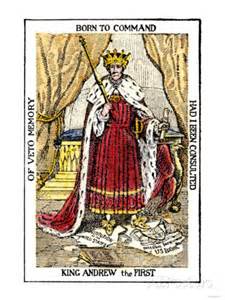
The power King Andrew exercised rivaled the Almighty’s.
So the joke regarding the Cuban Missile Crisis of 1962 resonated with high school juniors. JFK’s skillful restraint in that perilous moment would certainly have resolved differently in the hands of the hotheaded, autocratic, Andrew Jackson.
Again, the joke is no longer funny.
Now America is saddled with an impulsive autocrat whose hunger for authority tramples our time honored liberties. He is attacking our communities, and arresting neighbors for his political gain. Moreover, this petty Napoleon shows little understanding of America’s legal tradition–basic high school history,, or civics. Then there are the ill-advised tariffs playing hell with the economy. Like Andrew Jackson, this current “president” carries himself as another absolute monarch.
The pertinent question this tale raises is this; what could this current, petty president, with little impulse control do in the turmoil of a similar crisis?
Tonight, June 21, 2025 we now know. This cannot end well.
Gail Chumbley is the author of the two-part memoir, “River of January,” and “River of January: Figure Eight.” Chumbley is also the author of three plays set in American history, and co-authored a screenplay based upon her books.


Feeling Alone
New York
1943-44
“Put that thing down, Helen. You’re not listening!” Eileen reached over, and snatched the pencil from her hand. “Let’s go to the show.”
“Hmm? What? A movie? Well, I don’t know. I need to finish this . . . “
“How many letters have you written this week? Honestly, Helen, you can take some time to go to see a film.”
Helen leaned back and stretched; glancing around toward her mother who was busy feeding the baby wiggling in her highchair. “What do you think, B?”
“Go. Go. We’re fine here. I’ll finish this, give her a bath and put her down.”
She turned back to her sister. “Okay, Eileen. What did you have in mind? What’s playing at Loew’s?”
Eileen smiled satisfied, spreading out a newspaper over Helen’s stationary. “Let’s see . . . Journey into Fear? I suppose not. Oh, here, Sahara. Your pal Bogart stars in that one.”
“Aren’t they both war pictures? I don’t know. I need to think about something else, actually anything else, but the war.”
“Song of Bernadette? Jennifer Jones pulls off a couple of slick miracles. That one ring your chimes?”
“Aren’t there any musicals or comedies? I really could use a giggle or two.” Eileen sighed and hunkered down on her elbows, and the sisters scanned the theater section, side by side.
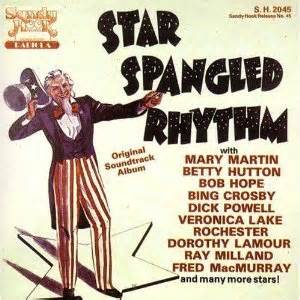
“Here—it’s your lucky day—we have two selections. Girl Crazy with Mickey Rooney, and Star Spangled Rhythm, starring Crosby, Hope, and Betty Hutton.” The older sister turned her face to Helen.
“I like Bing Crosby.”
“Then kiss your baby and grab your purse. In that order,” Eileen smiled, delighted that she convinced her sister to get out of the apartment.
They dashed into the movie house just as the overhead lights dimmed and the red satin curtains opened. A white light flickered and beamed from above the balcony, and the audience applauded. Distinct images filled the screen and the auditorium resounded in rich sound—a Disney cartoon flashed on the screen, “The Three Little Pigs.” Helen had to chuckle when a hand reached from the house of bricks, offering the huffing wolf a bottle of Listerine.
Quickly following, another clip opened in a solemn choral arrangement of Silent Night. Actress Bette Davis, seated before a Christmas tree, presented her children with war bonds as gifts. She kindly reminded them of the American fighting men, sacrificing their lives overseas while the family enjoyed the holiday in safety. Turning directly to the camera, Miss Davis encouraged those in the tiers to buy bonds as a way to win the war. Helen silently vowed to make a purchase in the morning.
United Newsreels boldly lettered the width of the screen, featuring a talon-bearing eagle, and a forceful marching tune. Hungry for actual footage of battlefronts, patrons waited eagerly for news updates. When the subtitle, War News from the Pacific projected, Helen nearly bolted from her seat, Eileen quickly grasping her sister’s arm—a gentle gesture telling her to stay. Reluctantly she viewed thick disarrayed hammocks of destroyed island palms, battle cruisers spinning turret guns toward exotic beaches, and endless rows of stretchers loading onto hospital ships. She felt slightly nauseous. Only her sister’s hand, and a reluctance to make a scene kept Helen seated. Finally, in what felt like forever an upbeat melody commenced and Star Spangled Rhythm splashed before her eyes. Relieved she literally exhaled her pent up anxiety.
“Holy mackerel sis! I thought I would have to tackle you to keep you in your seat.” The two girls hurried through the wet and chilly evening. “You know Chum is just fine, honey. We would be notified right away if anything had happened to him.”
“I’m awfully sorry Tommy. And I do appreciate you taking me out. But I need to get away from the war, not a firsthand eyeful of the Pacific front.” She frowned for a moment, then managed a grateful smile. “I did like the picture, though. Hope and Crosby were a good choice.”
“Good. Stop worrying. You’ll go gray.” The two continued down the sidewalk silently emitting small clouds of breath. Eileen spoke again, “You know we’ve had similar conversations before. Just like this. Walking home from somewhere.”
“I guess we have. But in those days you quizzed me about boys, passing flirtations. I’m honestly concerned about Chum . . . he is my husband. We have a baby.”
“Oh, I understand that, Helen. And I like Chum, too. Unlike Mother, I think you found yourself a good man. But do you ever wonder about the others? About Grant Garrett or Elie? I mean what they’re doing now.”
“Oh, well, yes. Sometimes. I think Grant is his third marriage, and still in Hollywood. He’s done some film work for Paramount, you know, adding jokes to dialog.” She smiled, remembering. “I don’t recall the movie but you could tell the jokes were Grant’s. Something like, ‘did you shoot the victim through anger—no, I shot him through the heart.’” She chuckled. “I think Grant is doing well, for Grant. As for Elie? I simply don’t know what became of him, and that bothers me. The last I heard he lived in Japan, and now the Japanese are fighting us. He might be back in Belgium, but the Germans have taken over. And considering how Hitler feels about Jews—yellow stars, camps, poor Elie has it coming at him either place.”
“Oh Helen. You’re right! That hadn’t occurred to me. Either place, he is in a mighty dangerous situation. Gosh, I hope he makes it through the war . . . if this war ever ends.”
“I worry, too. And I feel pretty guilty about how things ended with him. Not that I think lousing things up with Elie put him in danger. But we ended on bad terms, I had met Chum, and we were engaged. Still I hope he and his family are safe.”
Gail Chumbley is the author of River of January, and sequel, River of January; The Figure Eight..
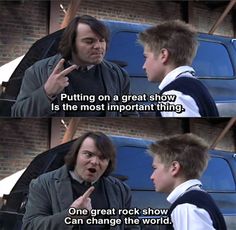
“A politician looks forward to the next election cycle, while a statesman looks forward to the next generation.” This admirable sentiment has been attributed to a number of speakers including Thomas Jefferson and the 19th Century Reverend James Freeman Clarke. But I heard the quote attached to President Gerald Ford. Whoever uttered these words has my full endorsement.
This morning began well. I awoke from a dream-filled sleep of taking roll, presenting lessons, and interacting with my students. They were all mixed up, hailing from a multitude of graduating classes, but still they were all my kids. I knew them well. In point of fact, most of my nights pass in a flowing narrative of teacher dreams, and I’ve gotten fairly used to this regular occurrence. The joke since retiring is, “I work so hard at night I should still be on the payroll.”
At any rate, after waking up, my mood remained jovial, still dialed in to happy. Tapping on my iPhone a picture appeared of a former student, now in a military uniform singing with three other soldiers. He and his brothers-in-arms were performing a rendition of the National Anthem at a public event. In another post a young lady, newly attending college revealed her fears about losing interest in reading for pleasure—a concern she happily resolved by opening a new book. Scrolling down the wall a bit, a wonderful family picture appeared of one of the kindest student’s I’ve had the pleasure to know. She posed before a Christmas tree with her three little boys, the youngest only two months old. Her husband’s caption clearly revealed his love for her and his boys. These posts are just, well, just so cool!
Not all teaching reminders and memories are as bright as those that I experienced this morning. Still, I wouldn’t have missed my time with these young people for a king’s ransom. Magic occurred in those classrooms; pure joy a guaranteed bi-product of the learning process.
I discovered over the years, that basic to the art of teaching and learning, is a faith in the future, a tangible something waiting ahead for every individual—a realized dream. All the hours of classroom preparation devoted to listening and thinking skills, observation, and problem-solving, were simply a training ground for young people to eventually find their place in the larger world.
While grappling with today’s incessant demands, it is far too easy to gloss over thoughts of the future. Caught up in the crowded moments that make up the present, many lose sight of the certainty of tomorrow. Teachers, however, are not permitted the luxury of settling in the moment. We must skip ahead of the “now,” planning and adjusting, then planning further. Intrinsic to our professional calling is the absolute assurance of a looming future, and we have to get our kids ready.
Perhaps stake holders could gain some perspective by casting aside trivial, momentary agendas—the noisy culture wars taking place across media battlegrounds, jousting in never ending finger pointing. Those distractions impede the progress available to our students, who are rapidly passing through the system. These kids are here today and gone tomorrow, quite literally.
When I assessed my students in class, I often envisioned them as adults, figuring out their individual niche. With that objective as my guide, I tried to design the best methods available to reach practical benchmarks. Even so, in the end, I had to let each class move on, a natural continuation forward to meet their futures, hopefully carrying my small contribution. An act of faith.
With our eyes vigilantly fixed on the countless tomorrows yet to come, would teachers be considered President Ford’s definition of statesmen? I’d like to think so.
Gail Chumbley is a retired educator and author of River of January. Also available on Kindle. Watch for “River of January: Figure Eight” this Fall.
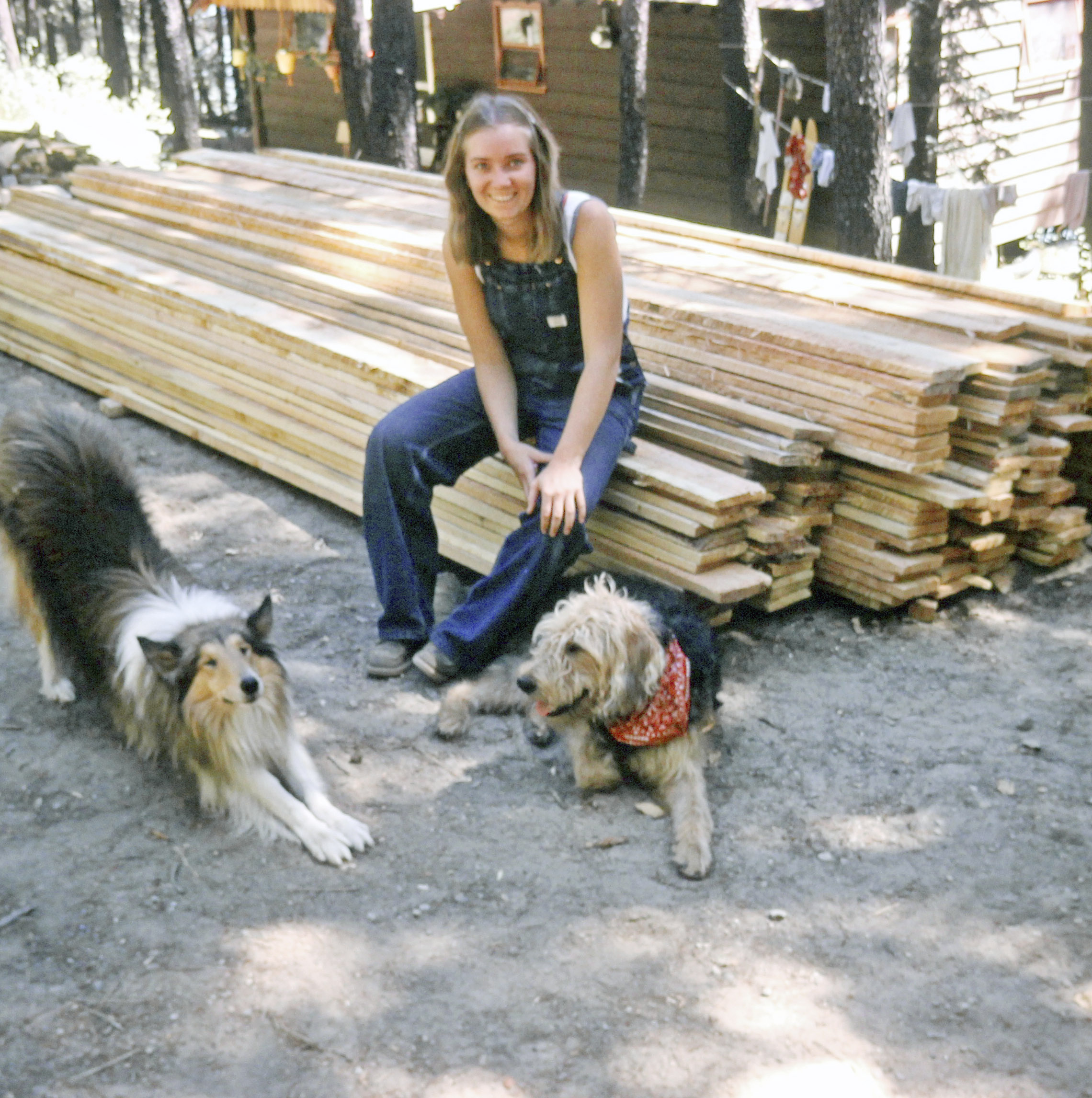
We had two cabins on a small lake in Northern Idaho.
Located between Lake Coeur de Alene, and the Pend Oreille, our little acre overlooked tiny Cocolalla, with large windows where we could watch the waves lap up on the beach. The original structure we astutely named the Little Cabin, later followed by the larger Big Cabin. This bigger cottage had been built with all the amenities of home; running water–hot and cold, a tub and toilet, a full kitchen, and electric heat.
Those early weekends in the Little Cabin hold many good memories. All of us crammed into that tiny wood box, the unfinished walls festooned with a lifetime of greeting cards, a big enameled wood stove, and a porcelain basin for washing dishes. Grandpa got his hands on a tall steel milk can and commandeered it for enough drinking water to get us through the weekend. As for entertainment, Grandma had an old radio that blasted the most impressive static, interspersed with Roy Orbison or Andy Williams fading in and out.
Once the Big Cabin was completed and my grandparents moved in, the smaller cabin was demoted to storage. It also housed a set of bunk beds, a fold-down couch, and one double bed; useful for my brothers who were just getting bigger. Now, in addition to greeting cards, the cabin stored every variety of water equipment. Fishing poles, life jackets, oars, and an outboard motor clamped to a metal barrel, with stacks of beach towels the size of blankets.
As I recall, a constant grit of sand coated the linoleum floor.
The property was my grandparents retirement dream, but a dream they happily shared with the rest of us. I knew, even then, that I was always welcome, always.
My grandpa was an early riser, a product of a lifetime as a mailman. He didn’t want to tiptoe around a little kid sleeping on his sofa at five in the morning. At bedtime my grandmother and I made our way to the Little Cabin in the dark by flashlight. Under the covers of the double bed, I would chafe my feet deep under the sheets to warm my toes. As we grew settled and peaceful she would begin to reminisce, talking to me for hours in that darkness. I learned of her life in those moments, warm in that cozy bed, listening to her voice, breathing the scent of the evergreen forest.
She told me of my biological grandfather, her first husband, who had left her bereft and penniless after my mother had been born. Despite the Depression, he liked to gamble away their money. My Grandma had to leave him and she struggled to find work as few jobs existed. Forced to farm out her daughter, my mother, in various homes, her the guilt still haunted her. Clearly it still broke Grandma’s heart that she was forced to separate from her little girl for months at a time. I could hear a wound that could never heal.
As the night grew deep, crickets and bullfrogs began to chorus. Flanked next to her, and pressed against some greeting cards, I prayed I wouldn’t spoil the magic by having to go potty. She kept, beneath the bed, a Chase and Sanborn coffee can that I hated to use. It felt cold and left rings on my little bottom. Still, considering options, the can was more appealing than a journey to the outhouse. Using that creepy outhouse in the daytime was bad enough, but at night unthinkable.
Finally poking her lightly, I would tell her. And she never hesitated. Showing no impatience at all, Grandma seemed to make my problem her own, reaching for the flashlight and finding that rusty can. She held the light on me so I could aim properly, then back into the warm bed. No recriminations.
She loved me.
I loved her.
Today my husband and I live in the woods. We don’t have a lake, but a river runs near and we can hear it on very quiet nights. I relax in my cozy bed in the darkness and listen to the crickets and bullfrogs, while breathing in a scent of pine. A sense of complete security, of love, of acceptance returns, synonymous with the love of my grandmother. She was home for me, and though gone these many years, my mountain cabin still echoes with her voice.
Gail Chumbley is the author of the two-part memoir “River of January,” and “River of January: Figure Eight.” Both are available at http://www.river-of-january.com and on Kindle.
gailchumbley@gmail.com
No doubt that one of the primary reasons I retired was burn out. I had worked in secondary classrooms the length of my adult life and struggled the last couple years largely due to growing political pressure. You see, I bought into the idea that hard work paid off and came to realize that I was dead wrong. My hard work didn’t matter. None of my colleagues hard work mattered. My student performance outcomes, though well above the national average didn’t matter. Nothing moved policy makers except that they could hire two new teachers for the price of me, and many of my fellow staffers.
When the mortgage market imploded in 2008, Southwestern Idaho flat-lined economically. While teachers, such as myself, fought draconian budget cuts the legislature didn’t listen. They didn’t care. The brutal impact on classroom numbers and lack of materials made no difference, their ears were closed. In fact, the Great Recession instead provided an opportunity to attack our union and kill protections such as negotiations, due process, and arbitration rights. I found that regardless of my expertise and my kids remarkable growth I was handed more students in class (220 every other day) and less time to teach (down 25% a week).
When I realized I could swing retirement I took it.
I worry about what is behind me in public classrooms. There are enormously bright kids out there begging to be challenged. These young people are smart, but need skills and information to develop their optimum potential. However, as long as law makers settle for cheap, keeping salaries spartan, and classrooms packed, I cannot see America preparing for the future. The results will reflect the dismal investment.
In my state the Superintendent of Education denied that teachers were leaving education due to the perceived oppression from the legislature. And he can tell himself and the entire House and Senate that tale. It’s just not true. Teachers want to succeed, aspire to excellence, wish to see achievement among their students. That is why the miserly funding and lack of support by policy makers has had such a negative impact. No one wants to go into a job already set up to fail.
Teaching as a profession shouldn’t be done at such personal sacrifice.
The following was written in August, 2010
Our days crawled by slowly, his recovery measured in increments. Transferred from the ICU one day earlier, a new face appeared in his hospital room, a physical therapist. With a breezy air he introduced himself, shook my hand then turned toward Chad. He fulfilled his efficient entrance in one smooth motion.
Medical people no longer inspired reverence for Chad. He had become weary of the abysmally slow institutional routine, the new faces everyday. Still despite his disillusion he was never rude to any of the medical staff, but I received a good run down when we were alone.
This particular therapist seemed to have arrived with a plan to rebuild my husband’s ravaged, broken body and depleted endurance. The regimen, the PT announced would start by having Chad sit up in a chair for five minutes. And though that sounded harmless enough it quickly became one of the trials of Hercules. With the help of the nurse, they diverted or unhooked the multitude of attachments to Chad’s body, now including pressure socks to prevent blood clots. The two then hoisted his body to a chair by the bed. Though bobbled around, he said nothing while the two stuffed and padded blankets around him like a newborn. Once he seemed balanced, the PT and nurse left. They left.
Five minutes can be a very long time in certain situations. The last five minutes in class. The last five minutes in a dryer cycle. At this particular moment my husband immediately began to sweat, and fretted that he would faint if he didn’t lay down. I scrutinized his movement with the vigilance of a gymnastic spotter, ready to catch him if he toppled.
Wasted muscle covered by white hosiery was all that remained of his legs, his exhausted head bowed in agonizing surrender begging me to help him back into bed. Where was the therapist? Why didn’t he stay?
I waited, searching for words of encouragement, but growing equally anxious. Poor Chad grew visibly physically anguished, swaying forward. Still no therapist.
“I can’t sit like this any longer,” he wailed. Panicked, I resolved that if the PT didn’t come back in sixty seconds, one minute, I would press the button for the nurse. I slowly began to reach over to the bed, for the call button pinned to his sheets. And that was when the therapist materialized, sweeping briskly into the room followed by the nurse.
“How did that go?” he inquired brightly. We didn’t answer, as he swiftly bent over Chad,to assess his condition.
“That was five minutes?” Chad gasped. “Seemed longer.”
“He didn’t do so well,” I added, feeling it my duty to tell the truth. The therapist and nurse didn’t reply as they hoisted him back to bed.
He then spoke up. “Well, the doctor wants him up to fifteen minutes before the hospital can release him.”
With that, the two blew out of the room, on to other matters, other patients.
Neither of us spoke. After a few moments Chad drifted back to sleep, lightly snoring. I stared ahead, drained.
Gail Chumbley is the author of the two-part memoir “River of January,” and “River of January: Figure Eight.” Both books are available at http://www.river-of-january.com, and on Kindle.
gailchumbley@gmail.com

