Mischlinge

When Mexico sends its people, they’re not sending their best. They’re not sending you. They’re not sending you. They’re sending people that have lots of problems, and they’re bringing those problems with us. They’re bringing drugs. They’re bringing crime. They’re rapists. DJT, June 15, 2015

Government-sponsored horrors aimed at the vulnerable require planning. The target group is first identified, their deficiencies propagandized, then malignant operations begin to remove that group. This age old pattern is a how-to for witch-hunts from 1692 Salem, to Native American extermination, to slavery, and to Joe McCarthy in the 1950’s Red Scare. Other examples in history abound as well, most notoriously the rise of German National Socialism following World War One.

Embittered by the 1918 Armistice, former Corporal Adolf Hitler founded his National Socialist movement in Bavaria. After organizing two para-military gangs, the Brown Shirts and Black Shirts, he led a failed coup attempt in 1923 Munich. This act of revolt landed him in jail, where he penned his infamous tract “Mein Kampf.” The substance of the book raked over grievances, particularly against Jewish people and other “so-called” betrayers of Germany. Hitler was clear in his writing, only genocide would root out Germany’s traitors.

Granted an early parole by a sympathetic judge Hitler quickly resumed leadership of his growing Nazi movement. By January, 1933 he had attained power as Chancellor under German President Paul von Hindenburg. Hitler efficiently made use of his expanding influence in the Reichstag, (German Parliament) to fulfill his unholy mission. Taking incremental steps the Nazi leader began with boycotts of Jewish businesses, then removal of Jewish and other undesirables from employment as civil servants. Soon Jewish students were forced from public schools, permitting only a small quota each year to enroll. By May of 1933 Hitler ordered book burnings of Jewish authors and others he viewed as subversive.

Events accelerated.

When President von Hindenburg died in 1934, Adolf Hitler seized absolute power over Germany. And he wasted no time in dialing up the violence against people he considered vile.

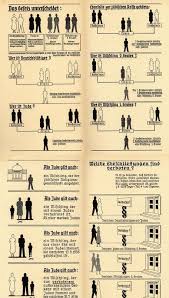
At a 1935 Nazi Party rally in Nuremberg the Fuhrer issued formal classifications of who was Aryan (pure German) and who was Jewish. Known as the Nuremberg Laws, marriages in particular were outlawed between Jewish and Aryan couples. The image above is one document reflecting that Nazi framework, outlining which marriages were permitted by the state and those “verboten” (forbidden).

Hitler insisted these laws were necessary to protect German blood, but the laws also served to isolate not only Jews, but Gypsies, Homosexuals, Jehovah Witnesses, and others. In truth one man defined which human lives were valuable, and those that were expendable.

The ground was prepared for the genocide that would follow.

Dachau was the first extermination camp built in 1933. From that beginning until 1945 the railcars rumbled nonstop to thousands of ash-strewn death camps, while Hitler’s SS liquidated Jewish ghettos of thousands of men, women, and children. By May of 1945 somewhere around 11 million victims perished in a region historians refer to as the “Bloodlands,” including 6 million Jews.

Euphemistically referred to as Racial Hygiene, the Holocaust unfolded gradually and in relative secrecy. However, by the end of the European war and Germany’s defeat the world wondered how this horror could have happened.

We are watching how at this moment.

In Trump’s America that pattern is repeating. The founding of the United States according to Thomas Jefferson insisted that people are born with natural rights, life, liberty, and the pursuit of happiness. But from the George Floyd murder to Trump publicly announcing brown people traffic drugs and are rapists, that assumption has been ignored. This administration has taken racial profiling to a criminal level, as this tyrant harnesses the might of the federal government to carry out warrantless abductions.

Even if American citizens are caught up in sweeps, many insist that this is different, and that those taken deserve it. The pieces of evil are all there.

Racial exceptionalism has been the cause of mass suffering from the Armenian genocide in World War One, to Cambodia’s killing fields in the late 1970’s. The signs are all too familiar.

Trump’s makes no pretense of his intentions stating on 60 Minutes that his ICE goons haven’t gone far enough in terrorizing and kidnapping civilians. The sanctioned ongoing violation of civil and human rights has been grinding away as you’ve read this essay.

The United States was meant to be different–a land with freedom from fear, where people are secure in their places and property. This tradition does not rely on one man’s racism and deliberate cruelty. A cautionary tale is replaying, and we cannot escape that past, nor avoid the sinister outcome.

Mischlinge was used by the Nazi’s as a derogatory legal term. Literally mischlinge means mongrel, a person of mixed blood.

Gail Chumbley is the author of the two-part memoir “River of January,” and “River of January: Figure Eight,” co-writer of the screenplay, “Dancing On Air” based on those books. She has penned three stage plays on history topics, “Clay” on the life of Senator Henry Clay, “Wolf By The Ears” examining the beginnings of American slavery, and “Peer Review” where 47 is confronted by specters of four past presidents.

An Open Letter to the GOP

A great deal of chaos has been unleashed in the last 8 months of Republican rule. The leader of the party, Mr. Trump has harnessed the federal system to pursue interests that are exclusively his own. More concerned for opportunities to line his own pockets, leveraging executive power for revenge, and concealing criminal records that compromise his interests appear to take priority. This behavior is not surprising as creating turmoil is Trump’s signature move, evidenced through his trail of bankruptcies, and fraud, to the tune of 88 indictments and 34 convictions.

He is a rapist. 

That is the net sum of the party’s leader.

Perhaps you find solace in arguing Trump was the choice of the people, and since the electoral tilt leaned Republican, you tell yourselves his crimes are irrelevant. By extension, the destruction of law does not bother his base, so why should it bother GOP legislators? 

Because you know better, that’s why. 

The harm? Willfully ignoring that criminality and sanctioning Trump to whip about like an inflatable tube man, deconstructing America’s blueprint of government as he pleases. Perhaps you actually believed him when he said he could shoot someone on Fifth Avenue and get away with it. Your indifference, or fear of being primary-ed seems to say yes, the party would condone even that.

It isn’t possible you are criminal by nature, surely a desire to serve guided your decision to run for public office, but Trump is a criminal by nature. Yet, the GOP remains on the sidelines rather than insist on transparency to the media or your constituents. This reticence to defend the indefensible speaks of a consciousness of guilt. As handmaidens to Trump, the party is nothing more than accomplices in an ongoing crime spree. 

And those offenses are many. Flagrant. Abuse of power, violation of the emoluments clause, retaliation against his perceived enemies leading to groundless lawsuits, not to forget stealing national intelligence. 

America and the world are witnessing a national smash and grab.

The party is in possession of all three branches of government and yet your stewardship has only made the rich richer, the poor more desperate, the middle class squeezed, and now has closed the United States down. THE UNITED STATES. “The City on the Hill, The World’s Last Best Hope,” We the People,” all closed for business because you have submitted utterly to a remorseless predator.

Soon Trump will have no use for Congress. In Trump-world only one counts and it isn’t any of you, or the rest of us for that matter. The Legislative Branch will atrophy, a fate to which the Supreme Court has already succumbed.

But how about this alternative? What if members were to stand up and vow no more free passes for Trump? Get out there in front of the cameras and announce “I was sent to Congress to do the work of the people, not one man.” Instead of letting him seize ultimate power, you instead take a stand and seize history? 

If any Republican member of Congress who, at this moment, demonstrated the courage of a Jeff Flake, or a Liz Cheney you could break this fever, and save America a lot of suffering. Dear Congressmen and Senators, imagine it, you would prove a honest profile in courage. 

Gail Chumbley is the author of the two-part memoir “River of January,” and “River of January: Figure Eight,” co-writer of the screenplay, “Dancing On Air” based on those books. She has penned three stage plays on history topics, “Clay” on the life of Senator Henry Clay, “Wolf By The Ears” examining the beginnings of American slavery, and “Peer Review” where 47 is confronted by specters of four past presidents.

American Expatriates and Celebrities

In the long history of the world, only a few generations have been granted the role of defending freedom in its hour of maximum danger. I do not shrink from this responsibility–I welcome it.  John F Kennedy, 1961

To American expatriates abroad and celebrities remaining at home,

Armed with your fame and recognizable voice all of you hold a public leadership role whether you choose to have one or not. Brave, out-spoken spokesmen for Democracy are a bit short on the ground and America needs her sons and daughters to rise up in defense. 

No one runs us out of our home.

This is not a normal time, nothing about this administration is normal and leaving the country or remaining silent sends a message of throwing in the towel. You are abandoning the rest of us to hold the frontlines the best we can, but your face and words are needed. Too many in the press, in politics, and in the sports world are caving to accept this unacceptable lout out of fear or resignation. That behavior must end.

Charlie Chaplin, Adolph Zukor, and Douglas Fairbanks Jr  sold war bonds during the First World War, Gable and Stewart enlisted in the service to fight Nazi tyranny. Carole Lombard lost her life in a plane crash after raising $2 million dollars for the war effort. You owe it to Dalton Trumbo, Ring Lardner and those of The Hollywood Ten who stood fast for freedom when caught in the fear of America’s Red Scare. Lena Horne, Pete Seeger and Zero Mostel, among others, faced blacklisting through the perilous period of McCarthyism. This is exactly the same ‘once in a generation’ moment testing our commitment to our democratic principles.

Leaving the country or remaining silent sends the terrible message of surrender. And leaving is selfish. Giving up on resistance essentially says to hell with the United States. This is the time when we need you most to stand tall. Liz Cheney hasn’t cut and run, nor has Adam Kinzinger. And he hates them the most because they know he’s an absurd phony. They also know they will never give up on America and neither should you. 

Now that is a valiant example of patriotism. We can do no less.

Those of the future are depending on all of us to make this perilous moment right and to pass on an unsoiled America for generations to come. Moreover, our posterity will learn who stood fast in this momentary struggle for liberty and those who abandoned America in its time of need.

This is merely one chapter in the story of America and we are still a young nation. The United States is founded upon the will of the people and this administration is not your will or mine. Today’s corrupt collaborators who have prostituted our republic for momentary gain will fall by the wayside. These sycophants will share this wannabe dictator’s fate.

And that petty bag of stupid will fail, it is in his DNA. That’s what he’s always done. And there will be a lot of rebuilding ahead of us and your encouraging presence will be critical. No one runs us out of our country, nor do we forsake our duty in time of America’s need. We are not a servile people and do not bow down to anyone. Our rights according to Mr. Jefferson are derived by our Creator, and no one man can take them away. 

America has come so far in realizing A More Perfect Union. The expansion of the vote, black males, women, white and black, Native Americans, and for 18-year-olds. Other gains include people with disabilities, women in the military, reproductive rights, marriage equality, and the election of America’s first black President. And all of us at home have witnessed much of this affirming progress.

So come home, we really need you in our time of peril. We need your voice, your humor, music and the public demonstration of your persistence. That goes for the rest of you with a public profile. You are still here, and we need you to step up. Do not be afraid. Stand fast and speak truth to power.

Be loud. 

Gail Chumbley is the author of the two part memoir River of January, and River of January: Figure Eight. She has also authored three stage plays, Clay, Wolf By The Ears, and Peer Review. Chumbley is the co-writer of Dancing On Air a screenplay based on her River books.

A Useful Myth

Arguing for the goodness of his vast wealth, Andrew Carnegie, in 1889 proffered society is all the better for the existence of the rich. He stated that God had given him the talent to make money, and he would use his God-given talent to it’s full extent. This steel baron continued that the prosperity of the few, like himself, lifts the standard of living for all citizens. Shorthand for his philosophy, let the rich get richer because it’s good for everybody.

Economist and social critic Henry George took issue with Carnegie’s premise. In rebuttal George insisted that in no way did concentrated wealth help anyone except the rich. Carnegie’s Gospel of Wealth was in fact a myth, and useful one for oppressing the lower classes. Where Carnegie argued the betterment of people, George countered a wedge had been forced through society, crushing the poor into oblivion. 

In our time Carnegie’s argument has permeated American culture, and has matastasized so deeply in our belief system, that the super rich are nearly worshipped. Today’s robber barons, Bezsos, Zuckerberg, Musk, Gates, and others are perceived as superior, breathing the rare air of the most blessed. These characters are untouchable.

In the tradition of Henry George the reality is something quite different. According to psychologists the super wealthy share strikingly similar characteristics. Obsession with money drives these individuals. Making money, keeping money, and making more money is an obsession. Appearances are everything and must be maintained at all times. The exhaustive race for money and rank distorts moral judgement, compassion, and empathy. Screwing others over is part of the game.

Another characteristic shared by the ultra rich is confidence and a capacity for risk, however I would argue that also describes gang leaders and con men. Most compelling is that these individuals are no happier for their efforts.

Like Henry George our culture needs to dispense with the idea of moral superiority among the wealthiest. God did not make these men rich no more than God make drunks drunks, and druggies, druggies. This is obsessive-compulsive behavior and should be seen as such.

As to charitable work among this crowd, remember the Sacklers made OxyContin, a ton of money, leading to thousands of American deaths, while donating millions to museums and universities. Clearly vast wealth does not require a moral compass, nor help the most vulnerable among us.

The Presbyterian in Scotland-born Carnegie knew his justification ran counter to his childhood faith. From the First Commandment’s “Thou shall have no other gods before me,” to Jesus’ “Verily I say unto you it is hard for a rich man to enter the kingdom of heaven. This steel man betrayed and countered the tenets of his youth, creating the false god of money.

And Americans have been devout followers ever since.

Gail Chumbley is the author of the two part memoir River of January, and River of January: Figure Eight. She has also authored three stage plays, Clay, Wolf By The Ears, and Peer Review. Chumbley is the co-writer of Dancing On Air a screenplay based on her River books.

Peer Review Excerpt 2

This post comes from a full stage play titled Peer Review. It was composed during DJT’s first term and serves to illuminate the contrast to earlier presidencies.

SCENE TWO

The stage lightens in a mix of gold and white. A bed and two arm chairs made in the same colors sit center stage, The New York City skyline is projected on the back curtain. The sound of papparazzi and cameras snapping is heard offstage. An elevator dings. After a moment the President enters stage right with two men in suits wearing earpieces. The men walk around the area and bed. The President turns and speaks.

THE PRESIDENT
Call maintenance, that damn elevator shouldn’t stall between floors. That was a good ten minutes, dammit. I’m gone a few weeks and the building goes to hell. There’s nothing in here. Get out.

The men exit. The President removes his jacket, and walks to the dresser. He peers down in a drawer, then finds what he is looking for. A file of yellow and red.

Except this little gem and it’s really something.

He lies on the bed reading and chuckles happily. His cell phone plays “Hail To The Chief.” The President answers.

Where are you? I just got here, great crowd outside. Yeah, I’ll get it done. Hey, I said I’d do it. What do you mean you don’t trust me? Give me a break, That whole Stormy Daniels garbage is . . . No. Don’t hang up. We’ll sit down with the lawyers and renegotiate the whole deal. But then you will join me in DC, and the boy, too. This staying in New York is no good, makes me look bad to the country. Yeah, yeah, I’ll get Reince on it today. Hey, I said I will.

He tosses the phone on the bed and resumes reading.
Huh. Erdogan didn’t tell me this. How does the CIA find this crap out? I need some Putin-Ukraine stuff. Who woul’da thought I’d read something?

He chuckles, and soon grows sleepy. The President drops the open file and closes his eyes. After a moment a spot rises on a figure entering the stage.

He is tall, wearing a 18th Century blue and buff military uniform, knee breeches, white stockings and carries a sheathed saber. His white hair is combed back, and tied with a black ribbon at the nape of his neck. Standing near the bed, he speaks slowly with elegance.

THE GENERAL
I am very fond of New York City. During the War for Independence I maintained camp nearby for much of the duration.

The President sits upright, and reaches for a pillow to shield himself. He squeaks.

THE PRESIDENT

Shit!

THE GENERAL
Congress had directed me to burn Manhattan ahead of invading British Regulars. You see, Congress wished to leave nothing of use for the Redcoats. Destroying the city left me conflicted, and alas, that order I could not obey. As fate would have it, a fire did erupt in the chaos, demolishing vast tracts of the city. A very regrettable situation.

The General poses regally, glancing at the president. He continues.

Sometime later I returned to serve as President here in New York.

He gestures with his saber to the skyline.

Concerning the demands made upon me as I served those first critical years, none resolved easily, nor without great cost. But our fledgling nation teetered on dissolution and we, as the first government under new Constitution, had to stand resolute.

The President lowers his pillow to speak in a forced, but faltering menacing tone.

THE PRESIDENT
I don’t know who you are, or how you got in here, but this is my room, and my 30,000 square foot apartment, in my extremely valuable building. So clear out!

The General appears not to hear, serenely seating himself in an arm chair. He levels his gaze at The President.

THE GENERAL
My colleague said you were tiresome, however, I am staying.

THE PRESIDENT
Who said that? What colleague . . .oh, jeez, him. Well I’m important NOW. So you and that other fossil can beat it back to central casting.

THE GENERAL (Untroubled)

I, too struggled with grandiosity. In my youth I pined for the advantages of wealth and status that surrounded me. Stately mansions dotted the inlets and vast river systems of Tidewater Virginia, the place of my birth. I longed for a life of importance, gentility, and of wealth. I would be an English gentleman residing in elegance upon his landed estate.

THE PRESIDENT
The English are wusses, and you’ve blah blah’d enough. I’m in New York to get away from all that history garbage. That old dump where I have to stay is filled with that crap. So goodbye Rambo.

The General waits, then rises and un-sheaths his blade. The President again grasps his pillow. The General resumes his story.

THE GENERAL
Born the first son of a second family, I fell heir to nothing but my father’s name. Augustine and Lawrence, my older brothers, received all the honors of a gentleman’s life. I loved them, idolized them, especially dear Lawrence, and begrudged him nothing of his inheritance. However, I cannot deny the depth of my anguish as a second class Virginian.

THE PRESIDENT (To himself)

When my Father died I stuck it to my brother. He couldn’t handle money, the guy was a drunk.

THE GENERAL
Another temptation concerned a young matron, the wife of my best friend. Sally was her name, and I loved her very much. Our correspondence, especially while I served in the war against the French was perhaps too forward, and flirtatious. I longed for Sally, but she was not, nor ever could be mine.

The General sighs, deep in thought.

THE PRESIDENT
I never let any marriage license stop me. Mine or any available broad. That’s all they’re good for, arm candy and a roll.

THE GENERAL
We are all too aware of your misogyny, and absence of propriety. Even Mr. Kennedy said he attempted more discretion in his dalliances. I’m reminded of a letter from the Marquis de Lafayette informing me of his wife’s passion for me. Amused, I replied youthful women are inclined to youthful men, not those of graying hair. And still it is so.

The president sits up with his pillow on his lap.

THE PRESIDENT
Younger women love me. They really do. I’ve dated some beauties, too. You should see some of the pageant contestants I’ve bagged-and Playboy bunnies, too.

From the wing a soldier in Continental uniform approaches the General handing him a dispatch. The General reads the parchment, and marks it with a quill pen. The soldier leaves.

THE GENERAL
Sir, I do not believe ‘love’ is quite the term for what you’re describing. unbridled debauchery perhaps is more precise?

THE PRESIDENT

What the hell? How did he . . .?

THE GENERAL
It is the disciplined man who owns his passions. Decorum is what separates us from animals, wouldn’t you agree?

The president sits mouth agape at the soldier. The General continues.

THE GENERAL
Elegant balls were quite popular venues for young people to meet. I don’t mind saying that I may have been one of the finer dancers in the Tidewater. Those evenings were grand; dinners, music, and refinement in abundance. Oh, how I yearned to rise in social rank.

THE PRESIDENT
I hear ya. Those Manhattan snobs, that artsy-fartsy Met crowd, boxed me out. Treat my kids that way, too. Jerks.

THE GENERAL
Envy did little to further my integrity as a gentleman. In the war against the French the royal governor entrusted me to offer land patents to volunteers willing to join the Virginia militia. Over the course of the conflict I made many of those acres my own. You see land was the mark of a gentleman, but I was an imposter. That villainy has troubled me for an eternity. I pray my service to my nation has polished away some of the tarnish.

THE PRESIDENT
Don’t sweat it, business is business. Regulations are a pain in the ass. If you have an opening take it. Never hesitate. I’d a done the same thing.

The soldier-courier again appears on stage carrying more documents and a feather pen. The general agains peruses the contents, and marks the paper. The president raises his hands in a questioning gesture. The courier disappears.

THE PRESIDENT
There is a squadron of Secret Service out in that living room! How does that guy just walk in here?

THE GENERAL
Colonel Hamilton? He is a very clever young man. A great mind, that one. (Pauses) I disagree with your assessment of regulations. Had it not been for the rigor used to organize the army, particularly at Valley Forge, America would not exist. Good order was the key to eventual victory.

THE PRESIDENT
But you were the boss, right? You made the rules. Everyone I brought in has stabbed me in the back, didn’t follow my rules. Bunch of lowlife. Tillerson, Bolton, Mulvaney.

THE GENERAL
Perhaps those staff members possessed standards and realized you were not a leader worth following.

The president stands up outraged, the general stares him back down.

THE GENERAL
Those of my staff earned positions through merit. Tallmadge, Knox, and Hamilton, here, were gentlemen I trusted with my life. The hangers-on, the men who conspired for my command eventually revealed their ineptitude, and villainy. Those characters fell by the wayside.

THE PRESIDENT
A lot of people don’t realize this, but I don’t know American history. How did you win that war?

THE GENERAL
I never confronted the Regulars unless I had an advantage, like at Trenton, though I detested avoiding any fight. (Pauses) I kept the Continental Army together, and out of British hands. I knew the King could not fight forever. And I knew history was watching our every move, and we owed the future to never give up.

THE PRESIDENT
What the hell does that even mean? History watching! I could care less what happened before me, or when I go out.

THE GENERAL
And I am sorry for that, as will be your grandchildren. The family name is disgraced for all time. The rest of us, those whom I am representing, all understand this. Each chief executive found inspiration in taking part in something greater than ourselves. This, (he gestures toward the window) the United States of America has never been attempted before, a people’s government. The world is housed with predictable despots stealing from, and brutalizing the powerless.

THE PRESIDENT
Oh, come on, give me a break, everybody cheats and steals. Especially here in America.

THE GENERAL
Indeed. But we try to be better. We all have tried. President Chester Arthur felt you ought to know that he, too, served the monied interest. But once president, Mr. Arthur left the grift behind. Like the rest of us he found humility understanding all citizens, for all time would weigh his executive stewardship. He treasured America more than money and power.

The president slumps into a chair. He jabs a finger at the general, changes his mind and lowers his hand.

THE PRESIDENT
I didn’t take a salary. My people liked that, makes me look like a good guy.

THE GENERAL
All the while, behind the scenes, you pilfer on a grand scale. (The General glares) The Continental Army did not suffer want and cold at Valley Forge and Morristown for you to overcharge the federal government for lodging Secret Service at your resorts. Nor did they starve so guests at your Washington hotel could be egregiously overcharged.

The general continues to glare for a long moment and slowly cools down.

THE GENERAL
After Yorktown, and the surrender of Lord Cornwallis, hostilities slowly began to quiet. Royal ships, loaded with Redcoats set sail for England and our land stood liberated. Many difficulties remained such as discharging soldiers, and securing their long overdue pay for services nobly rendered.

The general again looks out at the New York skyline.

THE GENERAL
Word arrived that officers, also unpaid, had set into motion a plot to overthrow the slow-moving Congress and make me king. The ring leaders, encamped north of here in Newburg, awaited my arrival to complete the conspiracy.

THE PRESIDENT

King, huh? I like the sound of that.

THE GENERAL
As I had hoped the plot came to nothing, and that is when I resigned my commission and returned home to Mount Vernon.

THE PRESIDENT
Resigned? Went home! What is wrong with you? You had the whole deal on a plate!

THE GENERAL
Why? Because I am an American. We have no need of kings here, and I longed for home, longed for my wife and family. I’d been away for seven years and I yearned for my farm.

THE PRESIDENT
You could’a had the whole country at your feet and you went home to your farm? Gave up power for cowpies and dirt?

THE GENERAL
“’Tis not in mortals to command success. But we’ll do more, Sempronius, we’ll deserve it. When vice prevails, and impious men bear sway, the post of honor is a private station.”

The general sits down on the edge of the bed. The president, in his bed again clutches his pillow closer.

THE GENERAL
It’s a quote from my favorite stage play, Addison’s “Cato.” As Julius Caesar amassed growing power in the Roman empire, Cato the Younger, a lover of Republican virtue, stood in opposition to Caesar’s tyrannical grasp. When Cato could not accept life under extravagance and corruption he took his own life rather than submit to depravity.

The president stifles a yawn, shakes his head to clear it then speaks.

THE PRESIDENT

I liked the musical, “Cats.”

THE GENERAL
This work had a deep impact upon me and upon my generation. Patrick Henry’s “Give me liberty” quote reflects lines from the play, as does poor Nathan Hale’s last words regretting to have “only one life to give for his country.” During our miserable winter camp at Valley Forge I saw to it the play was performed for the men. We too, were confronting an extravagant and tyrannical empire.

The general rises and returns to the window.

THE GENERAL
And that is why I returned home. My duty had been fulfilled, and my services were no longer required.

The courier returns, this time in civilian garb, the general removes his hat, pistol, and sword. He examines the paperwork, scribbles, and the courier departs. The president stands, holding his pillow, watching the courier, then shrugs. He moves back to his bed.

THE PRESIDENT
Now just hold on. You, I mean, you’re the guy who became president, right? The first one?

THE GENERAL

Yes.

THE PRESIDENT
You should’a just grabbed power in the first place. People wouldn’t have cared. I can say or do anything, and my people love me for it. They’re a sad bunch of losers, really.

THE GENERAL
America did not, and does not now, need a king. I only returned to the public arena because my country called. An uprising in Western Massachusetts pitted war veterans against the state legislature in Boston. Vessels exchanged gunfire on rivers over navigation rights-Americans were battling Americans, again.

The general approaches the president who places his pillow over his face.

THE GENERAL
In Philadelphia a convention was set by Mr. Madison, and Colonel Hamilton to strengthen the national government. Though I was weary, short of funds, and reluctant to leave Mount Vernon, I eventually consented to join the assemblage.

The president lowers his pillow and speaks.

THE PRESIDENT

That sounds boring. But farming sounds boring, too.

THE GENERAL
America’s future rested upon what you term as boring. (He pauses) Though stifling hot that Philadelphia summer, with tempers running high, all members resolved to see the convention through. Unrest across this new country lent a sense of urgency, and we could not fail.

The president appears to not listen, fusses with his hair, staring at the ceiling.

THE GENERAL
Listen when I am speaking. Incorrigible halfwit. Leadership requires listening.

THE PRESIDENT
I’m listening. I give myself an A+ on listening. By the way, do you put powder or something on your hair? I worry mine doesn’t look natural in some light.

THE GENERAL
Addle pated oaf! Colonel Roosevelt cautioned me of your conceit. But I will not depart until I have spoken my piece. The Constitutional Convention labored from May, 1787 until September, and in all those sessions only one day concerned the role of the president, Article Two to be precise. And the reason so little time was allocated to this subject? Because I was, whether I wished it or not, the model for the chief executive.

THE PRESIDENT

One day?

THE GENERAL

One day.

The general pauses, then steps over to the bed. He leans over the intimidated president.

Delegates determined the age requirement, the rule for candidates being native born, with four year terms.

THE PRESIDENT

One day, huh. How come so short?

THE GENERAL
Please listen the first time! Because the office was designed for me. I gave up rank, and returned to civilian life, I could be trusted with power. My successor, later wrote, “May none but Honest and Wise Men ever rule under This Roof.” Since that blessing, with one exception, men of political restraint have served as Commander In Chief. Until you. A greedy, self-deluded dunce. Your infamy will never be forgotten, becoming instead a catchphrase for colossal incompetence.

The general rises, adjusts his hat, retrieves his gun and sword, then turns to the president.

THE GENERAL

When my dearest Martha died after my own passing, she was interred beside me, not in a New Jersey sporting green for a tax deduction.

As the general steps offstage an elevator ding is heard again, then a knock on the president’s door. A voice calls out.

SECRECT SERVICEMAN

The elevator issue is fixed, sir. We can go now.

The president adjusts his hair, and straightens his tie. He rushes off stage. A moment later a spotlight catches him hurrying back, picking up the security file, and placing it under his jacket, and again scurries offstage.

The stage goes dark.

END OF SCENE

Gail Chumbley is the author of the two part memoir River of January, and River of January: Figure Eight. She has also authored three stage plays, Clay, Wolf By The Ears, and Peer Review. Chumbley is the co-writer of Dancing On Air a screenplay based on her River books.

If interested in developing any of these pieces reach out at chumbleg.blog

The Business of America

President Calvin Coolidge once famously proclaimed “The business of America is business,” which meant his administration would pursue a “hands off” approach toward the business sector over the interests of the American people. In office from 1923 to 1929 President Coolidge kept to his pro-business principles that, in turn charged the roar into the Roaring Twenties.

By the end of October 1929, six months into the new Hoover Administration, Coolidge’s lax policies came due dropping the Dow Jones Industrial into free fall. This financial catastrophe capped off a decade of easy money made through frenzied and unregulated trades, not only by wealthy holders, but by regular folks taking stock tips from friends or newspapers.

A large portion of these everyday newbies purchased shares “on-margin,” meaning 10% down with 90% on credit, usually borrowed from private banks. The only collateral required was the promise of certain and endless gains. And why not? The market had grown at an astounding rate from $27 billion in the mid-1920’s to $87 billion by 1929. 

Coolidge’s free-market detachment produced a carnival atmosphere with everyday people hot in the market game.

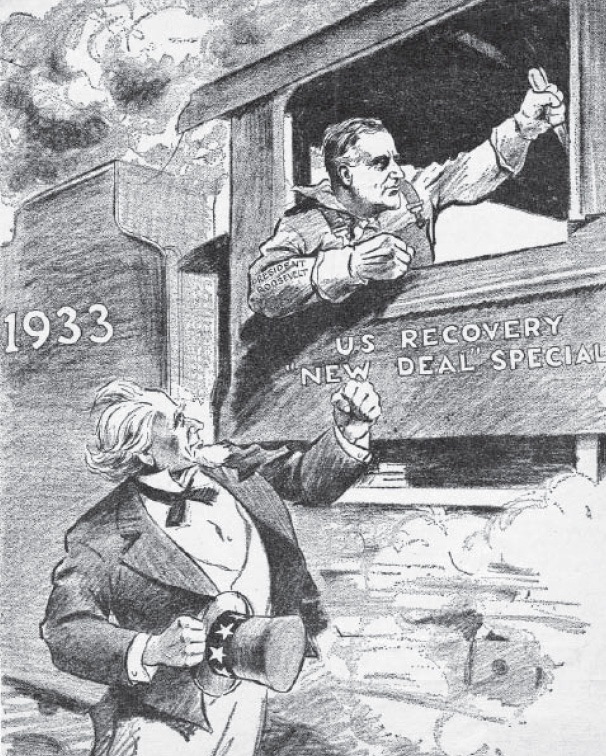
By 1932 the party was over. The now suffering nation had had enough of hands off and predatory money practices. Massive unemployment, thousands of bank failures, hunger, homelessness, and a Dust Bowl in the heartland brought America to its knees, and Democrat Franklin Delano Roosevelt to the White House.

Seeing nothing beneficial for the American people in catering only to the rich, FDR brought an end to GOP policies. His administration instead offered a New Deal for economic revival. Through a massive legislative agenda Roosevelt and Congress intended to not only meet the emergency, but restore economic growth, and eliminate the conduct that led to the Depression in the first place.

One of the most popular New Deal relief programs was the Civilian Conservation Corps. Unemployed young men were put to work throughout the nation building trails and campsites in forests like the Great Smokey Mountain National Park, and urban building projects like the River Walk in San Antonio, Texas. (Consider that idle young men in Germany at the same time donned Black and Brown Shirts and broke heads for Hitler.)

Addressing the chaotic banking system FDR proposed systematic changes. Some 6000 banks had failed between 1930 and 1933 before the new president took office. Panicked depositors waited in long lines to demand their money until banks simply ran out of cash and locked their doors. Confidence collapsed. 

In his first days Mr Roosevelt announced a Bank Holiday where banks closed for four days to stop panic withdrawals. Auditors then inspected banking institutions across the country and surprisingly many banks were deemed solvent and reopened. Not finished with banking, FDR also took to the radio to explain the banking system, and with his cheerful confidence encouraged the public to take cash out of their mattresses, coffee cans, and backyard holes and return deposits to local banks. Thousands did just that. 

In order to prevent another such economic catastrophe the Glass-Steagall Act (1933), was passed by Congress to protect the public from high risk banking practices. One piece of the law was the Federal Deposit Insurance Corporation, FDIC, which is still in effect today. Depositors had the backing of the federal government to protect their funds from any loss. Moreover the Roosevelt Administration was determined to keep people in their homes, many of whom were facing foreclosure. The Home Owners Refinancing Act provided federal assistance to those who had paid their mortgages in good faith, but now faced eviction. 

In the first hundred days of Roosevelt’s New Deal 77 laws in total were passed by Congress, all aimed at restoring the health of the country. To the majority of Americans it felt like this president truly cared about their wellbeing. Roosevelt’s ascendency to the White House, next to Abraham Lincoln’s certainly stands as the most consequential in America’s continuing experiment in self government.

On a side note Franklin Roosevelt suffered from polio and could not walk, though he believed he’d walk again. FDR never gave up. And the truth of the matter is it took a man in a wheelchair to put the United States back on its feet. Franklin Roosevelt, unlike his predecessors knew that the business of America is “We The People.”

Gail Chumbley is a history educator, author, and playwright. Her work includes River of January, River of January: Figure Eight, both available on Kindle, plays Clay on the life of Senator Henry Clay, Wolf By The Ears a study of American slavery, and Peer Review where Donald Trump meets four past presidents.

If you like, please share this on social media.

A Good Deal

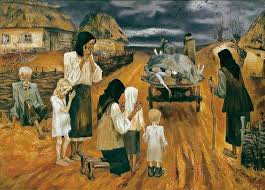
A painting by Valeriy Franchuk, “Harvest of famine” (2000)

A Reblog.

NBC news recently ran a piece on Trump meeting with Ukrainian President Volodymir Zelenskyy. In a video clip Mr. Trump announced that he had spoken with Zelenskyy about opening talks with Vladimir Putin to end the conflict between the two countries. Trump stated to the cameras that Russian President Vladimir Putin would give Ukraine a “good deal.”

Mr. Trump does not know nor does he care about Ukrainian history. If he did, the president would understand that negotiating with the Russian leader is unthinkable, a non-starter. To understand why is to look not only into Ukraine’s recent past but back into the 1930’s.

Putin’s first attempted assassination targeted Ukrainian President Viktor Yushchenko. In 2004 Yushchenko narrowly escaped death after surviving dioxin poisoning, a combination of toxic chemicals which left him weakened and permanently disfigured.

Putin, as a former KGB operative is a master of murder, and why the International Criminal Court has an arrest warrant for him.

An impulsive hustler by nature Trump shows little interest in the crimes of Vladimir Putin. After the recent meeting in Alaska, Trump again called on Zelenskyy to make a deal with Putin. That the Russian has targeted Zelenskyy in numerous assassination attempts on multiple occasions, including three failed hits in one week is of no consequence.

However this narrative reaches back further to the early Twentieth Century, when another strongman, Josef Stalin rose to power.

Following the 1924 death of Bolshevik leader Vladimir Lenin, Stalin coldly and efficiently murdered his own rivals consolidating his power as an absolute despot.

Launching his Five Year Plan, Stalin’s vision for economic prosperity, he ordered collectivization of Ukrainian farms, seizing land and harvests for Russia’s consumption. Calling farmers Kulaks, a pejorative name, Stalin justified his actions by fabricating enemies, complete with mass arrests, show trials, executions, and deporting thousands to Siberia. In that period alone thousands of Ukrainians perished in freezing rail cars, or worked to death in frigid Siberian work camps.

The total number of transportation deaths remains unknown.

However transport was not the worst weapon employed by Stalin. Ukrainian Communist party workers not only stole seasonal harvests but also the seed for future planting.

A genocide followed.

From 1930 through 1933 millions of Ukrainians starved to death or resorted to cannibalism due to Stalin’s disastrous Five Year Plan. Production dropped under the forced collective effort, and the Communist leader had to find scapegoats for the disaster, so he pinned blame on the farmers. Kulaks were dying in massive numbers on purpose to undermine the Kremin’s economic plan.

Stalin insisted he was the victim of treachery.

Called the Holodomor, (death by hunger) as it is remembered, cost the lives of somewhere between 3.5 to 5 million Ukrainians. Adding that number to those deported to Siberian gulags it is safe to say that the Ukrainian people suffered a monstrous horror.

Ukrainian memories and justifiable outrage remain vivid.

As for that ‘good deal’ with Vladimir Putin, President Zelenskyy is not interested. The Ukrainian President has no faith in Russian promises, and is not impressed by Mr. Trump and his previous effort to shake Zelenskyy down for corrupt political ends.

Today thousands more Ukrainian soldiers and civilians have lost their lives fighting this Putin-engineered war, but with national memory to guide them Ukrainians will not back down. Ever.

Independence from Russian oppression is relatively new and very fragile, and that nation will never surrender on Trump’s assurances of a ‘good deal.’ The people of that battered nation know better.

So should we.

This is the web site of the Ukrainian Embassy in DC if you’d like to make a contribution.

https://www.ukrainehouse.us/

Gail Chumbley is a history educator and writer.

Beyond The Symbols

Patriotic symbols, music, and the Pledge of Allegiance recited at a solemn ceremony can be deeply moving. A simple presentation of the flag at a formal function can be awe-inspiring. The lone, austere notes of Taps played at a military funeral elevates a moment into sacred reverence.

The sounds and symbols of American devotion are powerful.

Still, as commanding as recitations, patriotic colors, and America the Beautiful can feel, deeper symbols in our shared history can reveal so much more.

In his book, Washington’s Crossing, historian David Hackett Fischer introduces his volume with a discussion of Emmanuel Leutze’s famous painting of the same name. Fischer guides the reader through elements in the painting, noting passengers figure by figure as they frantically navigate the frozen Delaware River on that long ago Christmas night. 

Why is this particular work especially moving? Because at that juncture, December 25, 1776, the Revolutionary War looked to be flaming out after barely a start. Defeat had dogged Washington’s Continentals after being chased off of Long Island, and driven out of New York City the previous summer. As Washington planned his surprise Christmas attack, victorious Redcoats had settled into winter camp in New York City.

Humiliated, Washington knew he had to strike hard and he had to win.

Viewing his situation with the “clarity of desperation” the General ordered an assault on Hessian (German mercenary) held Trenton, New Jersey. The Continental army would have to use the element of surprise fighting against a better armed and better fed opponent. Risky to the extreme, Washington knew we, meaning America, for all time, was dependent upon his actions that night.

As for the painting, the artist depicts freezing soldiers huddled in a boat with more watercraft in the backdrop. From the starboard side, (to the right of General Washington) sits an oars-man, distinctly Black, putting his back into his strokes, ploughing through dangerous ice floes. Behind him, facing forward at the bow, is another swarthy figure, perhaps a Native American. He is desperately kicking ice with his left boot while handling a sharpened pole to break open a passage through the impossible crust. To the foreground an immigrant (a Scot by the look of his hat) studies the river’s surface closely as he pulls forward to port, while another behind him, in fisherman gear, studies the treacherous water. Others are made up of rustics, one at the tiller, along with a wounded passenger.

General Washington centers the painting as he is the central figure of the drama. Behind the General is Major James Monroe, and another rugged frontiersman by the looks of his garb. Both men are grasping a 13-star (Betsy Ross) flag, in a grip that elicits an attitude of determination and desperation, with perhaps a bit of warmth. Below both flag bearers sits a WOMAN, yes, a woman pulling her oar with an analytic eye upon the clotting water.

Black, Native, white, immigrant, the highborn, the humble, men and women, yesterday, today, and the future: all of our American lives balanced on the gamble played that night in 1776.

The point I believe Leutze is trying to convey is that we all don’t have to be the same. No one has to agree on the details of our beliefs to ride on that boat. The truth is Americans all have and had different realities and ambitions: differing views of liberty. Still, all onboard had to carefully respect each other’s space and not overturn that fragile vessel, Liberty, for we must stay afloat and row in the same direction. It is in all our interests to do so.

And that metaphor of America, that boat, tested our resolve on one of the nation’s most critical nights. Inspiration doesn’t come any better than from Leutze’s allegorical Washington’s Crossing.

Gail Chumbley is the author of the two-part memoir, River of January, and River of January: Figure Eight. Chumbley has also penned two stage plays, Clay, and Wolf By The Ears, concerning the life of Senator Henry Clay, and an in-depth examination of the beginnings of American slavery. Gail is currently working on another piece, Peer Review, best described as Dickens A Christmas Carol meets presidential history.

Lest We Forget

https://www.youtube.com/watch?v=9_hT32LAZvg

This new year begins with Americans caught in a moral quagmire. Traditional beliefs such as love of country and confidence in leadership seems to suffer from vast divisions. Our American experiment in self government has been turned on end, and what was once seen as threatening, is now open to a sliding scale of opinions. Our national values are, as sung in the musical Hamilton “Upside Down.”

I came into the world as the Cold War simmered between the US and the USSR. Khrushchev had replaced Stalin, and nuclear missiles rested uneasily, waiting for one wrong move from either side. America, caught up in the Red Scare convicted and executed suspected spies, Julius and Ethel Rosenberg. The House on UnAmerican Activities Committee, (HUAC) became the equivalent of political show trials, publicly ruining the reputations of citizens, suspected as secret Russian collaborators.

Real covert agent, Klaus Fuchs, stole nuclear secrets from the Manhattan Project at Los Alamos. David Greenglass, a physicist, turned Russian agent, and brother of Ethel Rosenberg, worked also on the Manhattan Project. English MI6 agent, Kim Philby, worked for a time in the offices of the OSS, (later the CIA) only to defect to the USSR, with all he knew of American and British secrets. American Communist and union organizer Eugene Dennis, was sentenced to five years for his affiliation with the Kremlin. Soviet spy, Whittaker Chambers renounced his Russian allegiance and became the darling of the conservative right, naming State Department official Alger Hiss as a Russian operative.

Whether true or not, many other Americans were stained with suspicion of acting as Communist agents. Joe McCarthy made a name for himself as a Commie hunting Senator. Caught in the fear were playwright Arthur Miller, screen writer Dalton Trumbo, actor Larry Parks, stage actor, Zero Mostel, movie star, Sterling Hayden, who all found their careers in tatters. Refusing to name others, HUAC branded these unfriendly witnesses as“Fifth Amendment Communists.” These accusations, for many of the accused, never washed off.

The 1950’s were dangerous years for political nonconformists.

So it is no small wonder that many Americans of a certain age are flummoxed by the denial of Russian election hacking at the highest levels of our government. This new president has repeatedly demonstrated absolutely no concern for our democracy, for fear it undermines his legitimacy. In other words he is more worried about his own hide while the most direct and sinister Russian attack ever, has infected our elective process. And worse, his band of true believers gloss over the breach as well, buying into the propagandized term of “Fake News.” Is this president truly more important than the country and people he was elected to serve? Does he understand the prime objective of Russian apparatchiks is to undermine the United States of America?

As for the members of Congress who know more of this breach, and still enable this president- is protecting your party more important than saving our democracy? Are your partisan priorities more vital than the oaths you swore to uphold the Constitution? If the answer is a blind yes, then what was the point of the suffering of that earlier generation—the ruin of artists and free thinkers, the brutal crimes of the guilty? The 33,000 loyal Americans who died fighting Communism in Korea? Or the 58,000 boys who were killed fighting the pro-Communists in the jungles of Vietnam? Are these past sacrifices meaningless in light of current political expediency? Are you going to shout ‘fake news’ while giving away our sovereignty?

America has a vibrant, if not an often difficult history. We who love our country would like a future, as well.

*It wasn’t the Ukraine, either.