This post comes from a full stage play titled Peer Review. It was composed during DJT’s first term and serves to illuminate the contrast to earlier presidencies.
SCENE TWO
The stage lightens in a mix of gold and white. A bed and two arm chairs made in the same colors sit center stage, The New York City skyline is projected on the back curtain. The sound of papparazzi and cameras snapping is heard offstage. An elevator dings. After a moment the President enters stage right with two men in suits wearing earpieces. The men walk around the area and bed. The President turns and speaks.
THE PRESIDENT
Call maintenance, that damn elevator shouldn’t stall between floors. That was a good ten minutes, dammit. I’m gone a few weeks and the building goes to hell. There’s nothing in here. Get out.
The men exit. The President removes his jacket, and walks to the dresser. He peers down in a drawer, then finds what he is looking for. A file of yellow and red.
Except this little gem and it’s really something.
He lies on the bed reading and chuckles happily. His cell phone plays “Hail To The Chief.” The President answers.
Where are you? I just got here, great crowd outside. Yeah, I’ll get it done. Hey, I said I’d do it. What do you mean you don’t trust me? Give me a break, That whole Stormy Daniels garbage is . . . No. Don’t hang up. We’ll sit down with the lawyers and renegotiate the whole deal. But then you will join me in DC, and the boy, too. This staying in New York is no good, makes me look bad to the country. Yeah, yeah, I’ll get Reince on it today. Hey, I said I will.
He tosses the phone on the bed and resumes reading.
Huh. Erdogan didn’t tell me this. How does the CIA find this crap out? I need some Putin-Ukraine stuff. Who woul’da thought I’d read something?
He chuckles, and soon grows sleepy. The President drops the open file and closes his eyes. After a moment a spot rises on a figure entering the stage.
He is tall, wearing a 18th Century blue and buff military uniform, knee breeches, white stockings and carries a sheathed saber. His white hair is combed back, and tied with a black ribbon at the nape of his neck. Standing near the bed, he speaks slowly with elegance.
THE GENERAL
I am very fond of New York City. During the War for Independence I maintained camp nearby for much of the duration.
The President sits upright, and reaches for a pillow to shield himself. He squeaks.
THE PRESIDENT
Shit!
THE GENERAL
Congress had directed me to burn Manhattan ahead of invading British Regulars. You see, Congress wished to leave nothing of use for the Redcoats. Destroying the city left me conflicted, and alas, that order I could not obey. As fate would have it, a fire did erupt in the chaos, demolishing vast tracts of the city. A very regrettable situation.
The General poses regally, glancing at the president. He continues.
Sometime later I returned to serve as President here in New York.
He gestures with his saber to the skyline.
Concerning the demands made upon me as I served those first critical years, none resolved easily, nor without great cost. But our fledgling nation teetered on dissolution and we, as the first government under new Constitution, had to stand resolute.
The President lowers his pillow to speak in a forced, but faltering menacing tone.
THE PRESIDENT
I don’t know who you are, or how you got in here, but this is my room, and my 30,000 square foot apartment, in my extremely valuable building. So clear out!
The General appears not to hear, serenely seating himself in an arm chair. He levels his gaze at The President.
THE GENERAL
My colleague said you were tiresome, however, I am staying.
THE PRESIDENT
Who said that? What colleague . . .oh, jeez, him. Well I’m important NOW. So you and that other fossil can beat it back to central casting.
THE GENERAL (Untroubled)
I, too struggled with grandiosity. In my youth I pined for the advantages of wealth and status that surrounded me. Stately mansions dotted the inlets and vast river systems of Tidewater Virginia, the place of my birth. I longed for a life of importance, gentility, and of wealth. I would be an English gentleman residing in elegance upon his landed estate.
THE PRESIDENT
The English are wusses, and you’ve blah blah’d enough. I’m in New York to get away from all that history garbage. That old dump where I have to stay is filled with that crap. So goodbye Rambo.
The General waits, then rises and un-sheaths his blade. The President again grasps his pillow. The General resumes his story.
THE GENERAL
Born the first son of a second family, I fell heir to nothing but my father’s name. Augustine and Lawrence, my older brothers, received all the honors of a gentleman’s life. I loved them, idolized them, especially dear Lawrence, and begrudged him nothing of his inheritance. However, I cannot deny the depth of my anguish as a second class Virginian.
THE PRESIDENT (To himself)
When my Father died I stuck it to my brother. He couldn’t handle money, the guy was a drunk.
THE GENERAL
Another temptation concerned a young matron, the wife of my best friend. Sally was her name, and I loved her very much. Our correspondence, especially while I served in the war against the French was perhaps too forward, and flirtatious. I longed for Sally, but she was not, nor ever could be mine.
The General sighs, deep in thought.
THE PRESIDENT
I never let any marriage license stop me. Mine or any available broad. That’s all they’re good for, arm candy and a roll.
THE GENERAL
We are all too aware of your misogyny, and absence of propriety. Even Mr. Kennedy said he attempted more discretion in his dalliances. I’m reminded of a letter from the Marquis de Lafayette informing me of his wife’s passion for me. Amused, I replied youthful women are inclined to youthful men, not those of graying hair. And still it is so.
The president sits up with his pillow on his lap.
THE PRESIDENT
Younger women love me. They really do. I’ve dated some beauties, too. You should see some of the pageant contestants I’ve bagged-and Playboy bunnies, too.
From the wing a soldier in Continental uniform approaches the General handing him a dispatch. The General reads the parchment, and marks it with a quill pen. The soldier leaves.
THE GENERAL
Sir, I do not believe ‘love’ is quite the term for what you’re describing. unbridled debauchery perhaps is more precise?
THE PRESIDENT
What the hell? How did he . . .?
THE GENERAL
It is the disciplined man who owns his passions. Decorum is what separates us from animals, wouldn’t you agree?
The president sits mouth agape at the soldier. The General continues.
THE GENERAL
Elegant balls were quite popular venues for young people to meet. I don’t mind saying that I may have been one of the finer dancers in the Tidewater. Those evenings were grand; dinners, music, and refinement in abundance. Oh, how I yearned to rise in social rank.
THE PRESIDENT
I hear ya. Those Manhattan snobs, that artsy-fartsy Met crowd, boxed me out. Treat my kids that way, too. Jerks.
THE GENERAL
Envy did little to further my integrity as a gentleman. In the war against the French the royal governor entrusted me to offer land patents to volunteers willing to join the Virginia militia. Over the course of the conflict I made many of those acres my own. You see land was the mark of a gentleman, but I was an imposter. That villainy has troubled me for an eternity. I pray my service to my nation has polished away some of the tarnish.
THE PRESIDENT
Don’t sweat it, business is business. Regulations are a pain in the ass. If you have an opening take it. Never hesitate. I’d a done the same thing.
The soldier-courier again appears on stage carrying more documents and a feather pen. The general agains peruses the contents, and marks the paper. The president raises his hands in a questioning gesture. The courier disappears.
THE PRESIDENT
There is a squadron of Secret Service out in that living room! How does that guy just walk in here?
THE GENERAL
Colonel Hamilton? He is a very clever young man. A great mind, that one. (Pauses) I disagree with your assessment of regulations. Had it not been for the rigor used to organize the army, particularly at Valley Forge, America would not exist. Good order was the key to eventual victory.
THE PRESIDENT
But you were the boss, right? You made the rules. Everyone I brought in has stabbed me in the back, didn’t follow my rules. Bunch of lowlife. Tillerson, Bolton, Mulvaney.
THE GENERAL
Perhaps those staff members possessed standards and realized you were not a leader worth following.
The president stands up outraged, the general stares him back down.
THE GENERAL
Those of my staff earned positions through merit. Tallmadge, Knox, and Hamilton, here, were gentlemen I trusted with my life. The hangers-on, the men who conspired for my command eventually revealed their ineptitude, and villainy. Those characters fell by the wayside.
THE PRESIDENT
A lot of people don’t realize this, but I don’t know American history. How did you win that war?
THE GENERAL
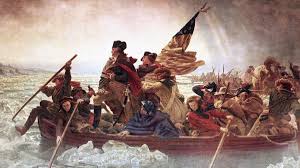
I never confronted the Regulars unless I had an advantage, like at Trenton, though I detested avoiding any fight. (Pauses) I kept the Continental Army together, and out of British hands. I knew the King could not fight forever. And I knew history was watching our every move, and we owed the future to never give up.
THE PRESIDENT
What the hell does that even mean? History watching! I could care less what happened before me, or when I go out.
THE GENERAL
And I am sorry for that, as will be your grandchildren. The family name is disgraced for all time. The rest of us, those whom I am representing, all understand this. Each chief executive found inspiration in taking part in something greater than ourselves. This, (he gestures toward the window) the United States of America has never been attempted before, a people’s government. The world is housed with predictable despots stealing from, and brutalizing the powerless.
THE PRESIDENT
Oh, come on, give me a break, everybody cheats and steals. Especially here in America.
THE GENERAL
Indeed. But we try to be better. We all have tried. President Chester Arthur felt you ought to know that he, too, served the monied interest. But once president, Mr. Arthur left the grift behind. Like the rest of us he found humility understanding all citizens, for all time would weigh his executive stewardship. He treasured America more than money and power.
The president slumps into a chair. He jabs a finger at the general, changes his mind and lowers his hand.
THE PRESIDENT
I didn’t take a salary. My people liked that, makes me look like a good guy.
THE GENERAL
All the while, behind the scenes, you pilfer on a grand scale. (The General glares) The Continental Army did not suffer want and cold at Valley Forge and Morristown for you to overcharge the federal government for lodging Secret Service at your resorts. Nor did they starve so guests at your Washington hotel could be egregiously overcharged.
The general continues to glare for a long moment and slowly cools down.
THE GENERAL
After Yorktown, and the surrender of Lord Cornwallis, hostilities slowly began to quiet. Royal ships, loaded with Redcoats set sail for England and our land stood liberated. Many difficulties remained such as discharging soldiers, and securing their long overdue pay for services nobly rendered.
The general again looks out at the New York skyline.
THE GENERAL
Word arrived that officers, also unpaid, had set into motion a plot to overthrow the slow-moving Congress and make me king. The ring leaders, encamped north of here in Newburg, awaited my arrival to complete the conspiracy.
THE PRESIDENT
King, huh? I like the sound of that.
THE GENERAL
As I had hoped the plot came to nothing, and that is when I resigned my commission and returned home to Mount Vernon.
THE PRESIDENT
Resigned? Went home! What is wrong with you? You had the whole deal on a plate!
THE GENERAL
Why? Because I am an American. We have no need of kings here, and I longed for home, longed for my wife and family. I’d been away for seven years and I yearned for my farm.
THE PRESIDENT
You could’a had the whole country at your feet and you went home to your farm? Gave up power for cowpies and dirt?
THE GENERAL
“’Tis not in mortals to command success. But we’ll do more, Sempronius, we’ll deserve it. When vice prevails, and impious men bear sway, the post of honor is a private station.”
The general sits down on the edge of the bed. The president, in his bed again clutches his pillow closer.
THE GENERAL
It’s a quote from my favorite stage play, Addison’s “Cato.” As Julius Caesar amassed growing power in the Roman empire, Cato the Younger, a lover of Republican virtue, stood in opposition to Caesar’s tyrannical grasp. When Cato could not accept life under extravagance and corruption he took his own life rather than submit to depravity.
The president stifles a yawn, shakes his head to clear it then speaks.
THE PRESIDENT
I liked the musical, “Cats.”
THE GENERAL
This work had a deep impact upon me and upon my generation. Patrick Henry’s “Give me liberty” quote reflects lines from the play, as does poor Nathan Hale’s last words regretting to have “only one life to give for his country.” During our miserable winter camp at Valley Forge I saw to it the play was performed for the men. We too, were confronting an extravagant and tyrannical empire.
The general rises and returns to the window.
THE GENERAL
And that is why I returned home. My duty had been fulfilled, and my services were no longer required.
The courier returns, this time in civilian garb, the general removes his hat, pistol, and sword. He examines the paperwork, scribbles, and the courier departs. The president stands, holding his pillow, watching the courier, then shrugs. He moves back to his bed.
THE PRESIDENT
Now just hold on. You, I mean, you’re the guy who became president, right? The first one?
THE GENERAL
Yes.
THE PRESIDENT
You should’a just grabbed power in the first place. People wouldn’t have cared. I can say or do anything, and my people love me for it. They’re a sad bunch of losers, really.
THE GENERAL
America did not, and does not now, need a king. I only returned to the public arena because my country called. An uprising in Western Massachusetts pitted war veterans against the state legislature in Boston. Vessels exchanged gunfire on rivers over navigation rights-Americans were battling Americans, again.
The general approaches the president who places his pillow over his face.
THE GENERAL
In Philadelphia a convention was set by Mr. Madison, and Colonel Hamilton to strengthen the national government. Though I was weary, short of funds, and reluctant to leave Mount Vernon, I eventually consented to join the assemblage.
The president lowers his pillow and speaks.
THE PRESIDENT
That sounds boring. But farming sounds boring, too.
THE GENERAL
America’s future rested upon what you term as boring. (He pauses) Though stifling hot that Philadelphia summer, with tempers running high, all members resolved to see the convention through. Unrest across this new country lent a sense of urgency, and we could not fail.
The president appears to not listen, fusses with his hair, staring at the ceiling.
THE GENERAL
Listen when I am speaking. Incorrigible halfwit. Leadership requires listening.
THE PRESIDENT
I’m listening. I give myself an A+ on listening. By the way, do you put powder or something on your hair? I worry mine doesn’t look natural in some light.
THE GENERAL
Addle pated oaf! Colonel Roosevelt cautioned me of your conceit. But I will not depart until I have spoken my piece. The Constitutional Convention labored from May, 1787 until September, and in all those sessions only one day concerned the role of the president, Article Two to be precise. And the reason so little time was allocated to this subject? Because I was, whether I wished it or not, the model for the chief executive.
THE PRESIDENT
One day?
THE GENERAL
One day.
The general pauses, then steps over to the bed. He leans over the intimidated president.
Delegates determined the age requirement, the rule for candidates being native born, with four year terms.
THE PRESIDENT
One day, huh. How come so short?
THE GENERAL
Please listen the first time! Because the office was designed for me. I gave up rank, and returned to civilian life, I could be trusted with power. My successor, later wrote, “May none but Honest and Wise Men ever rule under This Roof.” Since that blessing, with one exception, men of political restraint have served as Commander In Chief. Until you. A greedy, self-deluded dunce. Your infamy will never be forgotten, becoming instead a catchphrase for colossal incompetence.
The general rises, adjusts his hat, retrieves his gun and sword, then turns to the president.
THE GENERAL
When my dearest Martha died after my own passing, she was interred beside me, not in a New Jersey sporting green for a tax deduction.
As the general steps offstage an elevator ding is heard again, then a knock on the president’s door. A voice calls out.
SECRECT SERVICEMAN
The elevator issue is fixed, sir. We can go now.
The president adjusts his hair, and straightens his tie. He rushes off stage. A moment later a spotlight catches him hurrying back, picking up the security file, and placing it under his jacket, and again scurries offstage.
The stage goes dark.
END OF SCENE
Gail Chumbley is the author of the two part memoir River of January, and River of January: Figure Eight. She has also authored three stage plays, Clay, Wolf By The Ears, and Peer Review. Chumbley is the co-writer of Dancing On Air a screenplay based on her River books.
If interested in developing any of these pieces reach out at chumbleg.blog