House Rules

ls

Tass had had a bad night. She hopped up on the hour to meet the demands of cleansing medications, followed by gatorade chasers in preparation for a morning procedure. I wasn’t exactly perky myself, between traveling all day to care for her, and worry over what the morning would bring. Waking and dressing was of little consequence–we were fully alert before 7 AM.

Tass chirped obsessively that she hadn’t properly cleaned her system, and she fretted over controlling herself until we reached the clinic. My ridiculous attempts at small talk proved no distraction to her intensity–she could hardly hear me.

Her summer had been a tough row to hoe. Digestive problems plagued her every step, literally as well as figuratively. Tass had taken up running and was beginning to truly embrace the sport when her insides began to betray her. So now, after fruitless medical appointments, we were off to the digestive health center to literally look up “her old address,” in the words of M*A*S*H’s Captain Henry Blake.

Two receptionists manned the front window. One young lady, a bit stocky in build, with thick, dark, kinky hair greeted us. The other, a tall thin blonde, scurried back and forth, running from this computer to that, a phone clutched to her ear. She paid us no mind.

Behind the glass, their station had been cheerfully decorated with a variety of Fall memorabilia. A yellow duckie with turkey feathers roosted on the computer, while a vampire ladybug observed us as Tass completed reams of paperwork.

Our secretary wore a hippy-print smock, festooned with peace signs, and little faux buttons saying “Love,” “Peace,” and “Happy,” covering the fabric. Her bustling co-worker was clearly an active Utah Jazz fan. A poster bearing #20 decorated her station, with game tickets posted beneath, and her purple and yellow lanyard bore her swaying hospital ID.

Their cheerful surroundings and attire did not reach the region of their faces. Not a smile could be detected behind that glass window–nothing but purposeful business. Only the plush lady-bug smiled, and she wanted to drink our blood.

In a no-nonsense fashion the receptionist requested Tass’ deductible payment. A sign next to her desk echoed the demand. Payment Due On Day Of Service. That’s code for “cash on the barrel-head,” or we would proceed no further into the facility. Exhausted from the restless night, Tass handed over her payment, then miserably darted to the restroom.

Combining worry and sleep deprivation we had no smiles to compensate for any lack in the receptionist. Tass’ registration process became a mutual, somber wash.

Staking chairs in the waiting room, we were now at the mercy of the clinic’s time table, trapped in the belly of a whale.

Fox news narrated our anxious wait time–time that permitted a more in-depth appraisal of the office suite. There were paintings hanging on the walls, and they were lovely, too. Scenes of Canyonland National Park–Zion, Moab, etc . . . But strangely they only rendered some others as distinctly odd.

Enclosed in black frames were official disclosure documents, about four in all. Enumerated were lists of office policies dotted behind glass, all absolving the clinic of any responsibility for this or that unforeseen outcome. Costs may vary from quotes, Payment due prior to services, Physicians may or may not claim financial interests in this clinic, and other arcane declarations.

“Man,oh man,” these dudes have it all covered,” crossed my thoughts.

The medical staff, in contrast to the muscle in the front office, were all beyond wonderful and compassionate. We couldn’t help but adore Tass’ nurse from the get-go. The doctor was nothing if not an angel sent from above. Her care was superlative from pre to post treatment. And Tass came out with with a good result.

But still, the duality of healthcare is troublesome. The icy chill of the relentless business angle where there is no personal concern, can not help but eclipse the heartfelt goodness of skilled providers.

Whether outcomes are good or bad, diagnosis positive or negative, the house wins.

Oh, That’s Today!

helenhayes600w

There were times when I’d be blathering along on some historical subject, and in a sudden epiphany realize, “and it happened today!” One time, displaying a before-and-after photo of the USS Maine in a lecture on the Spanish-American War, it dawned on me that the date was February 15, 1898–that very day. “Oh, that’s today!” sprang from my mouth. Various reactions crossed the many faces of my students. Ranging from, “she really needs a life,” to “that might be mildly interesting, but it’s not.” My kids seemed to exude more sympathy than interest in my sudden, self-induced enthusiasm. “Geez, don’t all hop up all at once,” was my usual sardonic response. Then they would laugh.

December 7th got a nod, September 17th, Constitution Day, and my personal favorite, “The Seventh of March Speech.” That one you ought to look up. Finest speech made in the Senate to my way of thinking. I made a practice of asking a baritone-voiced student to read Daniel Webster’s words if March 7th fell on a school day. There’s May 8th, V-E Day, September 11th, March 5th, Boston Massacre–all acknowledged and more to boot.

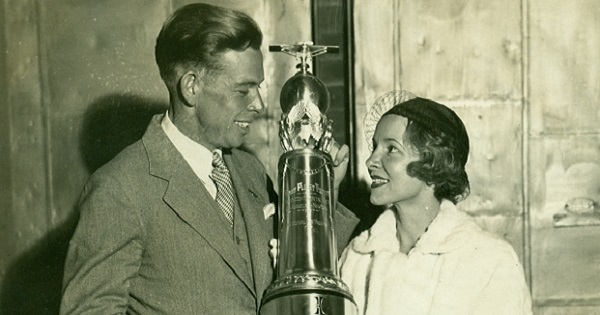
Today I presented a book talk on River of January for a local service club. I shared the story of Chum’s epic, 1933 air race, (that he won) soaring through the night sky from Los Angeles to New York. Chattering happily I flipped to the slide pictured above. This is the actress Helen Hayes awarding Chum his first place trophy at the Capitol Theater on October 4, 1933. The Capitol was premiering Miss Hayes’ new film, Night Flight, and the race was somehow wound up with the movie. Well, that was 81 years ago today. So of course, I grew just as ridiculously excited as I used to in my history classes. “Oh. My. Gosh. That’s today!” And I will commend this group of adults for not judging me as harshly as my eye-rolling students. These fine people laughed–as happy as I felt with the coincidence.

So there it is. Chum won the “Darkness Derby” on October 3, 1933 and Miss Hayes handed over cash and a trophy the following evening in New York.

It was a Wednesday night, October 4th, that Chum’s life dramatically changed exiting that theater. He now had award money, and a trophy that proved his merit as an up-and-coming pilot holding his own in the Golden Era of Aviation.

When My Worst is My Best

This piece dates to last November. Worth a recycle.

gail chumbley's avatarGail Chumbley

The tumor institute quickly became far too familiar, an unsolicited home away from home.  He’d press the down button on the stainless steel elevator, lowering us into that stark, beige basement–the waiting room.  An ordeal.  I pretended to be brave. 

The smell in the unit was a combination of baby powder and rubbing alcohol, probably from the hand sanitizer dispensers positioned everywhere on those bland beige walls.  Fox News blared from a 12 inch television in the corner— while stunned patients and family members stared.  Health magazines and pamphlets were scattered on cookie cutter office chairs and faux-wood end tables. 

We didn’t belong in this surreal place and neither of us were prepared for what was coming. 

Walking phantoms, hairless and fragile, shuffled awkwardly, angular-ly across the nondescript carpet, escorted by unnaturally jolly nurses dressed in flowery scrubs.Patients ambled down one of two passages traversing this subterranean ward.  A straight…

View original post 135 more words

But I Had Other Plans!

HospitalI

This post comes from last year. Not much of a throw back Thursday, but a powerful reminder for those of us affected by cancer.

gail chumbley's avatarGail Chumbley

I clearly remember the day my husband told me he had throat cancer.  The news was so impossible to believe that I honestly wanted to reply, “No, Chad, you don’t, we don’t have time for cancer.”  I tend to resist any emergency that I can’t package up and manage, or eliminate by a force of will.

As he stood in the kitchen, his hands resting on the sides of the sink, tears filled his eyes.  I read in those tears that he had given up and accepted his medical condition, and that made me mad.  We weren’t going to lay down and admit that the big scary C-word would take center stage in our lives.  It wasn’t convenient–medical procedures would be scheduled when I had to work, or had other commitments to fulfill.

I couldn’t see past the treatments, the financial burden, or the fear a cancer diagnosis leaves in…

View original post 159 more words

Blame Jefferson

imagesIn the film A More Perfect Union, James Madison, played by actor Craig Wasson asks Benjamin Franklin, (Fredd Wayne) if the Commonwealth of Pennsylvania had good government. Franklin barely takes a breath before replying, “Alas no. It is controlled by one faction or another.” That line–whether authentic or not, seems to resonate in the historic record.

The bloody struggle over slavery, followed later by the violence of the civil rights movement, provides the clearest examples of state governments hiding agendas behind the 10th Amendment, and it’s political progeny–the States’ Rights doctrine.

How did this misunderstanding begin? And why so quickly after the ratification of the tightly-scrutinized Constitution in 1787?  How did controversy emerge almost at once challenging the authority of the Federal Government in relation to the state?

The answer lies in the industrious pen of Virginia Planter, Thomas Jefferson.

Now, whether Mr. Jefferson intended to condemn the nation to perennial disarray is open to debate, as we only have his letters and other writings to peer into his 18th Century thoughts. But the fact that he was serving as ambassador to the French Court during the productive Philadelphia Constitutional Convention speaks volumes to his resentment for being left out of the monumental proceedings. The final document, had  Jefferson been in attendance, would have read much differently, if finished at all.

Once the American ambassador returned to America from his overseas post, he got busy undermining the newly established sovereignty of the Federal Government. As his philosophy took shape, Jefferson emerged the outspoken defender of states’ rights, heading an alliance of like-minded political leaders, forming America’s first opposition party: the Democratic Republicans. The essential philosophy of these primarily Southern Planters was to challenge the role of the new central government in their internal affairs. As a sectional ruling class these planters had no intention of taking orders from any entity beyond their local legislatures (which these men dominated). Sadly this states’ rights ethos born in the late 18th Century has surfaced for better than two centuries. Local power has protected itself at all costs, and this sophistry finds vilifying the Federal government useful.

In my home state the cry has once more raised in support of the 10th Amendment and States’ Rights. Why again have shrill voices denounced the role and power of the Federal Government? (and certainly the Feds are not perfect, red tape, outright mistakes, and conflicting policies have certainly made Washington look bad). Yet, there is a sense that the Government of the United States is inherently bad, and that local government just isn’t.

We as American citizens and residents of our states should question the motivation behind thickly spread political propaganda. Are local pubahs so in love with their political rhetoric they can’t work within the federal system? Is insider cronyism and privilege driving legislative decisions? Are those locally elected too limited in their understanding of the federal system, and too steeped in their political theories to develop sound state policies?

Here in Idaho, the itch to develop public lands for grazing, lumber or mining rights runs high. Rural folk, possessing scant understanding that public lands near their homes belongs to all of us and agitate for less restricted use. Unfortunately these demands for local control usually means gaining access to federally regulated resources on those public lands, with cattle, cross cutting, and excavating for various ores. The U.S. government, at the same time has the obligation to manage those resources, with an eye to safeguard the land for future generations.

Jeffersonian philosophy runs close to the surface out here, and rose loudly with the election of Barack Obama. Outraged disapproval grew clear when school districts around the state asked teachers not to broadcast President Obama’s message to students. Idaho’s kids didn’t need to hear from this mistake of a president! Even our Congressional delegation has to keep up the anti-government charade, and these politicians ran to serve in Washington DC–the highest level of government! Talk about compartmentalized thinking!

This divisive States’ Rights doctrine doesn’t work well for “We The People.” Local community and political leaders can too easily blur what they want, over what is best for the people of the state. Idaho has cut funding to Medicare and Medicaid, while losing one federal court challenge after another, paying thousands of dollars to stop Gay Marriage, Obamacare, and an unconstitutional Ag-Gag law to stifle farm animal abuse. That money could better be channeled to improving education, overcrowded prisons, and mental health support. Sometimes I think political leaders here forget what this state would lose in aid if not for the rest of America’s tax dollars. It’s like they’re glad to open the checks but feel no reciprocal responsibility to America.

The ideal of localized power favored by Jefferson’s theoretical reasoning just hasn’t worked out in reality, not even for him. Following the purchase of Louisiana in 1803, members of his own party lambasted the President for using powers the Chief Executive did not legally possess.

As for me? I’ll take the collective wisdom of the nationalistic framers of the Constitution, which included George Washington. Those 40 men understood what kind of union they intended to shape. Article IV of the the document couldn’t be much clearer;

This Constitution, and the Laws of the United States which shall be made in Pursuance thereof; and all Treaties made, or which shall be made, under the Authority of the United States, shall be the supreme Law of the Land; and the Judges in every State shall be bound thereby, any Thing in the Constitution or Laws of any State to the Contrary notwithstanding..


Cocolalla

73115959-SLD-004-0017

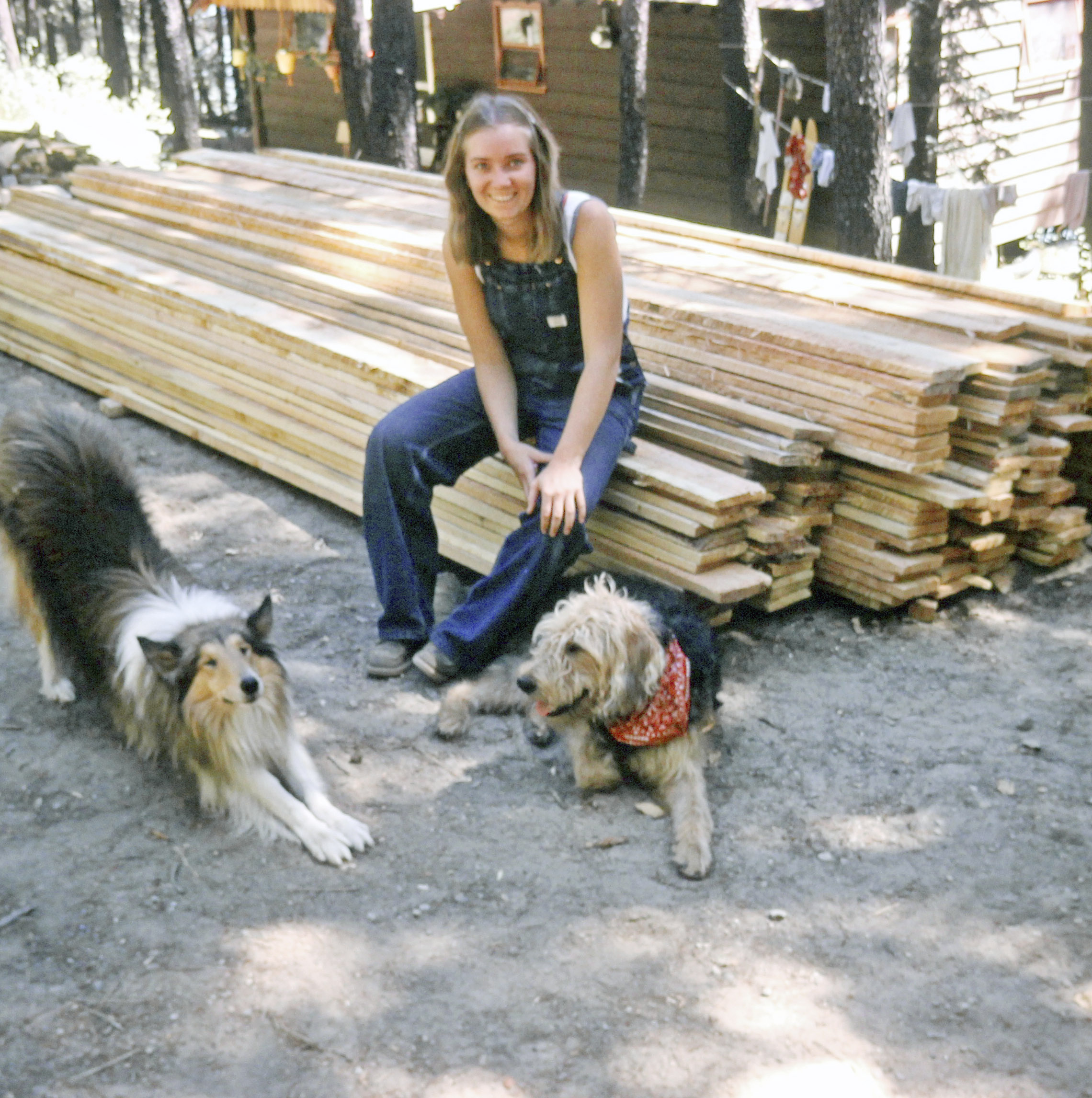
We had two cabins on a small lake in Northern Idaho.

Located between Lake Coeur de Alene, and the Pend Oreille, our little acre overlooked tiny Cocolalla, with large windows where we could watch the waves lap up on the beach. The original structure we astutely named the Little Cabin, later followed by the larger Big Cabin. This bigger cottage had been built with all the amenities of home; running water–hot and cold, a tub and toilet, a full kitchen, and electric heat.

Those early weekends in the Little Cabin hold many good memories. All of us crammed into that tiny wood box, the unfinished walls festooned with a lifetime of greeting cards, a big enameled wood stove, and a porcelain basin for washing dishes. Grandpa got his hands on a tall steel milk can and commandeered it for enough drinking water to get us through the weekend. As for entertainment, Grandma had an old radio that blasted the most impressive static, interspersed with Roy Orbison or Andy Williams fading in and out.

Once the Big Cabin was completed and my grandparents moved in, the smaller cabin was demoted to storage. It also housed a set of bunk beds, a fold-down couch, and one double bed; useful for my brothers who were just getting bigger. Now, in addition to greeting cards, the cabin stored every variety of water equipment. Fishing poles, life jackets, oars, and an outboard motor clamped to a metal barrel, with stacks of beach towels the size of blankets.

As I recall, a constant grit of sand coated the linoleum floor.

The property was my grandparents retirement dream, but a dream they happily shared with the rest of us. I knew, even then, that I was always welcome, always.

My grandpa was an early riser, a product of a lifetime as a mailman. He didn’t want to tiptoe around a little kid sleeping on his sofa at five in the  morning. At bedtime my grandmother and I made our way to the Little Cabin in the dark by flashlight. Under the covers of  the double bed, I would chafe my feet deep under the sheets to warm my toes. As we grew settled and peaceful she would begin to reminisce, talking to me for hours in that darkness. I learned of her life in those moments, warm in that cozy bed, listening to her voice, breathing the scent of the evergreen forest.

She told me of my biological grandfather, her first husband, who had left her bereft and penniless after my mother had been born. Despite the Depression, he liked to gamble away their money. My Grandma had to leave him and she struggled to find work as few jobs existed. Forced to farm out her daughter, my mother, in various homes, her the guilt still haunted her. Clearly it still broke Grandma’s heart that she was forced to separate from her little girl for months at a time. I could hear a wound that could never heal.

As the night grew deep, crickets and bullfrogs began to chorus. Flanked next to her, and pressed against some greeting cards, I prayed I wouldn’t spoil the magic by having to go potty. She kept, beneath the bed, a Chase and Sanborn coffee can that I hated to use. It felt cold and left rings on my little bottom. Still, considering options, the can was more appealing than a journey to the outhouse. Using that creepy outhouse in the daytime was bad enough, but at night unthinkable.

Finally poking her lightly, I would tell her. And she never hesitated. Showing no impatience at all, Grandma seemed to make my problem her own, reaching for the flashlight and finding that rusty can. She held the light on me so I could aim properly, then back into the warm bed. No recriminations.

She loved me.

I loved her.

Today my husband and I live in the woods. We don’t have a lake, but a river runs near and we can hear it on very quiet nights. I relax in my cozy bed in the darkness and listen to the crickets and bullfrogs, while breathing in a scent of pine. A sense of complete security, of love, of acceptance returns, synonymous with the love of my grandmother. She was home for me, and though gone these many years, my mountain cabin still echoes with her voice.

Gail Chumbley is the author of the two-part memoir “River of January,” and “River of January: Figure Eight.” Both are available at http://www.river-of-january.com and on Kindle.

gailchumbley@gmail.com

Waiting is the Hardest Part

Funny, but this blog still resonates a year later.

gail chumbley's avatarGail Chumbley

My son forwarded a Huffington Post story featuring the rejections endured by prominent authors.  I know that he meant it as a kindness, that everybody struggles in the book business.  Still, despite his good intentions, the story brought me down.  The business end of publishing always leaves me with a chill.

Writing, though sometimes a struggle, has been an affirming experience for me, delving into a story of risk and adventure.  I’ve been in the cockpit in an air race, suffered through butterflies waiting to go on stage in Paris, London, and Buenos Aires.  Now that the story is with the editor, I have to face the next battle–getting noticed by a publisher.  That arena is about money, markets, and deal-making.  And though I understand there are other options for getting River of January out there, those alternative routes are just as mystifying.

For any of us trying to get…

View original post 67 more words

The New Old Oregon Trail

WesternUSMigrationRoutes

My intention in the classroom was to make my lessons in history pertinent to today. And it actually wasn’t that hard because geographic places don’t change location, just the cobwebs of time cloud the human story.

The high school where I worked sat on the north alternate of the Old Oregon Trail. In fact the highway down a couple blocks from the building was the asphalted remnant of the actual Trail. I would ask the kids to raise their feet still sitting in their desks, then stomp down, (bet the classroom below liked that) explaining they were sitting atop the Oregon Trail, the topic for the day.

I began this western migration unit by paying homage to those inhabitants of the west who never asked for conquest. Some effort was made in acknowledging the rich role played by native peoples who had once populated the far reaches of the American West. I described what a wagon contained, that most emigrants walked, and what supplies were necessary for success. We would talk hardships; accidents, disease and death, and speculated if our school might have ghosts like in the movie, Poltergeist.

I projected a map on the wall of other trails west—California, Mormon, Santa Fe, etc . . . I continued by explaining that the Panic of 1837, another of countless bank failures had forced people from their secure homes to face an unknown future, and pointed out western areas of settlement founded by those emigrants who survived the trek.

“Who in here was born in Idaho?” I would suddenly ask. A small number of hands would go up, and we’d chat about native Idahoans for a moment. “Out of state?” I followed up quickly after. This time the majority of students waved excitedly, anxious to tell of their own 21st Century emigration story. “Where is your family from? What brought you here?” And around the classroom we traveled with tales from Massachusetts, Florida, and Texas. “My dad lost his job when the economy crashed—or my mother was promoted. Lo and behold the ageless push and pull of human migration remarkably mirrored those of 1837.

“How did you travel to southern Idaho?” “I-15 to I-84,” says one kid. “I-84 over the Blue Mountains from Portland,” offers another. “Interstate 5, then over Donner Pass. It took us forever.” I refer back to the trails map of the old west, and we reexamine the freeways and highways of today. A moment of epiphany, as time is momentarily frozen.

That is the story of Southern Idaho. Populations come from all around our land-locked state, and “home” for most inhabitants does not mean Boise. And I have observed over the years that there are three major umbilical cords tying residents to places outside the region.

The first home, (and the group where I belong) lies up, in the Pacific Northwest. Somehow, over the years, the Oregon Trail shifted backward into reverse bringing many to the Gem State. Living and working in the Treasure Valley folks hail from Roseburg, Oregon, to Bellingham, Washington, and east to Spokane. (In that mix are sprinkled a few newcomers from Alaska as well.) Holiday flights for this group means PDX, SEA, GEG, but all taking off from BOI. This crowd conceptualizes home as a place with a chilly surf, dripping madrona trees, and plenty of slugs oozing through wet moss.

The next category is made up of Californians. This group has found a region and climate similar to what they left behind, sans the overpopulation and crime. These people are notoriously disliked in Idaho as opportunistic trespassers. Perceived as “carpetbaggers,” Californians are on record as selling their Orange County, or Marin County homes for bundles, then invading Idaho to reinvest. This crowd is vilified for running up the price of local real estate, leaving poor Idahoans further marginalized. I’m not so sure that these gloom and doom charges are valid, but as a historian I do find some humor in this generalization. I’ve read The Grapes of Wrath, and those destitute Okies received no warmer California welcome back  in the 1930’s.
Needless to say the glorious landscape of the Golden State is home for many transplanted Boiseans. I do recall the empty desks on Thanksgiving Wednesday for families driving over Donner Pass to see grandma in the warmer climes of the gentle southwest.

The last major group, makes up by far, the largest portion of Boiseans with roots outside the state. These are LDS residents who might have been born in Idaho, but more often than not, came into the world in Utah. This faction is formidable in size because the Wasatch Valley is the point of origin for their Mormon faith. For example even if a student was born in Boise, and graduated from high school along the Snake River basin, they will, more often than not, seek higher education in Utah. Those same young people usually marry and have their own children in the Beehive State, but may return to Idaho later to expand and raise their families. Home for the Mormon faithful is identical to those back in Utah. Life centers around their Ward, their Stake House, the Temple–all rich with historic traditions, rites, and the stress on community passed down from the earliest days of Deseret.

All of these visions of “home” remain powerful in my area. The idea of belonging stretches out of Boise in all directions, much like the wooden spokes on an old wagon wheel.

When a Boisean says “I’m going home,” it is very likely doesn’t mean a house in town.